The Poetic Line
"You weep for the three cups spilled at your feet — the two still upright wait in silence for you to turn."
Keywords
| Category | Dignified | Undignified |
|---|---|---|
| General | Loss, grief, disappointment, re-evaluation, sobering, necessary release | Wallowing, self-pity, bitterness, refusing to move on, victim mentality |
| Spiritual | Sacred grief, initiation through loss, soul cleansing, surrender | Spiritual despair, feeling abandoned by the divine, refusing grace |
| Psychological | Confronting shadow, emotional audit, acknowledging pain | Depression, rumination, denial, frozen in regret |
| Physical Health | Allowing the body to rest and mourn, release of stored grief | Stress-related illness, heartache manifesting physically |
| Relationships | Honest grieving of ended relationships, learning from heartbreak | Clinging to exes, replaying resentments, inability to trust |
| Financial | Accepting a financial loss, cutting losses | Bankruptcy obsession, refusal to salvage what remains |
| Vocational | Career disappointment forcing redirection, valuable failure | Quitting in despair, inability to see transferable skills |
| Shadow / Thoth Distinction | Thoth: necessary destruction, the putrefying power of Water | Unprocessed grief leaking into every area of life |
Narrative Description
General Meaning
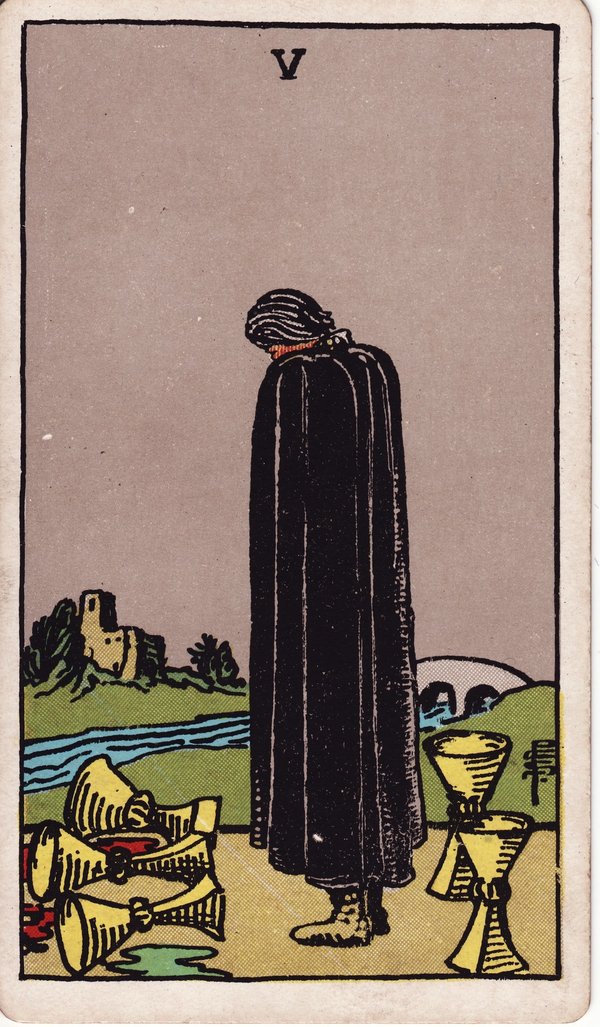
The Five of Cups is the first shadow card in the suit, marking the transition from the Four's static complacency into raw emotional loss. A cloaked figure bows in grief before three overturned cups, their contents spilled across the ground, while two cups remain upright behind them.
The Five asks the hardest emotional question: can you grieve without being consumed by grief? The spilled cups represent real loss — the end of a relationship, the death of a dream, the collapse of an expectation you built your identity around. Yet the two upright cups mean loss is rarely total.
The card can be understood as an affair with memories of past losses — so caught up in what has fallen that you remain incapable of seeing what still stands. Forgiveness becomes the central medicine: of others, of self, of the circumstances that brought the loss.
In the Thoth tradition, the Five is called "the Lord of Loss in Pleasure" — capturing its essential paradox. The loss is of pleasure, not of life itself. Something that brought joy has been taken away, and the grief is proportionate to the love that preceded it.
Symbolism & Imagery
In the RWS deck, the cloaked figure bows in total defeat. Three spilled cups pour emotional waters onto the ground. Two cups remain upright behind them — what still endures. The black cloak suggests mourning but also concealment. A bridge and castle across the river represent the path to safety, reachable only when grief has been processed enough to cross.
In the Thoth deck, Crowley shows an inverted pentagram — the triumph of matter over spirit. A white hand holds lotuses with petals torn by fiery winds. No water flows from the fountain; the sea below is arid and stagnant.
Astrological & Elemental Layer
Mars in Scorpio, 1st Decan. Mars — aggression, action. Scorpio — fixed water, deep, intense. When Mars enters Scorpio, its force is channeled into emotional and psychic depths rather than outward battle. The war is within.
Crowley calls this "the putrefying power of Water" — the stagnant, rotting quality of unexpressed or overwhelmed feeling.
Kabbalistic / Tree of Life Layer
Geburah — Severity, the fifth Sephirah. The force that breaks what no longer serves. In the Suit of Cups (Water), Geburah's influence is antipathetic — fire and water do not mix naturally. The harshness cuts through the stagnation of the Four, not to destroy for its own sake, but to clear ground for genuine feeling.
Sequential Narrative
The Four of Cups offered apathy. That refusal to engage leads directly to the Five's crisis. The loss is the catalyst that forces the emotional system to move again. The transition from Four to Five is one of the most painful in the suit.
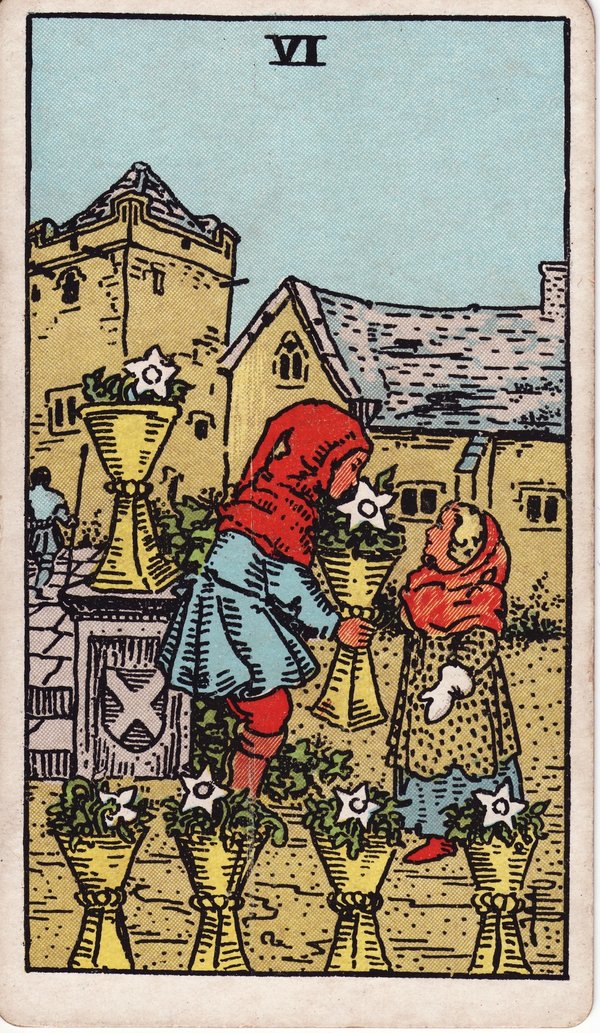
The Six of Cups follows with the reward of that movement — pleasure, harmony, recovery after the storm. The bridge in the Five leads directly to the walled garden of the Six. You cannot reach the garden without crossing the water.
Advising For / Advising Against
- If advising FOR: Grieve fully. Loss deserves mourning. Take the time you need. The two upright cups will still be there when you are ready to see them. Do not rush the crossing — but eventually, do cross.
- If advising AGAINST: Do not mistake mourning for identity. If months have passed and you still cannot raise your eyes, you have moved from grief to self-imprisonment. Is this grief still serving you, or has it become a wall?
Card of the Day
You are walking through a loss today. The temptation is to stare at what shattered. But two cups stand right behind you — a kindness you received, a lesson the loss taught, a resource you forgot. Name one thing that remains. That one thing is the seed of your return.
Elemental Dignities Notes
Water in Cups intensifies — grief feels oceanic. Earth (Pentacles) grounds. Fire (Wands) turns sorrow into anger. Air (Swords) brings detached analysis — helpful but potentially cold if it rushes past the feeling stage.
Deck-Specific Notes
- If using a Thoth deck: Emphasis on the theological geometry of disappointment. No bridge, no home visible. The hope is hidden in the context of the sequence. Read this as a spiritual crisis rather than an emotional one.
- If using a Marseille-tradition deck: Five cups only, no human figure. A more abstract statement about the nature of loss itself.
- If using a blended or contemporary deck: Pay attention to how the deck handles the tension between despair and hope.
Journaling & Contemplation Prompts
- What "spilled cups" am I still staring at? Is there a grief I have refused to complete?
- What are the two upright cups I have been ignoring?
- When have I mistaken productive grief for self-pity? How do I tell the difference?
- What bridge do I need to cross, and what would it cost to finally walk toward it?
Additional Associations
| Association Type | Value |
|---|---|
| Color(s) | Black, deep red, muddy blue-gray, watery brown |
| Crystals / Stones | Smoky quartz, black tourmaline, bloodstone, obsidian |
| Herbs / Plants | Blackthorn, cypress, wormwood, lotus |
| Archetypes (Jungian) | The Orphan, the Grieving Mother, the Shadow Self |
| Mythological Figures | Demeter mourning Persephone, Niobe weeping, Orpheus losing Eurydice |
| Numerological Resonance | Five: conflict, dynamic disruption |
| Playing Card Equivalent | Five of Hearts |
| I Ching Hexagram Parallel | Hexagram 51 — Zhen / The Arousing (Shock): thunder that clarifies and reorders |
| Body / Organ Correspondence | The heart, the reproductive organs (Scorpio), the kidneys (grief storage) |
Shadow & Integration Message
The Five of Cups is not a punishment; it is permission to fall apart so you can reassemble more truthfully. Integration comes when you honor the spilled cups without ignoring the standing ones. The shadow is not the grief itself but the belief that grief is the final state. The greatest honor you can pay to what is gone is to live fully with what remains.