The Poetic Line
"Five fists around the same ember — the friction that keeps the fire from dying."
Keywords
| Category | Dignified | Undignified |
|---|---|---|
| General | Competition, debate, creative friction, diversity of approach, vigorous disagreement, finding the strongest idea through conflict | Petty fighting, sabotage, destructive criticism, chaos without purpose, ego-driven conflict, the fight that benefits no one |
| Spiritual | The testing of faith, spiritual growing pains, the dark night as refiner, wrestling with the divine, the community that sharpens through disagreement | Spiritual combativeness, using belief as a weapon, the crisis of faith that breaks rather than strengthens, dogmatic infighting |
| Psychological | Healthy competition, the willingness to have hard conversations, ego strength that can withstand challenge, constructive dissent | Defensiveness, taking everything personally, creating conflict to avoid intimacy, the chip on the shoulder, persecution complex |
| Physical Health | Competitive sports, the body challenged and strengthened, the stress that builds resilience | Adrenal exhaustion from constant conflict, stress-related illness, injuries from fighting, the body breaking under chronic pressure |
| Relationships | Passionate disagreement that clears the air, competitive play, the relationship strong enough to fight fair | Constant bickering, one-upmanship, fighting as intimacy substitute, unresolved conflict that poisons connection |
| Financial | Healthy market competition, vying for resources, the bid or proposal process, competitive advantage earned through excellence | Cutthroat competition, undercutting, financial conflict (lawsuits, disputes), the race to the bottom |
| Vocational | Team debate producing better outcomes, competitive drive, the clash of ideas that sparks innovation, office politics navigated skillfully | Toxic workplace competition, sabotage, credit-stealing, bureaucratic infighting, conflict that destroys productivity |
| Shadow / Thoth Distinction | Lord of Strife — the necessary chaos that births stronger order; Saturn in Leo as the discipline that forges true creative authority, not mere self-expression | The strife that serves ego rather than evolution; Saturn in Leo as creative blockage, the inner critic that attacks rather than refines, the tyrant who rules through conflict |
Narrative Description
General Meaning
The Five of Wands is the card of creative friction. After the celebration of the Four — the completion, the earned rest — the Five arrives like cold water thrown on a fire: good, you've built something solid. Now let's see if it can hold. This is not tragedy but testing. The fire that was contained in the Four's canopy is loose again, spilling into argument, into the productive chaos of strong wills colliding.
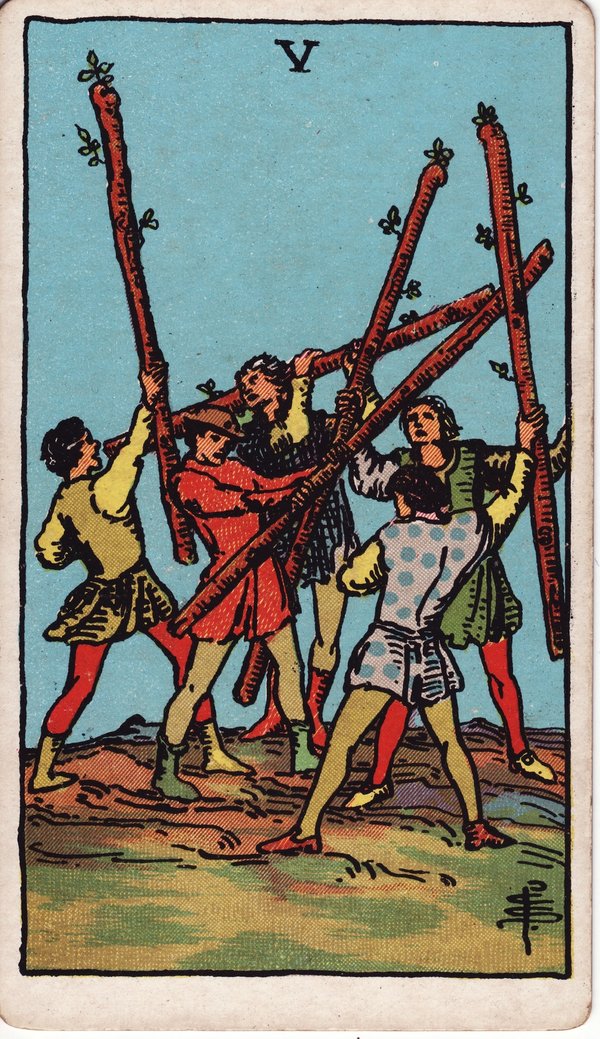
When the Five appears in a reading, it signals a period of conflict — but not all conflict is the same. The RWS card shows five young men with wands raised, but Waite himself noted they might be engaged in "sport or strife — or even a sham fight." That ambiguity is the point. The Five asks: is this conflict making something stronger, or is it just making noise?
The feeling is heated, energetic, sometimes frustrating. Not the calm of the Four or the anxiety of the Three — the adrenaline of competition, the spark of debate, the friction of multiple strong personalities in the same room. Whether that feels invigorating or exhausting depends on your relationship with conflict itself.
In the suit's story, the Five is Geburah's intervention — the correction that stops Chesed's generosity from turning into complacency. The Four built the castle; the Five tests its walls. Every suit has this moment: the disruption that reveals whether the first four cards' work was sound or just comfortable. The Five of Wands is the fire that burns away pretense, groupthink, the easy answers.
Symbolism & Imagery
Rider-Waite-Smith (1909): The RWS Five of Wands shows five young men in a melee, each holding a wand raised. The wands cross at odd angles — no two are aligned. The men wear different clothing — different backgrounds, different approaches. Their expressions are not mortal combat; they could be playing, competing, or genuinely fighting. The scene is outdoors, under a bright sky, on uneven ground.
The key is the number: five figures, five wands, five approaches. Everyone has fire, something they're fighting for, but no one's wand aligns with anyone else's. Not good versus evil — five different versions of "good," each convinced of its own rightness.
The uneven ground matters: the footing is uncertain. The bright sky says this is not life and death — it's whose idea wins, whose approach prevails, whose fire burns brightest. The Five of Wands rarely signals physical danger. It signals the danger of ego, of the fight that burns energy without producing resolution.
Thoth (Crowley/Harris, 1944): The Thoth Five of Wands, titled "Strife," shows five wands in an unstable pattern — a pentagram that cannot hold its shape. The wands are tipped with flames against a turbulent orange-red sky, the color of heated argument. A central wand, larger than the others, suggests the dominant force or ego around which the conflict swirls.
Crowley's treatment emphasizes the energetic quality: heat without structure, fire without a vessel. The pentagram — symbol of the microcosm, of humanity — is in disarray. The will in its unrefined state: multiple, competing, unable to integrate. The solution is not to eliminate the conflict but to find the higher synthesis the Six (Tiphareth, harmony) will eventually bring.
Astrological & Elemental Layer
Saturn in Leo, the 1st Decan of Leo. This is one of the most challenging placements in the Wands suit. Saturn is the planet of limitation, discipline, the lessons that only time teaches. Leo is fixed fire — creative self-expression, pride, the need to be seen. Saturn in Leo is the stern teacher facing the exuberant student: Your fire needs refining. Prove it.
The 1st Decan is the Saturn decan in the Chaldean system, intensifying the pressure. This is the decan of the artist whose work is rejected, the leader challenged, the ego broken before it can be rebuilt.
But Saturn in Leo is not purely negative. Saturn's discipline, applied to Leo's creativity, produces mastery. The conflict is not random chaos — it is the right kind of pressure. Saturn asks Leo: Can you still shine when no one is applauding? The Five of Wands is the moment the answer is tested.
Kabbalistic / Tree of Life Layer
The Five sits in Geburah — Severity, the fifth Sephirah, the sphere of Mars on the Tree. Geburah is necessary destruction: the fire that burns away dross, the sword that cuts what is unworthy, the discipline that corrects Chesed's excess. Where Chesed gives freely, Geburah asks: Is it worthy?
In Wands, Geburah is the first major test. The Ace's fire, the Two's direction, the Three's launch, the Four's celebration — all affirmative, all moving forward. Geburah says: prove it. The fire is subjected to pressure, the will forced to compete, the vision forced to defend itself.
Geburah is also the sphere of fear — not neurotic anxiety but the sacred fear that rises when something real is at stake. The Five often signals the querent cares deeply about the outcome. The stress is real because the investment is real. Geburah's gift: it reveals what we actually value. We fight for what matters. The Five shows us what that is.
For the querent: the conflict you face is not random suffering. It is the pressure that reveals whether your fire is strong enough to become what it claims to be. The Four was a resting place, not a destination. You are in Geburah now, and Geburah's work is to make you worthy of Tiphareth — the harmony that is earned, not given.
Sequential Narrative: Position in the Suit Story
← Previous card: Four of Wands — the celebration is over. The community that danced together must now contend with the reality that dancing is easy and building is hard. The Five reveals the cracks the Four's party papered over.
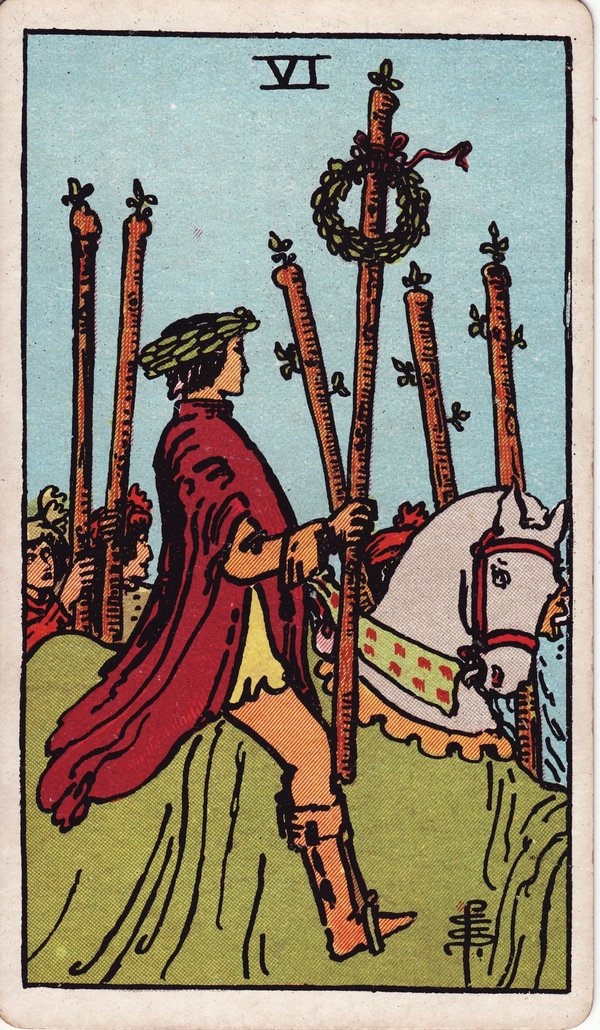
→ Following card: Six of Wands (Lord of Victory, Jupiter in Leo) — the conflict resolves, a winner emerges. The chaos of the Five clarifies into the triumph of the Six, where one approach proves itself strongest and is recognized by the community. But the victory is only meaningful because the Five was genuinely contested.
The Five's role in the arc: The Five of Wands is the suit's crucible. Without it, the fire is never tested, and the Six's victory would be hollow. The Five teaches that conflict is not the opposite of harmony — it is often harmony's necessary precondition.
Advising For / Advising Against
-
If advising FOR: Engage. The conflict is happening whether you join or not — your withdrawal will not restore peace, it will only leave your perspective absent from the resolution. Fight fair. Argue with passion, not malice. Remember the others are rivals, not enemies — they want something similar, just by a different route. Let the best idea win, and be willing to discover it might not be yours.
-
If advising AGAINST: Check whether you are fighting for the cause or fighting for your ego. Saturn in Leo's shadow is the insecurity that disguises itself as conviction — needing to win not because the idea is right but because losing would feel like annihilation. Also: is this conflict real or manufactured? Are you creating strife to avoid intimacy, to feel alive because peace feels like death? If the battle serves the self rather than the work, lay down the wand.
Card of the Day
Today brings friction — a disagreement, a competing priority, a clash of approaches. Do not avoid it. Do not take it personally. Treat it as sport, as the friction that sharpens the blade. Say what you think. Listen to what others think. Let the best idea win, and if it isn't yours, learn from the one that is. The goal today is not harmony. It is clarity, earned through honest contest.
Card of the Year
A Five of Wands year is one of competition, challenge, and growth through conflict. Professional rivalries, ideological debates within a community, or the internal struggle to reconcile competing desires. The work is not to eliminate the conflict but to engage it productively — to learn which battles are worth fighting and which are ego dressed as principle, to emerge with your fire tested and your priorities clear.
Elemental Dignities Notes
- Strengthened by Fire (Wands): Additional Wands intensify the conflict — more competitors, higher stakes, escalating chaos. This can be productive (a genuine tournament of ideas) or destructive (a brawl).
- Strengthened by Air (Swords): Air feeds Fire — Swords bring intellect and articulation to the clash, potentially elevating it from brawl to debate. But Swords can also sharpen the conflict's edge.
- Weakened by Water (Cups): Water and Fire are enemies. Adjacent Cups may dampen the Five's competitive fire with emotional considerations — hurt feelings, desire to preserve relationship, reluctance to fight. This can be constructive (tempering) or avoidant (suppressing necessary disagreement).
- Weakened by Earth (Pentacles): Earth smothers Fire. Adjacent Pentacles introduce practical concerns that may make the conflict seem trivial, or ground it in tangible stakes rather than abstract ego.
Yes / No Tendency
Neutral to Leaning No — active conflict rarely gives a clean affirmative. For questions about whether conflict will arise, the answer is yes. For questions about whether a venture will succeed easily, expect obstacles, competition, a fight for your position. For questions about whether to engage, the Five says yes — the strife is necessary — but the outcome will not be clean nor the process pleasant.
Timing & Manifestation
Seasonally, this card belongs to midsummer — July 22–August 1 (Saturn in Leo, 1st Decan), when the sun burns hottest and tempers flare. The moon phase is the Full Moon: visibility at its peak, tension at its peak — everything illuminated, including what everyone is fighting over. Manifestation speed is immediate — the Five does not sit in waiting; conflict manifests within days. Resolution timing depends on the maturity of the participants: productive conflict resolves in days; ego-driven conflict drags for weeks or months.
Common Misreads / Nuances to Know
Misread 1: "The Five of Wands is always destructive — avoid conflict at all costs." The Five equally represents the productive clash that produces the strongest outcome: the design team that argues its way to brilliance, the athletes whose competition sharpens both. The Five only becomes destructive when it serves ego rather than the work.
Misread 2: "The Five of Wands means physical violence." Despite the raised wands, this card rarely indicates physical danger. Waite described it as possibly sport or a sham fight. Read this as competitive tension — ideas, strategies, priorities — not physical threat, unless surrounding cards clearly say otherwise.
Misread 3: "The Five is only about external conflict." The five clashing wands can represent competing desires within the querent's own psyche — the person torn between security and passion, loyalty and ambition.
Nuance for Thoth readers: Saturn in Leo often manifests as creative blockage. In Thoth-informed readings, the Five appears when the inner critic attacks the creative impulse. The advice is not to fight harder but to recognize the critic as part of the process, not an obstacle to it.
Shadow & Integration Message
The shadow of the Five is the addiction to conflict — the person who has learned that the only way to feel alive is to fight. Saturn in Leo, shadowed, picks fights to prove worth, mistakes belligerence for strength. The friction that should sharpen becomes the constant abrasion that wears everything down. A subtler shadow is the fear of resolution — keeping conflict alive because stopping would mean facing the quiet, and the quiet is where unprocessed pain lives. The shadow asks: are you fighting for something, or are you fighting because stopping would mean feeling something you're not ready to feel?
Integration means engaging conflict without being consumed by it. Attack ideas, not people. Know what you are willing to lose over — not every hill is worth dying on. Develop a practice of post-conflict recovery; the adrenal system takes time to reset. The integrated Five is the athlete who competes fiercely and shakes hands after, the warrior who fights for a cause and tends their own wounds. Fight without hatred, lose without resentment, win without gloating.
Deck-Specific Notes
- If using a Thoth deck: The Five of Wands appears as a dynamic, unstable pentagram of flaming wands. The emphasis is on strife as an energetic principle — the necessary friction before integration. In a Thoth reading, this card is less about interpersonal drama and more about internal or systemic forces that must clash before a higher synthesis can emerge.
- If using a Marseille-tradition deck: The Marseille Five of Batons typically depicts five staffs in a pattern that suggests both order and tension — a structure that could hold or could collapse. The emphasis is on the instability of the moment and the need for integration.
- If using a blended or contemporary deck: The psychological and astrological layers apply across visual traditions. Consult your deck's guidebook for any departures.
Journaling & Contemplation Prompts
- What am I fighting for right now — and am I fighting for the thing itself or for the feeling of being right?
- Where in my life have I been avoiding necessary conflict by pretending to value harmony?
- What would "fighting fair" look like in my current situation?
- What have past conflicts taught me about what I truly value — and what I was merely defending?
Additional Associations
| Association Type | Value |
|---|---|
| Color(s) | Turbulent orange-red (strife, heated argument); deep grey (Saturn, the weight of consequence); flashes of gold (Leo, the creative fire being tested) |
| Crystals / Stones | Hematite (grounding during conflict, Saturnine stability); Red Jasper (endurance, the stamina to stay in the fight); Smoky Quartz (transmuting the negative charge of conflict into productive energy) |
| Herbs / Plants | Thistle (Saturn, the prickly defense, the plant that thrives in harsh conditions); Cayenne (Fire, the heat of competition, the spice of debate); Comfrey (the healer that follows the fight — Saturn knows conflict requires recovery) |
| Archetypes (Jungian) | The Warrior (not the berserker — the disciplined combatant); The Shadow (the ego's hidden investments that fuel conflict); The Trickster (the fight that is really a game) |
| Mythological Figures | The Greek agon — the sacred contest, the Olympic spirit of competition as worship; Jacob wrestling the angel (the struggle that earns the blessing); The War of the Roses (conflict between equally valid claims to sovereignty) |
| Numerological Resonance | 5 = instability, challenge, the pentagram. Heh (ה) = 5, the window — through which the light of conflict enters, illuminating what was hidden. |
| Playing Card Equivalent | Five of Clubs — competition and conflict in the suit of enterprise |
| I Ching Hexagram Parallel | Hexagram 6 — Song / Conflict. "Conflict. You are sincere and are being obstructed. A cautious halt halfway brings good fortune." The dispute that must be engaged but not to the death. |
| Body / Organ Correspondence | The heart (Leo — the organ of courage and pride, stressed by conflict); the adrenal glands (the body's response to competition); the muscles (the instruments of the fight, the tension conflict generates) |