The Poetic Line
"The harvest is not fuel for the next planting — it is the feast that makes the work worth doing."
Keywords
| Category | Dignified | Undignified |
|---|---|---|
| General | Celebration, harmony, homecoming, completion of a phase, community, shared joy | Unfinished business, delayed celebration, instability, joylessness, the party that never happens |
| Spiritual | Sacred community, ritual celebration, gratitude as practice, the holiness of shared joy, consecrating the milestone | Empty ritual, spiritual bypassing through festivity, using celebration to avoid the next hard step, gratitude as performance |
| Psychological | Satisfaction, earned rest, belonging, the security of accomplishment, contentment | Restlessness disguised as ambition, inability to enjoy success, imposter syndrome poisoning the celebration, fear that joy is provisional |
| Physical Health | Recovery after effort, the body at rest and restoration, celebrating physical milestones, the health of community | Exhaustion that prevents enjoyment, the body unable to rest, celebration that damages health (overindulgence), neglecting recovery |
| Relationships | Commitment celebration, wedding, anniversary, family gathering, the relationship as sanctuary, shared accomplishment | Relationship instability, the celebration that masks cracks, fear of commitment, avoiding the next step, the partner who can't celebrate your wins |
| Financial | Financial milestone reached, celebrating gains, return on investment phase one, abundance shared with community | Premature celebration, spending beyond means to create the appearance of success, instability beneath the party |
| Vocational | Project completion celebrated, team recognition, reaching a milestone, the earned break, organizational stability | Resting on laurels, team celebration that papers over dysfunction, completing a phase poorly and pretending it's finished |
| Shadow / Thoth Distinction | Lord of Completion — the sovereign who knows when to rest; Venus in Aries as the harmony that crowns individual effort; the dance after the battle | The completion that is really avoidance — declaring victory to escape the harder work ahead; Venus in Aries as seduction by comfort, the refusal to leave the party |
Narrative Description
General Meaning
The Four of Wands is the card of celebration — not the forced cheer of obligatory social events but the genuine, earned joy that follows the completion of a significant phase. After the Ace's spark, the Two's choice, and the Three's launch, the Four arrives with a simple, profound invitation: stop and celebrate. The ships have reached harbor. The first harvest is in. The foundation is laid. There will be more work tomorrow, but today is for joy.
In a reading, the Four of Wands signals a milestone — a wedding, a graduation, a project launch, a move into a new home, any moment where the community gathers to mark an achievement. This is one of the most uncomplicatedly positive cards in the Minor Arcana. It does not carry the weight of responsibility (Two), the anxiety of waiting (Three), or the struggle of conflict (Five). It carries only the simple goodness of people gathered in a place they have built, celebrating something they have earned.
The emotional register is warmth, belonging, ease. The Four of Wands often appears when someone needs permission to enjoy their life — to stop pushing, stop optimizing, stop treating every achievement as merely the platform for the next one. The card does not deny that more work exists. It simply insists that the work is not the whole story. The celebration is also real. The joy is also the point.
In the suit's narrative, the Four is the first place of rest. The fire has not gone out — the wands are still lit, still vibrant — but it has been given a structure that contains it, channels it, and in containing it, makes it safe enough to dance around. The Four is Chesed in action: the merciful king who builds not just fortresses but feasting halls.
Symbolism & Imagery
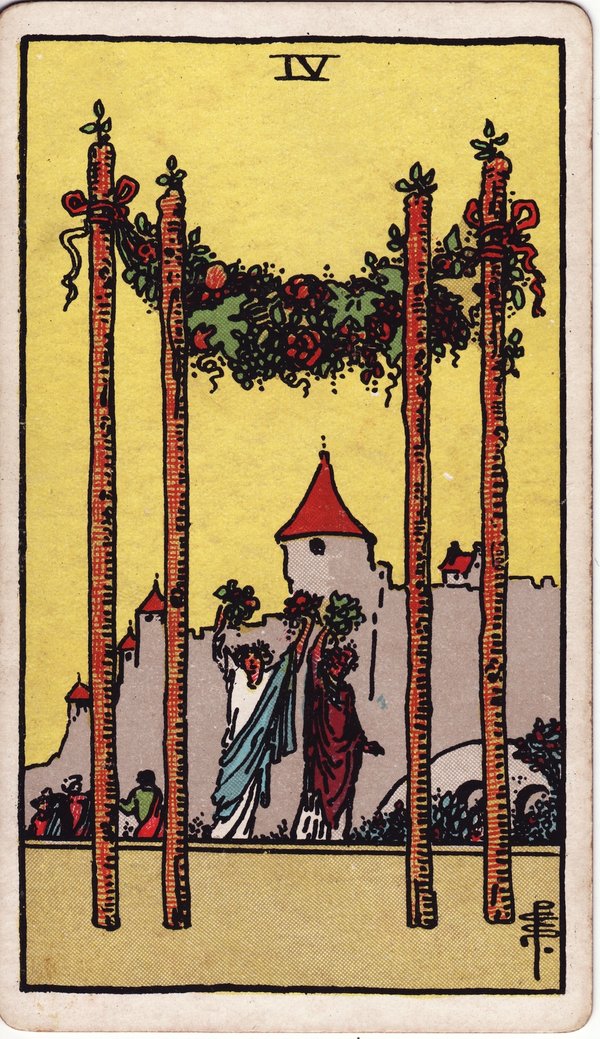
Rider-Waite-Smith (1909): The RWS Four of Wands is one of the most instantly legible cards in the deck. Four tall wands, garlanded with flowers and fruit, form a celebratory canopy — a chuppah, a harvest arbor, a festival arch. Beneath it, two figures (often interpreted as women) dance or raise bouquets in joy. In the background, a castle stands solid and complete — the finished work, the established home, the structure that makes celebration possible.
The garlands are crucial: they weave the four wands together into a single structure. The number four represents stability, and here that stability is not rigid but alive — the wands are planted in the ground (rooted, committed) while the flowers and fruit speak of growth, abundance, and the passing of seasons. The canopy is both shelter and threshold — it marks a boundary between the ordinary world and the sacred space of celebration.
The castle in the background ties back to the Two of Wands — the castle the merchant stood on, surveying his options. Now the castle is complete, and the figure has descended from the battlements to dance. The ships of the Three have returned. The waiting is over. The party has begun.
Thoth (Crowley/Harris, 1944): The Thoth Four of Wands, titled "Completion," depicts four wands arranged in a pattern that suggests both stability and motion — a wheel, a mandala, a completed cycle. The wands are tipped with flames, and the background is a rich, warm gold and amber — the colors of harvest, of Venusian warmth, of fire tamed to hospitality. Rams' heads (Aries) appear at the corners, grounding the astrological attribution in the imagery.
Crowley's treatment emphasizes the principle of completion rather than the event of celebration. The Thoth Four is not a party scene but an energetic statement: the fire has achieved its first complete form. The structure is sound. The work of this phase is done. What the RWS renders as narrative, the Thoth renders as geometry — but both say the same thing: rest now, for the foundation holds.
Astrological & Elemental Layer
Venus in Aries, the 3rd Decan of Aries (approximately April 11–20). Venus is the planet of love, beauty, harmony, attraction, and the arts. In Aries — the sign of individual initiative, raw assertion, and the pioneer's solitude — Venus is in a sign of its detriment. This might seem like a difficult placement, but in the Four of Wands, it resolves beautifully: Venus softens Aries' sharp edges, teaching the warrior to dance, the pioneer to build a home, the individual to make space for community. Aries gives Venus courage and fire — the willingness to celebrate openly, loudly, without self-consciousness.
The 3rd Decan of Aries is ruled by Venus in the Chaldean system (each decan has a sub-ruler drawn from the Chaldean order of planets). Venus ruling Aries' final decan adds a note of completion and grace — the ram's head bowed in acknowledgment, the fire banked to a warm glow. This decan carries the energy of "the work is done, the reward is here."
The decan's shadow: Venus in Aries can also manifest as impatience with celebration itself — the restless energy that can't settle into joy, the mind already moving to the next project while the body goes through the motions of the party. The Four asks: can you actually be present for your own joy?
Kabbalistic / Tree of Life Layer
The Four sits in Chesed — Mercy, the fourth Sephirah, the first sphere below the Abyss. Chesed is the principle of benevolent order: the king who rules not by force but by generosity, the architect who builds not prisons but palaces, the force of expansion that is guided by love rather than mere appetite.
In the suit of Wands, Chesed represents the first point of genuine stability. The Ace's fire, the Two's direction, and the Three's launch have all been dynamic — moving, choosing, sending. Chesed says: stop. Build here. Let this be a place. The Four of Wands is the fire that has learned to dwell — not extinguished but housed, a hearth rather than a wildfire.
Chesed is also the sphere of Jupiter — expansive, generous, benevolent. The celebration of the Four is not a private satisfaction but a communal event because Chesed's nature is to give, to share, to overflow. The four wands form a square — the first stable shape in sacred geometry — and within that square, there is room for everyone.
For the querent, the Kabbalistic layer suggests: the structure you have built is good. It can hold weight. It can hold joy. Do not be afraid to rest in it, even temporarily — rest is not collapse; it is the recognition that the foundation is sound.
Sequential Narrative: Position in the Suit Story
← Previous card: Three of Wands — the ships were launched, the venture was set in motion. The Three was the card of watching and waiting. The Four is the card of arrival — the ships have returned, the first cycle is complete, and the community gathers to mark the milestone.
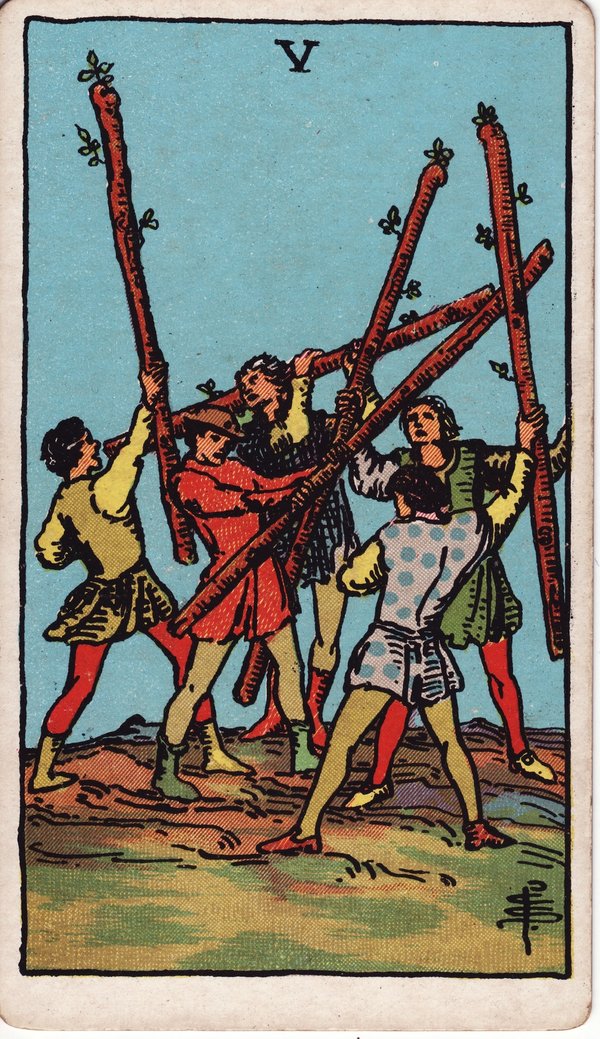
→ Following card: Five of Wands (Lord of Strife, Saturn in Leo) — the celebration ends, and the next phase brings conflict. The stability of the Four is disrupted by the Five's competitive chaos. This is not a tragedy — it is the natural rhythm of the suit. Rest prepares you for the next challenge; the party does not last forever, but it lasts long enough to renew you for what comes next.
The Four's role in the arc: The Four of Wands is the suit's first harmonic — the point where the fire's energy, properly directed and launched, achieves its first complete form. It is a resting place, not a destination. But the resting is real, and the celebration is necessary. Without the Four, the suit becomes an endless grind — a fire that burns without ever warming anyone.
Advising For / Advising Against
-
If advising FOR: Celebrate. Mark the milestone. Gather the people who helped you get here and acknowledge what has been accomplished. Do not minimize your achievement by immediately asking "what's next?" The pause is productive. The joy is fuel. The community that celebrates together builds together. Let yourself feel the satisfaction of a phase well completed.
-
If advising AGAINST: Do not mistake the party for the destination. The Four of Wands is a milestone, not a terminus. Celebration that becomes complacency is the shadow of this card — the team that rests on its laurels while the next challenge gathers force. Also: examine whether the celebration is real or performative. Are you genuinely marking an achievement, or using festivity to avoid acknowledging that the work is not actually done?
Card of the Day
Today is a day for celebration — whether of a major milestone or the simple, ordinary goodness of being alive among people you care about. If there is something to mark, mark it. Joy is not a luxury. It is a practice. Today, practice it.
Card of the Year
A Four of Wands year — when this card dominates a yearly spread or thematically characterizes the period — is a year of stability, completion, and celebration. A major milestone will be reached: a wedding, a home purchase, a career achievement, the successful launch of a long-planned project. The work of the year is less about initiation (Ace) or expansion (Three) and more about consolidation, gratitude, and building the structures that will support the next phase. Enjoy it. These years are rare.
Elemental Dignities Notes
- Strengthened by Fire (Wands): Additional Fire intensifies the celebratory energy — bigger party, more joy, the bonfire rather than the hearth. But too many Wands can make the celebration frenetic, the restlessness creeping back in.
- Strengthened by Air (Swords): Air feeds Fire — Swords bring the words for the toast, the clarity to articulate what has been achieved, the intellectual recognition that deepens emotional celebration.
- Weakened by Water (Cups): Water and Fire are enemies. Adjacent Cups may flood the celebration with excessive emotion — nostalgia, sentimentality, or grief for what was lost in the achieving — that dampens the simple joy of the moment.
- Weakened by Earth (Pentacles): Earth smothers Fire. Pentacles adjacent may introduce practical concerns that crash the party — financial anxiety, material limitations, the weight of "what's next" arriving too soon.
Yes / No Tendency
Strong Yes — one of the most affirmative cards in the suit. The Four of Wands represents earned joy, stability, and the successful completion of a phase; for questions about milestones, homecoming, or community, the answer is a confident yes. For questions about beginning something new, the Four says yes but urges the querent to complete and celebrate the current phase before launching the next.
Timing & Manifestation
Seasonally, this card belongs to late spring — April 11–20 (Venus in Aries, 3rd Decan), when Aries' fire transitions toward Taurus' earth and the first hints of summer stability appear. The moon phase is the Waxing Gibbous: nearly full, the harvest nearly complete. Manifestation speed is fast — the Four represents arrival, not continued striving; results manifest within days to weeks. If the querent has been working toward a goal, the Four says it is here or imminently arriving. The season of late spring to early summer is the natural window for celebrations or commitment ceremonies.
Common Misreads / Nuances to Know
Misread 1: "The Four of Wands is the happy ending — the journey stops here." In the suit's narrative, the Four is the first moment of rest, not the destination. The Five of Wands follows immediately. The Four says: enjoy this moment fully, but do not build your house here — the road continues.
Misread 2: "The Four is exclusively about weddings and romantic commitment." The RWS canopy strongly suggests marriage, but the card equally applies to home purchases, graduations, job promotions, creative launches, spiritual initiations, or any milestone that deserves communal recognition.
Misread 3: "The Four guarantees the stability is permanent." The canopy is made of wands and garlands, not stone. The Four represents stability, not eternity. Rest, but do not disband the watch.
Nuance for Thoth readers: Crowley's "Completion" (the mandala of flaming wands) shifts emphasis from social celebration to energetic principle. In Thoth readings, ask what has actually been completed — an inner cycle, a healing phase, an integration period — even if there is no outward celebration.
Shadow & Integration Message
Shadow: The shadow of the Four is the refusal to leave the party. The celebration that was earned becomes the celebration that is clung to — the graduate who lives in the past, the couple whose wedding was perfect while their marriage is neglected. Venus in Aries, shadowed, becomes the restless celebrant who moves from party to party because silence feels like failure. A deeper shadow is celebration used as spiritual bypass: the community that gathers to celebrate while ignoring the injustice at its gates, the family that throws elaborate parties to avoid acknowledging dysfunction.
Integration: Integration of the Four requires the discipline of earned rest. The celebration is real and necessary but also temporary. Celebrate fully, without guilt or minimization — the work that earned this joy will not be diminished by acknowledging it. Mark the milestone with specificity: name what was completed, thank those who helped. Before the party ends, plant a seed for the next phase. The key virtue is gratitude without attachment: enjoy the harvest without needing it to last forever. Venus in Aries, integrated, loves openly and celebrates boldly, then returns to the work with a heart full enough to begin again.
Deck-Specific Notes
- If using a Thoth deck: The Four of Wands appears as four flaming wands arranged in a mandala-like pattern, rams' heads grounding the Aries attribution. The emphasis is on completion as an energetic principle rather than a social event. Read it as confirmation that a cycle has genuinely ended and the next may begin from solid ground.
- If using a Marseille-tradition deck: The Marseille Four of Batons typically depicts four staffs or batons woven together into a sturdy lattice or square — a structure of mutual support. The emphasis is on the stability of the arrangement rather than the celebration it enables, but the meaning is consistent.
- If using a blended or contemporary deck: The psychological and astrological layers apply across visual traditions. Consult your deck's guidebook for any departures.
Journaling & Contemplation Prompts
- What milestone have I reached that I haven't allowed myself to fully celebrate?
- Who helped me get here — and have I thanked them, publicly and genuinely?
- Am I able to rest in accomplishment, or does my mind immediately race to "what's next"? What would it cost me to pause?
- What does "home" mean to me — not just a physical place but a structure of belonging?
Additional Associations
| Association Type | Value |
|---|---|
| Color(s) | Rich gold and amber (harvest, Chesed's warmth, Venusian glow); green (the garlands, living growth); warm red (Aries fire, the hearth) |
| Crystals / Stones | Rose Quartz (Venus, love, community harmony); Garnet (the warmth of the hearth, grounded passion); Emerald (Chesed — Jupiter's stone, abundance and mercy) |
| Herbs / Plants | Myrtle (Venus, wedding garlands, sacred celebration); Ivy (the bonds of community, the wreath of achievement); Rose (Venus, the beauty that crowns the work) |
| Archetypes (Jungian) | The Host; The Community Elder; The Good King (Chesed); The Celebrant |
| Mythological Figures | Hestia/Vesta (goddess of the hearth, the sacred fire of home); Demeter (harvest celebration, the joy of the gathered community); King Arthur (the round table — equality, fellowship, the hall that holds the celebration) |
| Numerological Resonance | 4 = stability, foundation, the square, the fourfold symmetry of the completed phase. Daleth (ד) = 4, the door — the threshold into settled ground. |
| Playing Card Equivalent | Four of Clubs — stability and completion in the suit of action and enterprise |
| I Ching Hexagram Parallel | Hexagram 37 — Jia Ren / The Family. "The Family. The perseverance of the woman furthers." The hexagram of the hearth, the household, the community bound by love rather than obligation. |
| Body / Organ Correspondence | The heart (Venus — the organ of love, connection, and the warmth of belonging); the arms (that embrace, that dance, that build the canopy); the home — the body at rest in a place of safety |