The Poetic Line
"His truth does not cut — it clears. The wound was already there; he simply names it."
Keywords
| Category | Dignified | Undignified |
|---|---|---|
| General | Intellectual authority, clear judgment, decisive action, truth-telling, strategic thinking, principled leadership | Cold cruelty, intellectual arrogance, manipulative use of reason, indecisiveness disguised as analysis, abuse of power |
| Spiritual | Discernment, sacred clarity, the sword of truth cutting through illusion, dharma, alignment of word and spirit | Spiritual bypassing through intellectualization, using doctrine as a weapon, dogmatism that rejects mystery, the guru who cannot be questioned |
| Psychological | Analytical precision, mental discipline, objectivity, the capacity to separate thought from emotion when necessary, cognitive integrity | Emotional repression disguised as rationality, hypercriticism, paranoia about being wrong, terror of vulnerability masked as superiority |
| Physical Health | Mental clarity supporting physical wellbeing, disciplined health routines, seeking expert medical opinion, nervous system regulation through structure | Stress-related illness from overwork, tension headaches, jaw clenching, high blood pressure from suppressed emotion, neglect of the body in favor of the mind |
| Relationships | Clear communication, setting healthy boundaries, intellectual partnership, honesty even when difficult, reliability and follow-through | Emotional coldness, using logic to dismiss partners' feelings, controlling communication, the partner who is always right, inability to offer warmth |
| Financial | Strategic financial planning, sound investment decisions, consulting experts, contracts that serve both parties, disciplined budgeting | Ruthless negotiation, financial manipulation, using money as control, legal loopholes exploited against the vulnerable, cold calculation without ethics |
| Vocational | Leadership through expertise, decisive management, intellectual authority, speaking truth to power, judicial roles, advisory positions | Micromanagement, intellectual bullying, taking credit for others' ideas, paralysis by analysis in leadership, the toxic boss who prizes being right over being effective |
| Shadow / Thoth Distinction | Righteous anger channeled into justice, the warrior-intellectual who fights with precision, the piercing insight that heals by exposing | The inquisitor, the cold tyrant of reason, the mind that has severed itself from the heart and now turns on all warmth as weakness |
Narrative Description
General Meaning
The King of Swords is the sovereign of the intellectual realm — the card of the mature, disciplined mind that has learned to wield thought not as a weapon of cruelty but as an instrument of clarity. Among the court cards, he represents the highest expression of the Air element: the mind that has been trained, tempered, and placed in service of something larger than its own cleverness.
In a reading, the King of Swords signals a time when clear thinking, honest communication, and principled decision-making are required. He appears when the situation demands that you step into intellectual authority — to speak a hard truth, to render a fair judgment, to cut through confusion with the blade of reason. This is not the card of the clever trickster (that belongs to the Knight/Prince of Swords in his shadow) but of the mature thinker who understands that intelligence without integrity is merely cunning, and that the truest use of the mind is to serve what is real.
The King of Swords does not shy away from difficult conversations or uncomfortable conclusions. His gift — and his challenge — is the willingness to say what others will not, to see what others avoid, to name what others obscure. In this sense, he carries an echo of the Fool's freedom (the willingness to be out of step) combined with the Magician's mastery (the skill to channel that freedom into effective action). He is the card of the expert, the judge, the strategist, the honest advisor — the person who has earned the right to render a verdict because they have done the work of understanding.
In the shadow, the King of Swords becomes the cold tyrant of reason — the intellect that has severed itself from the heart and now rules through fear of being wrong. His clarity calcifies into cruelty. His decisiveness becomes rigidity. His truth-telling becomes a bludgeon he wields to dominate, not to liberate. The undignified King has confused being right with being whole, and in doing so has lost access to everything reason alone cannot touch: compassion, intuition, mystery, love.
Symbolism & Imagery
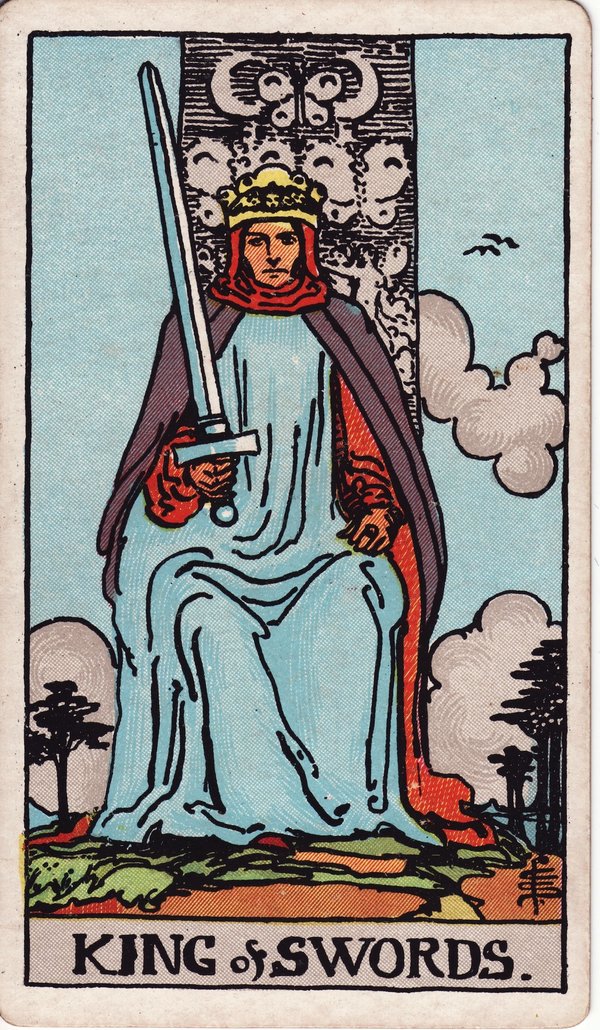
Rider-Waite-Smith (1909): The RWS King of Swords sits on a stone throne, facing forward — confronting the viewer, not looking away. He holds his sword upright in his right hand, the hand of conscious action, and the blade points upward: the mind reaching toward higher truth. His left hand rests on the arm of the throne, open but still — he is not wielding the sword aggressively; he is displaying it as a symbol of his office. His throne is decorated with butterflies and crescent moons — creatures of the air — and in some versions, sylphs or winged figures appear on the back of the throne, emphasizing that this king rules the realm of intellect, communication, and invisible currents.
Behind him, the sky is clear and blue — no clouds, no storm, no confusion. The clarity of the sky mirrors the clarity of his mind. His expression is stern without being cruel, serious without being cold. He is not smiling because he is not here to charm — he is here to be honest. His crown is simple, a band of gold, not ornate: his authority comes from what he knows, not from what he wears.
His cape is blue — the color of truth, loyalty, and the throat chakra (communication). In some versions, it is lined with red, the color of passion, suggesting that beneath the cool exterior of reason burns the Fire of Air: the passion for clarity that drives the King's entire being.
Thoth (Crowley/Harris, 1944): In the Thoth deck, the Knight of Swords (equivalent to the RWS King) is depicted as a mounted warrior charging forward on a white horse — the intellect in active motion, the mind as a vehicle of will. His helmet is crowned with a winged crest, and his sword is raised and ready. Behind him, winged figures attend, and the entire composition pulses with kinetic energy. Where the RWS King is seated (having arrived at authority), the Thoth Knight is riding (pursuing truth in action). The elemental quality of Fire of Air is rendered visually: the sword (Air) driven by the horse's charge (Fire), the intellect propelled by passionate will.
The color palette of the Thoth Knight of Swords is sharp — whites, silvers, pale blues, and flashes of red. The lightning bolt motif that appears throughout the Swords suit in Thoth is present here, suggesting sudden insight, the flash of genius, the mind that illuminates in an instant.
The key difference between traditions: RWS emphasizes the King's state — the settled authority of the mature intellect. Thoth emphasizes his movement — the intellect as a force that charges into the unknown, that masters through active engagement rather than passive contemplation. Both are true: the King of Swords has arrived at his throne through relentless motion; the Knight of Swords charges forward carrying the authority his clarity has earned.
Astrological & Elemental Layer
The King of Swords rules the third decan of Taurus and the first two decans of Gemini — approximately May 11 through June 20. This is the bridge between fixed earth and mutable air: from the solid ground of Taurus (where values are built and secured) into the quick, mercurial territory of Gemini (where ideas multiply and communication becomes paramount).
The Taurus III decan (May 11–20) carries the energy of Saturn-ruled Taurus according to the Chaldean system — the weight of material responsibility meeting the nascent intellectual quickening. This is the part of the King's nature that understands that thinking must serve something real, that ideas have consequences in the world of bodies and bank accounts. The King of Swords is not a dreamer divorced from reality; his intellectual authority is grounded in practical wisdom.
The Gemini decans (May 21 – June 20) are Mercury's own territory, and here the King's elemental nature as Fire of Air finds its fullest expression. Gemini is the sign of the communicator, the networker, the dual-seeing mind that can hold opposing ideas and still function. The first decan of Gemini is ruled by Mercury, doubling the mercurial quickness. The second decan is ruled by Venus in Chaldean order, adding a note of aesthetic sensibility — the King of Swords' pronouncements are not only true but well-formed, artful even in their precision.
Fire of Air is one of the more complex elemental combinations in the Golden Dawn court system. Air is the element of thought, intellect, communication, and abstraction. Fire is the element of will, passion, initiative, and transformation. Together, Fire of Air produces an intelligence that is not passive or scholastic but active, driven, and world-changing. The King of Swords does not merely think clearly — he thinks with purpose. His clarity is not the cool detachment of pure Air but the focused heat of a mind that has chosen what it serves and serves it absolutely.
The challenge of Fire of Air is that passion can overheat reason, transforming the King's clarity into the cruelty of the zealot. The gift of Fire of Air is that it makes the intellect into a force of nature — a mind that can cut through centuries of accumulated confusion in a single sentence, a judgment that can liberate as decisively as a sword stroke.
Kabbalistic / Tree of Life Layer
Court cards do not occupy fixed Sephiroth in the same way pip cards do; they are more properly understood as the elemental forces that move through the Sephiroth. In the Golden Dawn system, the Kings (Knights in Thoth) are attributed to Chokmah — the second Sephirah, Wisdom, the first masculine emanation from Kether. Chokmah is the sphere of pure drive, the impulse to create, the force that initiates all manifestation.
The King of Swords as Chokmah-in-Air represents the first stirring of intellectual wisdom — the primal idea, the originating thought, the conceptual seed from which all understanding grows. He is not the elaborated knowledge of Hod (the Eighth Sephirah, the sphere of intellect proper) but the source of knowledge: the capacity to see what no one has yet seen, to formulate what no one has yet formulated.
In the Tetragrammaton (YHVH), Kings correspond to Yod — the first letter, the Father, the initiating spark. The King of Swords is Yod in the world of Yetzirah (the formative world, the realm of Air). He is the seed of intellect, the first thought that will eventually become a system, a philosophy, a body of law. His Kabbalistic function is to begin the intellectual process, not to complete it — to see the truth clearly enough to speak it, trusting that others will build the structures around what he has named.
For the querent, the Kabbalistic layer suggests: the clarity you are seeking is not the end of the journey but its beginning. The King of Swords does not offer you a finished system — he offers you the capacity to begin thinking clearly about what matters. His gift is the first cut, the decisive distinction, the word that makes everything else possible.
Representing a Person
Court cards are multidimensional: they represent personality types, behavioral modes, roles, and actual people. This section covers the King of Swords in all these dimensions.
As a person: The King of Swords archetype describes someone who has made the intellect their primary instrument and has disciplined that instrument to serve truth rather than ego. In their dignified expression, they are the wise advisor, the fair judge, the honest critic, the strategist who sees three moves ahead but also knows why the game is worth playing. They value clarity above comfort, integrity above popularity, and precision above poetry — though their precision often becomes a kind of poetry in itself.
Their gifts: the ability to see through deception, to name what is actually happening, to make decisions that others are too confused or too afraid to make. They are the person you turn to when you need an honest answer, when sentiment has clouded the situation, when the stakes are too high for self-deception.
Their shadow: when the intellect becomes a defense against feeling, the King of Swords transforms into the cold tyrant — the person who uses their intelligence to dominate, to humiliate, to keep others at a distance. They may be incapable of admitting error, because being wrong threatens the very foundation of their identity (I am the one who knows). In relationships, this shadow figure is the partner who is always right, the parent whose criticism leaves no room for the child's becoming, the boss whose brilliance makes everyone around them feel stupid and small.
Thoth court name difference: In the Thoth system, this figure is the Knight of Swords, not the King. The Thoth Knight rides — he is the intellect in motion, the questing mind that achieves authority through action rather than station. This reframing is significant: it suggests that intellectual authority is not something one is granted but something one continually earns through the quality of one's thinking and the integrity of one's speech. The Thoth Knight of Swords is more dynamic, less seated, more willing to charge into the unknown than to preside over the known.
As a mode of being: When the King of Swords appears as an invitation to the querent, it asks: Where in your life are you being called to speak clearly? What truth have you been avoiding because it is uncomfortable? What decision are you delaying because you fear the consequences of making it? The King of Swords as a mode of being is not about becoming cold or unfeeling — it is about becoming honest, about letting your mind serve your integrity rather than your comfort.
Astrological personality traits: Born approximately May 11 – June 20, the King of Swords carries the groundedness of late Taurus into the quick, social intelligence of Gemini. Taurus gives this personality steadiness, a respect for what is real and tangible, a certain stubbornness about what they know to be true. Gemini gives them verbal quickness, intellectual range, and the capacity to see multiple sides of any question. The result is someone who can argue any position — but who, in their maturity, chooses to argue for what is true rather than what is clever.
Birthday range: May 11 – June 20. This range covers Taurus III (May 11–20) and Gemini I–II (May 21 – June 20). In the Golden Dawn/Thoth decan system, court cards each rule one decan of the preceding sign plus two decans of their primary sign — 30 degrees total, approximately 30 days.
Advising For / Advising Against
-
If advising FOR: Speak. The truth you have been holding back is needed — not as a weapon but as a clearing. Make the decision you have been postponing. Trust that your thinking is clear enough and that further analysis is now a form of avoidance. The King of Swords counsels you to step into intellectual authority: say what you mean, mean what you say, and let your word be your bond. Lead with your mind, but do not leave your heart behind — clarity is not the same as coldness, and the sharpest truth can be delivered with compassion.
-
If advising AGAINST: Do not mistake cruelty for honesty. If your "truth-telling" leaves others diminished rather than freed, you are not wielding the King's sword — you are using it as a bludgeon. Be especially wary of using intellectual superiority to avoid emotional vulnerability. The King reversed warns: your need to be right may be preventing you from being connected. Put the sword down. Feel something. Admit you do not know. The judgment you are about to render may be premature — or may be serving your ego rather than justice.
Card of the Day
Clarity is your ally today and honesty is your assignment. You may be called upon to make a decision, render a judgment, or speak a truth that has waited too long. Trust your mind — you have done the work, gathered the evidence. Say what is true, with as much kindness as the truth allows. Notice where you are tempted to soften or hedge — and ask whether the situation needs clarity, not comfort.
Card of the Year
Note: Year cards are calculated from Major Arcana numbers (0–21). This Minor Arcana card does not function as a primary year card. However, as a Personal Year Shadow Card, the King of Swords may appear as a recurring theme within a larger year-card energy — particularly in years governed by The Magician (I), Justice/Adjustment (XI/VIII), or The Hermit (IX). In such a year, the King of Swords' energy manifests as: a persistent call to intellectual honesty, recurring situations that demand clear judgment, encounters with authority figures who challenge your thinking, or the slow maturation of your own capacity to speak and lead with integrity. The invitation of a King of Swords shadow year is to examine where you wield your intellect as a weapon rather than a tool, and where you remain silent when your voice is needed.
Elemental Dignities Notes
The King of Swords is Fire of Air — a complex elemental combination in which the active, driving quality of Fire animates the intellectual, communicative nature of Air. In a spread, his relationship to neighboring cards follows the Golden Dawn elemental dignity system:
- Strengthened by Air (Swords): Like element intensifies like element. Adjacent Swords cards sharpen and validate the King's intellectual authority — his pronouncements carry greater weight, his reasoning becomes more precise. However, an excess of Air without Fire can produce analysis paralysis, the King frozen in deliberation.
- Strengthened by Fire (Wands): Fire supports Air in the elemental system. An adjacent Wands card feeds the King's Fire of Air with raw passion and initiative — he becomes more dynamic, more willing to act on his convictions, less likely to retreat into pure abstraction.
- Weakened by Earth (Pentacles): Earth and Air are enemies in elemental dignity. Adjacent Pentacles cards ground the King's intellect in material concerns, but they also weigh him down — his clarity becomes bogged in practical considerations, his pronouncements meet the resistance of physical reality.
- Neutral / Mixed with Water (Cups): Fire and Water are enemies, but Air and Water are neutral to friendly — a mixed influence. Adjacent Cups cards may either soften the King (adding emotional intelligence to his clarity) or drown his Fire (sentiment overwhelming his resolve). The balance depends on the specifics of the spread.
Deck-Specific Notes
- If using a Thoth deck: This card appears as the Knight of Swords — a mounted warrior charging forward with raised sword. The Thoth Knight emphasizes action over station, quest over throne. Where the RWS King has arrived, the Thoth Knight is still riding — and this changes the interpretative emphasis: less about settled authority, more about the active pursuit of truth through intellectual engagement. The elemental quality (Fire of Air) remains constant; what shifts is the posture: the King presides; the Knight charges.
- If using a Marseille-tradition deck: The King of Swords (Roy d'Épée) is seated, holding his sword upright — sometimes appearing more martial, sometimes more judicial depending on the deck. In the Marseille tradition, the King of Swords often carries stronger connotations of legal authority, military command, or the power of the state. His relationship to the other Swords court cards is more strictly hierarchical than in RWS or Thoth.
- If using a blended or contemporary deck (e.g., Fountain Tarot, Wild Unknown, etc.): The psychological and astrological layers of this entry apply across visual traditions. The core archetype — the mature intellect in service of truth, the authority of clear thinking — persists regardless of specific imagery. Consult your deck's guidebook for any departures from the RWS/Thoth framework, particularly regarding court card naming conventions or elemental attributions.
Journaling & Contemplation Prompts
- What truth have I been avoiding speaking — to myself, to someone I love, to a situation that needs clarity — and what am I afraid will happen if I speak it?
- Where in my life am I using intellectual superiority to protect myself from emotional vulnerability? What would happen if I put the sword down?
- If I had to render a binding verdict on the most important decision currently before me — right now, no further deliberation — what would that verdict be, and what makes me hesitate to trust it?
- Who in my life represents the King of Swords energy, and what is my relationship to their authority? Do I trust it? Resent it? Aspire to it?
- How comfortable am I with not being the smartest person in the room? What happens to my sense of self when I admit I do not know?
Additional Associations
| Association Type | Value |
|---|---|
| Color(s) | Pale blue (truth, clarity, the throat chakra); silver (the sword's edge, lunar reflection of solar intelligence); white (purity of intention); steel gray (discipline, the metal of the mind) |
| Crystals / Stones | Lapis Lazuli (truth, wisdom, the third eye); Sodalite (logical clarity, communication); Clear Quartz (amplification of mental energy, precision) |
| Herbs / Plants | Sage (clarity, purification, wisdom); Peppermint (mental alertness, sharp focus); Rosemary (memory, mental discipline, the herb of scholars) |
| Archetypes (Jungian) | The Sage; The Judge; The Father (in his intellectual aspect); The Senex (in shadow — the rigid old man who has lost the capacity to learn) |
| Mythological Figures | King Solomon (the wise judge who cuts through deception); Athena (goddess of strategic wisdom, born from the head of Zeus); Odin (the all-seeing father who sacrificed an eye for wisdom); Thoth (Egyptian god of writing, knowledge, and judgment) |
| Numerological Resonance | Court rank = culmination of the suit. The King as the 14th card of Swords: 1+4 = 5, the number of instability, conflict, and the mind forced to adapt. The King of Swords is the intellect that does not rest, the clarity that disturbs complacency. |
| Playing Card Equivalent | King of Spades — the highest court card of the suit of swords/blades. In cartomancy, the King of Spades often represents a dark-haired, authoritative man; a judge, lawyer, military officer, or intellectual authority. |
| I Ching Hexagram Parallel | Hexagram 20 — Kuan / Contemplation (View). "The king contemplates the signs of the times and thereby perfects his teaching." The hexagram of the ruler who observes clearly before acting, whose authority flows from deep seeing rather than force. |
| Body / Organ Correspondence | The throat (communication, the spoken word — ruled by Mercury, Swords' planetary energy); the nervous system (the body's information network); the right hand (conscious action, the hand that wields the sword). In astrological medicine, Gemini rules the shoulders, arms, and hands — the instruments of expression and action. |
Shadow & Integration Message
The King of Swords' shadow is not mere intellectual arrogance — it is the tragedy of a mind that has lost its connection to everything that reason cannot contain.
This shadow often develops as a defense: early experiences of emotional pain drive the King-to-be into the realm of pure thought, where feelings cannot reach. The mind becomes a fortress, and every intellectual victory reinforces the walls. But the price of this fortress is isolation — the King who cannot be touched also cannot be loved, cannot be surprised by beauty, cannot be undone by grief in the way that grief undoes us toward growth.
Integration means allowing the sword to be set down. It means recognizing that the capacity for clear thinking is not threatened by the capacity for deep feeling — that the two are not opponents but partners. The integrated King of Swords can cry and still render a fair judgment. He can admit confusion without losing his authority. He can love without losing his mind. Integration is the return of the heart to the throne room — not to overthrow the King, but to sit beside him.
Elemental Intelligence (Suit Framing)
In the Jungian cognitive function mapping, the suit of Swords corresponds to the Thinking function (Jungian cognitive functions), the sanguine humour, and the intellectual/merchant class. The King of Swords represents the most concentrated expression of this framing within the court: Thinking elevated to sovereignty.
The sanguine humour, associated with Air, is characterized by sociability, intellectual curiosity, and responsiveness. In its balanced expression, the sanguine King is the lively, alert ruler who engages with ideas and people with equal enthusiasm. In its excess, the sanguine humour becomes scattered, superficial, unable to commit — and the shadow King may embody this by talking brilliantly without ever arriving at a genuine conclusion.
The "class" association of Swords — the intellectual class, the lawyers and scholars and advisors who serve power through expertise — reaches its apex in the King. He is the adviser who has become the authority, the expert who now sits in judgment. His class is not inherited but earned: he rules because he knows, and what he knows has been won through disciplined application of the mind.
Timing & Manifestation
For timing in a reading, the King of Swords points to the Gemini season and the late Taurus window: approximately May 11 through June 20 in any given year. This is the period when the Sun transits the decans this court card governs.
More archetypally, the King of Swords suggests a timeframe characterized by decisions and declarations rather than slow unfolding. His energy is swift — the verdict rendered, the truth spoken, the contract signed. When he appears in a timing position, expect events to crystallize suddenly after a period of deliberation or confusion. The King does not dawdle; once he has seen clearly, he acts.
In the context of a project or process, the King of Swords marks the moment of intellectual completion — the point at which analysis yields to judgment, research yields to conclusion, deliberation yields to action.
Yes / No Tendency
The King of Swords leans toward Yes, but with conditions. His "yes" is not an enthusiastic affirmation but a considered judgment: yes, the path is viable if you approach it with clarity, integrity, and intellectual discipline. If you are avoiding hard truths, making decisions based on wishful thinking, or refusing to do the necessary analysis, the King of Swords' tendency shifts toward No — not yet, not without greater honesty.
In reversed / ill-dignified position, the tendency shifts toward No, or beware. The reversed King warns against decisions made from intellectual arrogance, against trusting an authority figure whose motives may not be pure, against speaking before you have truly understood. The "no" is protective: do not proceed until the mind is clear and the heart is honest.
Common Misreads / Nuances to Know
Misread 1: "The King of Swords is cold and unfeeling." This is the most common flattening of this card. The King is not cold — he is clear, and clarity can be mistaken for coldness by those who have learned to expect warmth to accompany truth. The King of Swords in his dignified form cares deeply about what is true — and that caring is a form of love, even if it does not look like a hug.
Misread 2: "The King of Swords reversed is simply indecisive." While indecision is one possible reading of the reversal, the more frequent message is misuse of intellectual power — cruelty disguised as honesty, manipulation disguised as logic, the kind of intellectual authority that diminishes rather than liberates. The reversal is often more dangerous than the upright, not less.
Misread 3: "The King of Swords always represents a man." While court cards often appear as gendered figures in the imagery, the energy they represent is available to all people regardless of gender. The King of Swords can represent anyone who wields intellectual authority — a female judge, a nonbinary strategist, any person who has made their mind an instrument of clarity and service.
Nuance for Thoth readers: The Thoth Knight of Swords is more dynamic and questing than the seated King. If you read primarily with the Thoth deck, emphasize action, pursuit, and the ongoing nature of intellectual mastery — the Knight has not yet arrived because the journey of understanding never truly ends.