The Poetic Line
"She has been wounded and thought about her wounds. Her sword is precise because her heart no longer needs your approval."
Keywords
| Category | Dignified | Undignified |
|---|---|---|
| General | Perceptive, articulate, independent, honest, fair-minded, wise through experience, the truth told with grace | Cold, bitter, cutting, judgmental, overly critical, the truth wielded as a weapon, emotional distance as armor |
| Spiritual | Spiritual clarity, the wisdom that integrates head and heart, the truth-seeker who has found, the teacher who speaks plainly | Spiritual arrogance, the guru who uses truth to diminish, the bitterness of the wounded healer who has not healed |
| Psychological | Emotional intelligence, self-awareness, the mind that understands its own wounds, clarity about boundaries | Repressed grief turned to cynicism, the intellect used to avoid feeling, the persona of independence masking isolation |
| Physical Health | Health through mental clarity, the body respected through boundaries, healing through honest self-assessment | Stress-related illness from unexpressed emotion, the body paying for the mind's detachment, refusing help |
| Relationships | Honest communication, clear boundaries, the partner who sees you and accepts you, independence within connection | Emotional unavailability, the partner who analyzes instead of feels, cutting words, the relationship as interrogation |
| Financial | Clear-eyed financial management, honest assessment of resources, independence, fair dealings | Financial coldness, the budget that allows no joy, using money as control, the inheritance fought over rather than shared |
| Vocational | The wise leader, the fair judge, the communicator who bridges, the professional whose word is trusted | The cold boss, the office critic, the colleague who is always right and never kind, the career built on others' failures |
| Shadow / Thoth Distinction | Queen of the Thrones of Air: Water of Air as the mind's capacity for compassionate clarity — the intellect that has been deepened by feeling, the truth that is delivered with awareness of its impact, the sovereignty that comes from having faced one's own darkness and made peace with it | The Queen without her Water: the mind that has severed itself from feeling, the truth-teller who has become the executioner, the independence that is really isolation, the wisdom that has curdled into bitterness |
Narrative Description
General Meaning
The Queen of Swords is the card of mature intellectual sovereignty — the mind that has been through the suit's journey and emerged not hardened but clarified. She has faced the Swords' wounds — the heartbreak, the defeat, the imprisonment, the torment — and has integrated them into wisdom. She does not flinch from truth. She does not soften what needs to be said. But she also does not wound carelessly. The Queen of Swords has learned that honesty without compassion is cruelty, and compassion without honesty is sentimentality.
In a reading, the Queen of Swords signals the need for clear, honest communication informed by emotional intelligence. She represents the person who can see the situation clearly — who is not clouded by wishful thinking or emotional reactivity — and who can articulate what they see with precision. She can be a literal person (often a woman who embodies these qualities, or someone of any gender with this energy) or a mode of being the querent is called to embody.
The Queen's central paradox is Water of Air: she feels deeply, but she thinks about what she feels. She is not cold — she is contained. The difference is crucial. The Queen of Swords has not numbed herself; she has learned to hold her emotions in a way that informs her thinking rather than overwhelming it. She is the card of the well-boundaried person who can say "this is what I feel, this is what I think, and this is what I need" without apology and without aggression.
Symbolism & Imagery
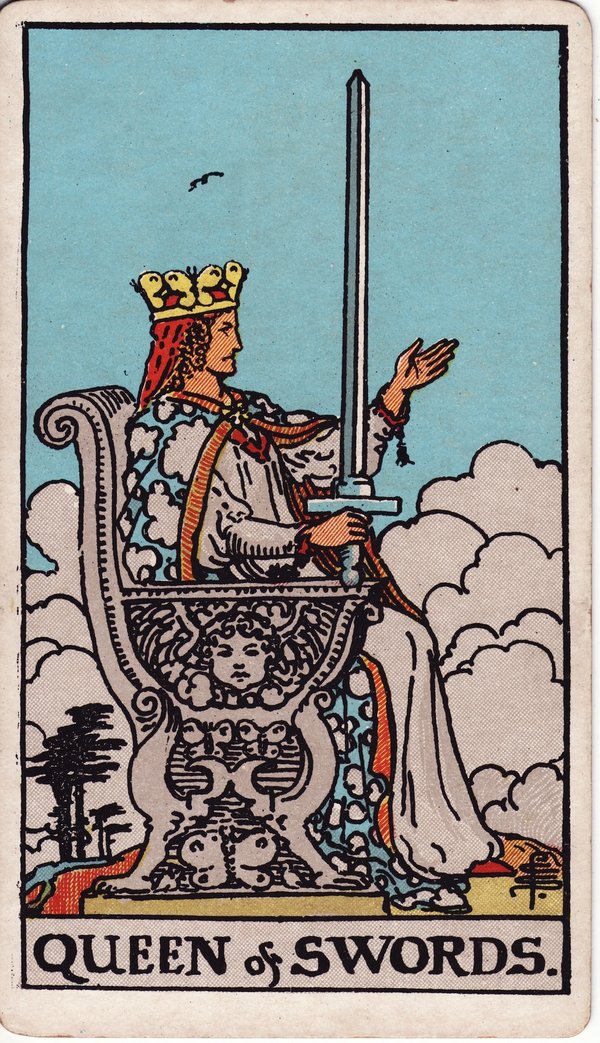
Rider-Waite-Smith (1909): The Queen sits on a stone throne, elevated above the landscape. She holds a sword upright in her right hand — the hand of action, of conscious will. Her left hand is extended, palm open — a gesture of reception, of welcome, of the Water dimension that tempers her Air. Her expression is serious but not cold; she is assessing, not judging.
Butterflies and birds adorn her throne and crown — winged creatures that reinforce the Air element. The sky behind her is clear, with soft clouds — not the storm of the Knight's charge but the clarity that follows the storm. The landscape below is distant; she surveys it from a position of remove. She is not detached in the sense of uncaring; she is detached in the sense of perspective. She has stepped back far enough to see the whole picture.
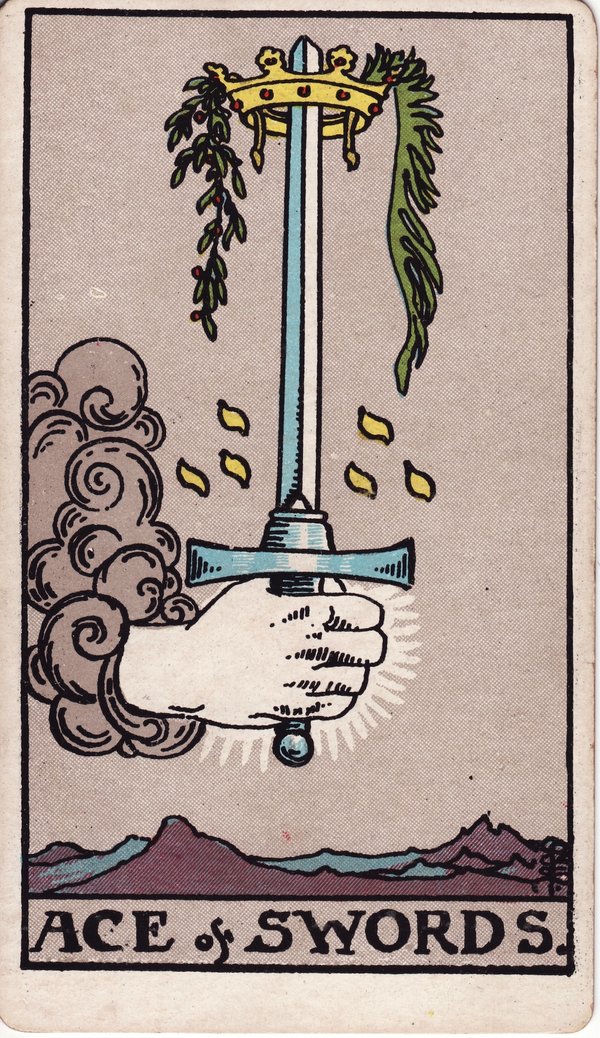
The single upright sword echoes the Ace of Swords — she carries the suit's pure clarity, but now matured through experience. The Ace offered the sword as a gift; the Queen has learned to hold it. Her throne is stone — solid, permanent — suggesting that the wisdom she embodies has been earned, not borrowed.
Thoth (Crowley/Harris, 1944): The Thoth Queen of Swords — Queen of the Thrones of Air — is more dramatic. She holds the severed head of a bearded man in her left hand — an image that has disturbed many readers. In the Thoth system, the severed head represents the liberation of the mind from its attachments and illusions. She is the "Liberator of the Mind" — the one who cuts away false beliefs, outdated identities, and mental constructs that no longer serve. The sword in her right hand is the instrument of this liberation. She does not kill the person; she kills the illusion. The image is shocking, but the intention is freedom.
Representing a Person
As a person: The Queen of Swords is perceptive, honest, and self-possessed. She has often been through significant difficulty — loss, betrayal, grief — and has processed it into wisdom rather than bitterness. She is the friend who tells you the truth you don't want to hear, but tells it with enough clarity that you can receive it. She has strong boundaries — not walls, but fences with gates she controls. She is independent without being isolated, articulate without being aggressive, and kind without being sentimental. Her shadow is the Queen who has not healed: the bitter, cutting, cold version whose honesty is actually cruelty and whose independence is actually fear of connection.
As a mode of being: The querent embodying the Queen of Swords is being asked to bring clarity to their situation without losing compassion. Speak the truth. Set the boundary. Make the decision with your head and your heart together. You do not need to be liked to be effective. You do not need to soften what is true. But you must also remember that the truth, to be received, must be delivered with awareness of the person receiving it.
Astrological personality traits: Water of Air, expressed through Virgo III and Libra I–II, gives the Queen analytical precision (Virgo) softened by diplomatic grace and a deep concern for fairness (Libra). She notices everything — Virgo's detail-orientation — and weighs it carefully — Libra's balance. Her Water dimension gives her emotional perception: she knows what others are feeling, often before they do. She can be critical (Virgo's shadow) or indecisive (Libra's shadow), but in her integrated form, she is the most discerning and articulate figure in the deck.
Thoth court name difference: The Thoth system retains "Queen" — but as "Queen of the Thrones of Air," emphasizing her sovereignty over the realm of thought. Her elemental signature is Water of Air: the emotional depth that makes her truth-telling wise rather than merely accurate.
Advising For / Advising Against
-
If advising FOR: Speak. The truth you have been holding needs to be said — not shouted, not weaponized, but spoken with the clarity you have earned through experience. Set the boundary you have been avoiding. Trust your perception — you see this situation more clearly than you think. You do not need anyone's permission to tell the truth, and you do not need to be liked to be right. The Queen of Swords counsels honesty delivered with awareness of its impact — the blade that heals rather than wounds.
-
If advising AGAINST: You have let your clarity become coldness, your independence become isolation, your honesty become cruelty. The truth you are speaking may be accurate, but it is not kind — and the unkind truth, however accurate, damages the speaker as much as the recipient. Ask yourself: is this the Queen of Swords, or is this the Queen without her Water — the mind that has severed itself from the heart? Reconnect. Feel what you have been analyzing. The truth will still be true after you have let yourself feel it.
Card of the Day
Speak clearly today. Say what you mean. If a boundary needs to be set, set it. If a truth needs to be told, tell it with precision and care. You have the perception to see what is really happening and the articulation to communicate it. Trust that. And if someone speaks truth to you today — even if it stings — receive it. The Queen of Swords does not waste her words.
Elemental Dignities Notes
- Strengthened by Fire (Wands): Fire energizes the Queen's clarity into action — the truth-teller becomes the truth-enactor, the boundary-setter becomes the boundary-enforcer. Risk: the fire can tip her precision into aggression.
- Strengthened by Air (Swords): Additional Air sharpens the Queen's perception to a razor's edge — she sees everything, misses nothing. This can be clarifying or exhausting, depending on whether she can put the sword down.
- Weakened by Earth (Pentacles): Earth grounds the Queen in practical concerns — the material world's demands may distract from the intellectual clarity or may provide necessary stability for a mind that lives in the realm of thought.
- Neutral with Water (Cups): The Queen is already Water of Air — additional Water deepens her emotional intelligence but may also flood her clarity with feeling. The balance she maintains between head and heart is delicate; other Water cards can tip it.
Deck-Specific Notes
- If using a Thoth deck: The Queen of the Thrones of Air holds the severed head — the Liberator of the Mind. The image is initiatory: she represents the capacity to cut away what no longer serves, including outdated self-concepts. The emphasis is on liberation through clarity, even when the clarity is shocking.
- If using a Marseille-tradition deck: The Queen of Swords in the Marseille tradition focuses on the sword in her right hand — the hand of conscious logic. The emphasis is on her role as the objective advisor, the one who sees clearly and speaks plainly.
- If using a blended or contemporary deck: The core archetype of the perceptive, articulate truth-teller applies across traditions. Some decks soften her, some intensify her severity. The core meaning persists: the mind that has been deepened by feeling, the truth that is spoken with wisdom.
Journaling & Contemplation Prompts
- What truth have I been withholding — and who needs to hear it, including myself?
- Is my clarity in service of connection or protection? Am I telling the truth to heal or to wound?
- What boundary do I need to set that I have been avoiding?
- How have my wounds made me wiser — and where have they made me harder?
- If I spoke with the Queen's combination of honesty and compassion, what would I say?
Additional Associations
| Association Type | Value |
|---|---|
| Color(s) | Grey (the throne, the color of balanced judgment, neither black nor white); white (the clouds, the clarity of perception); pale blue (Air, the sky of thought); silver (the blade, the moon's reflection — the Queen's Water dimension visible in her Air) |
| Crystals / Stones | Lapis Lazuli (wisdom, truth-speaking, the stone of the Queen who knows and speaks); Sodalite (logic with intuition, the stone of the balanced mind); Amazonite (boundaries, truth, the stone of speaking one's mind with heart) |
| Herbs / Plants | Sage (clarity, purification, the herb of the truth-teller who clears the air); Motherwort (the mother-herb, the plant of the mature woman, boundaries, heart protection); Mugwort (dreams, intuition, the herb that connects the Queen's Water to her Air) |
| Archetypes (Jungian) | The Wise Woman / Crone (the mature feminine, the one who has lived and learned); The Anima (the inner feminine in her integrated form — perceptive, articulate, sovereign); The Wounded Healer who has healed |
| Mythological Figures | Athena (goddess of wisdom, born from Zeus's head — the mind that emerges fully formed, but Athena also weaves, also judges, also protects); The Morrigan (Celtic goddess of sovereignty and battle — the Queen who sees the outcome before the battle begins); Pallas Athena (the aspect of Athena associated with the severed head — the Gorgon on her shield, the truth that petrifies illusion) |
| Playing Card Equivalent | Queen of Spades — in cartomancy, a woman of intelligence and independence, sometimes a widow, often associated with legal matters, boundaries, and clear communication. |
| I Ching Hexagram Parallel | Hexagram 20 — Kuan / Contemplation (View). "Contemplation. The ablution has been made, but not yet the offering. Full of trust they look up to him." The hexagram of the observer who sees clearly from a position of elevated perspective. The Queen of Swords surveys her domain, understands what she sees, and speaks accordingly. |
| Body / Organ Correspondence | The throat (the organ of speech, the Queen's primary instrument — the truth passing from mind to world); the eyes (perception, the organs of the observer); the heart (Water's organ within Air — the Queen feels, and her feeling informs her sight). Virgo governs the digestive system (processing, discernment); Libra governs the kidneys (balance, filtration). |
Shadow & Integration Message
The Queen of Swords' shadow is the Queen who has not healed — whose wounds have become armor, whose clarity has become coldness, whose honesty has become cruelty. This is the Queen who uses her perception to find weakness rather than truth, whose words cut because she has been cut and has not forgiven, whose independence is a fortress built on the ruins of trust that was never rebuilt.
Integration means reclaiming the Water in Water of Air — letting the heart inform the head again, risking the vulnerability that the sword was meant to protect. The integrated Queen of Swords is not armored; she is clear. Her boundaries are gates, not walls. Her truth-telling is an act of love, not of dominance. She has felt her wounds, thought about them, and chosen — consciously — to remain open.
Elemental Intelligence (Suit Framing)
In the Jungian cognitive function mapping, the Queen of Swords is the Thinking function in its most mature, integrated mode — the mind that has been tempered by feeling, the intellect that has learned to serve the heart without being ruled by it. The sanguine humour is here in its most refined expression: the bright, sharp energy of Air channeled through the depth of Water. The Queen belongs to the ruling class — but she rules through wisdom, not force, through perception, not decree.
Timing & Manifestation
For timing, the Queen of Swords suggests a period of weeks to months — the duration of a deliberate process of clarification and truthful communication. In seasonal timing, the Queen rules the period from approximately September 11 through October 20: the transition from Virgo's harvest season through the autumn equinox into Libra's season of balance. Her energy is the energy of autumn clarity — the year's truth-telling before winter's rest.
Yes / No Tendency
The Queen of Swords does not give simple yes/no answers — she gives clarity that enables the querent to decide. When she appears, the question is being refined. In dignified position, the clarity is available and should be acted on once it arrives. In undignified position, the clarity is being resisted or distorted by emotional material that needs to be processed first.
Common Misreads / Nuances to Know
Misread 1: "The Queen of Swords is cold or heartless." The Queen is Water of Air — she feels deeply, but she does not let her feelings override her judgment. Her composure is not numbness; it is emotional discipline. She is not cold; she is clear. The distinction matters enormously.
Misread 2: "The Queen reversed means she's become emotional." Reversed, the Queen more often represents the loss of her Water — the mind that has severed itself from feeling, the truth-teller who has become cruel. Or it represents the Queen's shadow: bitterness, cutting words, isolation disguised as independence.
Misread 3: "The severed head in the Thoth image means violence." The head represents attachments, false beliefs, and outdated self-concepts — not literal killing. The Queen of Swords liberates the mind by cutting away what no longer serves. The image is initiatory, not literal.