The Poetic Line
"The heart bleeds where the truth finally found an opening."
Keywords
| Category | Dignified | Undignified |
|---|---|---|
| General | Heartbreak, emotional pain, sorrow, grief, facing painful truth, necessary release | Wallowing in despair, self-pity, refusing to heal, repressed grief festering, negative self-talk |
| Spiritual | Purification through pain, the dark night that precedes dawn, truth as spiritual surgery | Spiritual despair, crisis of faith, refusing meaning in suffering, bitterness poisoning the sacred |
| Psychological | Facing reality, releasing denial, the grief that integrates loss, emotional honesty | Depression, self-criticism run amok, rumination, refusing to let go, catastrophizing |
| Physical Health | Emotional release supporting physical healing, the body processing grief, heart health awareness | Stress-induced illness, grief manifesting physically, heart conditions, chest pain from carried sorrow |
| Relationships | Necessary ending, honest acknowledgment of pain, grief as part of love, speaking hard truth | Unresolved heartbreak poisoning new connections, wallowing in the story of betrayal, refusing closure |
| Financial | Facing financial losses honestly, cutting emotional attachment to money, the truth about debt | Self-destructive financial behavior from grief, ignoring financial reality, loss spiraling |
| Vocational | Acknowledging career disappointment, learning from failure, honest post-mortem | Carrying workplace wounds into new roles, bitterness about professional setbacks, refusing to move on |
| Shadow / Thoth Distinction | The Lord of Sorrow: Saturn in Libra's gift of honest reckoning — the sorrow that understands what was lost and why, the clarity of grief that knows exactly what it grieves | Saturn's shadow in Libra: the sorrow that becomes identity, the wound that is picked open rather than allowed to heal, grief used as a reason to withdraw from life |
Narrative Description
General Meaning
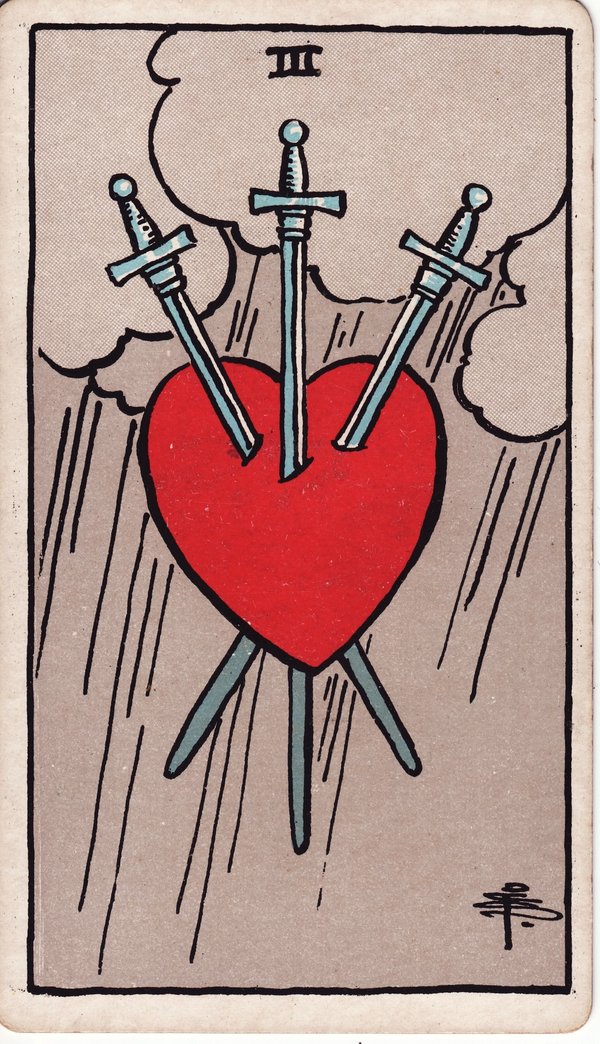
The Three of Swords is one of the most immediately recognized cards in the tarot — and one of the most resisted. A heart floats in a storm-dark sky, pierced by three swords. Rain falls. No softening. No symbolism to decode. The meaning is direct: something has broken your heart, and the pain is real.
When the Three of Swords appears, something has broken open. The pain is specific — grief, betrayal, loss — and it will not be avoided. The Swords suit is the suit of mind and truth, and this is the moment when a painful truth can no longer be denied. The stalemate of the Two has broken — whether by choice or by events — and the result is loss. The three swords trace the triangulation of sorrow: the self, the other, and the wound between them. There is no abstracting this; it must be felt.
But the Three of Swords is not only a card of suffering. It is also a card of honesty. Saturn in Libra brings the cold, clarifying light of reality — not the reality we wish for, but the reality that is. The heart is pierced, but the swords go all the way through. The pain is clean, not infected. There is a strange mercy in this card: the truth, once acknowledged, can be grieved. And grief, unlike denial, has an ending.
Symbolism & Imagery
Rider-Waite-Smith (1909): Against a background of grey storm clouds and slanting rain, a large red heart floats in the air, pierced by three swords. There are no figures, no narrative context — only the heart, the swords, and the weather. The image is iconic in its simplicity. The swords enter at different angles, suggesting that the wound is not singular but compound: multiple truths, multiple losses, multiple betrayals arriving at once.
The rain suggests tears, the release of grief, the washing-clean that follows acknowledgment. The clouds are dark but breaking — the storm is not without end. The heart itself is stylized, almost valentine-like, which paradoxically intensifies the impact: this is not a realistic anatomical heart but a symbol of love, the universal organ of emotional connection, now visibly wounded.
The absence of figures is important. The Three of Swords does not show us who did the piercing or why. It shows only the result. This is grief in its pure, depersonalized form — the experience of sorrow itself, before the story about who is to blame. The message: the pain is here. The question is what you will do with it.
Thoth (Crowley/Harris, 1944): The Thoth Three of Swords — Lord of Sorrow — replaces the pierced heart with three swords intersecting in a dark, geometric configuration. The composition is angular, severe, almost architectural: a structure of grief. Three dark roses appear, symbols of sorrow in the Thoth system. The card is Saturn in Libra rendered visible: the weight of reality (Saturn) pressing on the scales of relationship and balance (Libra). Crowley called it "the dark sea of Binah" — the Great Mother receiving sorrow into form, giving it shape so that it can be understood and eventually released.
The Thoth version is less visceral than the RWS but perhaps more philosophically complete. It insists that sorrow is not random — it has structure, cause, and meaning. It arises where love (the Two's potential) has been given form (the Three's function) and that form has proven to be loss. Understanding — Binah's gift — includes understanding that some things end.
Astrological & Elemental Layer
Saturn in Libra. Saturn is the planet of limits, discipline, time, and hard reality. Libra is the sign of balance, relationship, justice, and harmony. Together, they produce the coldest, most honest assessment of what is real — and what is real, in relationships and in the weighing of life, sometimes includes loss.
The second decan of Libra (approximately October 3 through October 12) is the decan of consequence. The scales have been lifted, the weighing has begun, and the results are beginning to appear. Saturn here refuses sentimentality. If a relationship is over, Saturn in Libra will not let you pretend otherwise. If a situation is untenable, Saturn in Libra will not let you negotiate with the facts. The sorrow is real, but so is the clarity that comes with it.
This is the card's paradox: Saturn wounds, but Saturn also heals. By forcing acknowledgment of what is lost, it makes genuine recovery possible. The Lord of Sorrow is not the Lord of Despair. Sorrow has an object — it knows what it mourns. Despair is formless. Sorrow can be processed; despair consumes.
Kabbalistic / Tree of Life Layer
The Three of Swords sits in Binah — the third Sephirah, Understanding, the Great Mother, the vessel of form. Binah is the first Sephirah on the Pillar of Severity, and all Threes carry her quality: limitation, structure, the giving of boundaries. In the Swords suit, Binah's gift is the understanding that comes only through experiencing limitation — the mind learning that some truths are painful and that this pain is the cost of consciousness.
Binah is also associated with the dark sea, the depths, the place where form dissolves back into potential. The Three of Swords contains this dissolution in its intellectual register: a belief, a relationship, an expectation, an identity — something that had form is dissolving, and the mind must understand why.
For the querent, the Kabbalistic layer suggests: the sorrow you are experiencing is not meaningless. It is Binah's method of teaching. Understanding does not always feel good. Sometimes it feels like a blade. But it is the difference between merely experiencing pain and learning from it. You are being asked to let the truth shape you — to receive the form that sorrow gives, rather than resisting it into permanent suffering.
Sequential Narrative: Position in the Suit Story
The Three of Swords follows the Two of Swords — the stalemate, the suspended decision — and represents the moment when the tension breaks. The blindfold has come off. The choice has been made, or made for you. And it hurts.
The Two protected the heart behind crossed swords. The Three shows the heart unprotected, pierced. This is not a punishment — it is the consequence of the Two's resolution. Something was held in suspension; now it has resolved, and the resolution involves loss. The Ace gave clarity; the Two discovered that clarity is complex; the Three discovers that clarity can wound.
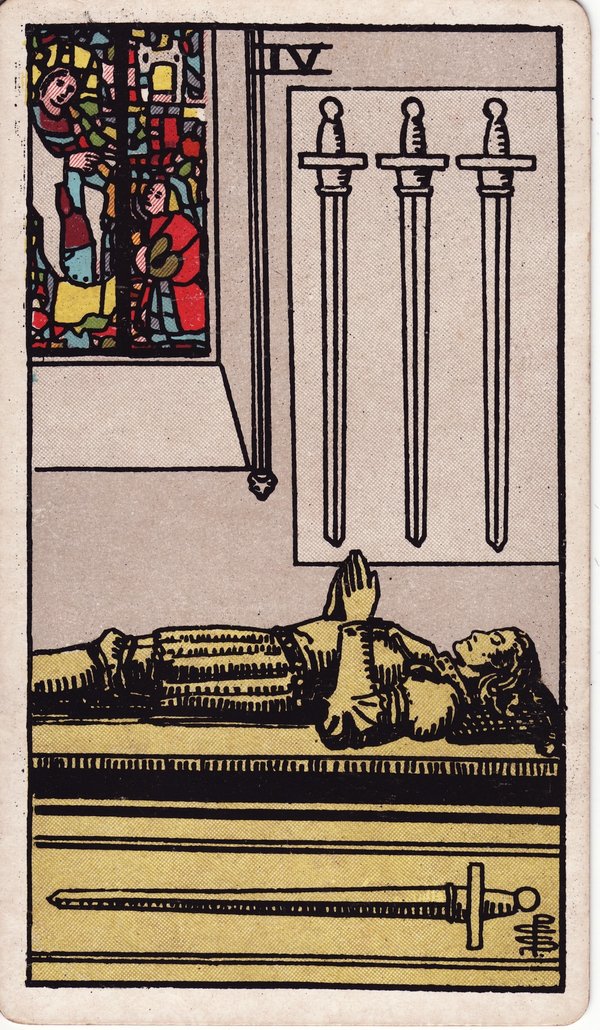
The Three flows into the Four of Swords — the Lord of Truce — where the wounded heart retreats into stillness. The Four is the direct response to the Three: after the storm, rest. After the wound, convalescence. The Three is the acute phase of grief, the moment when the pain is most present. The Four, which follows, is the beginning of recovery — not the end of grief but the first pause within it.
Advising For / Advising Against
-
If advising FOR: Let yourself grieve. The pain you are feeling is not a malfunction — it is the appropriate response to loss. The swords have gone through; pretending they haven't will only drive them deeper. Cry. Speak the truth about what hurts. Saturn in Libra asks for honesty, not stoicism. The sorrow is the price of having loved, and paying it is the only way to be free of the debt.
-
If advising AGAINST: Do not make sorrow your identity. The Three of Swords is a passage, not a destination. If you have been wearing your grief like a coat for longer than the grief itself requires, it is time to consider whether the sorrow has become a way of avoiding life rather than processing it. Saturn in Libra wants you to learn, not to linger. The heart heals. Let it.
Card of the Day
Today, grief may surface. A fresh wound or an old one revisiting. Either way, feel it — don't fix it, don't explain it away, don't pretend it's something more spiritual than what it is. Let the rain fall. The storm will pass. In the meantime, be gentle with yourself and with anyone else carrying a pierced heart. Some days, the only task is to endure.
Elemental Dignities Notes
- Strengthened by Fire (Wands): Fire intensifies the pain but also accelerates the processing. The grief burns through faster. Risk: anger complicating sorrow. Gift: the will to move through the pain rather than freeze in it.
- Strengthened by Air (Swords): Multiple Air cards intellectualize the grief — the mind analyzing the wound rather than feeling it. This can be protective or alienating, depending on the spread's context.
- Weakened by Earth (Pentacles): Earth provides stability that can ground the grief — or bury it. The physical world may demand attention that pulls the querent away from necessary emotional processing.
- Neutral with Water (Cups): Water supports the emotional release. Cups adjacent to the Three of Swords create a flood of feeling — cleansing if the querent is ready, overwhelming if they are not.
Deck-Specific Notes
- If using a Thoth deck: The Lord of Sorrow presents as geometric swords intersecting through dark roses. The emphasis is on the structure of grief — its causes, its meaning, its place in the architecture of consciousness. The Thoth Three is less about personal heartbreak and more about the universal experience of sorrow as a teacher.
- If using a Marseille-tradition deck: The Three of Swords in the Marseille tradition shows a central sword cutting through two curved blades that had previously (in the Two) protected growth. The flower from the Two is destroyed. This emphasizes that the sorrow is the result of a decision or action — not random suffering but the consequence of the Two's resolution.
- If using a blended or contemporary deck: The psychological layer of grief, truth, and necessary pain applies across traditions. Some modern decks soften the RWS image; others intensify it. The core meaning — a painful truth that must be faced — persists.
Journaling & Contemplation Prompts
- What am I grieving that I have not allowed myself to name?
- Is this sorrow teaching me something, or have I made it a home?
- What did I lose — specifically, precisely? What did that loss cost me?
- How does my mind try to protect me from feeling pain, and is that protection helping or hurting?
- If I let this grief move through me completely, what would be on the other side?
Additional Associations
| Association Type | Value |
|---|---|
| Color(s) | Red (the heart, blood, passion, the life that is wounded); grey (storm clouds, the emotional weather of grief); black (Saturn's color, the void of loss) |
| Crystals / Stones | Rose Quartz (heart healing, self-compassion in grief); Obsidian (Saturn's stone, facing hard truth, protective grounding during emotional excavation); Malachite (heart chakra, transformation through facing pain) |
| Herbs / Plants | Hawthorn (heart medicine, the herb of heartbreak and heart healing in traditional herbalism); Bleeding Heart (symbolic — grief that is visible, acknowledged); Yarrow (wound-healing, the herb of the wounded warrior) |
| Archetypes (Jungian) | The Wounded Healer (Chiron — the one who heals others from the depth of their own wounds); The Mourner; The Truth-Teller Who Pays for the Truth |
| Mythological Figures | Inanna's descent (the goddess who is stripped of her powers, killed, and hung on a hook — and who returns, transformed); The Pierced Christ / Sacred Heart (the wound that redeems); Cassandra (the truth-teller whose truth is not believed — a different kind of Three of Swords sorrow) |
| Numerological Resonance | 3 = the first form, the result of the union of 1 and 2. In Swords, 3 is the truth that emerges from the stalemate — and the truth, here, is loss. But form also means: this has shape, this has boundaries, this will not last forever. |
| Playing Card Equivalent | Three of Spades — in cartomancy, heartbreak, sorrow, a separation. Sometimes: tears, a letter bearing bad news. |
| I Ching Hexagram Parallel | Hexagram 39 — Chien / Obstruction. "Obstruction. The southwest furthers. The northeast does not further. It furthers to see the great man." The hexagram of the blocked path — difficulty that must be acknowledged and navigated, not denied. The obstruction is real, but it directs the traveler toward the right turning. |
| Body / Organ Correspondence | Heart (the physical organ, the seat of emotional life in traditional medicine); chest and ribcage (the protective cage that is pierced); the vagus nerve (the nerve of grief — the physical pathway of heartbreak through the body). Saturn governs the bones and the structural limits of the body. |
Shadow & Integration Message
The Three of Swords' shadow is not simply grief — it is the addiction to grief. Saturn in Libra can become a grim satisfaction in being the one who was wronged, the one who suffers, the one whose pain proves their righteousness. This is the shadow of the Three: sorrow that has outlasted its cause, grief that has become a shelter from the risks of loving again.
Integration of the Three's energy means grieving fully — and then stopping. It means letting the swords do their work of piercing through denial, feeling the pain honestly, and then removing the swords when the work is done. The integrated Three of Swords is the person who can say, "This hurt me deeply. I have felt it. And now I am ready to feel something else."
Elemental Intelligence (Suit Framing)
In the Jungian cognitive function mapping, the Three of Swords is the Thinking function confronting the limits of its own power. The mind has analyzed, weighed, deliberated — and the conclusion is loss. The sanguine humour is darkened here: the natural optimism of Air meets the gravity of Saturn and discovers that some truths are simply hard. This is the intellectual's grief — the sorrow of one who thought that understanding would protect them from pain and has learned otherwise.
Timing & Manifestation
For timing in a reading, the Three of Swords suggests a period of acute grief — days to weeks, Saturn's slow transit through the awareness. The second decan of Libra corresponds approximately to October 3 through October 12. The event is already present; the question is not when it will arrive but how long it will take to process. Saturn does not rush; neither should the querent.
Yes / No Tendency
The Three of Swords leans toward no — the painful truth is that what you hope for is not what is happening. But this "no" is clarifying rather than defeating. In dignified position, the no brings honesty and the possibility of a cleaner yes elsewhere. In undignified position, the no is being resisted — the querent is refusing to accept what has already happened.
Common Misreads / Nuances to Know
Misread 1: "The Three of Swords always means romantic heartbreak." The pierced heart can represent any form of loss — the death of a dream, the end of a friendship, the collapse of a belief system, the grief of leaving a home or a vocation. The heart in the image is symbolic, not literal.
Misread 2: "This card means someone is going to hurt you." The Three of Swords often describes a pain already present — something the querent already knows but hasn't fully acknowledged. It is less a prediction of future wounding than a mirror held to existing grief.
Misread 3: "The Three of Swords reversed means you're healing." Reversed, the Three often indicates repressed grief — pain that has gone underground and is causing damage from the shadows. Healing requires the sword to be upright: the wound must be faced before it can close.