The Poetic Line
"He rides into the gale, blade raised, chasing a horizon that may not exist — but that is not the point."
Keywords
| Category | Dignified | Undignified |
|---|---|---|
| General | Action-oriented intellect, fast thinking, decisive communication, intellectual courage, charging toward truth | Recklessness, impulsivity, scattered energy, intellectual arrogance, charging without aim, burnout |
| Spiritual | Spiritual warrior, the quest for truth as sacred, intellectual devotion, fighting for principle | Spiritual fanaticism, crusader mentality, the believer who charges without listening, ideological rigidity |
| Psychological | Mental drive, clarity in action, the mind that moves, intellectual confidence, cutting through confusion | Impulsive thinking, the mind that cannot rest, intellectual aggression, defensive intellectualizing, anxiety-driven action |
| Physical Health | Mental energy supporting physical action, the fighting spirit, recovery through active engagement | Burnout, exhaustion from mental overdrive, accidents from rushing, the body paying for the mind's impatience |
| Relationships | Direct communication, intellectual connection, the partner who says what they mean, passionate debate | Picking fights, cutting words, rushing into and out of relationships, the partner who argues more than they love |
| Financial | Decisive financial action, quick assessment of opportunities, the bold investor, cutting losses swiftly | Impulsive spending, financial recklessness, gambling, the investment made without due diligence |
| Vocational | The driven professional, the innovator who charges ahead, intellectual leadership, the quick study | The bull in the china shop, the colleague who doesn't listen, career burnout, starting projects that aren't finished |
| Shadow / Thoth Distinction | The Prince of the Chariot of the Winds: Air of Air as the mind's capacity for pure, rapid, penetrating thought — the intellect as a vehicle drawn by the winds themselves, the genius that moves faster than others can follow | The Chariot that crashes: the mind that moves so fast it cannot steer, the brilliance that burns itself out, the intellectual who charges at windmills and calls it heroism |
Narrative Description
General Meaning
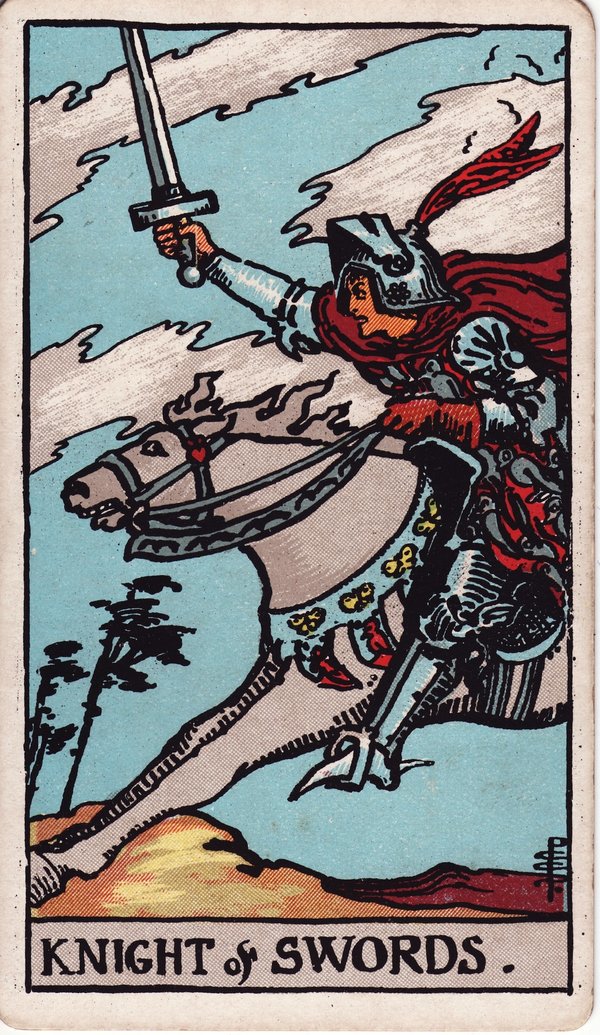
The Knight of Swords is the card of intellectual action — the mind in full charge, the truth-seeker who does not merely contemplate but rides into the field. This is the energy of the decisive thinker, the fast-talking advocate, the investigator who follows the evidence wherever it leads, the communicator who speaks the hard truth without hesitation. In the RWS image, the knight charges forward on a powerful horse, sword raised, cape streaming behind, utterly committed to forward motion.
In a reading, the Knight of Swords signals a time for decisive intellectual action — speaking up, making the argument, charging toward the truth. It can represent a person with this energy, or the querent being called to embody it. The Knight's gift is speed, clarity, and courage: the willingness to say what needs to be said, to ask the question others avoid, to move when others hesitate.
But the Knight is also the most volatile of the Swords court. Air of Air is inherently unstable — a hurricane of intellect that can destroy as easily as it can illuminate. The Knight in shadow is the one who charges without thinking, speaks without listening, cuts without caring what he cuts. The speed that is his gift is also his danger: he can arrive at the wrong conclusion faster than anyone else and defend it with terrifying conviction.
Symbolism & Imagery
Rider-Waite-Smith (1909): A knight in full armor rides a powerful white horse at full gallop. His sword is raised — not held at rest but actively brandished, a weapon in motion. His cape streams behind him, caught by the wind of his own speed. The horse's mane and tail are wild — this is a charge, not a parade. The sky behind him is turbulent with clouds, and birds scatter in his wake. The landscape is rushing past; he is focused entirely forward, on whatever lies ahead.
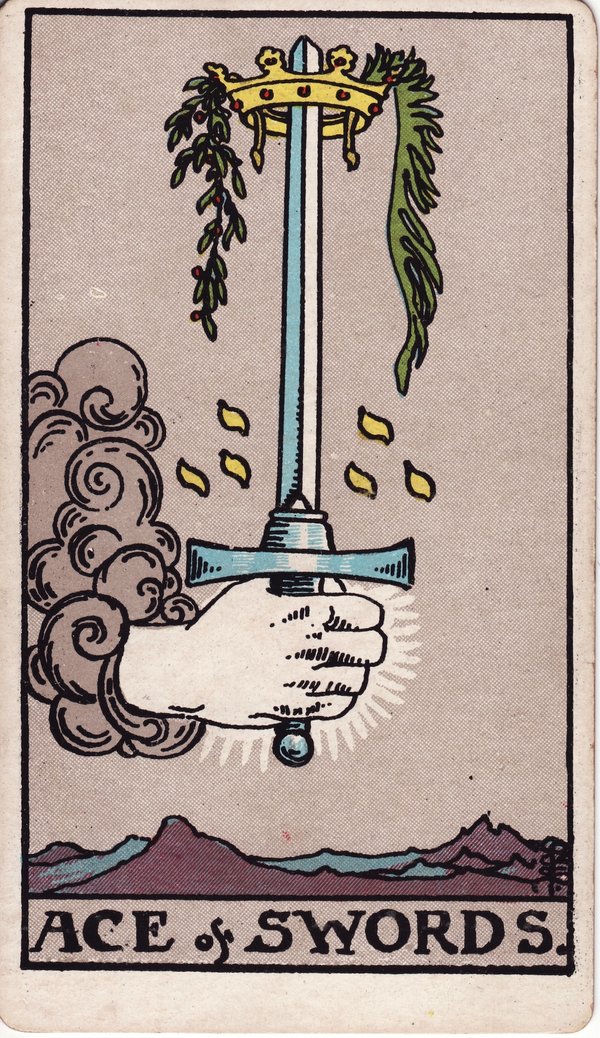
The white horse represents the purity of the intellectual impulse — the mind, when it is clear and undivided, moves with tremendous power. The raised sword is the Ace of Swords in action — truth wielded, not merely received. The streaming cape and scattered birds suggest the disruption the Knight leaves in his wake: he moves fast, and not everything survives his passage.
The figure is almost entirely forward-directed. He does not look back. He does not look to the side. This is the Knight's strength (focus, determination, the willingness to commit) and his weakness (the refusal to reconsider, to listen, to notice what is being trampled).
Thoth (Crowley/Harris, 1944): The Thoth Prince of Swords — Prince of the Chariot of the Winds — rides a chariot drawn by winged children who pull in different directions. The image captures the paradox of Air of Air: pure intellectual energy is powerful but directionless. The mind can go anywhere, which means it can end up nowhere. The children who draw the chariot are unreined — the Prince's intellect is brilliant but lacks the discipline to steer. The Book of Thoth describes him as "a perfect picture of the Mind" — and the mind, ungoverned, is both the greatest instrument and the most dangerous weapon.
Representing a Person
As a person: The Knight of Swords is intellectually intense, articulate, and driven. This person speaks quickly, thinks faster, and has little patience for those who cannot keep up. They are often found in professions that reward quick thinking and decisive communication — law, journalism, emergency response, entrepreneurship, academic debate. Their gift is intellectual courage; their shadow is intellectual aggression. They may be inspiring or exhausting, depending on whether you are ready for the speed.
As a mode of being: The querent embodying the Knight of Swords is being asked to act on their intellectual convictions — to speak, to decide, to charge. But they are also being warned: speed without direction is chaos. The charge must have a target. The sword must have a purpose. Before riding out, know what you are riding toward — and what you are willing to trample to get there.
Astrological personality traits: Air of Air, expressed through Capricorn III and Aquarius I–II, gives the Knight a unique blend of structuring ambition (Capricorn's final decan) and innovative intellectual force (Aquarius). This person is capable of building intellectual systems (Capricorn) and revolutionizing them (Aquarius). They are visionaries with follow-through — when they can stay focused. The Aquarian detachment combined with Capricornian practicality makes them formidable, but the Air-of-Air volatility can undermine their staying power.
Thoth court name difference: In the Thoth system, the Knight of Swords becomes the Prince of the Chariot of the Winds — Air of Air. The shift from "Knight" to "Prince" emphasizes his role as the son, the active questing force, rather than the king/father. The chariot imagery reinforces the theme of the mind as a vehicle — powerful, fast, and requiring a skilled driver.
Advising For / Advising Against
-
If advising FOR: Charge. The time for deliberation is over. You know enough. The truth you need to speak, the action you need to take, the argument you need to make — now is the moment. Do not wait for perfect certainty; it will not come. The Knight of Swords succeeds through decisive motion. Trust your intellectual instincts. Ride.
-
If advising AGAINST: Slow down. You are moving too fast to see what you are charging toward — or what you are leaving in your wake. The sword raised in conviction may be a weapon rather than a tool. Before you speak, listen. Before you act, verify. The Knight's shadow is the charge that ends in a cliff. Brake. Breathe. Aim.
Card of the Day
You may feel the urge to act decisively today — to say the thing, make the decision, charge ahead. Honor that impulse if it is aimed at something worthy. But also ask: am I charging toward something, or just charging? The Knight's energy is powerful but needs direction. Before you ride, pick your target.
Elemental Dignities Notes
- Strengthened by Fire (Wands): Fire feeds Air — the charge becomes a crusade, the intellectual conviction gains passion and will. This is a powerful combination for action, but the risk of burnout is high.
- Strengthened by Air (Swords): Additional Air accelerates the Knight — the mind moves even faster, the thoughts multiply. Risk: the chariot loses all steering. Gift: intellectual synergy, the meeting of minds that produces breakthrough.
- Weakened by Earth (Pentacles): Earth slows the Knight — the practical constraints, the material realities, the body's limits. This can be frustrating (the charge blocked) or saving (the cliff avoided).
- Neutral with Water (Cups): Water introduces emotion to the Knight's pure intellect — the charge gains heart or loses clarity, depending on the emotional material. The Knight who can feel as well as think is a more complete, less dangerous figure.
Deck-Specific Notes
- If using a Thoth deck: The Prince of the Chariot of the Winds rides a chariot drawn by unreined children. The emphasis is on the instability of pure intellect — the brilliance that lacks direction, the mind that can go anywhere and therefore risks going nowhere. The chariot is the vehicle of the soul; the children are the ungoverned thoughts that pull it.
- If using a Marseille-tradition deck: The Knight of Swords in the Marseille tradition is perhaps the most confident of the Marseille knights — prancing horse, battle-ready posture. The emphasis is on intellectual confidence bordering on arrogance: the knight who knows he is the smartest person in the room.
- If using a blended or contemporary deck: The core archetype of the intellectual warrior applies across traditions. Some decks emphasize the heroism of the charge; others emphasize its danger. The core meaning persists: the mind in decisive, rapid motion.
Journaling & Contemplation Prompts
- What am I charging toward — and what am I charging away from?
- When I speak quickly and decisively, am I illuminating or dominating?
- What would I notice if I slowed down — about the situation, about myself, about the people I am riding past?
- Is my intellectual speed a gift or a defense? What would happen if I let myself think slowly?
- If my mind is a chariot, who — or what — is holding the reins?
Additional Associations
| Association Type | Value |
|---|---|
| Color(s) | White (the horse, purity of intention, the clear mind); silver-grey (the armor, the blade, the intellectual sheen); storm-blue (the sky of the charge, the atmosphere of the mind in motion) |
| Crystals / Stones | Clear Quartz (amplification of mental energy, the stone of the focused charge); Labradorite (the stone of the adventurer, intellectual magic, the mind that sees what others don't); Hematite (grounding for the ungrounded mind, the stone that slows the charge enough to steer) |
| Herbs / Plants | Peppermint (mental alertness, the herb of the quick mind, the charge of clarity); Yerba Mate (sustained mental energy, the herb of the focused warrior); Rosemary (memory and mental sharpness, the herb of the mind that remembers its aim) |
| Archetypes (Jungian) | The Warrior (in his intellectual form — the knight who fights with words and ideas); The Hero on the Quest (the monomyth's active phase); The Puer Aeternus (the eternal youth who charges but never arrives — shadow form) |
| Mythological Figures | Perseus (the hero who rides — but with winged sandals, not a chariot — to slay Medusa, the Knight who uses intellect and speed to defeat what cannot be faced directly); Bellerophon on Pegasus (the hero who rides the winged horse — and whose hubris eventually throws him); Don Quixote (the knight who charges at windmills — the shadow of the Knight of Swords, the charge without a real target) |
| Playing Card Equivalent | Knight of Spades — in cartomancy, a fast-moving young man, a sudden departure, a conflict or argument that changes things quickly. |
| I Ching Hexagram Parallel | Hexagram 34 — Ta Chuang / The Power of the Great. "The Power of the Great. Perseverance furthers." The hexagram of great strength in motion — the powerful charge that must be guided by clarity of purpose. Strength without direction becomes destruction. |
| Body / Organ Correspondence | The legs (the charge, the part that propels the knight forward); the voice (the instrument of the charge — the words that are spoken quickly and decisively); the adrenal glands (the fight response, the body charging alongside the mind) |
Shadow & Integration Message
The Knight of Swords' shadow is the charge without a target — the intellectual energy that has become compulsive, the mind that must always be moving and has forgotten why. This is the Knight who rides because stopping would mean facing what the speed is protecting against: the fear that the charge has no purpose, that the certainty is a performance, that the truth being defended is not as clear as the defense suggests.
Integration means learning to aim. The Knight's speed is a gift, but only when it has a destination. The integrated Knight of Swords is the one who can charge decisively when the situation calls for it — and who can also stop, dismount, and think. The sword can be lowered. The horse can rest. The mind can be still. And when stillness is no longer needed, the charge can resume — this time with a target worth reaching.
Elemental Intelligence (Suit Framing)
In the Jungian cognitive function mapping, the Knight of Swords is the Thinking function in its most active, extroverted mode — the mind that does not merely analyze but acts, the intellect that rides into the world and engages with it directly. The sanguine humour is here at its most aggressive: the bright, sharp, fast-moving energy of Air that can cut through fog or cut down opponents. The Knight belongs to the warrior class — but a warrior of the mind, whose weapons are words and ideas, whose battles are arguments and investigations.
Timing & Manifestation
For timing, the Knight of Swords signals rapid development — days, not weeks. The event moves quickly once it begins. The Knight does not linger. In seasonal timing, the Knight rules the period from approximately January 11 through February 20: the depth of winter giving way to the first stirrings of spring, the cold clarity of Aquarius riding toward the thaw.
Yes / No Tendency
The Knight of Swords leans toward yes, and quickly — action is favored, decisiveness is rewarded, the charge will reach its target. But the yes comes with a qualifier: speed without aim is chaos. In dignified position, the yes is decisive and effective. In undignified position, the yes is impulsive — the charge that overshoots or crashes.
Common Misreads / Nuances to Know
Misread 1: "The Knight of Swords is always angry or aggressive." The Knight's intensity can read as anger, but his primary energy is intellectual drive, not emotional rage. He is charging toward truth, not toward a fight — though his speed may start one.
Misread 2: "Charge ahead no matter what." The Knight charges with purpose, not recklessly. The raised sword has a target. The advice is to act decisively, not to act blindly.
Misread 3: "The Knight reversed means failure." Reversed, the Knight more often indicates scattered energy or a charge in the wrong direction — not failure but misdirection. The speed is still there; it just needs to be aimed.