The Poetic Line
"The dark has its own kind of seeing — and it does not ask for light."
Keywords
| Category | Dignified | Undignified |
|---|---|---|
| General | Intuition, dreams, the subconscious, mystery, navigating uncertainty, trusting hidden knowing | Illusion, fear, deception, confusion, paranoia, losing touch with reality, being lost in the dark |
| Spiritual | Deep initiation, the dark night of the soul, shamanic journey, facing the shadow, the mystery that cannot be spoken | Spiritual bypassing, mistaking delusion for vision, cult-like thinking, rejecting the rational entirely, drowning in the unconscious |
| Psychological | Accessing the subconscious, dreamwork, integration of shadow material, trusting intuition over logic, navigating anxiety with awareness | Hysteria, projection, psychosis, unexamined fears running the show, the return of the repressed as nightmare, paranoia |
| Physical Health | The body speaking through symptoms, psychosomatic wisdom, attention to sleep and dreams, cyclical awareness, lunar rhythm alignment | Hypochondria, illness rooted in unprocessed emotion, sleep disorders, the body screaming unheard messages, chronic fatigue from emotional burden |
| Relationships | Deep emotional intimacy, unspoken understanding, navigating uncertainty together, trusting the bond through difficult passages | Projection onto partner, jealousy without basis, emotional manipulation, seeing what you fear rather than what is there, secrets and deception |
| Financial | Intuitive financial decisions, patience through uncertainty, seeing hidden opportunities, trusting the process during a foggy period | Financial deception, hidden debts, anxiety-driven decisions, being conned, confusion about money, not seeing clearly what you owe or are owed |
| Vocational | Creative work sourced from the unconscious, navigating office politics with intuition, trusting a career path that doesn't make logical sense yet | Workplace deception, hidden agendas, confusion about role, being gaslit, career fog without clarity, creative block tied to unprocessed material |
| Shadow / Thoth Distinction | Anubis the Guide — the jackal god who leads souls through the underworld; Khephra the scarab bearing the sun through night; the dark wisdom of the depths; facing the abyss and returning | The "dreadful madness of pernicious drugs" (Crowley); the venom of the Moon that abolishes the mind; getting lost in the shadow, unable to return; the crayfish eaten by its own depths |
Narrative Description
General Meaning
The Moon is the card of the threshold — the boundary between the conscious and unconscious, between the known and the unknown, between what you can name and what names you from the deep. It is the most psychologically sophisticated card in the deck, and it is also the one most likely to be misread as simply "bad." The Moon is not bad. It is deep. It is the place where fear lives, but also where vision is born.
In a reading, The Moon signals that the querent is in a period of uncertainty, where the usual maps don't work and the usual lights don't reach. Things are not what they seem. Information is incomplete or distorted. The rational mind, which navigates by daylight, is of limited use here. What is needed is a different kind of knowing — the intuition that sees in the dark, the animal intelligence that feels its way forward when the path is hidden.
The emotional register of The Moon is disorientation. Not the sharp shock of the Tower — something murkier, more diffuse. The sense that something is wrong but you can't quite name it. The dream you can't remember but that leaves a residue of dread. The feeling of being watched by something you can't see. This is not paranoia — or not necessarily. It is the psyche's way of signaling that there is material in the unconscious that needs attention, that there are depths that have not been sounded, that the surface of things is not the whole truth.
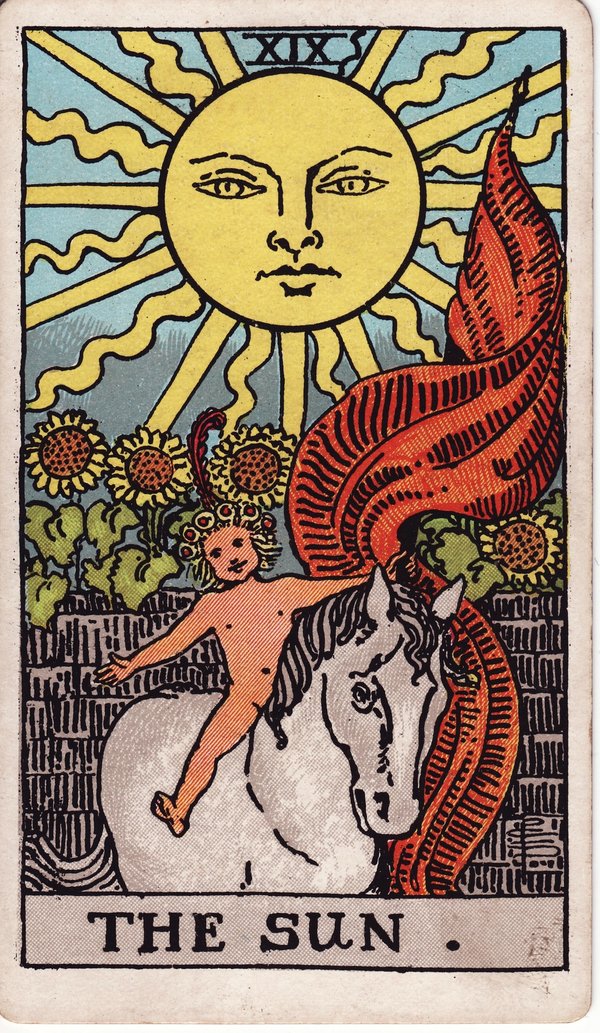
In the Fool's Journey, The Moon comes after The Star. The Star offered hope and renewal after the Tower's destruction. Now, with hope restored, the Fool must descend into the underworld — not as a punishment but as the next necessary stage. You cannot reach the Sun (19) without passing through the Moon (18). You cannot have the clarity of full consciousness without first traversing the territory of the unconscious. The Moon is the initiation that precedes illumination.
Symbolism & Imagery
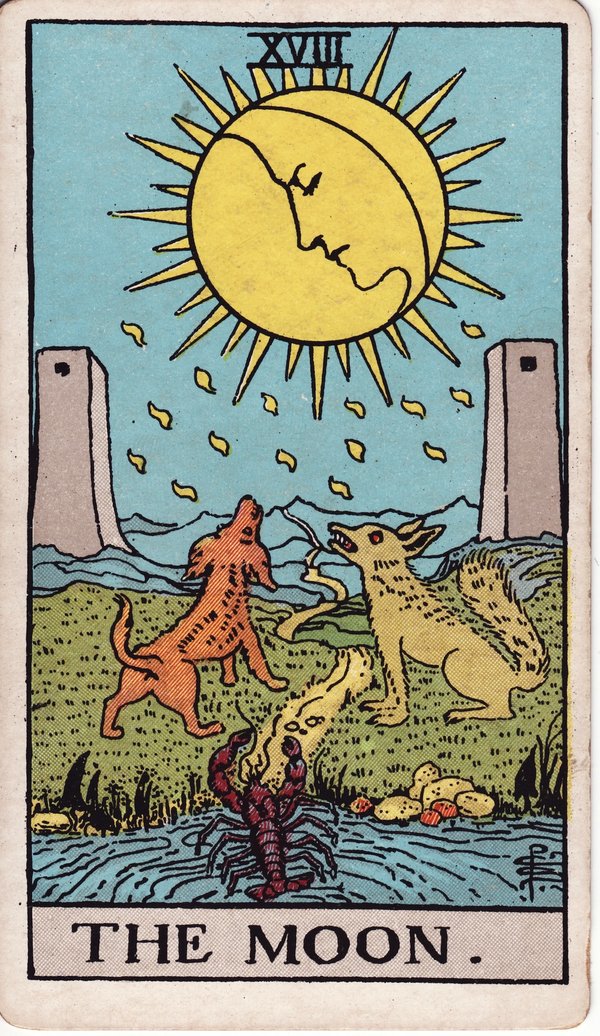
Rider-Waite-Smith (1909): Pamela Colman Smith's Moon depicts a full moon suspended between two towers, its face somber and half-veiled. A winding path leads from a pool of water in the foreground, disappearing into distant mountains. The path is the uncertain journey — it leads somewhere, but you cannot see where from here.
In the pool, a crayfish or lobster emerges — the most primitive creature in the deck, representing the earliest stirrings of consciousness from the unconscious depths. The crayfish is the reptilian brain, the survival instinct, the part of the psyche that predates language and logic. It is the thing that knows danger before you know why you know. Above the pool, a dog and a wolf howl at the moon — the domesticated and the wild, the tamed mind and the feral mind, both raising their voices to the same mystery. The dog is what you've trained. The wolf is what you can't control. Both are you.
The two towers flanking the path represent the forces between which the querent must navigate — good and evil? Conscious and unconscious? Past and future? Their similarity makes them hard to distinguish, and that is the point. In moonlight, opposites blur. The path between them is the narrow way through ambiguity, and the only reliable guide is the light overhead — partial, changeable, but real.
Thoth (Crowley/Harris, 1944): The Thoth Moon is darker, stranger, and more explicitly about the journey through the underworld. The central feature is a dark moon casting an eerie light over a landscape of shadow. At the bottom, the sacred scarab beetle Khephra bears the solar disk in its mandibles — the sun being carried through the darkness of night, the promise that light will return. Khephra is the Egyptian god of the morning sun, the one who rolls the solar disk across the sky, and in the Moon card he represents the seed of solar consciousness that survives even in the deepest darkness.
Anubis, the jackal-headed god, stands in double form between the Ways — the watcher at the threshold, the guide of souls through the underworld. Anubis is not a threat; he is a psychopomp, a companion through the death-rebirth process. The Thoth Moon explicitly frames the journey as initiatory: you are not lost, you are being led. The towers in the Thoth version become gateways — the pillars of the temple, the pylons of the Egyptian underworld.
Crowley wrote that this card represents "the darkest hour before the dawn" and warns of "the dreadful madness of pernicious drugs" — the Moon's shadow as the dissolution of the rational mind without the container of initiation. But the card also contains the seed of redemption: the beetle's solar disk, the jackal's guidance, the path that, however winding, leads somewhere real.
The key difference: RWS emphasizes the uncertainty — the murky journey through the fog. Thoth emphasizes the initiation — the necessary descent that transforms. Both are correct, and both are terrifying in their own way.
Astrological & Elemental Layer
The Moon is Pisces — the twelfth and final sign of the zodiac, the sign of the fish, the boundless ocean of spirit. Pisces is Mutable Water: it has no fixed form, no shore, no bottom. It is the mystic, the artist, the dreamer, the escapist, the addict, the saint. The Moon's Piscean energy dissolves boundaries — between self and other, between reality and imagination, between conscious and unconscious. This dissolution can be ecstatic or terrifying, depending on context and preparation.
In the RWS/Golden Dawn tradition, Pisces is ruled by Jupiter (the expansive, the spiritual, the benevolent) and Neptune (the illusory, the transcendent, the deceiving). The Jupiter side of Pisces gives the Moon's journey a quality of meaning — there is something to be learned in the depths. The Neptunian side gives the fog, the confusion, the potential for self-deception. The Moon asks: can you navigate a realm where the usual coordinates don't hold?
In the Thoth system, the card carries the specific decan of Moon in Scorpio — a double dose of lunar energy in the sign of death, transformation, and the depths. Scorpio is Fixed Water: it goes deep and stays there, probing, uncovering, refusing to look away. The combination of Pisces (the boundless ocean) and Scorpio (the deep diver) makes the Thoth Moon one of the most psychologically penetrating cards in the deck.
Kabbalistic / Tree of Life Layer
On the Tree of Life, The Moon occupies Path 29, connecting Netzach (Victory, the seventh Sephirah, the sphere of emotion and creative instinct) to Malkuth (Kingdom, the tenth Sephirah, the material world). This is the longest single path on the Tree, and it is the channel through which the entire structure of the upper Sephiroth pours into physical reality. Everything that exists in Malkuth — every body, every object, every relationship — has passed through this path.
The Hebrew letter Qoph (ק) means "Back of the Head." It is the letter of what is behind you, what you cannot see directly, what you know only by feeling. In the Sepher Yetzirah, Path 29 is called the "Corporeal Intelligence" — the consciousness that gives form to the formless, that clothes spirit in matter. But the clothing is inevitably a veiling. The pure light of the upper spheres, passing through the Moon's path, becomes distorted, partial, dreamlike. This is why the material world is both a revelation and a concealment — it shows you something of the divine, but never the whole thing.
For the querent, the Kabbalistic layer suggests: your confusion, your fear, your sense of being lost in the fog — this is not failure. It is the natural condition of incarnation. Spirit entering matter is inherently disorienting. The work is not to eliminate the fog but to learn to navigate within it. The path exists. Qoph is the part of you that knows the way even when your eyes can't see it.
Archetypal & Life-Stage Themes
The Moon embodies archetypes of the descent, the hidden feminine, and the confrontation with shadow:
The Dark Night of the Soul: The mystical tradition of the via negativa — the journey through spiritual desolation that precedes union. The Moon is the felt absence of the divine that is actually a deeper form of its presence. The querent who sits in the Moon's darkness is not abandoned; they are being prepared.
Hecate / The Crone: The Moon is associated with the dark aspect of the triple goddess — Hecate, the goddess of crossroads, witchcraft, and the night. She carries torches to light the way through the underworld, and she is accompanied by dogs (the howling hound on the RWS card). Hecate is not evil; she is the guide at the threshold, the one who knows the way through when all other guides have turned back.
The Shadow (Jungian): The Moon is the card of the personal and collective unconscious — the repository of everything the ego has repressed, denied, or never known. The creatures in the card (crayfish, dog, wolf) are shadow figures: primitive, instinctual, and powerful. The Moon's work is to meet these figures without being consumed by them. To integrate the shadow without becoming it.
Anubis / The Psychopomp: In the Thoth deck especially, the Moon is the initiatory journey through the underworld, guided by Anubis — the jackal god who weighs the heart, who leads the dead to judgment, who knows the paths through the darkness. The Moon in this frame is not chaos; it is a passage with a guide.
In the Fool's Journey, the Moon is the descent into the underworld — the katabasis, the journey to the land of the dead. It corresponds to the "Approach to the Inmost Cave" in the monomyth: the hero enters the territory of the shadow, where the rules of the ordinary world no longer apply, and must find a way through with only intuition as guide.
Advising For / Advising Against
-
If advising FOR: Go into the dark. The dreams you are having, the fears that are surfacing, the intuitions that don't make rational sense — pay attention. This is not a time for decisive action based on incomplete information. It is a time for listening, feeling, waiting. Trust the animal intelligence of your body. Trust the images that arise in the in-between states. The path is there, even if you can't see it. Qoph knows the way. Let yourself be led.
-
If advising AGAINST: Do not make major decisions in the fog. Do not trust appearances — yours or anyone else's. What looks like truth in moonlight may be a trick of shadow. Do not confuse your fear with intuition, your projection with perception. If you are drawn to substances, escapism, or spiritual experiences that bypass the rational entirely — pause. The Moon can become the "dreadful madness" Crowley warned of if you enter it without a container. Get grounded before you go deep.
Card of the Day
Today, the veil is thin. Your dreams may leak into waking life. Fear may rise — not as a warning about the present, but as an echo of something old. Do not try to logic your way out of it. Instead, ask: what is this fear trying to show me? The Moon does not ask you to solve anything today. It asks you to witness.
Card of the Year
A Moon year — calculated as personal year 18 — is a year of descent. This is not a year of outward achievement but of inward journeying. The themes: facing fears, working with dreams, navigating uncertainty, developing intuitive faculties. The Moon year can feel disorienting — as though the ground keeps shifting — but it is also deeply creative. Artists, writers, and mystics often produce their most powerful work in Moon years. The challenge is to stay grounded while going deep. Practices that help: dream journaling, therapy, shadow work, ritual, any modality that gives form to the formless. By year's end, you will know your own depths in a way you didn't before. The light of year 19 — The Sun — will be earned, not given.
Elemental Dignities Notes
The Moon is Water — the element of emotion, intuition, the subconscious, and the flow of feeling. In a spread, its elemental relationship to neighboring cards follows the Golden Dawn system:
- Strengthened by Earth (Pentacles): Earth supports Water — ground stabilizes fluid, practical awareness contains emotional overwhelm. A Moon adjacent to Pentacles represents emotional material that is being grounded, given form, and brought into practical awareness.
- Strengthened by Water (Cups): Like element intensifies like element. Multiple Water cards deepen the emotional and intuitive dimension — the Moon's journey becomes more immersive, more oceanic, and potentially more overwhelming without grounding.
- Weakened by Fire (Wands): Fire is Water's enemy in elemental dignity. The presence of Wands adjacent to The Moon suggests will and passion are in conflict with the need to surrender and feel. The fire may boil the water into steam, creating heightened emotional states that are difficult to navigate.
- Neutral / Mixed with Air (Swords): Air and Water can be a challenging mix. Air (intellect) may attempt to analyze what can only be felt, cutting through the fog prematurely. But Air can also provide the clarity that Water needs — naming the feelings, articulating the intuition, mapping the unmappable.
Deck-Specific Notes
-
If using a Thoth deck: The Thoth Moon is darker and more explicitly initiatory. Anubis stands as guide, Khephra bears the solar disk, and the entire card is framed as the passage through the underworld that precedes dawn. Crowley emphasized that this card represents "midnight" — the point of maximum darkness that contains, within it, the seed of the returning light. The reading emphasis shifts from "you are lost in confusion" to "you are being initiated through darkness, and there is a guide."
-
If using a Marseille-tradition deck: La Lune (The Moon) typically depicts a moon with a face, two towers, two dogs or wolves, and a crayfish in a pool. The Marseille Moon often emphasizes the dual nature of the psyche (the two animals) and the watchfulness of the towers (the conscious mind observing the unconscious).
-
If using a blended or contemporary deck (e.g., Fountain Tarot, Wild Unknown, etc.): The psychological and astrological layers of this entry apply across visual traditions. The core archetype — the descent into the unconscious, the navigation of uncertainty, the threshold between worlds — persists. Consult your deck's guidebook for any specific interpretive departures.
Journaling & Contemplation Prompts
- What am I afraid to see in myself? What have I pushed into the dark?
- When I dream, what returns? What image or feeling keeps surfacing that I haven't fully met?
- Where in my life am I navigating by intuition? Where am I pretending to have a map I don't actually have?
- The dog and the wolf both howl at the moon. What part of me is tamed, and what part is wild? What does each part want?
- If the path through the dark is real but unseen — what is the next step I can feel but not yet see?
Additional Associations
| Association Type | Value |
|---|---|
| Color(s) | Silver (the moon's light); deep blue-black (the night sky); grey (fog, uncertainty, the in-between); pale white-yellow (moonlight, the path barely visible) |
| Crystals / Stones | Moonstone (lunar connection, intuition, cycles); Labradorite (the magic of the threshold, navigating the unseen); Selenite (clarity in the dark, purification); Black Tourmaline (grounding during psychic work) |
| Herbs / Plants | Mugwort (dreams, threshold journeys, astral travel); Blue Lotus (Egyptian sacred plant, altered states without losing the body); Willow (water, emotion, the moon's tree); Jasmine (night-blooming, the scent of dreams) |
| Archetypes (Jungian) | The Shadow; The Anima/Animus in their mysterious aspect; The Crone; The Psychopomp; The Dreamer |
| Mythological Figures | Hecate (goddess of crossroads and the night); Anubis (guide through the underworld); Khephra (the scarab bearing the sun); Persephone (descent and return); the Banshee (the wail from the otherworld) |
| Numerological Resonance | 18 = 3 × 6, the triple harmony of Tiphareth (beauty, consciousness) in the deep. 1 + 8 = 9, the Hermit's solitary wisdom — the knowing that comes only from going alone into the dark. Qoph = 100, the completion of a cycle of learning and the beginning of the next. |
| Playing Card Equivalent | No direct playing card equivalent, but the Moon's qualities of hiddenness and uncertainty resonate with cartomantic interpretations of the 9 of Hearts (the wish card, the card of things hoped for but not yet seen) |
| I Ching Hexagram Parallel | Hexagram 29 — K'an / The Abysmal (Water). "The Abyss repeated. If you are sincere, you have success in your heart, and whatever you do succeeds." The hexagram of danger and depth that, navigated correctly, becomes initiation. Water over Water — the deep calling to the deep. |
| Body / Organ Correspondence | The pineal gland (the "third eye," moonlight perception, melatonin and dream cycles); the lymphatic system (the body's watery cleansing network); Pisces rules the feet (the part that feels the path it cannot see). In astrological medicine, the Moon governs the stomach, the womb, the fluids of the body, and the rhythms of sleep and waking. |
Shadow & Integration Message
The Moon's shadow is not fear — fear is a natural response to the unknown. The Moon's shadow is the refusal to enter the dark at all. It is the person who has kept the lights on so long they've forgotten what the dark looks like. It is the rational mind that dismisses dreams, intuition, and the unconscious as "not real" — and in doing so remains governed by them without knowing it. The Moon's shadow also manifests as the opposite extreme: drowning in the unconscious, losing the boundary between symbol and reality.
Integration of the Moon means developing a relationship with the unconscious that is neither dismissive nor immersive. It means learning to enter the dark and return, to dream and to wake, to feel the fear and still follow the path. The integrated Moon is the shaman, the depth psychologist, the artist who can descend into the underworld and bring back a song. The guide who knows the way not because they've never been lost, but because they have.
Elemental Intelligence (Suit Framing)
In the Jungian cognitive function mapping — which maps the four suits to Jungian cognitive functions, humours, and class theory — The Moon as Water aligns with the Feeling function, the phlegmatic humour, and the class of healers, artists, and those who work with emotion. But The Moon's Water is not the contained, relational Water of the Cups — it is the oceanic, the pre-personal, the feeling that precedes emotion and the image that precedes thought. It is the phlegmatic humour at its most unformed: the dreaming infant, the mystic in trance, the artist receiving from the source before the work of shaping begins.
The Moon's "class" is the visionary, the mystic, the madman — the one who lives at the border between worlds, who is sometimes revered and sometimes institutionalized, depending on the era's tolerance for the irrational. Its humour is phlegm as the matrix of all form — the primal waters that contain every possible shape before any particular shape is chosen.
Timing & Manifestation
For timing in a reading, The Moon suggests a period of approximately one lunar cycle (28-29 days), or a period of uncertainty whose endpoint is not yet visible. The Moon is associated with Pisces season (approximately February 18 to March 20) and with the waning phases of the lunar cycle — the time of release, introspection, and preparation for the new.
The Moon's timing is not precise. It is the card of "you will know when you know." Trying to pin down exact dates during a Moon transit is counterproductive — the work is to surrender to the not-knowing and trust that clarity will arrive on its own schedule. "In the dark of the moon. When the fog lifts."
Yes / No Tendency
The Moon leans toward Unclear — ask a different question. The Moon is the card that refuses to give a simple binary answer because the situation itself is not simple. There is information you don't have, factors you can't yet see, emotional material clouding the picture. In a yes/no spread, The Moon is asking you to sit with the uncertainty rather than forcing a premature conclusion. The answer will come, but it's not available in this light.
In reversed / ill-dignified position, the tendency is toward No, or not what you think — the fog is lifting, but what you see when it clears may not be what you hoped for. The deception is being revealed, the secrets are coming to light, and the answer, when it arrives, may surprise you.
Common Misreads / Nuances to Know
Misread 1: "The Moon means deception — someone is lying to you." The Moon's "deception" is primarily self-deception. The card points to your own unconscious material distorting your perception, not to external villains plotting against you. If someone is lying, the more important question is: why can't you see it? What in your own psyche is making you susceptible to the illusion?
Misread 2: "The Moon is a bad card." The Moon is a difficult card, but not a bad one. It represents a necessary stage of every journey — the period of uncertainty, the dark night, the descent that precedes the ascent. Without the Moon, the Sun would be shallow. The Moon's difficulty is proportional to your resistance. The sooner you stop fighting the dark, the sooner you learn to see in it.
Misread 3: "Follow your intuition blindly when the Moon appears." The Moon's intuition is real, but it is mixed with fear, projection, and old trauma. "Listening to your gut" during a Moon transit requires discernment: is this intuition, or is this the crayfish recoiling from a shadow that looks like a predator but is actually a memory? The Moon is the time to receive intuitive material, not necessarily to act on it. Write down the dreams. Note the feelings. Wait for the Sun to confirm.
Nuance for Thoth readers: The Thoth Moon is a card of guided initiation — Anubis is present, Khephra carries the sun, the path is underworld but not underworld alone. If you read with the Thoth deck, interpret the Moon's darkness as purposeful, structured, and survivable. You are not adrift in chaos; you are on a journey with a psychopomp. The question is not "will I make it through?" but "what am I being shown?"