The Poetic Line
"Every ending is the center of a circle that has no edge."
Keywords
| Category | Dignified | Undignified |
|---|---|---|
| General | Completion, wholeness, fulfillment, integration, accomplishment, celebration, the end of a cycle, arriving home | Incompletion, lack of closure, short-cuts, delays, losing focus near the finish, feeling empty despite achievement, incompleteness |
| Spiritual | Enlightenment, cosmic consciousness, the Great Work completed, union with the All, the soul's homecoming, liberation in form | Spiritual bypassing, false enlightenment, mistaking a peak experience for permanent realization, attachment to the idea of being "done" |
| Psychological | Self-actualization, full integration of the personality, wholeness, the ego in service to the Self, earned self-acceptance | Inability to integrate achievements into identity, imposter syndrome, emptiness after success, the hollow crown, defining self by incompleteness |
| Physical Health | Wholeness of body-mind-spirit, full recovery, peak physical condition, the body as temple, integrated wellness | Ignoring one dimension of health for another, the body complete but the spirit empty, healing unfinished, the final step untaken |
| Relationships | Fulfilling partnership, shared completion, two whole people creating a third thing, relationship as sacred container, celebrating together | Codependency, expecting a partner to complete you, short-changing intimacy near the finish, the relationship that has everything except connection |
| Financial | Financial completion, debt paid off, abundance as the fruit of a completed cycle, the harvest, financial wholeness | Short-cutting financial goals, nearly there but not finishing, financial success that feels meaningless, reaching the number and feeling nothing |
| Vocational | Career fulfillment, the Great Work of a lifetime, vocational completion, retirement or transition to the next phase, the masterwork delivered | Resting on laurels, success that feels hollow because it wasn't yours, reaching the top and finding it empty, promotion without purpose |
| Shadow / Thoth Distinction | The Universe (Thoth) — Saturnian completion as cosmic architecture; the mandorla, the cosmic egg, the snake biting its tail; the end that is the beginning; the Virgin Universe giving birth to the Fool | False visions, being on a street to nowhere, running after false ideas, mistaking a partial view for the whole, early to reach for completion when substantial work remains |
Narrative Description
General Meaning
The World is the final card of the Major Arcana, the culmination of the Fool's Journey — completion, wholeness, fulfillment. After the calling of Judgement, after the rising from the grave, the Fool arrives here. Not at a destination but at a state of being. The World does not say "you have arrived at the end." It says "you have become whole." The difference matters.
In a reading, The World signals that a major cycle is completing. A project, a relationship phase, a career chapter, a stage of personal development — something that has been building for a long time is reaching its natural fulfillment. The querent is not struggling toward this completion; they are arriving at it. The energy of The World is not striving but receiving, not effort but celebration, not the tension of becoming but the peace of being.
But The World also carries a deeper message, encoded in its structure: completion is not ending. The wreath is a circle. The snake bites its tail. The final letter Tav folds back into the silence before Aleph speaks again. To pull The World is to be reminded that every ending is a beginning, that the graduate becomes a beginner in a new field, that the completed project creates space for the next one, that the self that has become whole is now capable of things the fragmented self could not imagine. The World is not the last card. It is the card that makes the first card possible again — but differently, at a higher level of integration.
The emotional register of The World is fulfillment — a deep, quiet, complete satisfaction that has nothing to prove. It is the feeling of finishing a marathon, of holding your newborn child, of looking back at a life's work and saying: it was enough. It was good. I am whole.
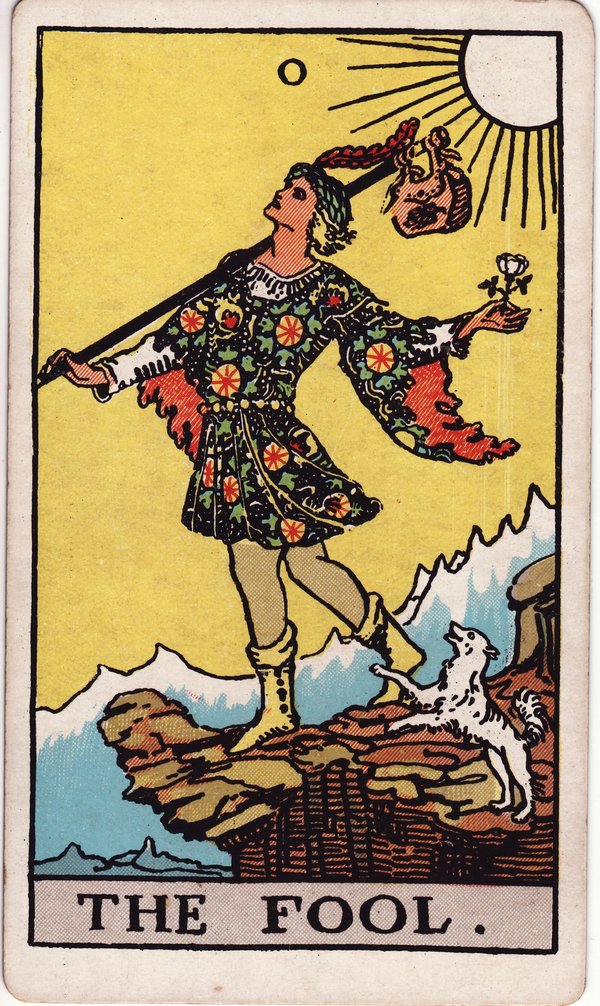
In the Fool's Journey, The World is the return. The Fool set out as innocence (0) and returns as wisdom (21). But the wisdom is not something added — it is something uncovered. The Fool was always the World; the journey was the process of discovering this. The wreath that encircles the central figure is the same shape as the zero of the Fool's number. The ending is the beginning seen from the other side. The World is the Fool, having traveled through every card, standing at the center of everything — and laughing.
Symbolism & Imagery
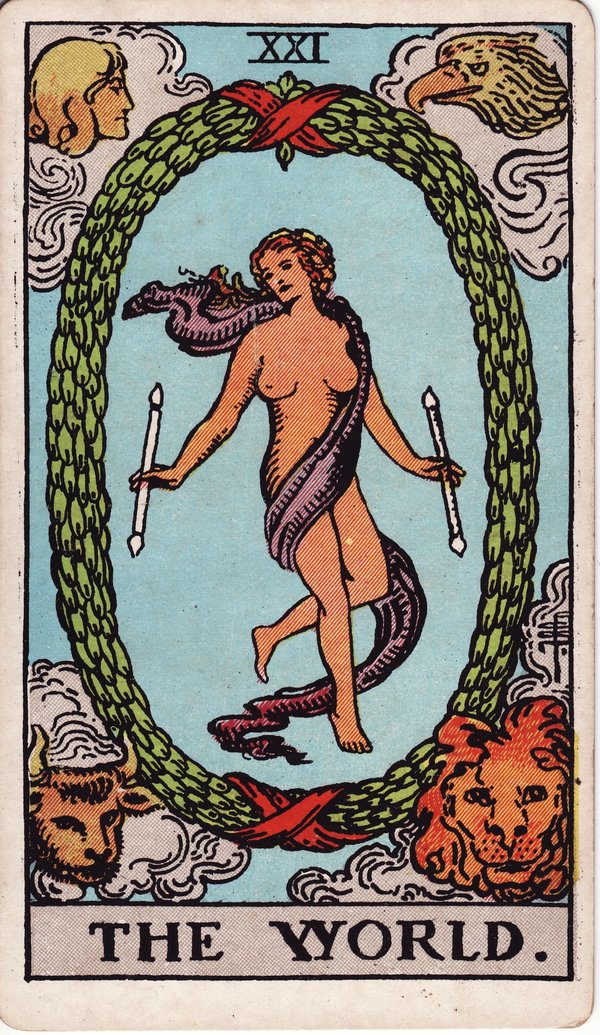
Rider-Waite-Smith (1909): Pamela Colman Smith's World depicts a nude female figure dancing within a large green laurel wreath, holding two wands or batons. She is wrapped in a flowing purple cloth that trails behind her, and she looks over her shoulder — at the past, at what she has left behind, at the journey that brought her here. But her body moves forward: she steps into the future, into the next cycle, into the new beginning that every true completion contains.
The laurel wreath is bound with red ribbons that form the shape of an infinity symbol at top and bottom — the lemniscate, the endless loop, the eternal return. The wreath is a circle, and the circle is both completion (the end of the circle) and continuity (the circle has no end). In the four corners of the card, outside the wreath, appear the four figures of the tetramorph: a lion (Leo, Fire, fixed), a bull (Taurus, Earth, fixed), a cherub/human (Aquarius, Air, fixed), and an eagle (Scorpio, Water, fixed). These are the four fixed signs of the zodiac, the four evangelists of Christian iconography, the four elements, the four suits of the Minor Arcana, the four directions, the four seasons — the totality of manifestation gathered around the center.
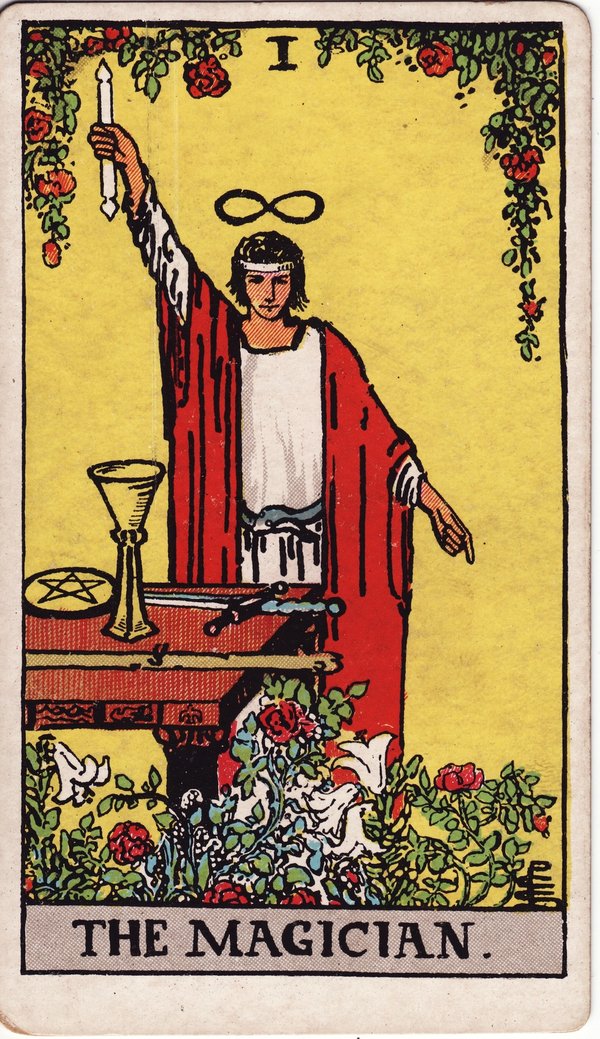
The central figure holds two wands — like the Magician (card 1), but doubled, completed. The Magician held one wand pointing up and one down, channeling energy. The World's dancer holds two in balanced symmetry: the energy has been channeled, the work is done, the balance is now effortless. She is not a magician manipulating forces. She is the dance itself.
Thoth (Crowley/Harris, 1944): The Thoth Universe is radically different in imagery but aligned in meaning. The central figure is no longer a dancer — it is a complex geometric composition: an ellipse containing a figure within concentric circles, surrounded by the figures of the tetramorph in the corners. The card is explicitly the glyph of the Great Work completed — the alchemical opus brought to its final stage, the Philosopher's Stone, the union of opposites in a single, stable form.
Crowley wrote that The Universe "represents the termination of the Trumps and as such serves as the complement to the Fool." The key Thoth emphasis is Saturnian: this is not just completion but structured completion. The universe is not chaos; it is cosmos — ordered, beautiful, and held within law. Saturn, the ruler of boundaries and form, ensures that the completion is real, not imaginary; earned, not fantasized; embodied, not merely thought.
The Thoth Universe also emphasizes the feminine aspect of completion. Crowley referred to the central figure as "the Virgin Universe" — the matrix that gives birth to all forms, the cosmic womb that is also the cosmic completion. This connects to the Hebrew letter Tav, which on the Tree of Life "appears as an emanation from the moon of Yesod, the foundation of the Tree and representative of the reproductive process." The Universe is not a dead end; it is a fertile completion that gives birth to the next cycle.
The key difference: RWS emphasizes the personal achievement — you have arrived, you are whole. Thoth emphasizes the cosmic structure — the universe is complete, and your wholeness is participation in that completion. RWS is intimate. Thoth is architectural. Both are true.
Astrological & Elemental Layer
The World is Saturn — the planet of structure, limitation, discipline, time, and mastery. Saturn is often feared in astrology (the Greater Malefic in traditional systems), but in The World, Saturn appears in its most exalted form: not the tyrant but the architect, not the prison guard but the teacher who knows that true freedom requires form. Saturn rules boundaries, and the World's wreath is a boundary — but it is a boundary that contains rather than confines, a sacred circle within which the dance is possible.
Saturn's energy in The World is the quality of earned completion. This is not a participation trophy. This is the marathon finished, the degree earned, the book written, the relationship that has survived decades. Saturn says: you did the work, and now the work is done. You respected the limits, and in respecting them, you transcended them. The structure is complete — not because it was easy but because you built it, stone by stone, through time and effort.
In the Thoth system, The Universe carries additional resonances of Neptune (cosmic omniscience, the dissolution of boundaries within the completed form) and Pluto (the creative-destructive power of the center, the point from which worlds are born and into which they dissolve). This makes the Thoth Universe a more complex card than the RWS World — it is simultaneously the end of one cycle, the totality of all cycles, and the power that generates cycles. It is Saturn's completion, Neptune's boundlessness, and Pluto's regeneration — all held in a single, stable glyph.
Kabbalistic / Tree of Life Layer
On the Tree of Life, The World occupies Path 32, the final path, connecting Yesod (Foundation, the ninth Sephirah, the sphere of the subconscious, the astral matrix, and the ego) to Malkuth (Kingdom, the tenth Sephirah, the material world). This is the last channel through which the entire structure of the Sephiroth pours into physical reality. Everything that exists in Malkuth — every body, every object, every relationship, every experience — has come through this path.
The Hebrew letter Tav (ת) means "Cross" or "Mark" — the sign, the seal, the signature of completion. Tav is the final letter of the Hebrew alphabet, and in the Sepher Yetzirah, Path 32 is called the "Administrative Intelligence" — the consciousness that directs and governs all the operations of the seven planets, the intelligence that coordinates the entire cosmic system. The World, in its Kabbalistic sense, is not a static endpoint but the dynamic intelligence that keeps the universe in motion — the dance that never stops, the breath that never ceases, the completion that is always giving birth to the beginning.
For the querent, the Kabbalistic layer suggests: you have arrived at the place where spirit becomes matter, where understanding becomes life, where the entire journey of the Tree has deposited its fruit in your hands. This is not transcendence — it is incarnation. It is not leaving the world; it is being fully in it, as a completed being, a whole self, a microcosm that reflects the macrocosm. The mark (Tav) is on you. You bear the signature of completion. Not because you are perfect, but because you are whole.
Archetypal & Life-Stage Themes
The World embodies archetypes of completion, unity, and the eternal return:
The Enlightened One / The Fully Realized Self: In Jungian terms, The World represents the Self — the totality of the psyche, the integration of conscious and unconscious, the endpoint of individuation. The central figure dances because she is whole — not because she has no shadow but because the shadow has been integrated, not because she has no wounds but because the wounds have become part of the dance.
The Mandala / The Cosmic Egg: The circular wreath is a mandala — the sacred circle that represents wholeness, the cosmos, the self. In Tibetan Buddhism, the mandala is both a map of the universe and a tool for realizing it. The World is the mandala of the Tarot: the complete picture, the integrated whole, the map that becomes the territory when you step into its center.
The Ouroboros: The snake that bites its own tail, the eternal cycle of death and rebirth. The World's wreath — bound with infinity ribbons — is the ouroboros in vegetal form. The message: every ending feeds the beginning. The completed self becomes the seed of the next self. The graduate becomes the beginner. The master becomes the student again — but at a higher level.
The Alchemical Marriage / The Great Work: In alchemy, the Great Work (Magnum Opus) culminates in the Philosopher's Stone — the union of opposites (masculine and feminine, sulfur and mercury, sun and moon) into a single, stable, luminous substance. The World is the Philosopher's Stone of the Tarot: the completed work, the integrated self, the stone that turns lead into gold.
The Dancer / Shiva Nataraja: In Hindu cosmology, Shiva's cosmic dance creates, sustains, and destroys the universe in an eternal cycle. The World's central figure — dancing within the circle — is this cosmic dance in human form. She is not a static icon of perfection; she is motion itself, the ongoing act of creation that is also completion.
In the Fool's Journey, The World is the return — the hero comes home, transformed, carrying the elixir. In the monomyth, this is the "Freedom to Live" stage: the hero has conquered death, achieved the boon, and returned to the ordinary world — but the ordinary world is no longer ordinary because the hero sees it with new eyes. The Fool has become the World, and the World is the Fool, beginning again.
Advising For / Advising Against
-
If advising FOR: Celebrate. You have arrived. Whatever this cycle has been — a project, a relationship, a phase of self-development, a period of struggle — it is completing, and you have earned the completion. Do not rush past this moment into the next thing. Stand in the center of the wreath and feel what wholeness feels like. Let yourself be satisfied. Let yourself be grateful. The dance is not over — it is eternal — but this particular movement has reached its resolution. Honor it. And then, when you are ready, step forward into the next one. The wreath is a doorway as well as a crown.
-
If advising AGAINST: Completion is not perfection. Do not hold yourself to an impossible standard of "finished" that prevents you from acknowledging what you have actually accomplished. If you are near the end but holding back — afraid that completion means loss, afraid that finishing means the journey is over — know that the journey never ends. The World is not a tomb. It is a womb. Finishing one thing makes space for the next. Also: beware the hollow victory. If the goal you achieved was someone else's goal, if the success you're holding feels empty, ask yourself whose life you've been living. The World's wholeness cannot be borrowed. It must be your own.
Card of the Day
Today, something is finishing. It may be a small thing or a large thing — a task you have been putting off, a chapter that quietly closes, a long project reaching its natural completion. Whatever it is, honor it. Do not skip the celebration. Take a moment to stand in the center and feel what it feels like to be whole. The wreath is around you. You have come so far.
Card of the Year
A World year — calculated as personal year 21 — is the culminating year of a nine-year cycle. This is the year of harvest, completion, and integration. Everything you have been working toward, struggling with, and becoming for the past eight years comes to fruition. The themes: finishing major projects, reaching long-sought goals, achieving a new level of personal integration, and preparing for the next cycle (which begins the following year with a new Fool/Personal Year 1). The challenge is to let the completion be complete — to not rush into the next thing, to not diminish what you've achieved, to actually receive the fulfillment that is available. A World year asks: Can you let yourself be done? Can you let yourself be whole? By year's end, you will know yourself as you have not known yourself before — not as a project to be improved but as a being who is already, and always was, complete.
Elemental Dignities Notes
The World is Earth — the element of manifestation, completion, the body, the material plane as sacred. In the Thoth system, it is explicitly Earth (Saturn). In a spread, its elemental relationship to neighboring cards follows the Golden Dawn system:
- Strengthened by Water (Cups): Water supports Earth — emotion nourishes form, feeling grounds the completion in meaning. A World adjacent to Cups suggests that the fulfillment is not just material but emotional — the heart is as full as the hands.
- Strengthened by Earth (Pentacles): Like element intensifies like element. Multiple Earth cards deepen the sense of stability, manifestation, and tangible achievement. The World flanked by Pentacles suggests material completion: financial freedom, physical health, the solid rewards of sustained effort.
- Weakened by Air (Swords): Air is Earth's enemy in elemental dignity. The presence of Swords adjacent to The World suggests intellectual restlessness or criticism that is undermining the sense of completion — the mind that cannot rest, the doubt that diminishes the achievement.
- Neutral / Mixed with Fire (Wands): Earth and Fire can be productive — Fire warms Earth into fertility. The World adjacent to Wands suggests the completion is energizing rather than final — the harvest fuels the next planting.
Deck-Specific Notes
-
If using a Thoth deck: The Universe (not The World) emphasizes Saturnian structure and cosmic architecture over personal dancing. The card is the glyph of the Great Work completed — the alchemical opus at its culmination. The central figure is the "Virgin Universe," the cosmic matrix that gives birth to all forms. Saturn rules — not the malefic Saturn of limitation but the Saturn of perfect form, the master builder whose work is done. The Thoth Universe contains the seed of the Fool — the next cycle gestates within the completed one. Crowley considered this card (along with the Fool) the two complementary poles of the entire Tarot system.
-
If using a Marseille-tradition deck: Le Monde (The World) typically depicts a central figure (sometimes Christ, sometimes a hermaphrodite, sometimes a dancer) within a mandorla or wreath, surrounded by the four evangelists/tetramorphs in the corners. The Marseille World often emphasizes the Christological/New Jerusalem reading — the central figure as the resurrected Christ or the soul in the heavenly city. The four figures are usually the lion, bull, eagle, and angel (Matthew, Mark, Luke, John).
-
If using a blended or contemporary deck (e.g., Fountain Tarot, Wild Unknown, etc.): The psychological and astrological layers of this entry apply across visual traditions. The core archetype — completion, wholeness, integration, the end of a cycle — persists. Consult your deck's guidebook for any specific interpretive departures, particularly if the card has been renamed or restructured.
Journaling & Contemplation Prompts
- What cycle in my life is completing right now? What am I not letting finish because I'm afraid of what comes next?
- When I imagine myself as whole — not perfect, not finished, but whole — what does that feel like? What is different?
- What have I accomplished that I haven't truly received? What achievement am I still minimizing?
- The central figure dances. If my life were a dance right now, what would the music be? Am I dancing to my own rhythm?
- The wreath is a circle. What ends today that begins tomorrow in a new form? What is the seed inside the harvest?
Additional Associations
| Association Type | Value |
|---|---|
| Color(s) | Green (the laurel wreath, completion, the verdant earth, flourishing); purple (the dancer's cloth, royalty, the crown chakra, spiritual completion); gold (the halo of achievement, the Philosopher's Stone, the precious); deep blue (the Thoth Universe, the cosmic space that contains all) |
| Crystals / Stones | Clear Quartz (amplification of wholeness, the completed crystal); Lapis Lazuli (the stone of kings, wisdom, the fully realized self); Garnet (the deep red of completion, the blood of the earth, Saturn's stone); Petrified Wood (the ancient, the completed cycle, what endures) |
| Herbs / Plants | Laurel / Bay (the wreath of victory, the crown of the poet and athlete); Oak (the king of trees, strength, endurance, the completed life); Frankincense (spiritual completion, the incense of the temple, the offering of the wise); Myrrh (the anointing oil of completion, the sacred death that births new life) |
| Archetypes (Jungian) | The Self (fully realized); The Mandala; The Cosmic Dancer; The Alchemical Marriage; The Philosopher's Stone; The Enlightened One |
| Mythological Figures | Shiva Nataraja (the cosmic dancer whose dance creates and destroys worlds); the Ouroboros (the serpent eating its own tail, the eternal cycle); the Phoenix at rest (the rebirth cycle completed, but holding the egg of the next phoenix); Sophia (divine wisdom, the feminine completion); the Buddha at enlightenment; the Christ of the Ascension |
| Numerological Resonance | 21 = the sum of all Major Arcana (0-21), the great gathering, the complete picture. 2 + 1 = 3, the Empress, birth, creativity — completion is fertile. 3 × 7 = 21, the Empress multiplied by the Chariot — creative mastery. Tav = 400, the macrocosmic number, the full extension of manifestation. |
| Playing Card Equivalent | The World (trump 21) has no direct minor arcana equivalent, but its qualities of completion, harvest, and fulfillment resonate most closely with the 10 of Pentacles (wealth, legacy, the harvest of a lifetime) and the 10 of Cups (emotional fulfillment, the happy ending) |
| I Ching Hexagram Parallel | Hexagram 63 — Chi Chi / After Completion. "After Completion. Success in small matters. Perseverance furthers. At the beginning good fortune, at the end disorder." The hexagram of everything in its right place — and the warning that completion is not permanent, that the perfect order contains the seeds of the next transformation. The World's wisdom: celebrate, but do not cling. |
| Body / Organ Correspondence | The entire body — the World is the card of embodiment, of spirit fully manifest in flesh. Saturn rules the bones (the structure that lasts), the skin (the boundary), the teeth (Tav as "tooth" in one reading), and the knees (the joints that bend in reverence and dance). The crown chakra (Sahasrara) — the thousand-petaled lotus, the seat of enlightenment. |
Shadow & Integration Message
The World's shadow is not failure — it is the success that feels empty. It is reaching the top of the mountain and finding no view. It is completing the degree, the book, the project, the relationship — and feeling nothing, or worse, feeling loss. This shadow arises when the completion was defined by someone else's standards, when the goal was pursued for the wrong reasons, when the "I" that wanted the achievement was not the true self but the conditioned self. The hollow World is the person who has everything and is nothing.
The World's shadow also manifests as the refusal to complete — the artist who can never finish, the student who collects degrees without ever graduating into real life, the person who stays in the "almost" because completion terrifies them. Finishing means letting go. Finishing means the next thing. Finishing means admitting that this part of the journey is over — and some part of you doesn't want it to be.
Integration of The World means completing with consciousness — finishing the cycle while acknowledging that the cycle was real, that the self who began it is not the self who finished it, and that the completion is not an end but a transformation. The integrated World is the person who can celebrate without grasping, finish without grief, and step into the next beginning with the wisdom of the completed self intact.
Elemental Intelligence (Suit Framing)
In the Jungian cognitive function mapping, The World as Earth aligns with the Sensation function, the melancholic humour, and the class of builders, farmers, and those who work with matter. But The World's Earth is not the mundane Earth of the Pentacles — it is Earth as sacrament, matter as the vehicle of spirit, the body as the temple of the divine. It is the melancholic humour at its most sublime: not sadness but depth, not heaviness but gravity in the best sense, not slowness but the patience that completes what it begins.
The World's "class" is the master — the one who has done the work so long and so well that the work has become effortless. Its humour is melancholic earth that has been worked into gold — the philosopher's stone, the completed opus, the matter that has been so thoroughly transformed by spirit that it shines.
Timing & Manifestation
For timing in a reading, The World suggests a period of approximately one Saturn cycle (29.5 years) in the largest frame, or the completion of whatever cycle the question concerns. In a more immediate frame, The World is associated with Saturn-ruled periods — Capricorn season (approximately December 22 to January 19) and Aquarius season (approximately January 20 to February 18, Saturn's traditional rulership) — and with the period around the winter solstice, the astronomical end of the old year and beginning of the new.
In a manifestation reading, The World is the strongest completion indicator in the deck: the cycle is ending, the goal is achieved or soon will be, the harvest is arriving. "At the end of the cycle. When the circle closes. Soon, and fully."
Yes / No Tendency
The World leans toward Yes — and more than yes. It is not just an affirmative; it is the affirmative that concludes the question. In a yes/no spread, The World says: yes, this is happening, and it is the culmination of everything that led to it. The question you are asking is the right question, and the answer is the fruition of a long process.
In reversed / ill-dignified position, the tendency is Almost, but not yet — you are near the finish, but something is preventing the final step. The wreath is there, but you haven't stepped into it. The dance is waiting, but you're still watching from outside. The missing piece is often internal: a reluctance to finish, a fear of what completion means, an attachment to the struggle. The question is not "will I complete this?" but "what am I afraid will happen when I do?"
Common Misreads / Nuances to Know
Misread 1: "The World means you've achieved everything — there's nothing left to do." The World is not the end of doing; it is the end of a cycle. The dancer is still dancing. The wreath is a doorway as well as a crown. Completion creates space for the next beginning. The World is not retirement from life; it is graduation to the next level. The Fool begins again — but as the World, not as the Fool.
Misread 2: "The World means global travel." The World can literally indicate international travel or a global perspective, but this is a surface reading. The deeper meaning is not geographic movement but spiritual arrival. You can be "in the World" sitting in your living room. The World is a state of consciousness, not a plane ticket. Travel symbolism is valid but secondary.
Misread 3: "The World reversed means failure." The reversed World rarely indicates failure. More commonly, it indicates incompleteness — the cycle is nearly finished, but something is missing. A piece of the puzzle is still in the box. The work is to identify what hasn't been integrated, what loose end hasn't been tied, what part of you is still standing outside the wreath. The reversed World is an invitation to complete, not a verdict of failure.
Nuance for Thoth readers: The Thoth Universe emphasizes Saturnian structure and cosmic architecture. This is not a "happy ending" card in the sentimental sense — it is a card of earned completion, completion that has been built, structured, and tested. Read The Universe as the glyph of the Great Work: you have done the alchemical opus. The stone is made. The gold is real. But the alchemist does not then cease to be an alchemist — they begin a new work at a new level. The snake is always eating its tail. The Universe is always giving birth to the Fool.