The Poetic Line
"The lightning has no quarrel with the tower — only with what it believed it was."
Keywords
| Category | Dignified | Undignified |
|---|---|---|
| General | Sudden upheaval, revelation, liberation through destruction, truth breaking through illusion, necessary collapse | Resisting inevitable change, clinging to crumbling structures, averting disaster at the cost of growth, delayed reckoning |
| Spiritual | Divine intervention, the lightning of enlightenment, ego-death, purification by fire, awakening through crisis | Spiritual bypassing, refusal of the dark night, building new dogmas on old ruins, mistaking destruction for wisdom |
| Psychological | Breakthrough, shattering of false beliefs, insight that reorganizes everything, the collapse of the false self | Denial, willful blindness, doubling down on delusion, terror of change, identity crisis without resolution |
| Physical Health | Crisis that forces healing, purging toxins, sudden diagnosis that leads to treatment, the body's revolt forcing attention | Ignoring warning signs, suppressing symptoms, resisting medical intervention, shock without integration |
| Relationships | Truth-telling that shatters illusions, necessary ending of a toxic bond, clearing away false intimacy, honest rupture | Avoiding the necessary breakup, staying in a collapsing structure, explosive arguments without resolution, ghosting as destruction without honesty |
| Financial | Bankruptcy as fresh start, market crash revealing unsustainable practices, forced simplification of material life | Denying financial ruin, doubling down on bad investments, hiding losses, refusing to cut unsustainable expenses |
| Vocational | Sudden job loss that redirects toward purpose, organizational restructuring that clears dead weight, career revelation through crisis | Clinging to a dying role, refusing to see the writing on the wall, surviving layoffs only to stagnate, fear-based career paralysis |
| Shadow / Thoth Distinction | The Eye of Shiva — cosmic destruction as creative act, the martial fire that purifies, the mouth (Peh) that speaks the unspeakable truth | Blind destruction without purpose, madness and despair, the Jaws of Dis consuming without regenerating, rage that destroys the destroyer |
Narrative Description
General Meaning
The Tower is the card that no one wants to pull and everyone needs. Sudden, irreversible collapse of structures that appeared solid — beliefs, relationships, careers, identities, institutions — but were in fact built on foundations that could not hold. The lightning does not strike randomly. It strikes what was already cracked.
In a reading, The Tower signals that a period of upheaval has arrived or is imminent. This is not subtle change — it is the earthquake, the pink slip, the phone call at 3 a.m., the realization that changes everything in an instant. The key insight that distinguishes The Tower from mere disaster is this: the structure was already false. The Tower does not destroy truth. It destroys pretense, illusion, and the ego's fortifications against reality. What falls deserved to fall. What remains — and what can be rebuilt — is real.
The emotional register of The Tower is shock, terror, disorientation, and — if the querent can access it — a strange, subterranean relief. Something that was not working is finally over. Something that was being held together by willpower and denial has been taken out of human hands. The Tower is the universe refusing to let you live in a lie any longer.
In the Fool's Journey, The Tower comes after the Devil. The Devil represented bondage to material illusion, to false securities, to the chains we forge for ourselves — but those chains were loose. The querent could have walked away at any time. The Tower is what happens when they don't. The false structure, left in place too long, is demolished from outside. The Fool does not choose to leave the tower. They are thrown from it. And the fall, however terrifying, is the only way out.
Symbolism & Imagery
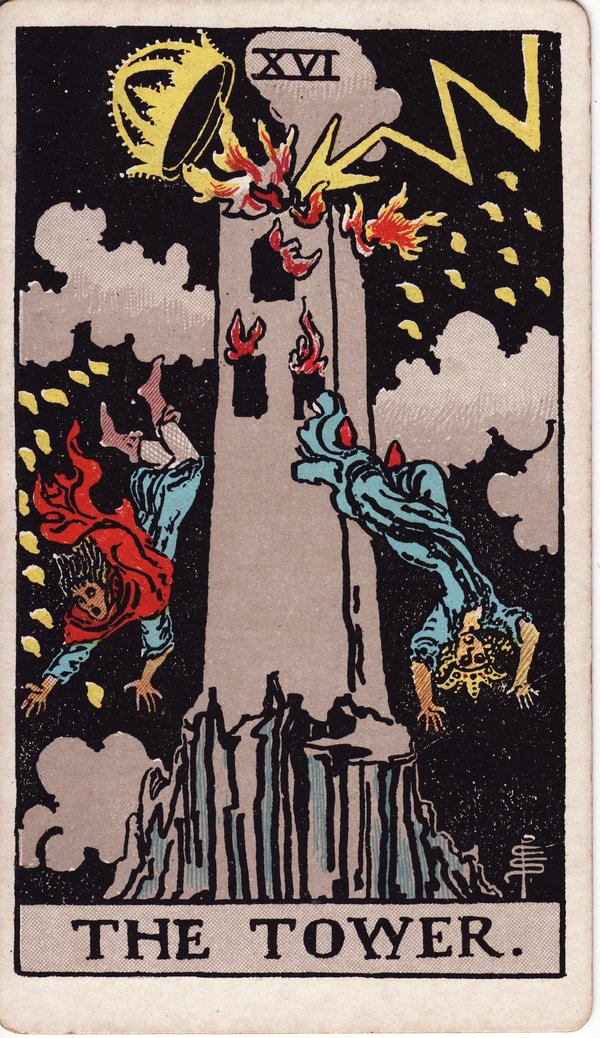
Rider-Waite-Smith (1909): Pamela Colman Smith's Tower depicts a grey stone tower struck by a jagged bolt of lightning from a darkened sky. The crown at the top of the tower is blown off — the ego, the ruling principle, the top of the hierarchy is the first thing to go. Flames erupt from the windows. Two figures plummet headfirst toward the ground, their arms outstretched in something between terror and surrender. They wear crowns as well — they are not peasants but the powerful, the ones who built the tower, the ones who thought they were safe.
Twenty-two flames — shaped like the Hebrew letter Yod — emanate from the lightning strike. Yod is the first letter of the Tetragrammaton, the divine name, the spark of creation. The same force that creates also destroys. The flames are not merely fire; they are divine energy, the raw creative-destructive power that cannot be domesticated by human structures. The dark sky and barren landscape emphasize the isolation of the moment — when the Tower falls, you are alone with what remains.
The falling figures are often rendered upside-down, suggesting the complete inversion of the world. Everything the querent knew is reversed. Up is down. Certainty is confusion. Power is vulnerability. But the upside-down figure is also the Hanged Man's posture — and the Hanged Man, a few cards earlier, taught that surrender is a form of seeing. The Tower's fall, viewed from the right angle, is the Hanged Man's wisdom arriving as an ambush.
Thoth (Crowley/Harris, 1944): The Thoth Tower is vastly more esoteric and violent. The dominant feature is the Eye of Horus — or the Eye of Shiva — at the top of the card, a glaring, all-consuming eye that opens to destroy the universe. When Shiva opens his third eye, worlds burn. The eye is the cosmic perspective that sees through all human pretense. Below it, the tower is being consumed by fire and disintegration. Figures fall, but they have lost human shape; they are "mere geometrical expressions," as Crowley wrote, meaning they have been liberated from the prison of organized form. The falling is emancipation, not punishment.
In the bottom right corner, the Jaws of Dis belch flame — the mouth of the underworld, the devouring principle that breaks down form into raw material for new creation. A dove and a serpent appear: the dove is the "Will to Live," the serpent the "Will to Die," the twin impulses that govern all existence. In the Thoth system, the serpent is specifically the Lion-Serpent Xnoubis or Abraxas, a Gnostic figure representing the totality of being beyond good and evil. The Tower in Thoth is not a punishment — it is a cosmic necessity, the preface to the Aeon (Judgement), the clearing of the ground for the new dispensation.
The key difference between traditions: RWS emphasizes the personal crisis — your tower, your fall, your humbling. Thoth emphasizes the cosmic process — the destruction that is always occurring at the level of reality itself, the fire that burns away obsolete aeons. Both are true. The Tower is both the worst day of your life and the moment the universe realigned itself on your behalf.
Astrological & Elemental Layer
The Tower is Mars — the red planet of war, severance, will, and aggression. Mars does not negotiate. It cuts. It burns. It acts. The martial energy of The Tower is the force that cannot be reasoned with, the intervention that does not ask permission. In astrology, Mars governs Aries (the self, the head, initiative) and Scorpio (death, transformation, the depths). The Tower partakes of both: the Aries impulse to break free and the Scorpionic process of death-and-rebirth.
In the RWS/Golden Dawn tradition, Mars is simply the astrological ruler. In the Thoth system, Fire is emphasized as the elemental nature — not Fire as coziness or passion, but Fire as the alchemical agent of purification. Alchemists knew that fire does not destroy; it separates. It divides the pure from the impure, the essential from the contingent, the true from the false. The Tower is the calcination stage of the alchemical opus — the burning away of all that is not gold.
Mars as a planetary force carries the quality of severance: the sword that cuts, the will that decides, the boundary that says "this and not that." When The Tower appears, something is being severed — a relationship, a belief, an identity, a way of life. The severance is not gentle. Mars does not do gentle. But it is precise. What is cut away needed to be cut away. The querent may not know this yet, but the cut itself is the proof.
Kabbalistic / Tree of Life Layer
On the Tree of Life, The Tower occupies Path 27, the path connecting Netzach (Victory, the seventh Sephirah, the sphere of emotion, instinct, and creative desire) to Hod (Splendour, the eighth Sephirah, the sphere of intellect, form, and structure). This is a path within the Pillar of Severity, and it carries the quality of rupture within the architecture of consciousness itself.
Netzach is the heart's knowing — the gut feeling, the artistic impulse, the emotional truth that bypasses logic. Hod is the mind's ordering — the system, the plan, the rational justification. When these two are in healthy relationship, emotion informs intellect and intellect gives form to emotion. When they are out of balance — when the rational structure has become a fortress against feeling, when the "plan" has become a prison — Path 27 delivers the lightning. The Tower is what happens when Hod forgets Netzach, when the system forgets why it was built.
The Hebrew letter Peh (פ) means "Mouth." It is the organ of speech, the breach in the body's sealed surface through which the interior becomes exterior. Peh is the letter of Mars, the explosive utterance, the word that cannot be unsaid. In the Sepher Yetzirah, Path 27 is called the "Exciting Intelligence" — the consciousness that stirs, that agitates, that breaks the stale equilibrium. The Tower is the Exciting Intelligence doing its work: the word that shatters the silence, the truth that shatters the lie.
For the querent, the Kabbalistic layer suggests: the collapse you are experiencing is not random. It is the necessary correction of an imbalance between your emotional truth (Netzach) and your mental structures (Hod). Something you felt but did not say, or something you rationalized but did not feel, has finally broken through.
Archetypal & Life-Stage Themes
The Tower embodies archetypes of destruction-as-transformation that appear across all cultures:
The Shattered Ego: In Jungian terms, The Tower is the moment the persona — the mask we present to the world, the carefully constructed identity — is struck down. What remains afterward is the raw self, stripped of pretense, humbled and terrified but also real. This is the necessary prerequisite for individuation: the false self must die so the true self can live.
The Destroyer / Shiva: In Hindu cosmology, Shiva's cosmic dance destroys the universe at the end of each cycle — not out of malice but because destruction is the prerequisite for creation. The Tower is the Shiva aspect of the psyche: the part of you that knows when something must end, the courage to burn down what cannot be saved.
The Tower of Babel: The biblical story of human ambition overreaching and being struck down by divine confusion of tongues. The Tower as hubris — the structure built to reach heaven that instead brings about fragmentation. In the querent's life, The Tower often appears when ambition has outpaced integrity, when the edifice was built to prove something rather than to be something.
The Thunderbolt of Zeus / Enlightenment: Across traditions, the lightning bolt is the symbol of sudden illumination — Zeus's weapon, the thunderbolt of enlightenment in Vajrayana Buddhism, the flash of insight that reorganizes consciousness in an instant. The Tower's lightning is not just destruction; it is revelation. The querent sees, in a flash, what was always true but hidden.
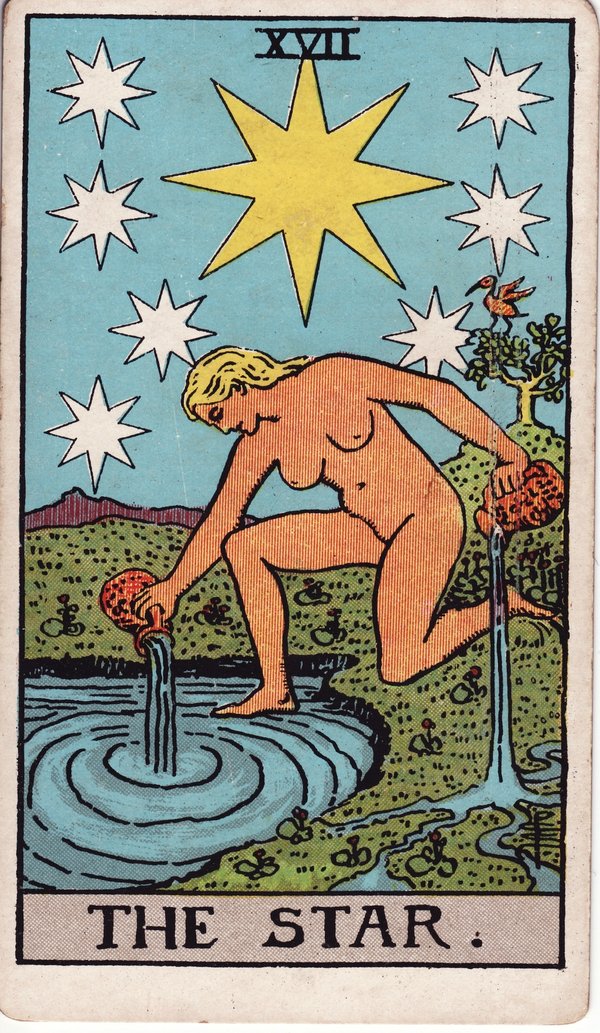
In the Fool's Journey, The Tower is the crisis at the end of Act Two — the dark night of the soul, the point where the hero loses everything before the final confrontation and resolution. It corresponds to the "Ordeal" stage of the monomyth: the cave, the belly of the whale, the death that precedes rebirth. The Fool is thrown from the tower and must survive the fall. The next card is The Star — hope, renewal, the first light after the storm. But first, the fall.
Advising For / Advising Against
-
If advising FOR: Surrender. The tower is falling and you cannot hold it up. Your resistance is the only thing making this more painful than it needs to be. Let go of what is being taken. Trust — not that everything will be fine, but that what remains after the collapse will be real. Truth, however brutal, is a better foundation than illusion, however comfortable. Speak the truth now. The mouth (Peh) is open. Say what you have been afraid to say.
-
If advising AGAINST: Do not tear down what still serves. Not every discomfort is a false structure. Not every frustration is a Tower moment. Ask yourself: Is this structure genuinely built on lies, or am I just tired of the work of maintaining it? Is the lightning divine intervention, or is it my own restlessness dressed as fate? If you cannot distinguish, wait. The Tower does not need your help to fall.
Card of the Day
Today, something cracks. It may be a small thing — a conversation that finally happens, a realization you have been avoiding. Do not brace against it. The crack is where the light gets in. You may feel unmoored, even frightened. That is appropriate. What remains after today will be more true than what you held before. Let the lightning do its work.
Card of the Year
A Tower year — calculated as personal year 16 when your birth month + birth day + current year sum reduces to 16 — is a year of demolition and revelation. This is not a comfortable year, but it is a necessary one. Structures that have been failing quietly will fail loudly. Relationships that have been held together by denial will end or transform. Career paths that were dead ends will be blocked so thoroughly you cannot pretend otherwise. The gift of a Tower year is truth. You will learn, by the end of it, what is real and what was scaffolding. You will lose things you thought were essential and discover you are still standing. The rebuilding begins in the final months. Do not rush it. The foundation must be laid on honest ground.
Elemental Dignities Notes
The Tower is Fire — the element of will, action, transformation, and purification. In a spread, its elemental relationship to neighboring cards follows the Golden Dawn system:
- Strengthened by Air (Swords): Air supports Fire — intellect sharpens the blade of action, clarity accelerates the necessary destruction. A Tower adjacent to Swords becomes more precise in what it demolishes, less random, more surgical.
- Strengthened by Fire (Wands): Like element intensifies like element. Multiple Fire cards create an inferno — the destruction is more total, but also more creative. The Tower flanked by Wands suggests a complete and rapid transformation.
- Weakened by Water (Cups): Water is Fire's enemy in elemental dignity. The presence of Cups adjacent to The Tower suggests the destruction is being resisted by emotional attachment, sentimentality, or the desire to preserve relationships at the cost of truth. The fire may be doused before it completes its work.
- Neutral / Mixed with Earth (Pentacles): Fire and Earth have a complex relationship — Fire can forge Earth into new forms, but Earth can smother Fire. If Pentacles surround The Tower, material concerns (money, security, physical safety) may either ground the transformation in practical reality or block it entirely through fear of loss.
Deck-Specific Notes
-
If using a Thoth deck: The Tower appears as the Eye of Shiva/Horus consuming a disintegrating structure, with the Jaws of Dis, dove, and serpent. The reading emphasis shifts from "personal crisis" to "cosmic necessity." The Thoth Tower is less a warning and more an inevitability — the destruction that must occur for the Aeon to arrive. The figures falling are not victims but beings liberated from form. The martial fire is not punishment but purification. Crowley associated this card with a secret of the 11th degree of the O.T.O., suggesting depths of initiatory meaning not accessible through public text.
-
If using a Marseille-tradition deck: La Maison Dieu (The House of God) is typically depicted as a tower struck by lightning or fire from heaven, with two figures falling. The Marseille Tower carries stronger Christian overtones of divine punishment for pride (the Tower of Babel), and the falling figures are sometimes interpreted as the rich man and the poor man — death and judgment leveling all human distinction.
-
If using a blended or contemporary deck (e.g., Fountain Tarot, Wild Unknown, etc.): The psychological and astrological layers of this entry apply across visual traditions. The core archetype — sudden collapse, revelation through crisis, the destruction of false structures — persists regardless of specific imagery. Consult your deck's guidebook for any departures from the RWS/Thoth framework.
Journaling & Contemplation Prompts
- What in my life am I holding together through sheer will, even though it wants to fall? What would happen if I stopped holding?
- Where have I built structures — beliefs, relationships, career paths — on foundations I know are false? What truth am I avoiding by maintaining them?
- When was the last time something fell apart in my life, and what remained afterward that was real?
- If the lightning struck right now and took the thing I am most afraid of losing — who would I be without it? Is that person someone I could learn to trust?
- What truth have I been afraid to speak? What would happen if I opened my mouth (Peh) and said it?
Additional Associations
| Association Type | Value |
|---|---|
| Color(s) | Grey (stone, rigidity, the color of the tower); red-orange (fire, Mars, destruction); black (the sky before and after the storm); white (the lightning of truth) |
| Crystals / Stones | Fire Agate (grounding through upheaval, courage); Hematite (protection during crisis); Smoky Quartz (transmuting negative energy, survival) |
| Herbs / Plants | Nettle (the sting that heals, purification); Cayenne (fire, circulation, the catalyst); Ash (the tree of Yggdrasil, world-axis, what survives the fire) |
| Archetypes (Jungian) | The Shattered Ego; The Destroyer (Shiva); The Trickster as Agent of Chaos; The Lightning-Struck Tower |
| Mythological Figures | Shiva (cosmic destruction and rebirth); Zeus (the thunderbolt); the Tower of Babel (hubris struck down); Jericho (walls brought down by sound); Kronos (time devouring all structures) |
| Numerological Resonance | 16 = 4 × 4, the squared structure that has forgotten its relation to the One. 1 + 6 = 7, the number of spiritual quest, the inner work that destruction makes possible. Peh (80) = the mouth that breaks silence. |
| Playing Card Equivalent | The Tower has no direct playing card equivalent, but among the trumps it corresponds to the destructive, sudden, Mars-ruled quality sometimes associated with the 5 of Spades in cartomancy |
| I Ching Hexagram Parallel | Hexagram 51 — Chên / The Arousing (Shock, Thunder). "Shock brings success. Shock comes — oh, oh! Laughing words — ha, ha! The shock terrifies for a hundred miles, and he does not let fall the sacrificial spoon and chalice." The hexagram of sudden disruption that reveals who is truly steady. The Tower's lightning and Chên's thunder are the same force. |
| Body / Organ Correspondence | The head (crown blown off — ego, skull, the ruling principle); the adrenal glands (fight-or-flight, Mars, the body's emergency response); the mouth (Peh, speech, the organ of truth-telling). In medical astrology, Mars governs the muscles, the blood, the inflammatory response — all systems that act suddenly. |
Shadow & Integration Message
The Tower's shadow is not the destruction itself — it is the refusal to let the tower fall. The querent who props up a crumbling structure, who patches cracks with denial, who calls their prison "home" rather than face the terror of freedom. This is the shadow of Mars inverted: not the warrior but the coward, not the truth-teller but the liar, not the fire but the ash that refuses to acknowledge it has already burned.
Integration of The Tower's energy means learning to distinguish between destruction that liberates and destruction that merely wounds. It means developing the discernment to know when a structure is false and the courage to bring it down yourself rather than waiting for the lightning. The integrated Tower is not the victim of catastrophe but the agent of necessary endings — the person who can say "this is over" with clarity and compassion, who can burn the old contract without burning the relationship, who can let the ego die without annihilating the self.
Elemental Intelligence (Suit Framing)
In the Jungian cognitive function mapping — which maps the four suits to Jungian cognitive functions, humours, and class theory — The Tower as Fire aligns with the Intuitive function, the choleric humour, and the warrior/creative class. But The Tower is not the developed Intuition of the Wands — it is Intuition as rupture, the sudden flash of knowing that bypasses all rational processing, the Aha! that is also an Oh no. It is the choleric humour at its most extreme: not directed will but explosive force, the anger that has been suppressed so long it has become a bomb.
The Tower's "class" is the revolutionary — the one who tears down the old order, the liberator who is also the destroyer, the figure who is necessary but rarely welcome. Its humour is choleric fire, but fire that burns indiscriminately until it learns, through integration, to become the controlled flame of the forge rather than the wildfire of the forest.
Timing & Manifestation
For timing in a reading, The Tower points to suddenness — events that arrive without warning, in a flash, disrupting whatever timeline the querent had constructed. Mars moves quickly through the zodiac (approximately 6-7 weeks per sign), and The Tower's events tend to manifest within that window, often within days rather than months. "Suddenly, and sooner than you think."
If pressed for a seasonal window: The Tower is associated with the fire signs (Aries, Leo, Sagittarius) and especially with the Mars-ruled periods — Aries season (late March to late April) and Scorpio season (late October to late November). These are the times when the martial energy is most active, but The Tower respects no calendar. Its truest timing answer is simply: when the structure can no longer stand.
Yes / No Tendency
The Tower leans toward No — but the no is a gift. In a yes/no spread, The Tower is a forceful negation, but it negates what should be negated. The answer is: no, this path is blocked; no, this structure will not hold; no, this plan was built on false assumptions. The "no" of The Tower is not rejection — it is redirection. The door slams so you will find the one that is actually open.
In reversed / ill-dignified position, the tendency is not yet — the collapse is coming, but you are resisting it. The structure is still standing, but the cracks are visible. The answer to "should I proceed?" is: you are proceeding toward a cliff. The question is whether you will jump or be pushed.
Common Misreads / Nuances to Know
Misread 1: "The Tower means disaster — something terrible is going to happen." The Tower does not cause disaster; it reveals that a disaster was already built into the structure. The lightning strikes what was already cracked. If your life was built on truth, the Tower has nothing to destroy. The card is not a prophecy of random catastrophe but a diagnosis of false foundations.
Misread 2: "The Tower reversed means you avoided the disaster." Avoiding the Tower is not a victory — it is a postponement. The reversed Tower often indicates the querent has seen the warning signs and is frantically patching cracks, but the structure is still unsound. The longer you prop it up, the more catastrophic the eventual collapse. The reversed Tower is an invitation to do the demolition yourself, consciously, rather than waiting for the lightning.
Misread 3: "The Tower is the worst card in the deck." The Tower is actually one of the most merciful cards, because it ends what should have ended long ago. The truly terrible cards are the ones that let you live in the lie indefinitely — the Devil, the reversed Moon, the Seven of Swords. The Tower, at least, is honest. It tells the truth. And the truth, however painful, is the only ground on which anything real can be built.
Nuance for Thoth readers: The Thoth Tower is explicitly framed as the preface to the Aeon — the destruction that clears the ground for the new dispensation. It is not a punishment but a cosmic necessity. If you read primarily with the Thoth deck, the "personal crisis" interpretation should be held within the larger frame of evolutionary necessity. The tower is falling because the aeon is changing. You are not being singled out; you are participating in a cosmic process.