The Poetic Line
"The chains are a necklace you put on — and only you can take it off."
Keywords
| Category | Dignified | Undignified |
|---|---|---|
| General | Bondage, materialism, addiction, shadow, attachment, the choice made from fear | Liberation, breaking chains, releasing attachments, shadow integration, freedom from addiction |
| Spiritual | Materialism as false religion, worship of the ego, spiritual darkness that precedes dawn, the dark night of the soul from the side of the one still in it | Spiritual liberation, breaking free from dogma, release from spiritual bondage, the dawn after the dark night, reclaiming sovereignty |
| Psychological | Unconscious patterns, addiction, obsession, the shadow self operating without awareness, the chains of habit and compulsion | Shadow work, confronting the unconscious, breaking addictive cycles, psychological liberation, integration of the dark self |
| Physical Health | Addiction, compulsive behavior, neglect of the body, bondage to physical cravings, the body as prison | Recovery, detoxification, breaking physical addictions, reclaiming the body as temple, liberation from compulsive patterns |
| Relationships | Codependency, toxic attachment, relationships based on power and control, sexual obsession, staying because leaving feels impossible | Breaking free from toxic relationships, recognizing codependency, reclaiming autonomy, healthy boundaries, sexual liberation from shame |
| Financial | Debt, materialism, greed, financial bondage, the golden handcuffs, measuring worth by net worth | Financial liberation, breaking free from debt, releasing attachment to wealth, discovering sufficiency, exit from golden handcuffs |
| Vocational | The golden cage — a well-paying job that imprisons the soul, serving ambition at the cost of integrity, work as addiction, power as drug | Leaving the golden cage, career liberation, prioritizing meaning over money, breaking free from professional identity that has become a prison |
| Shadow / Thoth Distinction | The initiatory darkness — the nigredo that must be entered to be transformed; Non serviam: "I will not serve" — the proud independence that is also the seed of liberation; the Baphomet of balance (male/female, human/animal, light/dark) degraded into the Devil of imbalance; the scapegoat who carries what the community cannot face | The light that breaks through the darkness; the moment of seeing that the chains were always loose; the scapegoat reclaimed as the prophet; the Luciferian light-bringer who has passed through the underworld and returned with fire |
Narrative Description
General Meaning
The Devil is the card of bondage — not the bondage imposed by external tyrants but the bondage we consent to, the chains we could slip off if we were willing to admit they exist. In the Fool's Journey, it arrives after Temperance/Art: the integration has been achieved, the opposites have been combined, the middle path has been found. And now — what? The Devil is the temptation to stop here, to build a comfortable cage out of the integrated self, to turn the alchemical gold into a hoard rather than a gift.
In a reading, The Devil signals that the querent is in some form of bondage — to a person, a substance, a pattern, a belief, a job, an identity, a way of being. The bondage may be obvious (an addiction that is destroying their life) or subtle (a career that looks successful from the outside but feels like a prison from the inside). The Devil does not judge the bondage. It simply shows it — and then shows, crucially, that the chains are loose.
This is the card's central teaching: the Devil's power is the power you give it. The chains around the necks of the RWS figures are not tight. They could remove them at any time. The bondage is maintained not by force but by belief — the belief that the chains are permanent, that the cage is home, that the familiar suffering is safer than the unknown freedom. The Devil is not an external entity; it is the shadow of your own psyche, the part of you that has learned to love the cage because the cage is known.
The emotional register of The Devil is heavy, dense, magnetic. This is not the airy lightness of the Fool or the serene clarity of Temperance. It is the weight of attachment, the gravity of desire, the pull of the familiar even when the familiar is harmful. There is a dark pleasure in the Devil card — the pleasure of indulgence, of giving in, of letting the shadow have its way. The card does not deny this pleasure; it simply shows its cost.
The Thoth card — which retains the name "The Devil" — emphasizes a different dimension: the initiatory and liberatory potential of the darkness. In the Thoth system, the Devil is associated with the principle of "Non serviam" — "I will not serve" — which can be read as Luciferian pride but also as the refusal to bow to illegitimate authority. The same energy that chains can also liberate. The question is whether the independence serves the ego or the spirit.
Symbolism & Imagery
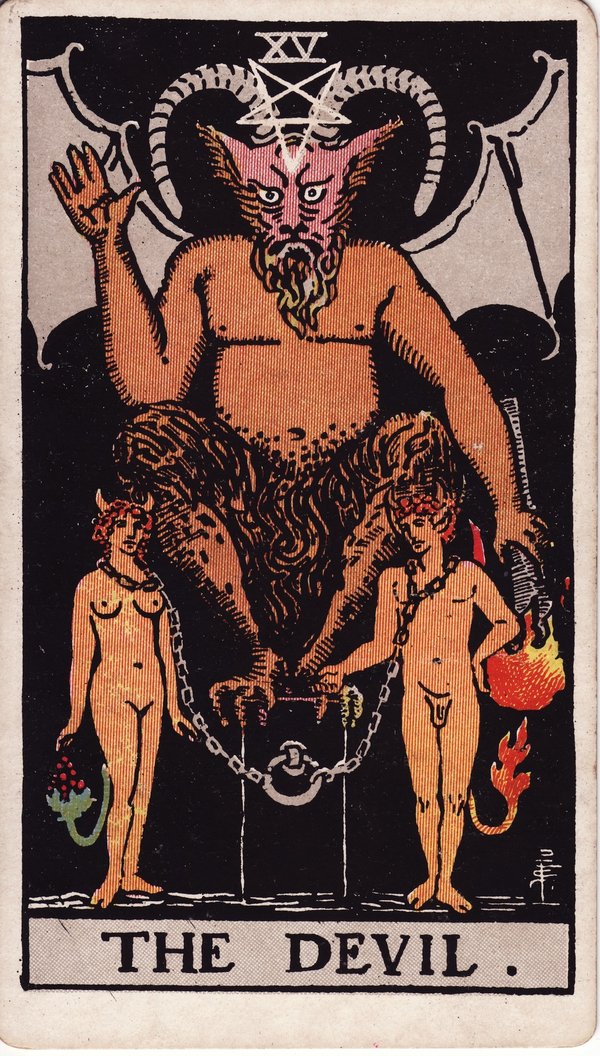
Rider-Waite-Smith (1909): Pamela Colman Smith's Devil is a composite creature — Baphomet, the Horned Goat of Mendes, with bat-like wings, a masculine chest and feminine hips (hermaphroditic, a dark parody of the integrated wholeness of the alchemical Rebis), the horns of Pan, and the hypnotic stare of a predator. An inverted pentagram floats above the head — the five-pointed star reversed, spirit below matter, the intellect in service to desire rather than the other way around.
The right hand is raised in a gesture that echoes the Hierophant's blessing — a dark parody of spiritual authority. The left hand holds a lit torch, flame downward — the fire of spirit turned toward the material, the light that illuminates only the shadows. The figure sits on a half-cube pedestal — half the stability of the Emperor's full cube, suggesting incomplete authority, power that rests on a partial foundation.
Chained to the pedestal are two figures — a man and a woman, naked, with small horns growing from their heads (they are becoming what they serve) and tails tipped with grapes (the woman — pleasure) and fire (the man — lust, the consuming passion). The chains around their necks are loose — this is the card's most crucial detail. They are not bound. They are choosing to stay. Their expressions are not of terror but of a kind of dazed contentment — the contentment of the addict who has had their fix, the contentment of the prisoner who has forgotten the outside world.
The entire scene is black — black background, black pedestal, black wings. This is the darkness of the unexamined shadow, the darkness in which the ego hides from the light of consciousness. But black is also the color of the nigredo, the first stage of the alchemical work — the blackening that must precede purification. The darkness of the Devil contains the seed of its own illumination.
Thoth (Crowley/Harris, 1944): Lady Frieda Harris's Devil for the Thoth deck is arguably one of the most powerful and complex cards in the entire Thoth Major Arcana. The central figure is the goat-god — not the degraded Christian Satan but the primal, generative force of nature: Pan, the life force itself, terrifying and beautiful in its raw power. The goat-god has a third eye in the center of the forehead — the eye of Ayin, the eye that sees what ordinary vision cannot, the cyclopean vision of the depths.
Enormous, spiraling horns erupt from the head and curve upward — phallic, generative, the horns of the ram and the goat, the symbols of virility and creative force that later traditions demonized. Between the horns, a phallus rises — not as obscenity but as the generative principle itself, the life force that the Devil represents. This is the god who was worshipped as Pan, as Dionysus, as Cernunnos — before the Christian tradition recast the horned god of nature as the enemy of the spirit.
At the base of the card, the testicles are rendered as the orbs of the Tree of Life — the Sephiroth themselves contained within the generative organs, as if to say: the creative power of the cosmos is not separate from the body; it IS the body, consecrated. The entire composition is a temple of the flesh, a cathedral of desire, a sacred rendering of what later traditions taught us to call profane.
In the background, the geometric grid of the Thoth aesthetic is present but distorted — the straight lines warping, the angles bending. The Devil bends reality around himself. His presence warps the space of consciousness, creating a gravitational field from which it is difficult to escape — not because the field is locked but because the pull is so strong.
Key difference between traditions: RWS depicts the Devil as a deception — the chains are loose, the bondage is illusory, and the task is to recognize the illusion and walk away. Thoth depicts the Devil as a power — the raw, generative, terrifyingly beautiful life force that can either chain or liberate, depending on whether it is integrated or repressed. RWS says: you are not really trapped. Thoth says: you are in the presence of a force that can trap you or set you free — and the difference is your relationship to it.
Astrological & Elemental Layer
The Devil is assigned to Capricorn, the tenth sign of the zodiac, ruled by Saturn. Capricorn is cardinal earth — the earth that initiates, that builds, that climbs. It is the sign of ambition, structure, authority, achievement, and the material world taken with utter seriousness. Capricorn builds the mountain; Capricorn climbs the mountain; Capricorn stands at the summit and says now what?
The Devil is what happens when Capricorn's ambition becomes detached from meaning — when the climb becomes the only thing, when the structure becomes the prison, when the achievement becomes the cage. The mountain goat that once climbed toward the sun now serves only the climb, forgetting why it began. Saturn, Capricorn's ruler, is the planet of limits, boundaries, time, and the hard lessons that teach wisdom. In the Devil, Saturn's limits have become the chains — not the healthy boundaries that define a life but the constrictions that crush it.
The element of Earth in the Devil is crucial: this is not the spiritual bondage of false belief (that would be Air) or the emotional bondage of toxic attachment (that would be Water). It is material bondage — the bondage to money, to status, to the body and its appetites, to the physical world mistaken for the whole of reality. Earth is the element of the tangible, and the Devil is what happens when the tangible becomes the only thing that is real.
In the Thoth system, the additional attribution of the Moon deepens the card's complexity. The Moon is the luminary of the night, the light that illuminates the unconscious, the tide that pulls the waters of the psyche. In the Devil, the Moon is the dark moon — the moon of Hecate, of the crossroads, of the places where the unconscious erupts into consciousness in forms that are terrifying because they are true. The Thoth Devil does not obscure the truth; it reveals a truth that the daylight mind would rather not see.
Kabbalistic / Tree of Life Layer
On the Tree of Life, The Devil occupies Path 26, the path connecting Tiphareth (Beauty, Harmony, the integrated self) to Hod (Splendor, Intellect, the rational mind). This is the path of Ayin — the Eye — the channel through which the light of the integrated self is filtered through the intellect. But Ayin is the eye that sees surfaces — the material, the apparent, the form without the essence. When the intellect sees only surfaces, it becomes the Devil: the mind that can rationalize anything, the intelligence that serves desire, the logic that proves the cage is freedom.
Tiphareth is the heart — the sphere of the Sun, of the integrated self that knows what it loves and why. Hod is the mind — the sphere of Mercury, of intellect, language, and analysis. The path between them should be a path of illumination: the heart informing the mind, the mind clarifying the heart. But the Devil is what happens when this path is reversed: the mind controlling the heart, the intellect building prisons for the feeling self, the rationalizations that justify staying in the cage because the cage has been analyzed and found to be "safe."
The Sepher Yetzirah describes this path as the "Renewing Intelligence" — the consciousness that renews, that reinvigorates, that restores the light to the darkened mind. This is the hidden promise of the Devil card: even here, on the path of Ayin, the light is being renewed. The darkness is not permanent. The eye that sees only surfaces can learn to see depths. The intellect that built the prison can be the same intellect that diagrams the escape.
For the querent, the Kabbalistic layer suggests: the bondage you are experiencing is in your mind. The same mind that created the rationalizations for staying can create the clarity for leaving. The path from Tiphareth to Hod is a two-way street. You have been walking it in the direction of darkness; you can turn around. The renewal is available. The question is whether you are willing to see differently.
Archetypal & Life-Stage Themes
The Devil embodies the archetype of the Shadow — the disowned parts of the self, the repressed desires, the denied truths, the hidden motives that operate beneath the surface of consciousness. But the Shadow is not evil; it is simply unconscious. The Devil's work is to bring the Shadow into awareness — not so that it can be destroyed but so that it can be integrated.
Pan / The Horned God: Before Christianity cast the horned god as Satan, Pan was the god of nature, of wild places, of the life force that runs through all living things — terrifying and beautiful, dangerous and generative. The Devil card recovers this older understanding: the horned god is not the enemy of the spirit but the spirit in the body, the sacredness of the flesh, the holiness of desire. The problem is not Pan. The problem is repressing Pan — because what is repressed does not disappear; it returns in distorted, compulsive forms.
Lucifer / The Light-Bringer: The name Lucifer means "light-bringer" — the morning star, Venus at dawn, the herald of the sun. In the Christian tradition, Lucifer is the fallen angel who said "Non serviam" — "I will not serve" — and was cast into hell. But the same principle of proud independence, when purified of ego, becomes the refusal to serve false authority, the courage to question dogma, the freedom to think for oneself. The Devil card contains both: the Lucifer of pride who falls into darkness, and the Lucifer of liberation who carries the light into the darkness and returns transformed.
The Scapegoat: In the Levitical tradition, the scapegoat was the goat upon which the sins of the community were ritually placed and which was then driven into the wilderness, carrying the sins away. The Devil card is the scapegoat — the one who carries what the community cannot face about itself. To integrate the Devil is to call the scapegoat back from the wilderness and ask: What did you carry for us? What truth did we exile with you?
The Shadow Lover: The Devil is the inverse of the Lovers card. Where the Lovers represent conscious, loving, chosen union, the Devil represents unconscious, compulsive, addictive attachment — the relationship we didn't choose but can't leave, the attraction that feels like fate but is actually pattern, the bond that is based on need and fear rather than love and freedom.
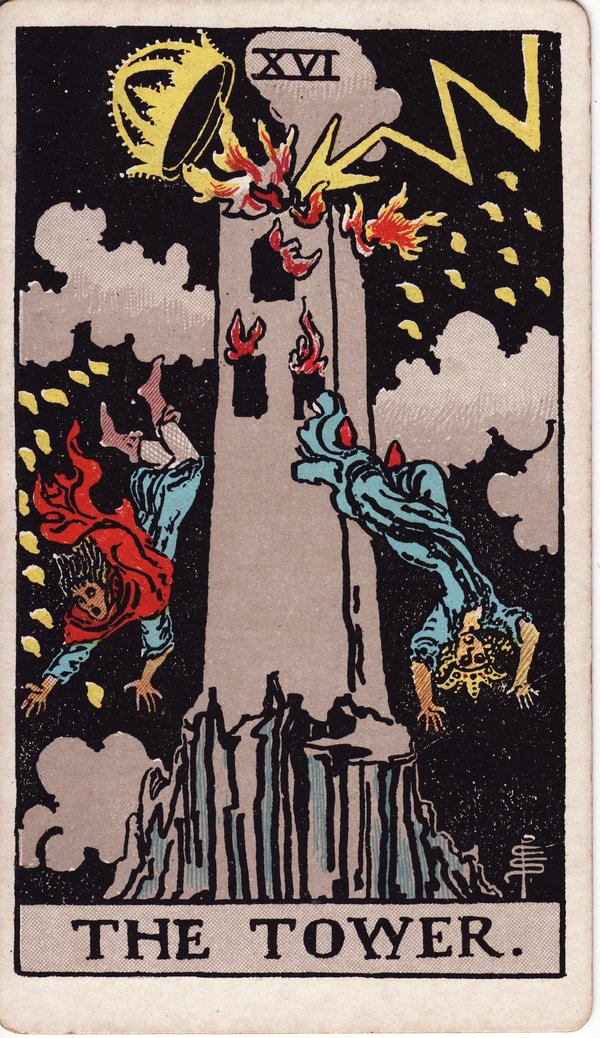
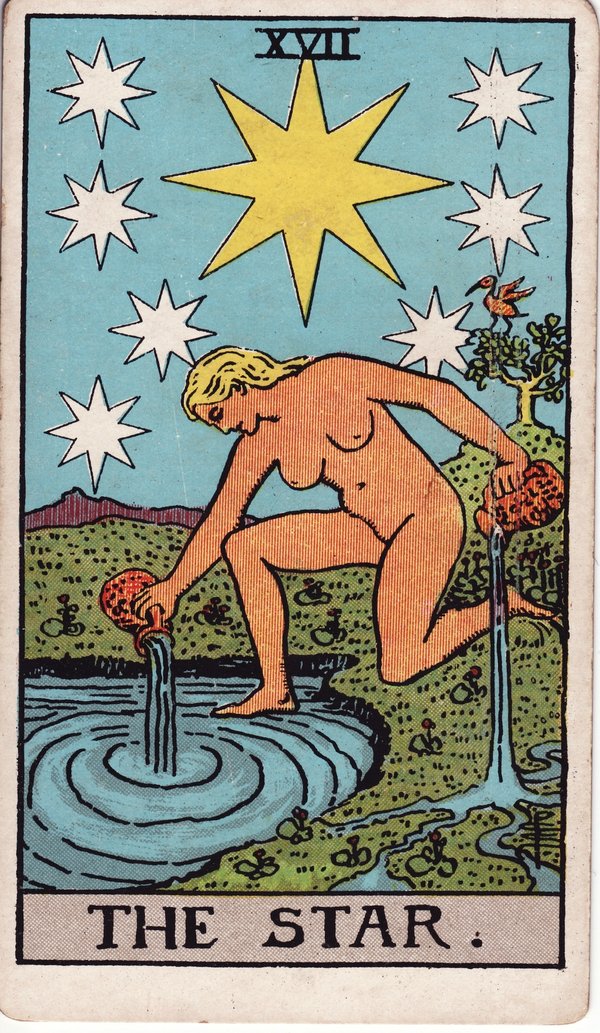
In the Fool's Journey, The Devil is the temptation of the middle journey — the point where the Fool has achieved enough integration (Temperance) that they could comfortably stop and build a golden cage out of their achievements. The Fool has faced death, integrated opposites, found the middle path. And now the question is: will you stay here, comfortable in your integration, or will you risk the further journey that requires confronting your deepest shadow? The Devil is not the enemy of the Fool's Journey. It is a necessary stage — the initiation into the darkness that must be entered before the Tower can fall and the Star can shine.
Advising For / Advising Against
-
If advising FOR: Look at what owns you. Not what you own — what owns YOU. The habit, the attachment, the person, the substance, the identity, the career, the grudge, the fantasy. Name it, because naming it is the first step toward loosening its hold. Then look closer: the chains are looser than they appear. The door of the cage is not locked — it was never locked. You are not being asked to break the chains through force; you are being asked to see them clearly enough to slip them off. The Devil upright is not a condemnation; it is a diagnosis. And a diagnosis is the beginning of treatment. You have the power to leave the cage. The question is whether you are willing to feel the terror and exhilaration of freedom.
-
If advising AGAINST: Do not make this card your identity. The Devil is a stage, not a destination. Do not romanticize the darkness, the bondage, the addiction, the "beautiful suffering" of the tortured soul. Do not confuse the Devil's magnetism with genuine power. The goat-god is compelling, but the goal is to pass THROUGH this initiation, not build a temple in the underworld. If you find yourself drawn to stay in the cage because the cage is interesting, because the bondage makes you feel special, because the darkness makes you feel deep — you have missed the point. The Devil's lesson ends in liberation. If you are not moving toward liberation, you are not doing the Devil's work; you are just serving the Devil.
Card of the Day
Today, pay attention to what has a hold on you — the habit you reach for without thinking, the pattern you repeat without choosing, the attachment you defend even though you know it costs more than it gives. The Devil does not ask you to break free today. It asks you to see — to notice the chains, to feel their weight, to recognize that they are not locked. You do not have to leave the cage today. But you do have to stop pretending it's not a cage. The first step toward freedom is the admission that you are not free. That admission, honestly made, is already the loosening of the chain.
Card of the Year
A Devil year — calculated as personal year 15 when your birth month + birth day + current year reduces to 15 — is a year of confronting shadow, facing addiction (to substances, to people, to patterns, to identities), and doing the difficult work of liberation. This is not an easy year. It is the year when what has been repressed returns, when the bill for years of avoidance comes due, when the cage you have been calling home is revealed for what it is.
The themes of a 15/Devil year: encounters with addiction (yours or someone close to you), toxic relationships that reach a crisis point, career situations where the golden handcuffs become unbearable, the shadow erupting into consciousness in ways that cannot be ignored. Mental health challenges may surface — this is the year when therapy, recovery programs, and shadow work move from optional to essential.
The challenge of a Devil year is not to flee the darkness but to enter it consciously. You cannot bypass the Devil; you must walk through its territory. The invitation is to do the alchemical work that this card demands: let the darkness teach you what it knows, let the chains show you where you have been bound, let the shadow reveal the power you have been projecting onto externals. The harvest of this year is liberation — but only if you are willing to face what you have been avoiding. The chains were always loose. This year, you finally see it.
Elemental Dignities Notes
The Devil is Earth — the element of the material, the physical, the tangible, and the structures that support and constrain. In a spread, its elemental relationship to neighboring cards follows the Golden Dawn system:
-
Strengthened by Earth (Pentacles): Like element intensifies like element. Additional Earth cards deepen the material bondage — The Devil alongside Pentacles becomes more about money, possessions, status, the tangible chains of the material world. The risk is becoming completely identified with the physical, losing all awareness of the spiritual dimension.
-
Strengthened by Water (Cups): Water supports Earth — emotion feeds the attachment, desire waters the roots of the bondage. A Devil adjacent to Cups becomes more about emotional addiction, toxic relationships, the chains of the heart. The Earth-Water combination creates mud — the swamp of attachment from which it is difficult to extract oneself.
-
Weakened by Air (Swords): Air is Earth's enemy in elemental dignity. Swords adjacent to The Devil suggest that intellect, clarity, and truth are cutting through the bondage — the mind is doing its proper work of seeing through the illusion. The sword of discernment can sever the chains that the Devil forged.
-
Neutral / Mixed with Fire (Wands): Fire and Earth can be productive if balanced — fire heats the earth into pottery, the earth gives the fire a hearth. But in the Devil's context, Fire often intensifies the bondage — passion feeds addiction, will feeds materialism, the fire of desire makes the chains feel warm rather than constraining.
Deck-Specific Notes
-
If using a Thoth deck: The Devil appears as the horned goat-god — not the degraded Christian Satan but the primal, generative force of nature: Pan, the life force itself. The card is explicitly initiatory: to encounter this Devil is to enter the nigredo, the dark stage of the Great Work that must be passed through to reach the albedo (purification). The reading emphasis shifts from "you are in bondage to illusion" to "you are in the presence of a cosmic power that can chain or liberate — and the difference is your integration of it." The Thoth Devil does not ask you to escape; it asks you to transmute.
-
If using a Marseille-tradition deck: Le Diable (The Devil) is typically depicted as a composite creature with bat wings, horns, and bestial features, standing over two smaller chained figures. The Marseille Devil is more directly the medieval Christian Satan — terrifying, punitive, the enemy of the soul. The psychological interpretation (the Devil as the shadow self, as the bondage we consent to) was developed later by occultists, though the seeds are present in the image: the figures are chained, but the chains are not always taut.
-
If using a blended or contemporary deck (e.g., Fountain Tarot, Wild Unknown, etc.): The psychological and astrological layers apply across visual traditions. The core archetype — bondage, shadow, materialism, the confrontation with one's own darkness — persists regardless of imagery. Consult your deck's guidebook for whether it leans more toward the Devil as external tempter (traditional Christian framing) or the Devil as internal shadow (Jungian/psychological framing). Many modern decks emphasize the latter, softening the card's terrifying reputation into a more therapeutic invitation.
Journaling & Contemplation Prompts
- What owns me? Not what I own — what OWNS me? What habit, attachment, person, or pattern would I defend even though I know it costs me more than it gives?
- Where in my life am I staying because leaving feels impossible? What would I need to believe to see that the chains are loose?
- What have I been projecting onto others — the judgment, the fear, the fascination — that is actually my own shadow?
- If I made a list of everything I am addicted to (substances, approval, busyness, drama, control, the internet, a person), what would be on it? What am I afraid would happen if I stopped?
- What would freedom actually feel like — not the idea of freedom but the embodied experience of it? What would I do tomorrow if I were free?
Additional Associations
| Association Type | Value |
|---|---|
| Color(s) | Black (the nigredo, the darkness of the unexamined shadow, the fertile void from which liberation emerges); deep red (passion, blood, the life force that the Devil both represents and distorts); gray (the color of ambiguous morality, the space between black and white where the Devil operates); dark brown/umber (Earth, the material, the dense gravity of the physical world) |
| Crystals / Stones | Obsidian (the stone of the underworld, volcanic glass that reveals shadow and cuts through illusion); Smoky Quartz (grounding, transmutation of negative energy, the stone that helps integrate the shadow); Black Tourmaline (protection, grounding, the stone that deflects what does not belong and anchors what does); Hematite (the iron of Mars, the strength to break chains) |
| Herbs / Plants | Mugwort (the herb of dreams and the unconscious, used to journey into the shadow); Belladonna / Deadly Nightshade (the beautiful poison, the plant of Hecate, the toxic that heals in homeopathic doses — a literal embodiment of the Devil's paradox); Patchouli (the scent of the earth and the body, associated with materiality, sensuality, and the dark, rich soil) |
| Archetypes (Jungian) | The Shadow; Pan / The Horned God; Lucifer / The Light-Bringer; The Scapegoat; The Shadow Lover; The Addict; The Tyrant (the Devil as the internalized oppressor) |
| Mythological Figures | Pan (the Greek god of nature, wild places, and the life force — later demonized into the Christian image of Satan); Lucifer (the light-bringer, the morning star, the angel who said "Non serviam"); Dionysus (the god of ecstasy and dissolution, who tears apart and reassembles); Hades (the lord of the underworld, the guardian of the treasures buried in darkness); Mara (the Buddhist tempter, who represents the attachments that bind to the wheel of suffering) |
| Numerological Resonance | 15 = 1 + 5 = 6 — the number of the Lovers, the inverse of the Devil. The Devil is the Lovers' shadow: the choice made unconsciously, the bond based on fear, the harmony of the cage. 15 = 3 x 5 — creation (3) meeting disruption (5), the form that carries the seed of its own dissolution. The Devil's number is inherently unstable — it contains the formula for its own liberation. |
| Playing Card Equivalent | The Devil has no direct playing-card equivalent, but thematically it connects to any card that represents the "bad hand" — the situation where the player feels trapped by the cards they hold, where the only winning move is to fold and walk away. The Devil is the card that says: the game is rigged — stop playing. |
| I Ching Hexagram Parallel | Hexagram 29 — K'an / The Abysmal (Water). "The Abysmal repeated. If you are sincere, you have success in your heart, and whatever you do succeeds." The hexagram of danger, of the abyss, of the dark water that must be navigated. Like the Devil, it counsels not flight but presence in the danger — the sincerity that transforms the abyss from a trap into a teacher. |
| Body / Organ Correspondence | The skeletal system (Capricorn's rulership — the bones, the structure, the framework that can become a cage); the skin (Earth's boundary, the container of the self, the surface that the Devil's eye sees); the teeth (the bones that bite, that grasp, that hold on — the literal embodiment of attachment). In astrological medicine, Capricorn and Saturn govern the bones, joints, and the structural limits of the body; the Devil card can signal the diseases of rigidity — arthritis, calcification, the body literally hardening into a prison. |
Shadow & Integration Message
The Devil IS the shadow — and therefore its integration message is the entire work of the card. But a specific nuance: the Devil's shadow is the denial of the Devil. The person who insists they have no shadow, no addiction, no bondage — who projects all darkness onto others while maintaining a pristine self-image. This is the Devil's deepest trick: to convince us that the Devil does not exist, that the chains are not chains, that the cage is freedom, that the addiction is "just how I am," that the toxic attachment is "true love."
In the Thoth framing, the shadow manifests as the goat-god worshipped — the querent who has entered the darkness and decided to stay, who has mistaken the nigredo for the destination rather than the stage, who has become a priest of the underworld rather than a traveler passing through. The initiatory darkness is sacred, but it is sacred as a passage, not a home. The Devil's temple is a waystation. Build an altar there, but do not take up residence.
Integration of the Devil's energy does not mean destroying the shadow — it means seeing it, naming it, owning it, and choosing what to do with it. The integrated Devil is the one who can feel desire without being ruled by it, who can acknowledge attachment without being defined by it, who can walk through the underworld without becoming a citizen. This is the Lucifer who has returned from the fall, carrying the light he found in the darkness — not the light he had before he fell but the light that only darkness can teach.
The integrated Devil is also the recovery of Pan — the reclamation of the body, of desire, of the life force that flows through the flesh without becoming bondage to the flesh. The body is not the enemy. Pleasure is not the enemy. The enemy is compulsion — the loss of choice. The integrated Devil enjoys the feast but is not enslaved by the menu. The integrated Devil makes love but is not addicted to the lover. The integrated Devil has walked through the fire of compulsion and emerged with the capacity to choose.
Elemental Intelligence (Suit Framing)
In the Jungian cognitive function mapping — which maps the suits to Jungian cognitive functions, humours, and class theory — The Devil as Earth aligns with the Sensation function, but specifically with distorted Sensation: the perception of the material world that has become so dominant that the other functions (Intuition, Feeling, Thinking) are atrophied. This is Sensation without Spirit — the body without the soul, the object without the meaning.
The "class" of the Devil is the materialist, the plutocrat, the addict, the one who has taken the physical world as the whole of reality and organized their life around its acquisition and consumption. Its humour is melancholic turned to the extreme of despair — not the productive melancholy that leads to wisdom but the frozen melancholy that has lost the capacity for transformation.
In the Jungian cognitive function mapping, The Devil as Earth-cardinal (Capricorn is a cardinal Earth sign) represents the initiation of materialism — the point at which the material world is taken not as one dimension of reality but as the foundation of reality, the basis from which all other values are derived. This is Earth that does not just ground but buries — the dirt that covers the seed and prevents its germination.
Yet, as with all things in the Tarot, the shadow contains the medicine. The Devil's Earth-cardinal energy, when integrated, becomes the foundation not of bondage but of embodiment — the sacredness of the physical, the holiness of the body, the recognition that spirit does not escape matter but incarnates within it. The Devil's lesson, fully learned, is that the material world is not the enemy of the spiritual — it is the medium of the spiritual. The chains become the roots. The cage becomes the temple.
Timing & Manifestation
For timing in a reading, The Devil suggests a period of bondage, addiction, or shadow work that may last through Capricorn season (approximately December 22 – January 19) or during a significant Capricorn/Saturn transit (Saturn in Capricorn, a Capricorn lunar eclipse, Pluto in Capricorn — the planet of the underworld in the sign of structure, a generational transit associated with the collapse of corrupt institutions). The third decan of Capricorn (approximately January 10–19, ruled by Mercury) carries a particular Devil resonance — the intellect in service to materialism, the rationalizations that maintain the cage.
But in another sense, The Devil's timing is the timing of addiction itself — which is to say, timeless. The Devil does not operate in chronos but in the eternal recurrence of compulsion: the same pattern repeating endlessly, the same chain worn day after day until it feels like skin. The Devil's question about timing is not "when will this end?" but "when will you choose to end it?" And the answer to that question is always: now, if you are willing.
Yes / No Tendency
The Devil leans toward Yes, but with a heavy cost. The thing you are asking about is available — the relationship, the job, the pleasure, the acquisition — but the Devil warns that it comes with chains. You can have it, but you will pay for it in freedom. The card asks: Is this yes worth the captivity that comes with it?
In reversed / ill-dignified position, the tendency shifts toward a liberating No — or a Yes to freedom. The chains are being broken, the addiction is being confronted, the shadow is being integrated. The reversal can be one of the most positive cards in the deck: the Devil inverted is the Devil overcome. The answer may be no to the thing you thought you wanted, so that you can say yes to something you didn't know you needed: your own liberation.
Common Misreads / Nuances to Know
Misread 1: "The Devil is evil." The Devil is not evil; it is unconscious. It represents the parts of the self that have been repressed, denied, or projected onto others. Calling the Devil "evil" is the very avoidance that keeps the chains in place. The card's work is not to destroy the Devil but to see it — to bring the shadow into consciousness where it can be integrated rather than projected. As Jung said: "One does not become enlightened by imagining figures of light, but by making the darkness conscious."
Misread 2: "The Devil upright means I'm trapped, and the Devil reversed means I'm free." The relationship between upright and reversed is more nuanced. The Devil upright often signals that the querent is beginning to see the bondage — the card appears precisely when the chains are becoming visible. The reversal can mean liberation, but it can also mean increased bondage — the Devil inverted is sometimes the Devil hidden, the shadow driven deeper into the unconscious, the addiction denied more fiercely. Context and surrounding cards are essential.
Misread 3: "The Devil means my relationship is toxic." It can — especially if accompanied by other cards suggesting toxicity. But more often, the Devil in a relationship context signals attachment that has become compulsive, bonds that feel like fate but are actually pattern, the gravitational pull of the familiar that prevents growth. The relationship may be salvageable if both parties are willing to do the shadow work. The Devil does not prescribe an ending; it prescribes awareness. What you do with the awareness is your choice.
Misread 4: "The Devil is about sex and that's bad." The Devil's association with sexuality is not a condemnation of sex; it is an invitation to examine the quality of one's relationship to desire. The card can signal healthy sexual exploration (especially in the Thoth tradition, where Pan is sacred), or it can signal compulsive, addictive, or exploitative sexuality. The Devil does not judge the presence of desire; it asks whether desire is being expressed consciously or compulsively, freely or addictively, as an act of love or as an act of consumption.
Nuance for Thoth readers: The Thoth Devil is the initiatory darkness — the nigredo that must be entered to be transformed. This card is not simply about bondage; it is about the sacred dimension of shadow work. The goat-god is not a demon to be fled but a power to be integrated. The question the Thoth Devil asks is not "what chains are you wearing?" but "what power are you ready to reclaim by walking through the darkness that currently frightens you?" The liberation that the Thoth Devil offers is not escape from the shadow but sovereignty over the shadow — the capacity to move through the underworld as an initiate rather than a victim.