The Poetic Line
"One hand holds the world — the other, the match."
Keywords
| Category | Dignified | Undignified |
|---|---|---|
| General | Choice, direction, planning, authority, vision, taking the long view | Indecision, false starts, misdirected ambition, fear of commitment, restlessness without purpose |
| Spiritual | Divine will crystallized, choosing a path, the sacred "yes" to one calling over others, alignment of desire and direction | Spiritual restlessness, unable to commit to a practice, chasing every tradition, the dark night of indecision |
| Psychological | Clarity of intention, confidence in direction, the courage to choose, owning your authority | Analysis paralysis, fear of choosing wrong, regret over paths not taken, the anxiety of freedom |
| Physical Health | Directed physical energy, athletic discipline, training with purpose, channeling vitality toward a goal | Restless energy without outlet, frustration manifesting as tension, burnout from scattered effort |
| Relationships | Defining the relationship, committing to a direction together, shared vision for the future, taking a stand | Ambivalence about commitment, keeping options open, failing to choose between partners, relationship as placeholder |
| Financial | Strategic investment, long-term financial planning, choosing one venture over many, calculated risk | Scattered investments, fear of committing capital, hoarding options, analysis paralysis in financial decisions |
| Vocational | Strategic career planning, claiming authority, long-range vision, choosing a specialty, entrepreneurial direction | Job-hopping without a thesis, refusing to commit to a path, the "portfolio career" as avoidance, authority without follow-through |
| Shadow / Thoth Distinction | Lord of Dominion — the sovereign who commands by right of vision; the will that has found its kingdom; Mars in Aries as the warrior who knows what he fights for | The tyrant who rules what he fears to lose; authority that masks insecurity; dominion over others as a substitute for dominion over self |
Narrative Description
General Meaning
The Two of Wands is the card of the first choice. After the Ace's pure ignition — the spark that could go anywhere, become anything — the Two arrives with a sobering demand: choose. The fire that was beautiful in its undirected potential must now be aimed. The world is laid out before you, and you are holding it in your hands — but holding is not acting, and the globe will not hold itself forever.
In a reading, the Two of Wands signals that the initial enthusiasm of a new venture, relationship, or creative project has crystallized into something more defined. You can see the territory now. The question is no longer "Does this fire exist?" but "What do I burn with it?" This is the card of strategic vision — not the giddy inspiration of the Ace but the sober, powerful moment of committing to a direction.
The emotional register of the Two is a mix of excitement and gravity. There is power here, genuine power: the power to choose, to set a course, to command the resources at your disposal. But power carries weight. The Two of Wands often appears when someone is standing at a crossroads with real stakes — the decision to leave a job, to commit to a partner, to launch a venture that will consume years of life. The card does not tell you which way to go. It tells you that you can go, and that not choosing is itself a choice — and usually the worst one.
In the suit's narrative, the Two is the moment the hero steps out the door. The Ace gave the spark; the Two gives the map. The Two of Wands is Chokmah — the first crystallization of Kether's pure light into something that has polarity, direction, a toward and an away. From here, the journey proper begins.
Symbolism & Imagery
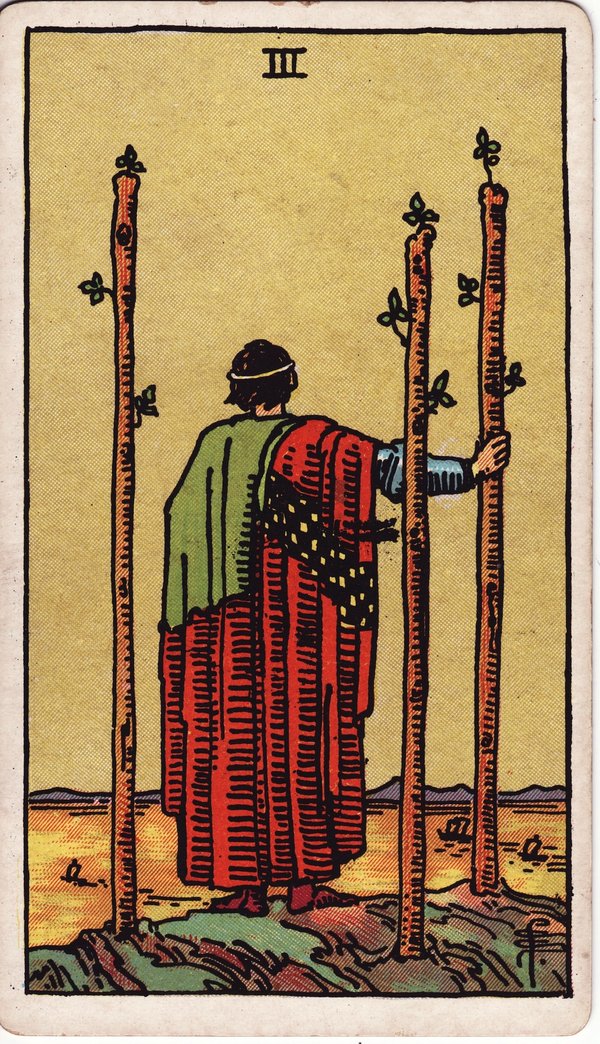
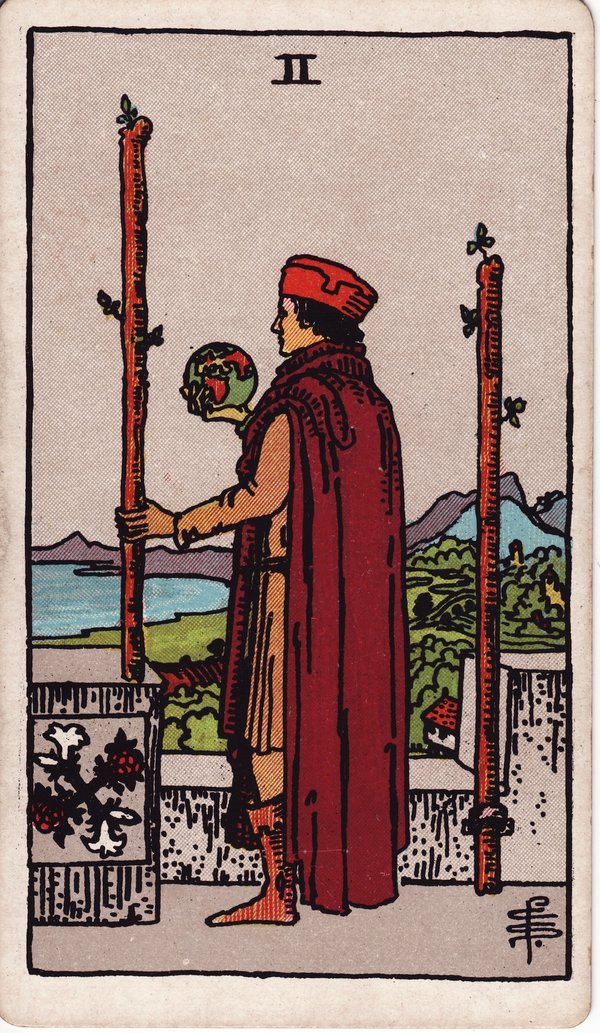
Rider-Waite-Smith (1909): The RWS Two of Wands depicts a wealthy merchant or lord standing on the battlements of a castle, holding a globe in his right hand and gazing out over a vast landscape. One wand is bolted to the wall behind him; the other he holds loosely. Beyond the parapet: a coastline, ships on the water, distant mountains — the entirety of the known world and the unknown beyond it.
The globe is the key symbol. This man holds the world — but he does not yet act with it. He surveys, considers, weighs. The bolted wand represents the stability of what he has already built (the castle, the resources, the position). The wand in his hand represents the as-yet-uncommitted fire — the power that is still mobile, still free, still capable of being directed anywhere. The ships on the horizon suggest trade routes, ventures, outward expansion. The Two of Wands says: you have the resources, you have the vision, you have the power — now choose the direction.
The figure stands between the security of the castle and the risk of the open sea. This is the essential tension of the Two: the comfort of what is known versus the call of what might be. He is dressed richly — he is not a beginner; he has already accomplished something. The Two is not the card of the novice but of the established person contemplating the next frontier.
Thoth (Crowley/Harris, 1944): The Thoth Two of Wands is radically different. It depicts two crossed wands — rendered as dorjes (Tibetan thunderbolt scepters, or vajras) — against a background of deep red-orange flame. The dorje is a symbol of indestructible power, the diamond thunderbolt that cuts through illusion. Where the RWS Two emphasizes the psychological moment of choice, the Thoth Two emphasizes the cosmic principle of directed force.
The crossed wands form a dynamic tension — they are not in conflict but in dialogue, two vectors of power intersecting at a point of decision. The flames behind them are the raw Fire of the Ace, now being shaped and channeled. Crowley's title, "Lord of Dominion," frames this card as an exercise of sovereignty: the self-possessed will that commands because it knows its own direction. There is no hesitation in the Thoth Two — there is the implacable pressure of Mars in Aries, the warrior who does not waver.
The key difference between traditions: RWS emphasizes the moment before the choice — the survey, the consideration, the held breath. Thoth emphasizes the act of choosing — the will that has already crystallized and now exerts dominion. Both are true. The Two of Wands is both the contemplation and the decision, the globe in hand and the wand already pointed.
Astrological & Elemental Layer
Mars in Aries, the 1st Decan of Aries (approximately March 21–30). This is Mars in its own sign — the planet of action, aggression, drive, and conquest operating in the sign of cardinal fire, the initiator, the pioneer. Doubled Mars in doubled Aries: this is the astrological signature of pure, undiluted forward momentum.
Mars governs the impulse to act, to assert, to claim territory. In Aries, that impulse is immediate and unfiltered — there is no Saturnine caution, no Mercurial calculation, no Venusian desire for harmony. The 1st Decan of Aries is the Mars decan (the decan ruled by Mars itself in the Chaldean system), intensifying the Martial quality even further. This is the warrior's first step onto the field — not yet engaged in battle but already committed to the fight.
The decan's energy colors the Two of Wands with urgency and authority. This is not the time for endless deliberation. The astrological layer insists: you know what you want — act on it. Mars in Aries does not suffer indecision gracefully. The shadow of this placement is impulsivity — choosing too quickly, acting before the terrain has been fully surveyed. The dignity of the Two lies in balancing Mars' urgency with the strategic awareness the card's imagery demands.
Kabbalistic / Tree of Life Layer
The Two sits in Chokmah — Wisdom, the second Sephirah, the first emanation into polarity. In the Tree of Life, Chokmah is the "father" principle: the first outward thrust of divine will, the masculine impulse that breaks the perfect unity of Kether and creates the possibility of relationship, distinction, and form.
Chokmah is the "I will" responding to Kether's "I am." In the suit of Wands, this means: the fire has found its first shape. The Ace's undifferentiated blaze becomes the Two's directed beam. Chokmah is wisdom not as accumulated knowledge but as the initial flash of insight — the moment when you suddenly see what must be done, before you can explain why.
The path from Kether to Chokmah is the first path on the Tree of Life, the primal channel of creation. The Two of Wands, sitting at Chokmah, represents the first step that the Ace's fire takes toward manifestation. Every subsequent card in the suit depends on this moment: if the direction chosen at Chokmah is true, the fire will find its way through Binah's form, Chesed's structure, all the way to Malkuth's completion. If the direction is false, the suit's entire journey will be a correction, a wandering, a return to source.
For the querent, the Kabbalistic layer suggests: the choice you make now is foundational. It sets the vector for everything that follows. Do not choose lightly, but also do not refuse to choose. Chokmah is not the place of endless deliberation — it is the place where wisdom flashes and direction crystallizes.
Sequential Narrative: Position in the Suit Story
← Previous card: Ace of Wands — the pure spark, the undifferentiated fire, the hand offering the wand. The Ace says "Here is creative power." The Two responds: "I will direct it there."
→ Following card: Three of Wands (Lord of Virtue, Sun in Aries) — the choice made at the Two becomes action at the Three. The ships the Two only surveyed are now launched; the direction is no longer theoretical but committed. The Two's strategic vision becomes the Three's implemented plan.
The Two's role in the arc: The Two of Wands is the hinge between inspiration and action. Without the Two, the Ace's fire burns in all directions and consumes nothing. The Two gives fire aim. It is the suit's first act of maturity — the recognition that having power is not enough; one must decide what to do with it.
Advising For / Advising Against
-
If advising FOR: Make the choice. You have deliberated enough; further deliberation is avoidance dressed as wisdom. The globe is in your hands — set it down and pick up the wand. The direction does not need to be perfect; it needs to be chosen. Mars in Aries does not ask for guarantees. It asks for commitment. Point the fire somewhere and begin.
-
If advising AGAINST: Do not confuse restlessness with readiness. The impulse to "do something" can be a flight from the discomfort of not knowing what to do. If the globe in your hands feels like a burden rather than a tool, you are not yet at the Two of Wands — you are still a tourist in the Ace. Wait until the direction feels not just exciting but inevitable. The true Two arrives as certainty, not as escape.
Card of the Day
Today, you are being asked to choose — not between good and evil but between one possible future and another. The choice will define what follows. Do not rush it, but do not defer it. Notice where your attention keeps returning. That is not random. The fire already knows where it wants to burn.
Card of the Year
A Two of Wands year — when this card appears as a dominant theme — is a year of pivotal decisions. The themes: choosing a career path, committing to a relationship, launching a venture, relocating, or making any long-term commitment that will shape the subsequent years. The energy is not of frenetic activity but of strategic positioning. You are on the battlements, surveying the kingdom. The work of the year is to decide what kingdom you intend to build — and then to take the first step off the parapet.
Elemental Dignities Notes
The Two of Wands is Fire in Chokmah — the first crystallization of pure Fire into directed will. In a spread, its elemental relationship to neighboring cards follows the Golden Dawn system:
- Strengthened by Fire (Wands): Multiple Wands adjacent to the Two intensify the pressure to choose and act. The fire builds, and the delay becomes unsustainable — the decision is forced, which can be clarifying or overwhelming depending on the querent's readiness.
- Strengthened by Air (Swords): Air feeds Fire — adjacent Swords bring intellectual clarity to the choice, helping the querent analyze options and commit with rational confidence rather than impulse alone.
- Weakened by Water (Cups): Water and Fire are enemies. Adjacent Cups may cloud the Two's clarity — emotional considerations, fears, and attachments can make a clean choice feel impossible. The Two's Mars-in-Aries decisiveness may drown in sentiment.
- Weakened by Earth (Pentacles): Earth smothers Fire. Adjacent Pentacles introduce practical constraints, financial considerations, or fear of losing security that can paralyze the Two's impulse to choose. The globe becomes too heavy to set down.
Yes / No Tendency
Leaning Yes — especially for questions about direction, commitment, and initiation. The Two of Wands affirms that the querent has the resources and clarity to move forward — the answer is yes, and the choice is yours to make. For questions about whether to delay or wait, the Two says no: Mars in Aries insists that not choosing is itself a choice, and usually the wrong one.
Timing & Manifestation
Seasonally, this card belongs to spring — Aries, the cardinal fire that initiates the astrological year, specifically March 21–30 (the 1st Decan of Aries, Mars in Aries). The moon phase is the New Moon: the moment before the first crescent, when intention is pure but not yet visible. Once the choice is made, manifestation accelerates rapidly — the astrological signature of Mars in Aries dictates that results follow within one lunar cycle. However, the planning phase itself may feel slow; the Two demands that the querent endure the waiting before the choosing.
Common Misreads / Nuances to Know
Misread 1: "The Two of Wands means you're stuck or indecisive." The figure on the battlements is not stuck — the survey is nearly complete. The Two represents readiness at the threshold, not paralysis. The decision is imminent, not absent.
Misread 2: "This card is purely about career and external ambition." Though the RWS imagery suggests a merchant surveying trade routes, the Two equally applies to spiritual commitments, creative direction, relational choices, or the decision to heal a wound. Dominion is over one's own life, not over a portfolio.
Misread 3: "The Two's advice is always to choose now, regardless of context." The card presses for movement, but surrounding cards matter. Adjacent Swords can indicate over-analysis; adjacent Cups can signal emotional attachments clouding the clarity. Sometimes the right choice is to wait — though the Two itself leans toward action.
Nuance for Thoth readers: Crowley's crossed dorjes emphasize already-chosen will, not deliberation. In a Thoth reading, treat the Two as confirmation that direction has been set rather than an invitation to decide.
Shadow & Integration Message
Shadow: The Two's shadow is sovereignty without purpose — the refusal to choose masquerading as strategic patience. The figure on the battlements can stay there indefinitely, globe in hand, never descending into the messy terrain of commitment. This shadow is especially seductive for capable people who have learned that choosing means risking failure. Better, the shadow whispers, to hold the world than to act in it. Mars in Aries, unredeemed, becomes the bully, the serial initiator who abandons every project the moment sustained commitment is required.
Integration: Integration of the Two's energy requires the courage to choose without a guarantee. No amount of surveying eliminates risk. The ships will still face storms; the venture may still fail. Integration means choosing anyway, naming what you fear losing, setting a deadline for the decision, and then cutting the rope. The Lord of Dominion rules by having chosen a kingdom; a kingdom chosen halfway is a rebellion waiting to happen.
Deck-Specific Notes
- If using a Thoth deck: The Two of Wands appears as crossed dorjes (vajras) against a field of flame. The emphasis is on the exercise of dominion rather than the contemplation of options. In a Thoth-based reading, treat this card as already decided — the will has chosen, and the question is now execution, not deliberation.
- If using a Marseille-tradition deck: The Marseille Two of Batons typically depicts two crossed staffs or batons, often forming an X against a plain or patterned background. The crossed wands represent the intersection of two forces, two wills, two possible directions. The stark simplicity of the Marseille image underscores the card's core meaning: a choice must be made.
- If using a blended or contemporary deck: The psychological and astrological layers apply across visual traditions. Consult your deck's guidebook for any departures from the RWS/Thoth framework.
Journaling & Contemplation Prompts
- What choice am I avoiding by pretending I need more information?
- If I knew I could not fail, what direction would I commit to today?
- What does "dominion" mean to me — and what am I afraid would happen if I fully claimed it?
- What would I do with my power if I stopped waiting for permission?
Additional Associations
| Association Type | Value |
|---|---|
| Color(s) | Deep red (Mars, dominion, will); orange-red (Aries fire, the first decan); gold (sovereignty, the globe) |
| Crystals / Stones | Bloodstone (Mars, courage, decisive action); Carnelian (Aries, initiative, creative fire channeled); Pyrite (strategic vision, claiming one's territory) |
| Herbs / Plants | Nettle (Mars, the sting of decisive action); Basil (Aries, royal herb of sovereignty); Cedar (strength, endurance, the long view) |
| Archetypes (Jungian) | The Sovereign; The Strategist; The Pioneer surveying the frontier |
| Mythological Figures | Alexander the Great (cutting the Gordian knot — the decisive choice); Odysseus (the long voyage home, the choice that defines a life); Ares/Mars (the warrior who knows what he fights for) |
| Numerological Resonance | 2 = duality, choice, the first polarity. Beth (ב) = 2, the house that receives the creative breath. The Two is the container for the One's fire. |
| Playing Card Equivalent | Two of Clubs — the first movement of the suit, the initial direction |
| I Ching Hexagram Parallel | Hexagram 3 — Zhun / Difficulty at the Beginning. The hexagram of the first steps after a new beginning, when direction is uncertain but must be chosen. "Difficulty at the Beginning works supreme success." |
| Body / Organ Correspondence | The head (Aries — the seat of decision, the commander of the body); the muscles (Mars — the body's engines of action); the adrenal system (the first surge, the readiness to move) |
Shadow & Integration Message
The Two of Wands' shadow is not simple indecision — it is the refusal of sovereignty. To truly choose a direction is to accept responsibility for the consequences of that choice. It is easier, in a way, to never choose — to keep the globe in hand, surveying the options, maintaining the illusion that all possibilities remain open. But the globe grows heavy. And the ships in the harbor, unlaunched, eventually rot.
A subtler shadow is the misuse of dominion: the Two as the tyrant, the one who rules not from vision but from fear of losing control. Mars in Aries, undignified, becomes the bully, the petty king, the authority that crushes rather than directs. The Lord of Dominion must learn that true sovereignty is not domination over others but alignment with one's own deepest will.
Integration of the Two's energy means making the choice — and then standing by it, adjusting course when needed but never pretending the choice was never made. It means claiming authority without becoming authoritarian, directing fire without extinguishing it, and holding the globe lightly even as you point the wand.