The Poetic Line
"The world calls it slowness. You call it reverence — every surface examined before the foot commits."
Keywords
| Category | Dignified | Undignified |
|---|---|---|
| General | Methodical progress, patient diligence, practical intelligence, reliability, steady effort, thorough preparation | Stubbornness, stagnation, plodding, obsession with detail, analysis paralysis, refusal to adapt |
| Spiritual | Grounded practice, devotion through discipline, sacred work, finding the infinite in the finite | Spiritual materialism, empty ritual, mistaking rigidity for devotion, using practice to avoid mystery |
| Psychological | Deliberate thinking, patience with process, realistic self-assessment, quiet confidence, focus | Obsessive rumination, perfectionism that prevents completion, risk-aversion that paralyzes, rigidity of thought |
| Physical Health | Consistent exercise routines, careful nutrition, methodical health practices, steady recovery | Obsessive fitness tracking, ignoring body's signals in favor of rigid protocols, neglecting flexibility for routine |
| Relationships | Steady loyalty, reliable partnership, slow-building trust, showing love through practical care, commitment | Emotional unavailability, treating relationships as projects, inability to be spontaneous, love expressed only through duty |
| Financial | Methodical saving, prudent investment, thorough research before spending, long-term planning, living within means | Miserliness, fear-based hoarding, inability to enjoy money, missed opportunities due to excessive caution |
| Vocational | Diligent craftsmanship, steady career advancement, reliable execution, quality over speed, mastery through repetition | Dead-end patience, staying in unfulfilling work out of fear, perfectionism that blocks delivery, ignoring innovation |
| Shadow / Thoth Distinction | The Prince as Charioteer of Earth: the intellect harnessed to material creation; the mind that builds what the heart imagines; the capacity to hold a vision steady through the long labor of realization | The mind that overthinks the ground until it cannot move: the Prince who analyzes the soil so thoroughly he never plants the seed; paralysis through precision |
Narrative Description
General Meaning
The Knight of Pentacles is the card of deliberate, methodical progress. In the suit of Earth, the Knight brings the element of Air — intellect, analysis, strategy — to the material world. This is not the flash of the Knight of Wands, charging toward inspiration, or the rush of the Knight of Cups, riding the wave of feeling, or the sharp velocity of the Knight of Swords, cutting through obstacles with speed. The Knight of Pentacles is the slowest of the four Knights, and this slowness is not a weakness but a feature: he moves at the pace of craft, of growth, of what is built to last.
The Knight of Pentacles understands that the material world rewards persistence over brilliance. He does not need to be the fastest or the most inspired — he needs to be the most reliable. In a reading, this card often signals a time for steady, focused effort rather than dramatic action. It counsels patience, thoroughness, and the willingness to do the unglamorous work that success actually requires. The Knight of Pentacles is the one who shows up every day, who checks the numbers, who does the maintenance, who keeps the operation running while others chase the next new thing.
The emotional register of this card is quiet and steady — there is no drama here, no urgent crisis. The Knight of Pentacles moves through the world with the calm of someone who has prepared for what is coming. His confidence is not loud; it is the confidence of competence, of having done the work, of knowing that the foundation will hold.
In the shadow, the Knight of Pentacles becomes stuck — so methodical that he cannot act, so careful that he cannot risk, so focused on detail that he loses the larger vision. The undignified Knight is the perfectionist who never ships, the saver who never spends, the planner who never executes. His patience becomes paralysis; his thoroughness becomes obsession; his reliability becomes rigidity. The lesson of this card, upright, is that slow is fine — but stopped is not.
Symbolism & Imagery
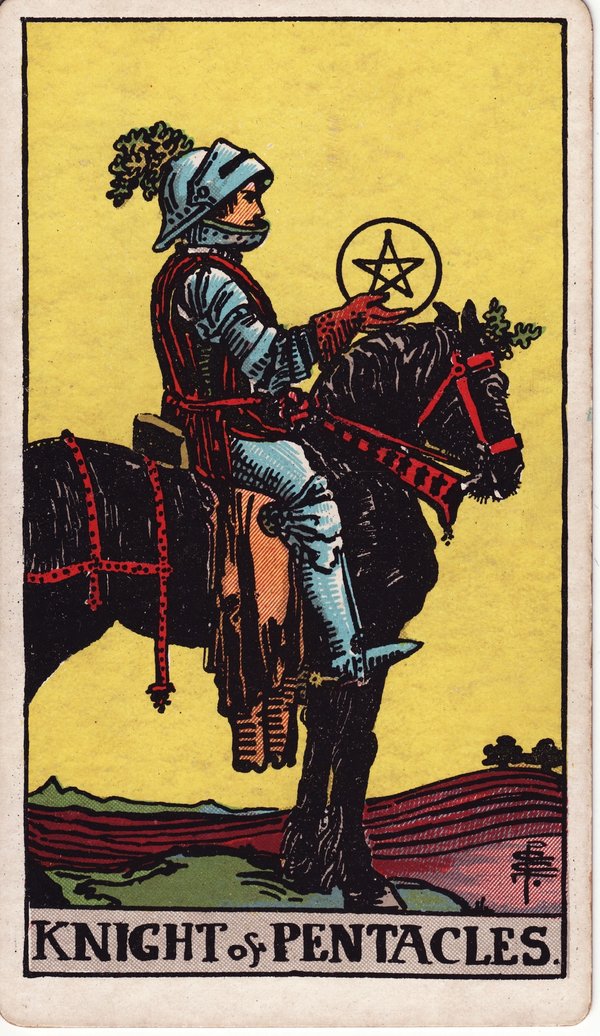
Rider-Waite-Smith (1909): Pamela Colman Smith's Knight of Pentacles sits upon a massive, stationary black horse in the middle of a plowed field. The horse is not moving — it is planted, statuesque, as solid as the earth beneath it. This is the only Knight in the RWS deck whose steed is not in motion. The Knight's posture matches: he gazes intently at the pentacle in his hand, studying it with the concentration of a surveyor examining a map.
The Knight wears heavy armor — practical, functional, not decorative — and his helmet is adorned with a plume of leaves, connecting him to the vegetative world. The sky behind him is a warm, golden-yellow, the color of ripe grain and harvest, not the dramatic reds or stormy grays of the other Knights' backgrounds. The entire scene is one of agricultural stillness: the field has been plowed, the soil is ready, and the Knight is pausing to assess before the next action.
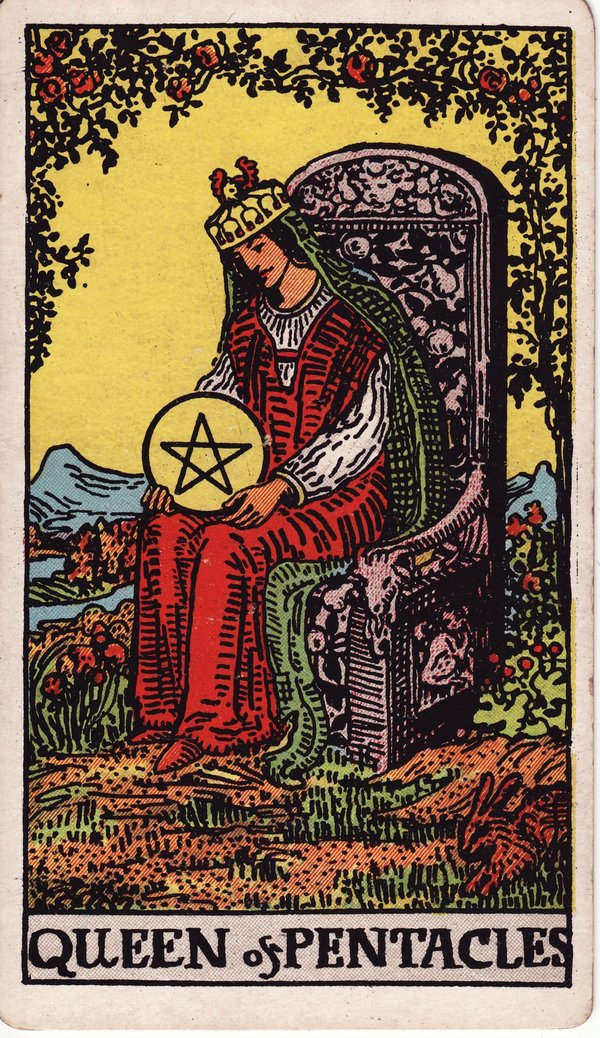
The pentacle he holds is not displayed to the heavens (like the Page) or offered to the world (like the Queen) — it is examined, analyzed, understood. This is the card of the mind applied to matter, and the Knight's gaze captures perfectly the quality of Air of Earth: intelligence in service of the tangible.
Thoth (Crowley/Harris, 1944): The Prince of Disks in the Thoth deck is a powerful figure riding a chariot drawn by a bull — the sacred animal of Taurus and a symbol of steadfast, generative power. The chariot is not a vehicle of speed but of force: it moves with the unstoppable momentum of a plow through soil. The Prince carries a flail (an agricultural implement of threshing) and a disk that bears the alchemical symbol of Earth, quartered by a cross. His armor is functional, his posture commanding but not aggressive.
Behind him, the landscape shifts from the barren heights of Aries into the fertile plains of Taurus — the decans he governs stretch across this threshold, from the last fire of spring's initiation into the steady warmth of earth's cultivation. The bull pulling his chariot grounds his authority in the generative power of the soil itself. The Prince of Disks does not conquer the earth — he works with it, channels it, directs its immense, slow power toward productive ends.
The key difference between traditions: RWS emphasizes the Knight's stillness — the pause to study, to plan, to ensure. Thoth emphasizes the Prince's motion — but it is the motion of a plow, not a racehorse. Both traditions agree on the essential quality: this court card moves with deliberation, not speed, and its power lies in its steadiness, not its swiftness.
Astrological & Elemental Layer
The Knight of Pentacles governs three decans across two signs, and this transition tells the story of his energy:
Aries III (Sun in Aries, ~April 11–19): The Knight inherits the final decan of Aries — the decan of the Sun, the decan of full, radiant expression. This is the last fire of spring's initiation, the concluding blaze of the Ram before the Bull takes over. The Sun in Aries gives the Knight a core of confidence and self-direction: he knows what he wants to build, and he carries the solar conviction that it is worth building. But this is Aries in its most tempered form — the third decan is often described as Aries "learning to share the stage," and for the Knight, this means translating the Ram's impulsive fire into sustained, patient effort.
Taurus I (Mercury in Taurus, ~April 20–29): The Knight's primary identity lies in the first two decans of Taurus. Taurus I, ruled by Mercury, is where the mind meets the soil. Mercury is the planet of thought, communication, and analysis; in Taurus, it thinks slowly, deliberately, practically. This is the decan of the craftsperson, the engineer, the farmer who plans the seasons. Mercury in Taurus does not theorize — it figures out what works. The Knight's methodical quality finds its astrological home here: the mind as tool, thought as applied practice.
Taurus II (Moon in Taurus, ~April 30–May 20): The second decan of Taurus is ruled by the Moon, which is exalted in this sign. Here, the Knight's practicality deepens into something more receptive and nurturing. The Moon in Taurus carries the quality of fertility — the soil that receives the seed, the patience that allows growth to happen at its own pace. This decan adds emotional steadiness to the Knight's intellectual method: he is not merely calculating but caring for what he builds. The Moon in Taurus is the decan of the gardener who tends as much as the engineer who plans.
Taken together, these three decans describe a figure who moves from the confident ignition of Aries into the steady, intelligent cultivation of Taurus. The Knight of Pentacles is the person who knows how to start a project and, more importantly, how to sustain it through the long middle where most efforts fail. His elemental nature — Air of Earth — means that his thinking is always grounded in the tangible. He does not abstract for its own sake; he analyzes in order to build.
Kabbalistic / Tree of Life Layer
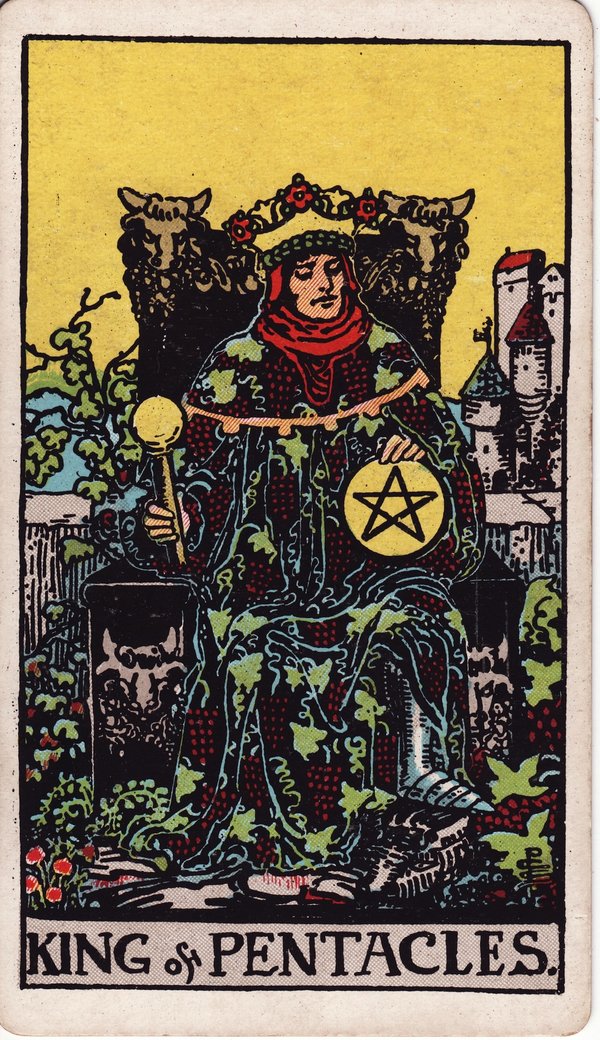
The Prince (Knight) sits in Tiphareth — the sixth Sephirah, the sphere of Beauty, Harmony, and the sacrificed and resurrected god. Tiphareth is the center of the Tree of Life, the point of balance between the supernal triad above (Kether, Chokmah, Binah) and the manifest triad below (Netzach, Hod, Yesod). As the mediating sphere, Tiphareth governs the integration of higher vision with lower practice — precisely the Knight of Pentacles' function: to take the abstract inspiration of the King and translate it into the methodical work of execution.
The Prince corresponds to the Qabalistic world of Yetzirah — the World of Formation, where ideas take on shape and structure before descending into material manifestation in Assiah (Malkuth). As Air of Earth, the Prince of Disks occupies a unique position: he brings the formative intelligence of Yetzirah (the architectural mind) into the densest element. He is the bridge between concept and concrete, the one who draws the plans that the Page will learn to execute and the Queen will nurture into flourishing.
The solar nature of Tiphareth — the sphere of the Sun — adds warmth and life-force to the Knight's methodical nature. He is not a cold calculator but a builder animated by genuine dedication. The sacrificed god of Tiphareth (Osiris, Christ, the Dying and Rising King) reminds us that what is built to last often requires the surrender of ego, the willingness to serve the work rather than one's own glory. The Knight of Pentacles builds not for recognition but because the work itself is sacred.
For the querent, the Kabbalistic layer suggests: the plans you are making, the work you are doing, is not merely practical — it is the mediating function of your own Tree of Life, translating higher purpose into material form. The patience you are cultivating is not just discipline; it is the Tipharethic capacity to hold the tension between aspiration and reality until they reconcile.
Representing a Person
As a person: The Knight of Pentacles represents someone who moves through the material world with methodical intelligence and unwavering reliability. This person is not flashy — they do not command a room with charisma (King) or nurture it with warmth (Queen) or charm it with fresh enthusiasm (Page). What they offer instead is something rarer: the quiet confidence of someone who has done the work and will continue to do it, regardless of whether anyone is watching.
The Knight of Pentacles is the person who reads the fine print, who checks the numbers twice, who keeps their commitments, who shows up on time, who finishes what they start — not because they are seeking approval but because this is simply how things are done. They are often found in professions that reward patience and precision: engineering, accounting, farming, surgery, carpentry, quality control, logistics. They are the person you want managing your retirement fund or building your house — not because they will dazzle you but because they will not fail you.
In shadow, the Knight of Pentacles becomes rigid, obsessive, and emotionally unavailable. They may confuse stubbornness for strength, or mistake their fear of change for wisdom. The undignified Knight is the micromanager, the hoarder, the perfectionist whose standards prevent any work from being finished. They may be so focused on the practical that they neglect the emotional and spiritual dimensions of life entirely.
As a mode of being: The Knight of Pentacles energy is what you embody when you commit to doing something thoroughly, correctly, and completely — regardless of how long it takes. This is the mode of the craftsman who refuses to cut corners, the investor who researches before buying, the partner who builds trust through consistent action rather than grand gestures. Call on this energy when you need steadiness, reliability, and the patience to see a long project through its middle.
Astrological personality traits: Grounded in Aries III and Taurus I–II, the Knight of Pentacles carries the initiating confidence of the Ram tempered by the Bull's patience. Typical traits include: determination, practicality, methodical thinking, reliability, stubbornness, sensuality, a strong work ethic, and a preference for the tried-and-true over the novel and unproven. The Solar Aries decan gives a core of self-belief; the Mercury-ruled Taurus decan gives analytical precision; the Lunar Taurus decan adds emotional steadiness and a nurturing relationship to the material world. This person is unlikely to be impulsive, flighty, or easily swayed by trends.
Thoth court name difference: In the Thoth system, the Knight of Pentacles becomes the Prince of Disks. The shift from "Knight" to "Prince" is significant: a Knight is defined by quest and combat, while a Prince is defined by inheritance and eventual sovereignty. The Thoth Prince is not merely a warrior on a mission — he is the heir apparent, the one being prepared to rule. This adds a dimension of gravitas and responsibility to the card. The Prince's methodical nature is not just caution; it is the preparation of one who knows the weight of what they will eventually carry. His elemental nature (Air of Earth) remains the same across both systems.
Advising For / Advising Against
-
If advising FOR: Commit to the long game. Do the thing thoroughly, not quickly. Check your work. Plan the steps before you take them. There is wisdom in slowness — not the slowness of hesitation but the slowness of craft, of growth, of what is built on a foundation that will not shift. The world is full of brilliant ideas that failed because no one did the unglamorous work of executing them. Be the one who executes. Show up. Follow through. Finish.
-
If advising AGAINST: You may be mistaking caution for wisdom. At some point, preparation becomes procrastination, and thoroughness becomes a way of never having to risk completion. Ask yourself: Are you still planning because the plan genuinely needs more work, or because planning feels safer than doing? Are you waiting for certainty that will never arrive? The Knight's shadow is the immobile horse — so focused on the ground that he forgets he can ride. Sometimes the most practical thing is to move forward with imperfect information. Done is better than perfect, and perfect is never done.
Card of the Day
Today calls for methodical, grounded effort. This is not a day for impulsive decisions, dramatic gestures, or chasing inspiration. It is a day for showing up, doing the work, and attending to the details. Slow down enough to do things correctly. Check your numbers. Read the fine print. Follow through on a commitment you made. The progress available today is quiet and incremental — it will not make headlines, but it will hold. Trust the pace. You are building something, and what is built to last is built one deliberate step at a time.
Card of the Year
A Knight of Pentacles year — while not a formal card-of-the-year calculation, which maps to Major Arcana — can be understood as a year-long invitation into methodical, patient labor within the material realm. This is a year to build something lasting: a career, a savings plan, a skill, a home, a body of work. The theme is not breakthrough but accumulation — the slow compounding of effort over time. You may feel frustrated by the pace at times. Other people may seem to be moving faster, achieving more, attracting more attention. The Knight of Pentacles reminds you that what matters is not speed but direction, not flash but foundation. This year, your task is to keep showing up. The harvest will come, but not yet. Right now, the work is the point.
Elemental Dignities Notes
The Knight of Pentacles is Air of Earth — the analytical mind applied to the material world. In a spread, its elemental relationship to neighboring cards follows the Golden Dawn system:
- Strengthened by Earth (Pentacles): Same-suit cards intensify the Knight's groundedness and practical focus. Additional Pentacles deepen his methodical nature, making his efforts more stable and his results more durable. However, too much Earth can tip him from patience into stagnation — the horse that will not move.
- Strengthened by Air (Swords): Same-element (Air) cards intensify the Knight's analytical quality. Adjacent Swords sharpen his thinking, add strategic clarity, and support his methodical approach. However, an excess of Air can pull him into abstraction and away from the hands-on engagement that is his strength.
- Weakened by Fire (Wands): Fire is Air's friend, but Fire's impulsiveness can destabilize Air of Earth's deliberate nature. Wands cards adjacent to the Knight may introduce impatience, push for speed over thoroughness, or agitate the steady pace he requires. Fire can help the Knight move when he is stuck, but it can also burn through his careful plans.
- Neutral / Mixed with Water (Cups): Water and Air do not have a strong dignity relationship in the classical system. A Cups card can either soften the Knight's dryness — adding emotional intelligence, receptivity, and relational awareness — or destabilize him by introducing emotional currents that his methodical nature struggles to process. The effect depends on the specific card and the surrounding spread.
Deck-Specific Notes
-
If using a Thoth deck: The Prince of Disks rides a chariot drawn by a bull, carrying a flail and a disk bearing the Earth symbol. The reading emphasis shifts from the RWS Knight's stillness-and-study to the Prince's slow-but-unstoppable forward motion — the plow that does not hurry but cannot be stopped. The Thoth Prince carries the gravitas of an heir apparent: his methodical nature is not just personality but preparation for sovereignty. The bull emphasizes the Taurus decans he rules and the fertile, generative quality of his earthiness.
-
If using a Marseille-tradition deck: The Cavalier de Deniers (Knight of Coins) is typically depicted on a stationary or slow-moving horse, holding a single coin. The Marseille Knight carries strong associations with thrift, caution, and the practical management of resources. His energy is steady rather than spectacular. In some Marseille versions, the Knight appears to be chasing a coin that remains just out of reach — a detail that can signal the fine line between prudent ambition and perpetual dissatisfaction.
-
If using a blended or contemporary deck: The core archetype — the methodical builder, the deliberate executor, the one who moves slowly because what they build must last — persists across visual traditions. Consult your deck's guidebook for any departures from the RWS/Thoth framework, particularly regarding astrological attributions and the Knight/Prince distinction.
Journaling & Contemplation Prompts
- Where in my life am I being asked to slow down and do something thoroughly rather than quickly? What would it cost me to honor that pace?
- Is my patience currently a form of wisdom or a form of avoidance? How would I know the difference?
- What am I building that will outlast the current season of my life? Am I attending to it with the steadiness it deserves?
- Where have I mistaken stubbornness for strength — persisting in a direction not because it is right but because changing course would require admitting I was wrong?
- What unfinished work in my life is waiting not for more planning but for the simple act of continuing?
Additional Associations
| Association Type | Value |
|---|---|
| Color(s) | Golden yellow (harvest, solar Tiphareth, ripe grain); deep brown (earth, soil, grounding); green (fertility, Taurus vegetation); in Thoth: the colors of plowed earth and the bull's fertile plain |
| Crystals / Stones | Tiger's Eye (grounded confidence, practical wisdom, the solar energy of Tiphareth); Hematite (grounding, methodical energy, protection during long labor); Green Jade (Taurus stone — patience, steadiness, prosperity through persistence) |
| Herbs / Plants | Oak (steadiness, strength that grows slowly, endurance); Comfrey (healing through patience, the "knitbone" plant — mending what is broken through steady application); Wheat (sustenance, the harvest of methodical cultivation) |
| Archetypes (Jungian) | The Craftsman / Artisan; The Steadfast Soldier; The Senex (the wise old man in his mature, grounded aspect — not yet the King, but no longer the youth) |
| Mythological Figures | Hephaestus (the divine smith who works the forge with patient mastery while the other gods chase drama); the Tortoise in the race with the Hare; Atlas (the one who holds the weight of the world — not because he is flashy but because he is reliable) |
| Numerological Resonance | Unnumbered — the mode of action before the destination, the journey that defines the arrival. As Air (intellect), carries the mental number 1 (singular focus) applied to Earth's 4 (stability, structure). |
| Playing Card Equivalent | Jack of Diamonds (sometimes associated with the mounted Knight in some systems) — but the Knight's closest playing-card analogue is ambiguous; some systems map him to a face card of the Diamond suit |
| I Ching Hexagram Parallel | Hexagram 53 — Chien / Development (Gradual Progress). "The wild goose gradually draws near the shore." The hexagram of slow, steady advancement — the marriage that takes years to arrange, the tree that takes decades to mature. Like the Knight of Pentacles, it teaches that what develops gradually cannot be rushed without damage. |
| Body / Organ Correspondence | The neck and throat (Taurus — the bull's neck, the voice, the passage between mind and body); the hands as instruments of craft; the skeletal structure (the earth element within the body, the framework that holds everything else). Mercury in Taurus suggests the nervous system as it governs fine motor control and methodical, practiced movement. |
Shadow & Integration Message
The Knight of Pentacles' shadow is paralysis disguised as prudence. It is the craftsman who never finishes the piece because it is never quite right, the investor who never deploys capital because the market might dip tomorrow, the partner who never commits because the timing isn't perfect. This is the shadow of analysis without action — Air so thoroughly applied to Earth that it grinds the soil to dust without ever planting the seed.
Deeper still is the Knight's potential for emotional withholding. Air of Earth can become so focused on the practical, the measurable, the efficient that it neglects the intangible dimensions of life: feeling, spontaneity, mystery, play. The shadow Knight of Pentacles is the person who provides everything material to their family but withholds emotional presence — the reliable provider who is also an absent parent, an unavailable partner.
Integration of this energy means honoring the Knight's gift for method, patience, and thoroughness while also knowing when to put down the analysis and act. It means allowing oneself to be spontaneous occasionally — to move before every variable is calculated, to trust that the foundation is solid enough to support some weight. The integrated Knight is the person whose reliability is a gift, not a cage — who can plan meticulously and then, when the time comes, commit fully.
Elemental Intelligence (Suit Framing)
In the Jungian cognitive function mapping, Pentacles (Earth) aligns with the Sensation function — direct, concrete engagement with reality. The Knight of Pentacles adds Air to this Sensation base: the intellect applied to the tangible. This is Sensation governed by Thinking — the cognitive orientation of the engineer, the craftsperson, the strategist who deals in facts and measurements rather than theories and abstractions.
In the humoural frame, the Knight of Pentacles corresponds to a tempered melancholic — the earth humour balanced by the air, preventing the melancholic's tendency toward depression from overwhelming the capacity for useful action. His "class" is the skilled laborer or the master craftsperson: neither the landless Page nor the sovereign King, but the one who has achieved competence through training and now applies it with consistency. He represents the dignity of work well done, the honor of the methodical middle.
Timing & Manifestation
The Knight of Pentacles governs the period from approximately April 11 to May 20 — Aries III through Taurus II. In a timing question, this card suggests that events will unfold during this window of the year, or more symbolically, during a period of deliberate, unhurried progress that spans approximately 30–40 days from the time of the reading.
The Knight's timing is never immediate: he moves at the pace of craft, not crisis. If this card appears in a timing position, expect the situation to develop methodically, with visible progress but no dramatic leaps. The message is: It is happening. It is moving. But it will take the time it takes — and that time is part of the process, not a delay in it.
Yes / No Tendency
The Knight of Pentacles leans toward Yes, with patience. The affirmation is qualified: yes, the outcome is achievable, the project can succeed, the goal can be reached — but not quickly, not without sustained effort, and not without attending to the details. If the querent is asking "Will this happen soon?", the answer tends toward no — or at least, not as soon as they hope. If they are asking "Is this worth pursuing?", the answer is yes, provided they are willing to commit to the long work.
In reversed / ill-dignified position, the tendency shifts toward not yet or not this way — the path is blocked not by impossibility but by an approach that is too cautious, too rigid, or too perfectionistic to succeed. The reversal asks: What are you refusing to risk? What step are you avoiding by over-preparing?
Common Misreads / Nuances to Know
Misread 1: "The Knight of Pentacles is boring." The Knight is not boring — he is deliberate, which is a different quality entirely. The impatience that finds him dull says more about the observer than about the Knight. There is profound intelligence in slowness, in the refusal to be rushed, in the willingness to do one thing thoroughly rather than many things superficially. The Knight of Pentacles rewards those who can sit with him long enough to see what he is building.
Misread 2: "This card means you should never take risks." The Knight counsels preparation and thoroughness, not risk-avoidance. The difference is crucial: a risk assessed and prepared for is not the same as a risk avoided. The Knight's methodical nature does not mean he never acts — it means he acts informed. He would say: take the risk, but do your homework first.
Misread 3: "The stopped horse means you're stuck." In the RWS image, the horse is not stopped because it cannot move — it is stopped because the Knight is surveying the field before choosing his direction. This is a pause of strategy, not of paralysis. The distinction matters in a reading: if the querent is genuinely stuck (reversed), the card is asking them to examine what fear or perfectionism is immobilizing them, not confirming that immobility is the correct state.
Nuance for Thoth readers: The Prince of Disks is in motion — his chariot drawn by a bull moves with the unstoppable force of a plow. If you are reading primarily with the Thoth deck, balance the RWS emphasis on stillness and study with the Thoth emphasis on slow but irreversible forward movement. The Prince is not pausing to plan; he is executing the plan, at the pace that the material world requires.