The Poetic Line
"Her abundance is not stored — it flows. A well dug deep enough does not need to withhold."
Keywords
| Category | Dignified | Undignified |
|---|---|---|
| General | Abundance, nurturing, sensuality, practicality, generosity, grounded warmth, material comfort | Overindulgence, possessiveness, smothering, materialism without spirit, neglect of self while caring for others |
| Spiritual | Embodied spirituality, sacred sensuality, finding the divine in the physical, gratitude as practice | Spiritual bypassing through comfort, using luxury to avoid inner work, worshipping the gift instead of the giver |
| Psychological | Emotional security, self-worth rooted in being not having, grounded confidence, generosity of spirit | Insecurity masked by accumulation, defining self through possessions, fear of scarcity driving hoarding, codependence |
| Physical Health | Vital physical health, attunement to the body's needs, healthy sensuality, nourishing self-care | Overindulgence in food/drink/comfort, neglecting health while caring for others, using the body without honoring it |
| Relationships | Nurturing partnership, physical affection, creating a warm home, generosity, showing love through tangible care | Smothering, possessiveness, enabling through over-giving, equating material provision with emotional presence |
| Financial | Financial abundance, generous giving, wise stewardship, enjoying wealth without attachment, investing in comfort and beauty | Hoarding, spending to fill emotional voids, financial codependence, mistaking net worth for self-worth |
| Vocational | Career that nourishes others, work that engages the senses, prosperity through service, creating beauty and comfort | Staying in a nurturing role that has become draining, undervaluing one's own labor, conflating professional identity with personal worth |
| Shadow / Thoth Distinction | The Queen as Binah-in-Matter: the capacity of the Divine Mother to manifest abundance in the physical world; the generosity that flows not from excess but from connection to Source | The Queen who gives until she is empty: nurturing that has become compulsive, generosity that masks an inability to receive, the mother who has forgotten she also needs mothering |
Narrative Description
General Meaning
The Queen of Pentacles is the card of grounded abundance — not wealth for its own sake, but wealth as a medium of care. She is the archetypal nurturer of the material world: the one who feeds, who provides, who makes the home warm and the body comfortable and the earth fertile. Her energy is deeply sensual without being hedonistic, practical without being cold, generous without being self-erasing.
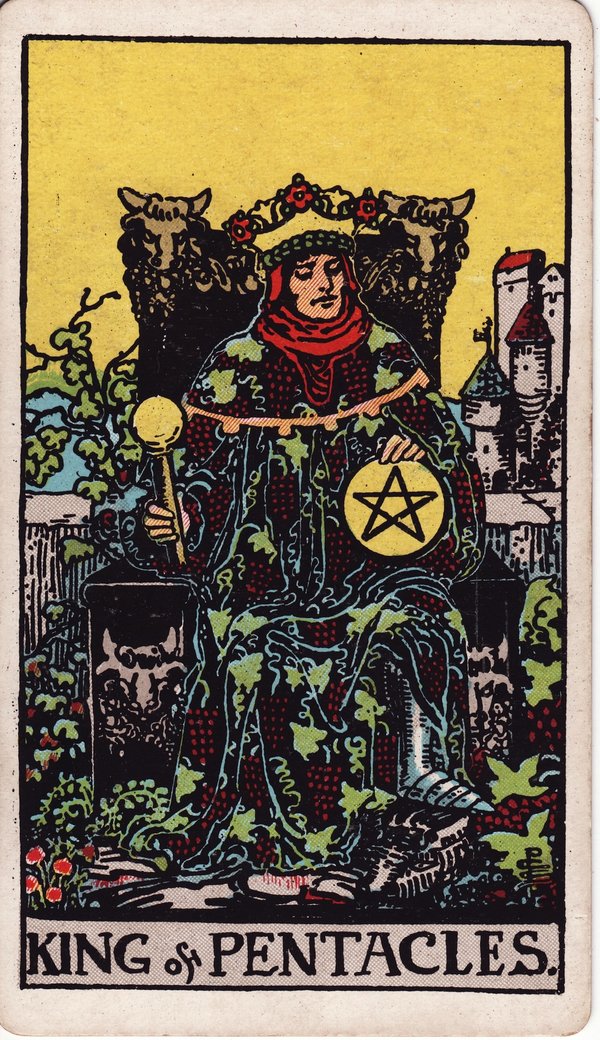
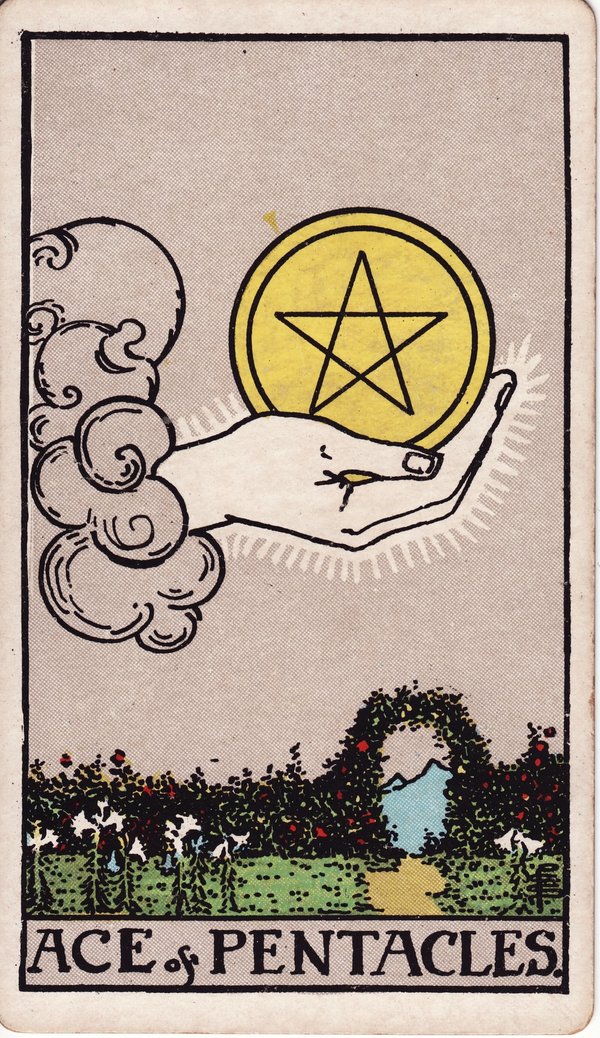
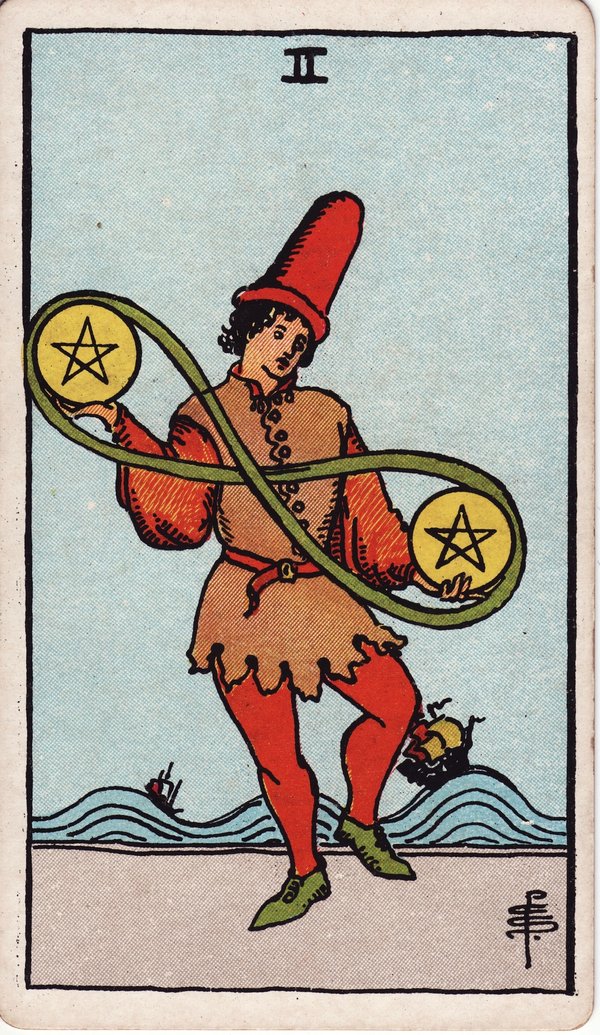
Where the Page studies the coin, the Knight plans with the coin, and the King commands the coin, the Queen enjoys the coin — and shares it. She understands, at a cellular level, that the purpose of material abundance is to nourish life. She is the card of the garden in full bloom, the kitchen that smells of fresh bread, the home that welcomes, the body that is celebrated rather than judged. She represents a relationship with the physical world that is neither ascetic rejection nor compulsive grasping but reverent, grateful participation.
In a reading, the Queen of Pentacles often signals a time of material or physical flourishing — financial stability, embodied health, domestic warmth, sensual pleasure. But more fundamentally, it signals an attitude toward the material world: one of gratitude, care, and responsible enjoyment. The Queen asks: Can you receive abundance without guilt? Can you share it without resentment? Can you hold the coin without being possessed by it?
The emotional register of this card is warm and steady. There is no anxiety here — the Queen of Pentacles has done the work, secured the foundation, and now rests in the pleasure of what she has cultivated. Her confidence is not the King's commanding authority but a quieter, more relational security: the confidence of knowing that she can provide, that the pantry is full, that the garden will yield, that the body is trustworthy.
In the shadow, the Queen of Pentacles can tip into overindulgence, possessiveness, or compulsive caretaking. The undignified Queen is the mother who smothers, the provider who uses gifts as control, the sensualist who has lost the boundary between enjoyment and addiction. Her generosity, when distorted, becomes a way of avoiding her own needs — giving so constantly to others that she forgets she is also worthy of receiving.
Symbolism & Imagery
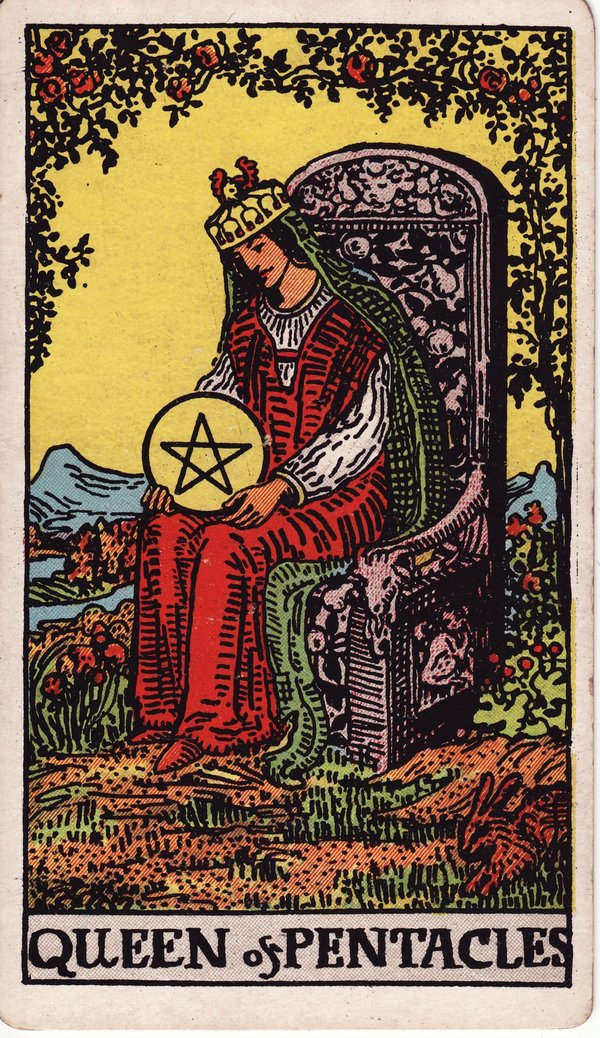
Rider-Waite-Smith (1909): Pamela Colman Smith's Queen of Pentacles sits upon a stone throne carved with images of fruit, vines, and the head of a goat — symbols of fertility, abundance, and Capricorn. She gazes down at the large golden pentacle cradled in her lap with an expression of serene, intimate affection — not the awe of the Page or the analysis of the Knight but the knowing love of someone who has held this coin long enough to understand it fully.
The landscape around her is lush and abundant: green grass, flowering plants, trees heavy with leaves. A small rabbit hops into the frame at the lower right — a symbol of fertility, quick reproduction, and the generative power of the earth. Behind her, a rose-covered arbor arches over the scene, and beyond that, a river winds through rolling hills toward distant mountains. The entire composition suggests a world that is fertile, cultivated, and at peace.
The Queen's robes are rich but comfortable — fine fabrics worn with ease, not ostentation. Her crown is modest, her posture relaxed. She holds the pentacle as though it is a living thing — a child, a pet, a beloved object — and her fingers curl around it with protective tenderness. This is not the grip of a miser but the embrace of a mother.
Thoth (Crowley/Harris, 1944): The Queen of Disks in the Thoth deck sits before a barren, wintry landscape transformed by her presence into a place of hidden fertility. She holds a large disk (the Earth symbol quartered by a cross) and a scepter topped with a globe. Her throne is adorned with vegetative motifs, and behind her head rests a crown or halo of interlocking spheres. A single flowering plant pushes through the snow at her feet.
The Thoth Queen carries a gravitas that complements the RWS Queen's warmth. She is described by Crowley as the "Queen of the Thrones of Earth," the "Queen of the Gnomes." Her domain is not the surface fertility of summer but the deep fertility of winter — the earth that holds the seed through the cold months, the mother who keeps the hearth lit while the world outside is frozen. Her barren landscape is not absence but latency: everything that will grow in spring is already present, held in her care.
The key difference between traditions: RWS emphasizes the Queen's active, visible abundance — the garden in bloom, the rabbit hopping, the overflowing fertility of summer. Thoth emphasizes her role as the keeper of winter's hidden life — the abundance that is preserved and protected through the lean season, the mother whose warmth makes survival possible. Both are true: the Queen of Pentacles is both the harvest and the seed bank, both the feast and the preservation of what will become the next feast.
Astrological & Elemental Layer
The Queen of Pentacles governs three decans across two signs, and this transition reveals the arc of her energy: from the questing fire of late Sagittarius into the grounded, ambitious stability of early Capricorn.
Sagittarius III (Sun in Sagittarius, ~December 11–21): The Queen inherits the final decan of Sagittarius — the decan of the Sun, the decan of full radiant expression and the completion of a quest. Sagittarius is the sign of the seeker, the archer aiming at distant horizons, the philosopher riding toward meaning. By the third decan, the quest is concluding — the archer has traveled far and is now, symbolically, turning homeward. The Sun in this decan gives the Queen a core of warmth, optimism, and expansive generosity: she has seen the wide world and chosen, not out of limitation but out of wisdom, to cultivate her own garden. Her abundance is not parochial — it is informed by having known both the far horizon and the hearth.
Capricorn I (Jupiter in Capricorn, ~December 22–31): The Queen's primary identity lies in the first two decans of Capricorn. Capricorn I, ruled by Jupiter, is a fascinating decan: the planet of expansion, luck, and generosity operating within the sign of discipline, structure, and ambition. Jupiter in Capricorn does not scatter its blessings — it concentrates them, builds with them, makes them last. This is the decan of the wise steward, the philanthropist who knows how to make money work, the provider who understands that generosity requires structure. The Queen's practical wisdom and her ability to enjoy wealth without losing herself to it have their astrological root here.
Capricorn II (Mars in Capricorn, ~January 1–20): The second decan of Capricorn is ruled by Mars, which is exalted in this sign. Mars in Capricorn is disciplined force — ambition channeled into sustained effort, drive harnessed to structure. This decan adds a quality of determined competence to the Queen's nurturing nature: she is not passive in her care but actively, skillfully engaged. Mars in Capricorn is the energy of the mountain goat that never stops climbing, but the Queen's Water nature tempers this with receptivity and emotional intelligence. She is ambitious not for ambition's sake but for what her achievements make possible — the security that allows generosity, the abundance that enables care.
Taken together, these three decans describe a figure who moves from the completion of a spiritual quest into the grounded work of building a life. The Queen of Pentacles has not abandoned the seeker's fire — she has brought it home. Her abundance is the fruit of that integration: the wisdom of the sage applied to the soil, the generosity of the philosopher expressed through the kitchen and the garden and the body.
Kabbalistic / Tree of Life Layer
The Queen sits in Binah — the third Sephirah, Understanding, the Supernal Mother. Binah is the great sea from which all forms arise, the feminine principle that receives the raw, undifferentiated force of Chokmah (Wisdom) and shapes it into the particular vessels of creation. Binah is associated with Saturn (structure, limitation, time) and with the element of Water (the primordial ocean, the womb of all things).
All four Queens are Water of their respective elements, and Water is Binah's element. The Queen of Pentacles, as Water of Earth, represents Binah's nurturing intelligence applied to the densest level of creation — the material world. She is the mother not of abstract ideas or spiritual aspirations but of actual, tangible things: the body that is fed, the home that is warm, the earth that is fertile. She is Binah incarnate in Malkuth — the Supernal Mother reaching all the way down into the kingdom of matter and making it bloom.
The Saturnine quality of Binah is often overlooked in the Queen of Pentacles, but it is essential: her nurturing is not formless indulgence but structured, disciplined care. Saturn gives her the wisdom to set boundaries, to know when enough is enough, to preserve as well as to provide. She is the mother who knows that love sometimes means saying no, that generosity without limits becomes depletion. The Saturnine Queen of Pentacles is the one who tends the garden through winter as well as summer.
For the querent, the Kabbalistic layer suggests: the abundance you are experiencing (or seeking) has its source not in your effort alone but in your connection to the formative, nurturing principle of the cosmos itself — Binah, the Mother, the source of all vessels. The question is not just "How can I get more?" but "How can I become a better vessel for what flows through me?" The Queen of Pentacles teaches that true abundance is not accumulation but circulation — receiving from Source and giving to the world, without hoarding or depleting either end of the circuit.
Representing a Person
As a person: The Queen of Pentacles represents someone who embodies grounded, generous abundance. This person is warm without being effusive, practical without being cold, and deeply connected to the physical world — the body, the home, the garden, the kitchen, the senses. They are the friend whose house always smells like something cooking, who remembers what you like to eat, who gives gifts that are thoughtful and tangible rather than abstract. They are often found in professions that involve nurturing through material means: chef, farmer, midwife, physical therapist, interior designer, financial advisor, anyone whose work nourishes bodies or homes or bank accounts.
The Queen of Pentacles is not flashy — her wealth, whether financial or otherwise, is worn quietly, used more than displayed. She takes genuine pleasure in the material world but is not enslaved by it: she can enjoy a fine meal without needing it, appreciate a beautiful object without coveting it. Her relationship to abundance is characterized by gratitude rather than grasping. She gives freely because she trusts that the well will be replenished — not through magical thinking but through the disciplined stewardship that ensures the well never runs dry.
In shadow, the Queen of Pentacles can become the smothering mother, the compulsive caretaker, the person whose identity is so wrapped up in providing for others that she has lost herself. She may use gifts and favors as a form of control, or equate her value with her output. The undignified Queen is also the sensualist who has crossed into addiction — food, drink, comfort, shopping — using the material world to numb rather than to nourish.
As a mode of being: The Queen of Pentacles energy is what you embody when you tend to the physical world with love: cooking a meal from scratch, tending a garden, decorating a room, caring for your body, managing your finances with both wisdom and enjoyment. This is the mode of the gracious host, the wise steward, the person who understands that the material world is not an obstacle to spiritual life but a medium for it.
Astrological personality traits: Grounded in Sagittarius III and Capricorn I–II, the Queen of Pentacles carries the expansive, questing warmth of the Archer tempered by the Goat's discipline and ambition. Typical traits include: generosity, sensuality, practicality, emotional warmth, financial wisdom, a love of comfort and beauty, strong nurturing instincts, and a quiet but unshakeable competence. The Solar Sagittarius decan gives a core of optimism and big-heartedness; Jupiter in Capricorn adds the ability to build lasting structures of abundance; Mars in Capricorn provides the disciplined drive to achieve what she sets out to accomplish. This person is unlikely to be frivolous, cold, or disconnected from the physical realities of life.
Thoth court name difference: The name "Queen" is the one court card title that is consistent across the RWS and Thoth systems — the Queen of Pentacles is the Queen of Disks. However, the Thoth Queen's symbolism (the wintry landscape, the barren earth hiding its fertility) emphasizes her role as preserver and protector of abundance through lean seasons, while the RWS Queen's imagery emphasizes the active, visible flourishing of summer. The elemental nature (Water of Earth) and the decans remain the same in both traditions.
Advising For / Advising Against
-
If advising FOR: Embrace the material world as a legitimate domain of spiritual practice. Your body is worthy of care. Your home is worthy of beauty. Your finances are worthy of wisdom. The Queen of Pentacles invites you to enjoy what you have without guilt, to share what you have without resentment, and to trust that tending the tangible is not a distraction from higher things but a direct expression of them. Feed someone. Plant something. Make something beautiful. Receive abundance with gratitude, and let it flow through you to others.
-
If advising AGAINST: Examine your relationship with giving. Are you nurturing others at the expense of nurturing yourself? Is your generosity a form of control, a way of keeping people dependent or indebted? Is your relationship with the material world tipping from enjoyment into dependency — food, drink, shopping, comfort becoming an anesthetic rather than a pleasure? The Queen's shadow is the empty well — the provider who has given everything and forgotten that she, too, needs to receive. If this card appears in a cautionary position, it asks: Who tends the gardener?
Card of the Day
Today carries the energy of grounded abundance and sensory delight. This is a day to tend to the physical world with love — cook a meal with attention, care for your body, make your space more beautiful, share something tangible with someone you care about. Notice the goodness that is already present: the warmth of the sun, the taste of food, the comfort of a chair, the presence of people you love. You don't need to produce anything today. Receive, enjoy, and share what is already here. Let yourself be nurtured. Rest in the abundance that surrounds you.
Card of the Year
A Queen of Pentacles year — while not a formal card-of-the-year calculation — can be understood as a year-long invitation into the nurturing stewardship of the material world. This is a year to cultivate abundance: in your finances, your home, your body, your relationships with the tangible. The theme is not acquisition for its own sake but flourishing — the garden tended until it overflows, the home made warm until it welcomes, the skills developed until they become generous. The challenge of this year is balance: the Queen's shadow is depletion through over-giving, and you may need to learn, for the first time, that receiving is as sacred as providing. The gift of this year is the deep, embodied knowledge that abundance is real, that the earth is generous, and that you are worthy of pleasure.
Elemental Dignities Notes
The Queen of Pentacles is Water of Earth — the nurturing, receptive, emotional quality of Water applied to the material world. In a spread, its elemental relationship to neighboring cards follows the Golden Dawn system:
- Strengthened by Water (Cups): Same-element cards intensify the Queen's emotional receptivity and nurturing warmth. Adjacent Cups deepen her capacity for connection, empathy, and relational intelligence — though an excess of Water can tip her from grounded nurturing into emotional overwhelm or sentimentality.
- Strengthened by Earth (Pentacles): Earth strengthens Earth. Same-suit cards deepen the Queen's practicality, material security, and connection to the body and the tangible. Multiple Pentacles cards around the Queen suggest a season of genuine material abundance and stability.
- Weakened by Air (Swords): Air is Earth's enemy in elemental dignity. Swords adjacent to the Queen may introduce over-analysis, detachment, or intellectual abstraction that cuts against her warm, embodied, sensory nature. The Queen's nurturing can be undermined by cold logic or excessive worry.
- Mixed with Fire (Wands): Fire does not strengthen or weaken Earth in classical dignity — it transforms it. Wands cards can bring creative energy, initiative, and warmth that amplify the Queen's generosity, but excess Fire can burn through her patience, push toward haste, or agitate her steady, receptive pace into restless productivity.
Deck-Specific Notes
-
If using a Thoth deck: The Queen of Disks sits before a barren winter landscape, holding a disk and scepter, with a single plant pushing through snow at her feet. The reading emphasis shifts from the RWS Queen's active, overflowing abundance to the Thoth Queen's role as the preserver of life through the dormant season. She is the mother of winter as much as summer — the one who keeps the hearth lit, the seed bank safe, the body fed through the cold months. Her abundance is hidden but no less real.
-
If using a Marseille-tradition deck: The Reine de Deniers (Queen of Coins) is typically depicted seated, holding a single coin and gazing at it as though it were a crystal ball — seeing futures in the coin, reading the material world for signs of what is to come. The Marseille Queen carries strong associations with providence, foresight, and the wisdom to prepare for lean times during fat ones. Her energy is the prudent steward as much as the generous host.
-
If using a blended or contemporary deck: The core archetype — the nurturing steward of material abundance, the one who tends the physical world with love — persists across visual traditions. Consult your deck's guidebook for any departures from the RWS/Thoth framework, particularly regarding astrological attributions.
Journaling & Contemplation Prompts
- Where in my life am I giving generously and where am I giving compulsively? Is there a difference I can feel in my body?
- How comfortable am I receiving — compliments, gifts, help, pleasure? What would it take to receive as graciously as I give?
- What is my relationship with my body right now? Do I treat it as a garden to be tended or a machine to be managed?
- When I think of "having enough," what arrives in my mind — a number, a feeling, an image? What would "enough" actually feel like in my body?
- What one sensual pleasure — a food, a texture, a scent, a sound — could I give myself permission to fully enjoy today?
Additional Associations
| Association Type | Value |
|---|---|
| Color(s) | Rich green (fertility, vegetation, the flourishing garden); deep gold (harvest, abundance, the ripe coin); warm brown (earth, home, the hearth); in Thoth: the colors of winter earth and the hidden life beneath snow |
| Crystals / Stones | Rose Quartz (nurturing love, the heart's generosity, self-care); Malachite (abundance, transformation of the material, the green of growing things); Citrine (prosperity, solar warmth, the optimism of the Jupiter-ruled decan) |
| Herbs / Plants | Rose (beauty, sensuality, the flower of Venus and the heart); Basil (abundance, the herb of kings and kitchens, prosperity through care); Apple (nourishment, fertility, the fruit of the earth mother in every tradition) |
| Archetypes (Jungian) | The Great Mother (in her nurturing, providing aspect); The Caregiver; Demeter (the goddess whose grief at losing her daughter renders the earth barren — and whose joy makes it bloom again) |
| Mythological Figures | Demeter (goddess of the harvest, the mother who makes the earth fertile through love); Hestia/Vesta (goddess of the hearth and home, the sacred center of abundance); Lakshmi (Hindu goddess of prosperity, beauty, and generosity — wealth as a spiritual quality, not merely a material one) |
| Numerological Resonance | Unnumbered — the mode of nurturing before the harvest, the sustaining presence that enables all subsequent fruition. As Water, carries the receptive number 2 (partnership, receptivity, the vessel) applied to Earth's 4 (stability, structure, manifestation). |
| Playing Card Equivalent | Queen of Diamonds — the mature feminine figure of the material suit, the queen of wealth and practical wisdom |
| I Ching Hexagram Parallel | Hexagram 37 — Chia Jên / The Family (The Clan). "The family. The perseverance of the woman furthers." The hexagram of the well-ordered home, the nourishing hearth, the family that thrives because each member is cared for. Like the Queen of Pentacles, it teaches that abundance is not just having but tending — the daily attention that keeps the household fed, warm, and whole. |
| Body / Organ Correspondence | The womb (Binah — the vessel of creation, the generative feminine); the breasts (nourishment, the body's first gift of sustenance); the digestive system (the body's alchemical apparatus for turning matter into energy — the Queen transforms the raw into the nourishing). Capricorn governs the knees and skeletal structure; the Queen's Saturnine discipline manifests through the body's framework. |
Shadow & Integration Message
The Queen of Pentacles' shadow is depletion disguised as devotion. It is the mother who has given every meal, every comfort, every resource to others and has nothing left for herself — not because she is generous but because she has forgotten that she, too, is worthy of care. This is the shadow of the compulsive nurturer: the one who cannot sit at the table until everyone else is served, who cannot rest until everything is done (and everything is never done), who uses providing for others as a way of avoiding the terrifying question of what she herself needs.
Deeper still is the Queen's potential for materialism-as-substitute — using food, drink, shopping, or sensual pleasure to fill a void that only meaning can address. The undignified Queen mistakes having for being, comfort for fulfillment, the coin for what the coin represents. She may become possessive — of people, of objects, of wealth — because she has lost the connection to Source that made her abundance flow freely in the first place. The hoarding Queen is a Queen who has forgotten Binah, forgotten that the well refills only when it also gives.
Integration of this energy means learning to receive as well as give. It means tending to one's own body, one's own pleasure, one's own well-being with the same devotion one brings to others. It means trusting that the earth is abundant, that the source is inexhaustible, and that generosity is sustainable only when the giver is also nourished. The integrated Queen of Pentacles is the one who lights the hearth fire and then sits beside it — not as a servant but as a woman who has earned her place in the warmth.
Elemental Intelligence (Suit Framing)
In the Jungian cognitive function mapping, Pentacles (Earth) aligns with the Sensation function — direct, concrete engagement with reality. The Queen of Pentacles adds Water to this Sensation base: the nurturing, receptive, emotionally intelligent quality applied to the tangible. This is Sensation governed by Feeling — the cognitive orientation of the caregiver, the host, the person for whom the material world is always already relational. A meal is never just food; a home is never just shelter; a coin is never just currency. The Queen of Pentacles feels the emotional and spiritual weight of every material thing.
In the humoural frame, the Queen of Pentacles corresponds to a balanced phlegmatic — the water humour tempered by the earth, producing steadiness, patience, and deep reserves of nurturing energy rather than the phlegmatic's shadow tendency toward inertia or apathy. Her "class" is paradoxical: she has the abundance of the sovereign class but the hands-on engagement of the laboring class — the lady of the manor who is also in the kitchen, the CEO who knows every employee's name. She transcends class through care.
Timing & Manifestation
The Queen of Pentacles governs the period from approximately December 11 to January 20 — Sagittarius III through Capricorn II. In a timing question, this card suggests that events will unfold during this winter window, or more symbolically, during a season of abundance that follows a period of preparation and preservation. The Queen's timing is not immediate but neither is it distant — she operates on the scale of seasons, the rhythm of growth and harvest.
The Queen's timeframe is mature and realistic: she does not promise overnight results but the steady accumulation of what has been carefully tended. If she appears in a timing position, the message is: The harvest is real, it is coming, and it will arrive in its season — not before. In the meantime, there is warmth to share and work to do. Neither is wasted.
Yes / No Tendency
The Queen of Pentacles leans strongly toward Yes. She is one of the most affirmative cards in the deck, particularly for questions related to material security, physical well-being, domestic harmony, financial stability, and sensual pleasure. Her yes is not the explosive yes of the Ace or the triumphant yes of The Sun — it is a quieter, steadier affirmation: yes, there is enough; yes, you are safe; yes, the garden will yield; yes, you can afford to be generous.
In reversed / ill-dignified position, the tendency shifts toward Yes, but at a cost — the abundance is real but the querent is depleting themselves in the process of achieving or maintaining it. The question becomes not "Will it happen?" but "Is the way you are pursuing it sustainable?" The reversal asks: Who is paying for this abundance, and is it you?
Common Misreads / Nuances to Know
Misread 1: "The Queen of Pentacles is just a 'mom' card." The Queen of Pentacles is a mothering archetype, but mothering is not restricted to literal parenthood or to women. To mother is to nurture, to tend, to protect, to feed — anyone, of any gender, can embody this energy. The Queen's domain is the material expression of care, which is as relevant to the CEO managing a company's finances as to the parent managing a household.
Misread 2: "This card means you're rich or should become rich." The Queen's abundance is not measured by net worth — it is measured by the quality of her relationship to the material world. A person with modest means can embody the Queen's energy more fully than a billionaire who is possessed by their possessions. The Queen of Pentacles is about the experience of abundance — the gratitude, the generosity, the embodied pleasure — not the quantity of assets.
Misread 3: "Reversed, this card means poverty or financial loss." The reversed Queen of Pentacles is more often about misrelationship to abundance than about its absence. The issue is not that there is not enough but that the querent's relationship to what they have is distorted — through hoarding, overindulgence, compulsive giving, or using material comfort to avoid emotional or spiritual work. The reversal is an invitation to examine the psychology of abundance, not a prediction of scarcity.
Nuance for Thoth readers: The Thoth Queen of Disks is surrounded by a barren landscape — snow, bare trees, frozen ground. This is not poverty; it is latency. She is the mother of winter, preserving the seed through the cold, keeping the hearth lit, waiting with patience for the spring she knows is coming. A Thoth reading should not interpret the barrenness as lack but as the hidden abundance of the dormant season — all the life of the coming year is already present, held in her care, invisible but real.