The Poetic Line
"The coin in your palm is heavy. The earth holds your weight. Wonder has already arrived — mastery can wait."
Keywords
| Category | Dignified | Undignified |
|---|---|---|
| General | Diligent study, grounded beginnings, practical curiosity, patient apprenticeship, learning by doing | Superficial effort, laziness, impractical dreaming, neglecting fundamentals, boredom with the basics |
| Spiritual | Embodied practice, sacred attention to the mundane, finding spirit in matter, beginner's reverence | Spiritual materialism, using practice to avoid real engagement, shallow faith without embodiment |
| Psychological | Openness to learning, patience with one's own ignorance, wonder, growth mindset, humility | Impatience with process, intellectual arrogance, refusal to be a beginner, judging competence prematurely |
| Physical Health | Beginning a fitness practice, learning about nutrition, listening to the body, slow steady progress | Neglecting physical needs, starting and abandoning health routines, obsessing over appearance over wellness |
| Relationships | Patient courtship, learning how to love well, physical affection grounded in tenderness, steady reliability | Immature attachment, rushing physical intimacy, treating relationships as projects, avoiding emotional depth |
| Financial | Starting a savings plan, learning financial literacy, practical budgeting, earning through honest labor | Financial naivety, spending before understanding, get-rich-quick thinking, ignoring practical constraints |
| Vocational | Apprenticeship, entry-level commitment, skill-building, willingness to start at the bottom, craftsmanship | Entitlement without effort, job-hopping without learning, dismissing entry-level work, refusing mentorship |
| Shadow / Thoth Distinction | The Princess as Throne: the capacity to receive and crystallize spiritual force into material form; the alchemical vessel that must be prepared before transformation can occur | The vessel refusing to hold: scattering energy before it can crystallize; the princess who will not sit still long enough to become a queen; distraction as avoidance of embodiment |
Narrative Description
General Meaning
The Page of Pentacles is the card of the earnest beginner — the student who has not yet mastered the craft but who brings to it an irreplaceable quality: genuine curiosity. In the suit of Earth, this beginner's mind turns toward the tangible world: money, the body, physical skills, the land, and anything that can be built, held, or counted. The Page does not need to be competent yet. What the Page brings is willingness — the willingness to be clumsy, to ask obvious questions, to try and fail and try again.
Where the Ace of Pentacles offers the seed of material opportunity, the Page is the one who kneels to plant it. The energy is slow, steady, and grounded. This is not the flash of inspiration (Wands) or the rush of feeling (Cups) or the sharp clarity of analysis (Swords). This is the patience to sit with something until you understand it through your hands. The Page of Pentacles learns by doing — by holding the coin, by working the soil, by moving the body.
In a reading, this card often indicates a new material or practical beginning: starting a job, learning a skill, opening a savings account, beginning a health regimen. But more fundamentally, it signals an attitude — the decision to approach the physical world with reverence and curiosity rather than with entitlement or indifference. The Page asks: What if you treated your body like a text worth studying? Your finances like a craft worth learning? The earth itself like a teacher worth listening to?
The shadow of this card is not malice but distraction. The undignified Page loses interest before the skill is acquired, mistakes enthusiasm for competence, or chases novelty rather than depth. The Page reversed is the student who never becomes the practitioner — not because they lack capacity but because they lack the patience to be a beginner for as long as beginnerhood requires.
Symbolism & Imagery
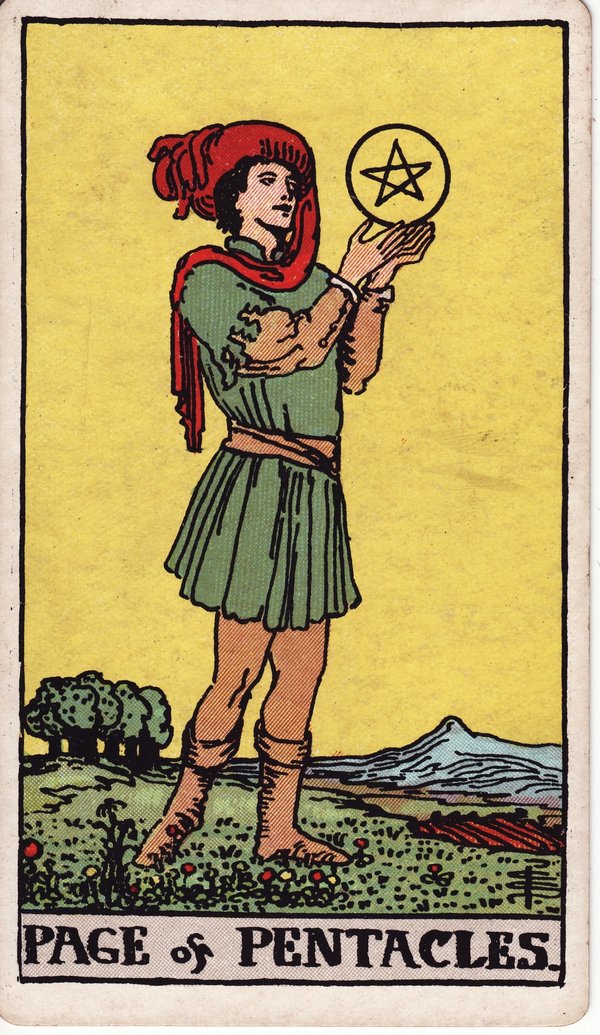
Rider-Waite-Smith (1909): Pamela Colman Smith's Page of Pentacles is a young figure standing in a field of green grass and blooming flowers, holding a single pentacle aloft with both hands, gazing at it with quiet fascination. The pentacle floats above the palms — it is not grasped or hoarded but held reverently, like an object of study, a gift being examined with care.
The landscape is fertile and calm. Rolling hills rise in the distance, cultivated fields stretch behind, and a stand of trees anchors the scene. There is no drama here — no cliffs, no storms, no urgency. This is the quiet countryside, the pace of growth rather than the speed of ambition. The Page's tunic is green, the color of vegetation, growth, and the heart chakra, and the beret or cap suggests a student's attire. His feet are planted. He is not going anywhere — he is arriving into presence.
The single pentacle is the focus. Unlike the Ace, which presents the coin as a divine gift from the clouds, the Page has taken the gift into his own hands and is learning what it means. The pentacle's five-pointed star within the circle — spirit manifesting through the four elements — is here approached not as a symbol but as an object: this particular coin, this particular body, this particular patch of earth.
Thoth (Crowley/Harris, 1944): The Princess of Disks in the Thoth deck is a powerful, grounded figure standing before an altar-like structure in a wintry or late-autumn landscape. She holds a large disk engraved with the symbol of the Earth — a circle quartered by a cross — and a staff (wand) that bears the globe of Malkuth, the sphere of Earth. Behind her head rises the headdress of the ram (Aries), and at her feet grow grain and vegetation pushing through snow. Her shield bears the alchemical symbol of Earth.
The Thoth Princess carries a gravitas that the RWS Page's lightness does not emphasize. She is the "Princess of the Echoing Hills," the "Rose of the Palace of Earth." She is not merely a student — she is the throne, the vessel through which the elemental force of Earth enters manifestation. Her pregnant belly suggests fecundity, the capacity to bear form into the world. The staff she holds represents her authority over the material plane; she does not merely study Earth — she is Earth's representative at the threshold of being.
The key difference between traditions: RWS emphasizes the beginner's innocence and wonder. Thoth emphasizes the Princess's role as the material terminus of a cosmic current — she is not learning Earth so much as she is the instrument through which Earth learns itself at the densest level of existence.
Astrological & Elemental Layer
The Page of Pentacles is Earth of Earth — the only court card to carry the same element in both positions (rank and suit). All other court cards mix two elements: a King is Fire of [element], a Queen is Water of [element], a Knight is Air of [element]. The Page alone is Earth of [element] — and so the Page of Pentacles is Earth doubled, the densest, most grounded, most materially focused energy in the entire court.
This doubling has profound implications. Earth of Earth does not move quickly. It does not theorize, romanticize, or abstract. It is. It is the soil that receives the seed, the body that receives sensation, the hand that receives the tool. The Page of Pentacles is not trying to transform Earth into something else (as Fire of Earth, the King, would) or to understand Earth conceptually (as Air of Earth, the Knight, would) or to nurture Earth into flourishing (as Water of Earth, the Queen, would). The Page simply attends to Earth — with the reverence of someone who knows that all higher operations depend on this foundation.
Pages/Princesses rule quadrants of the heavens rather than temporal decans. The Princess of Disks governs the Northern Quadrant — the zone of the sky around the North Pole. This is not a span of calendar dates but a region of space: the axis around which the heavens turn, the still point. Symbolically, this placement suggests that the Princess's function is not to move through time but to provide the stable referent against which movement is measured. She is the throne, the fixed point, the ground.
In the Golden Dawn system, the Princesses are described as "thrones" of their elements — the receptive, feminine pole that receives the force emanated by the Kings (the "masculine" initiators). Without the Princess, the King's fire has nowhere to land. Without the Princess, the Queen's nurturing has no vessel. She is the material endpoint of every spiritual current, the incarnation without which all higher operations remain theoretical.
Kabbalistic / Tree of Life Layer
The Princess (Page) sits in Malkuth — the tenth Sephirah, the Kingdom, the sphere of Earth and physical manifestation. Malkuth is the densest point on the Tree of Life: it receives the combined currents of all nine Sephiroth above it and crystallizes them into material form. The Princess's position in Malkuth means she is not traveling the Tree but receiving the Tree — she is the throne upon which the entire structure rests.
Qabalistically, Malkuth is associated with the Shekhinah — the indwelling feminine presence of the divine in the material world. The Princess of Disks, as Earth of Earth in Malkuth, represents the Shekhinah in her most embodied form: divinity not as transcendent light but as the ground beneath your feet, the body you inhabit, the coin in your hand.
The four Princesses together represent the four elements as they manifest in Malkuth — the complete material expression of the Tree's energies. The Princess of Disks is the most Malkuthian of all: Earth in the sphere of Earth. She is the point where the abstract architecture of the Tree becomes a particular place, a particular body, a particular life.
For the querent, the Kabbalistic layer suggests: whatever you are beginning exists not only as an idea or a feeling but must ultimately take form. The Princess of Disks asks you to ground your spiritual or intellectual work in practice — to build, to save, to move, to touch. Malkuth is not a lesser sphere because it is dense; it is the purpose of the entire Tree.
Representing a Person
As a person: The Page of Pentacles represents someone who approaches the material world with fresh eyes — a student, an apprentice, a novice who is earnest, attentive, and unashamed of their inexperience. This person may be young in age or simply young in a particular domain. They are curious about how things work, willing to start at the bottom, and patient with the slow accumulation of skill. They find genuine pleasure in small material tasks — gardening, budgeting, organizing, crafting — and they approach these with a reverence that others might reserve for spiritual practice.
In shadow, the Page of Pentacles can manifest as someone who never moves beyond beginner status — perpetually starting new practices, new savings plans, new skills, without ever achieving depth in any of them. They may confuse buying the equipment with doing the work, or mistake enthusiasm for discipline. They may also become pedantic — the novice who, having learned one thing, treats it as the whole truth.
Physically, the Page of Pentacles is often associated (in folk systems) with dark hair and eyes, an earthy complexion, and a sturdy build — but this is a physicalist tradition that modern readers may choose to set aside in favor of the archetypal personality.
As a mode of being: The Page of Pentacles energy is what you embody when you allow yourself to be a beginner without shame. It is the decision to learn something new — a language, a craft, a physical discipline — and to approach it with patience, curiosity, and humility. This mode is especially valuable when you have been operating from expertise for too long and have forgotten the generative power of not-knowing.
Astrological personality traits: Since the Page of Pentacles does not govern a temporal decan, its personality traits are drawn more from its elemental nature (Earth of Earth) than from a specific zodiacal signature. The typical traits include: groundedness, patience, sensuality, practicality, reliability, a strong connection to the body and the natural world, and a tendency toward slowness and deliberation. The Page may share traits with the earth signs (Taurus, Virgo, Capricorn) but is not limited to them.
Thoth court name difference: In the Thoth system, the Page of Pentacles becomes the Princess of Disks. The shift from "Page" to "Princess" is significant: a Page is a servant in training, while a Princess is a sovereign in waiting, the daughter of the King and Queen. The Thoth Princess carries more dignity and power than the RWS Page — she is not merely learning Earth but ruling its threshold, governing the point where spirit becomes matter. Her elemental nature (Earth of Earth) remains the same across both systems.
Advising For / Advising Against
-
If advising FOR: Begin. Do not wait until you feel ready — readiness is a byproduct of doing, not a prerequisite for it. Approach the material dimension of your life — your body, your finances, your physical space — with the curiosity of a student. Ask the simple questions. Practice the fundamentals. Let yourself be clumsy. The competence you are seeking lives on the far side of the practice you are avoiding. Start small, but start now.
-
If advising AGAINST: Do not mistake enthusiasm for discipline, or equipment for practice. The beginner's mind is sacred, but it is not an endpoint — it is a doorway. Are you perpetually starting and never deepening? Are you using "learning" as an excuse to avoid producing, performing, or committing? The Page's shadow is the eternal student who never graduates. If this card appears in a cautionary position, ask yourself whether it is time to stop preparing and start doing.
Card of the Day
Today carries the energy of the devoted beginner. Something in your life is inviting you to approach it as if for the first time — with fresh eyes, open hands, and the willingness to be inexperienced. This is not a day for grand gestures or dramatic breakthroughs. Small, grounded acts: saving five dollars, taking a walk, learning one new thing about your body or your craft. Pay attention to the physical world. Notice textures, temperatures, weights. There is wisdom in the tangible. Let yourself be a student of what is right in front of you.
Card of the Year
A Page of Pentacles year — while not a formal card-of-the-year calculation, which maps to Major Arcana — can be understood as a year-long invitation into beginner's mind within the material realm. This is a year to learn a new physical skill, to establish financial literacy, to begin treating your body as a subject of study and care. The theme is not achievement but apprenticeship: the slow, steady accumulation of competence through repeated practice. The challenge of this year is patience — the work will feel tedious at times, and the rewards will not arrive quickly. The gift of this year is foundation. Everything built later will rest on what you learn now. Honor the slowness. It is not a delay; it is the point.
Elemental Dignities Notes
The Page of Pentacles is Earth of Earth — the most grounded, stable, and dense of all court cards. In a spread, its elemental relationship to neighboring cards follows the Golden Dawn system:
- Strengthened by Earth (Pentacles): Same-element cards intensify and stabilize each other. Adjacent Pentacles cards deepen the Page's groundedness, making her more reliable, more patient, and more materially effective — though at risk of becoming inert or overly conservative.
- Strengthened by Water (Cups): Water nourishes Earth. A Cups card adjacent to the Page softens her seriousness with emotional warmth, adding receptivity and tenderness to her practicality.
- Weakened by Air (Swords): Air is Earth's enemy in elemental dignity. Swords adjacent to the Page may introduce over-analysis, abstraction, or restlessness that undermines her grounded, hands-on approach. The student may become lost in theory at the expense of practice.
- Mixed with Fire (Wands): Fire does not strengthen or weaken Earth in classical dignity — it transforms it. Wands can bring energy, initiative, and creative heat to the Page's methodical nature, but too much Fire may burn through patience, push too fast, or agitate what needs to grow slowly.
Deck-Specific Notes
-
If using a Thoth deck: The Princess of Disks appears as a pregnant, grounded woman before an altar, holding a disk and a staff, with Aries ram's horns in her headdress and vegetation pushing through snow at her feet. The reading emphasis shifts from "student learning about the material world" to "throne of Earth receiving and crystallizing cosmic force." The Thoth Princess carries a gravitas and sacred function that the RWS Page's light curiosity does not fully convey. She is the Shekhinah in Malkuth — divinity in its most embodied form.
-
If using a Marseille-tradition deck: The Valet de Deniers (Page of Coins) is typically depicted as a standing youth holding a single coin, often gazing at it with fascination. In many Marseille versions, a second coin lies at his feet, unnoticed — a detail that highlights the Page's tendency to fixate on one thing and miss the larger picture. The Marseille Page carries stronger associations with practical learning and financial beginnings than with the cosmic function of the Thoth Princess.
-
If using a blended or contemporary deck: The core archetype — the devoted student of the material world, the beginner approaching the physical with reverence — persists across visual traditions. Consult your deck's guidebook for any departures from the RWS/Thoth framework, particularly regarding the Page/Princess distinction and astrological attributions.
Journaling & Contemplation Prompts
- What skill, practice, or domain of knowledge have I been avoiding because I do not want to be a beginner again? What would it cost me to be clumsy for a season?
- Where in my life am I treating my body, my finances, or my physical environment as an afterthought rather than as a subject worthy of study and care?
- What would change if I approached one material task today — cooking, cleaning, budgeting, exercising — with the full attention of a student rather than the efficiency of an expert?
- How patient am I with my own learning process? Do I allow myself the time it takes to become competent, or do I judge myself for not already knowing?
- What is the difference between "keeping busy" and practicing? Which am I doing more of?
Additional Associations
| Association Type | Value |
|---|---|
| Color(s) | Green (vegetation, growth, the heart chakra); brown (earth, soil, grounding); gold (the coin, material value); in Thoth: the colors of winter earth and spring shoots |
| Crystals / Stones | Moss Agate (grounding, connection to earth, beginner's stone of gardening and growth); Green Aventurine (opportunity, luck in new ventures, heart-centered practicality); Smoky Quartz (grounding, patience, steadying the scattered mind) |
| Herbs / Plants | Patchouli (earth connection, grounding, fertility); Sage (practical wisdom, clearing space for new learning); Wheat / Cereal Grains (sustenance, patience, the slow growth of what nourishes) |
| Archetypes (Jungian) | The Student / Apprentice; The Innocent; The Child (pre-competence, pre-identity); The Alchemical Vessel (in Thoth) |
| Mythological Figures | Persephone before her descent (the maiden of spring, learning the world of growing things); Hephaestus as a youth (the divine craftsman before his mastery); the Chinese folk hero who learns a single task for years before becoming a master |
| Numerological Resonance | Unnumbered — the zero-before-one, pure potential without sequence, the beginner who stands outside the story waiting to enter |
| Playing Card Equivalent | Jack of Diamonds — the young servant or messenger of the material suit |
| I Ching Hexagram Parallel | Hexagram 4 — Mêng / Youthful Folly. "It is not I who seek the young fool; the young fool seeks me." The hexagram of the student who must ask sincerely and the teacher who answers only when the question is genuine. Like the Page, it speaks to the sacredness of beginner's mind and the danger of shallow inquiry. |
| Body / Organ Correspondence | The hands (the instruments of learning-by-doing, the body's primary tool of craft); the bones and skeletal structure (the earth element within the body — stability, foundation); the skin (the boundary between self and world, the organ of touch and sensation). In the Thoth system, the Princess of Disks rules the Northern Quadrant, associated with the grounding and stabilizing functions of the physical body. |
Shadow & Integration Message
The Page of Pentacles' shadow is not incompetence — it is the refusal to move beyond incompetence. It is the person who owns every book on the shelf but has read none of them deeply, who starts a new diet every Monday, who buys the running shoes but never runs, who romanticizes the idea of mastery while avoiding the tedium of practice. This is the shadow of the perpetual beginner — the one who mistakes novelty for progress and equipment for capability.
Deeper still is the Page's potential for materialism disguised as learning. The undignified Page can become obsessed with acquisition — more courses, more certifications, more tools — without ever applying what has been acquired. The shadow asks: Are you learning, or are you consuming the appearance of learning?
Integration of this energy means honoring the beginner's mind — the genuine openness, the willingness to be clumsy, the reverence for fundamentals — while also committing to the discipline that beginnerhood eventually demands. The integrated Page is the lifelong learner who is not afraid to be a novice but who also finishes what they start. They carry the beginner's curiosity into the practitioner's depth. They know that the first step is sacred, but so is the hundredth.
Elemental Intelligence (Suit Framing)
In the Jungian cognitive function mapping — which maps the suits to Jungian cognitive functions, humours, and class theory — Pentacles (Earth) aligns with the Sensation function, the melancholic humour, and the laboring/productive class. Sensation is the function of direct, concrete engagement with reality — the opposite of Intuition (Wands), which deals in patterns and possibilities. The Sensation type lives in the actual rather than the potential, the specific rather than the general.
The Page of Pentacles (Earth of Earth) is Sensation doubled — pure attunement to the physical, the tangible, the here-and-now. In the humoural frame, this is the melancholic turned from its shadow (depression, inertia) toward its light (depth, patience, reverence for the real). The Page's class — the laboring class — is here seen not as a station of limitation but as a station of dignity: the one who works with their hands, who learns the world through the body, who knows that everything spiritual must eventually become physical to matter.
Timing & Manifestation
Pages do not govern temporal decans in the Golden Dawn/Thoth system — they rule quadrants of celestial space rather than spans of the calendar. As a result, the Page of Pentacles offers a timing answer that is less chronos-bound than the other court cards: "When you are ready to begin — and no sooner." The Page's timeframe is governed not by the calendar but by the querent's willingness to be a beginner.
In folk timing systems, the Page of Pentacles is associated with the period from approximately March 21 through June 20 (Aries through Gemini), which can serve as an approximate seasonal window. But the deeper timing message of this card is: the event will manifest when you stop waiting to feel prepared and start acting. The Page does not rush, but neither does it delay indefinitely. Its pace is the pace of growth — steady, organic, unhurried but unceasing.
Yes / No Tendency
The Page of Pentacles leans toward Yes, but slowly. This is not the immediate yes of the Ace or the dramatic yes of The Chariot. The Page's yes is conditional on patience: yes, the opportunity exists; yes, the path is available; yes, the skill can be acquired — but only through steady, sustained effort over time. If the question is "Will this happen quickly?", the answer is no. If the question is "Is this worth beginning?", the answer is yes.
In reversed / ill-dignified position, the tendency shifts toward not yet — the timing is wrong, the preparation is insufficient, or the querent is approaching the matter with the wrong attitude (entitlement, impatience, or shallow curiosity rather than genuine willingness to learn). The path is not closed, but it requires a different approach.
Common Misreads / Nuances to Know
Misread 1: "The Page is an immature or childish person." The Page is not immature — it is inexperienced, which is a different quality entirely. Immaturity refuses to learn; inexperience simply has not yet learned. The Page's openness is not naivety but a deliberate posture of receptivity that even the most experienced practitioners must periodically reclaim.
Misread 2: "The Page means you should go back to school or get a certificate." The Page can indicate formal education, but more often it points to experiential learning — the kind that happens through the hands, the body, the daily practice. The Page is less about credentialing and more about apprenticeship to the real.
Misread 3: "Earth of Earth means this card is boring or slow." The Page of Pentacles operates at a different frequency than the faster suits, but its slowness is not a weakness — it is a feature. The patience to sit with a single coin, a single practice, a single question until it reveals its depth is a form of intelligence that the faster elements often lack. The Page's "boredom" is the restlessness of an unquiet mind encountering a quiet truth.
Nuance for Thoth readers: The Princess of Disks is not a student in the RWS sense — she is the throne of Earth, the material terminus of the entire Tree of Life. A Thoth reading that pulls this card should emphasize her sacred function as receiver and crystallizer of cosmic force, her role as the Shekhinah in Malkuth, and her gravitas as a sovereign-in-waiting rather than a mere apprentice. She is Earth learning itself at the densest level of being — and that density is not limitation but completion.