The Poetic Line
"The throne was not inherited — it was grown, ring by ring. The only wealth that matters is what outlasts the builder."
Keywords
| Category | Dignified | Undignified |
|---|---|---|
| General | Mastery, prosperity, authority, reliability, material wisdom, seasoned judgment, sovereignty earned through competence | Greed, tyranny, materialism without soul, stagnation, using wealth to control others, losing humanity to the role |
| Spiritual | The sacredness of stewardship, wisdom embodied in action, the spiritual dimension of work well done, legacy as devotion | Worshipping the creation instead of the creator, spiritual emptiness beneath material success, mistaking power for enlightenment |
| Psychological | Self-mastery, quiet confidence, patience born of experience, maturity, the integrated ego in service of something larger | Arrogance, smugness, rigidity, fear of change disguised as conservatism, identifying so completely with the role that the person disappears |
| Physical Health | Robust constitution, disciplined physical practice, the body as well-maintained instrument, vitality sustained through habit | Neglect of health for work, the body as afterthought, stress-related illness from the burden of control, indulgence rationalized as reward |
| Relationships | Steadfast commitment, providing security, protecting loved ones, reliability, love expressed through dependable action | Emotional unavailability, patriarchal control, equating financial provision with presence, using generosity as leverage |
| Financial | Financial independence, wise investment, wealth built through disciplined accumulation, prosperity shared with purpose | Hoarding, miserliness, wealth as identity, fear-driven accumulation, money as the only measure of worth |
| Vocational | Career mastery, executive leadership, entrepreneurship, building institutions, mentoring the next generation, the dignity of competence | Ruthless ambition, treating people as resources, clinging to power past relevance, the empire that outgrows its founder's humanity |
| Shadow / Thoth Distinction | The Knight as Father of Earth: the masculine initiatory fire that drives material creation; the capacity to envision, build, and steward an enduring legacy; the King who rules not to dominate but to serve the kingdom | The King who has become the mask: sovereignty without soul, the throne that imprisons the one who built it, the empire that devours its own architect |
Narrative Description
General Meaning
The King of Pentacles is the card of material mastery — not the beginner's wonder of the Page, the methodical diligence of the Knight, or the nurturing abundance of the Queen, but the settled, earned authority of someone who has built something lasting and substantial. He is the sovereign of the physical world: the titan of industry, the master craftsman, the patriarch whose wealth is not just financial but a wealth of experience, competence, and seasoned judgment.
Where the Emperor (Major Arcana IV) represents the archetype of authority in its pure, abstract form, the King of Pentacles represents authority as it manifests through the material realm — through money, property, institutions, and the tangible structures of power. He is not the lawgiver on the cosmic throne but the builder on the earthly one: the person who has constructed an empire through decades of disciplined effort, who has weathered market crashes and recovered, who knows that the secret to lasting prosperity is not brilliance but consistency applied over time.
In a reading, the King of Pentacles often signals a time of material stability and earned authority. He may represent a person of means and influence entering the querent's life — a mentor, an employer, a financial backer, a father figure — or he may represent the querent's own capacity for sovereign self-governance in the material realm. The card asks: Are you showing up as the king of your own life — responsible, disciplined, generous where appropriate, firm where necessary — or are you abdicating the throne to circumstances, impulses, or the opinions of others?
The emotional register of this card is calm, steady, and unflappable. The King of Pentacles does not panic. He has seen booms and busts, made and lost fortunes, weathered crises that would break lesser builders, and through it all he has remained standing — not because he is lucky but because he is prepared. His confidence is not the bravado of inexperience but the quiet certainty of someone who has been tested and has held.
In the shadow, the King of Pentacles becomes the tyrant, the miser, the person who has become what they own. The undignified King is the CEO who has sacrificed every relationship to the company, the patriarch whose children fear rather than love him, the wealthy man who cannot enjoy a single dollar of his fortune because he is terrified of losing it. He is the cautionary tale of what happens when sovereignty hardens into domination, when stewardship degenerates into hoarding, when the builder becomes indistinguishable from the building and forgets why he started building in the first place.
Symbolism & Imagery
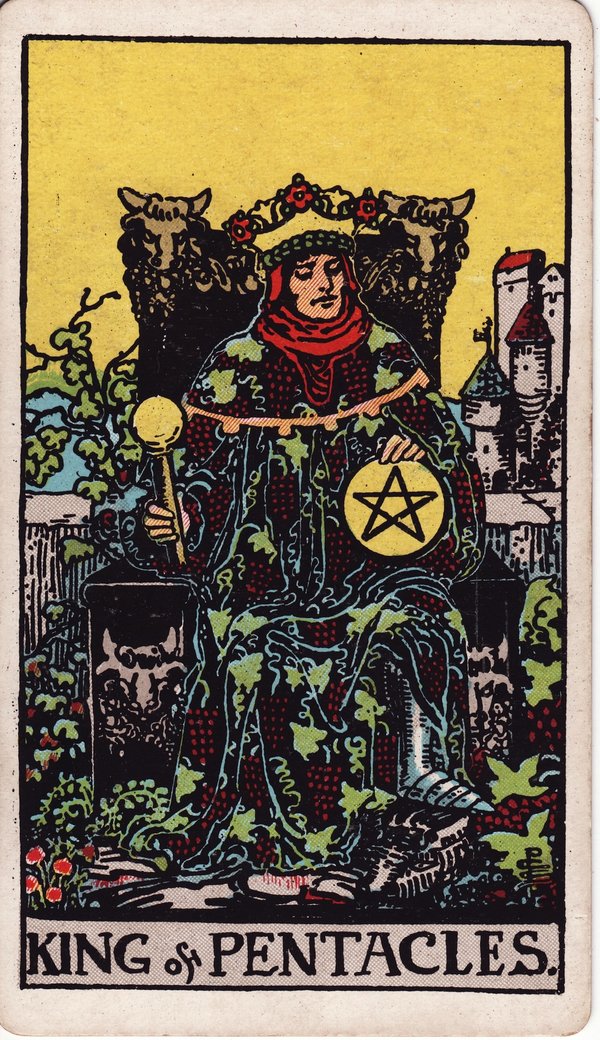
Rider-Waite-Smith (1909): Pamela Colman Smith's King of Pentacles sits upon a throne carved with bulls' heads — symbols of Taurus, fertility, and the generative power of the earth — and adorned with clusters of grapes and vines, the symbols of harvest and abundance. The throne itself is not ornate or gilded but solid, heavy, built to endure. It is the seat of someone who values substance over decoration.
The King holds a scepter in his right hand and a large golden pentacle in his left. The scepter is the symbol of his authority, but unlike the Emperor's commanding vertical staff, the King's scepter rests at an angle — his power is wielded with ease, not rigidity. The pentacle rests in his lap, not displayed to the heavens or examined for study but held with the casual confidence of someone who knows its value intimately and no longer needs to prove anything.
Behind him, a castle is visible — not a distant fantasy but his actual dwelling, built and maintained by his own efforts. Vines climb its walls; the structure is integrated with the natural world rather than imposed upon it. The landscape is fertile, cultivated, and orderly — fields, trees, a distant mountain. Everything in this image speaks of earned prosperity, of a world that has been shaped by patient, competent hands over a long span of time.
The King's robes are rich — deep reds and greens, the colors of life and passion intertwined with the fertile earth — but they are not ostentatious. He wears a crown, but it is modest. His expression is calm, even warm: he is not glowering with authority but resting in it. This is the face of someone who has nothing left to prove and nothing to fear.
Thoth (Crowley/Harris, 1944): The Knight of Disks in the Thoth deck — remember, Thoth's "Knight" is the RWS King — is a powerful, armored figure standing before a barren tree that, nevertheless, bears a single fruit. He holds a flail (the agricultural implement of threshing, associated with Osiris and the harvest cycle) and a large disk bearing the alchemical symbol of Earth. His helmet is crowned with a plume of grain or vegetation, and his posture is one of commanding stillness.
The landscape behind him is cultivated — plowed fields stretch to the horizon, the mark of human industry imposed on nature not to exploit but to order. The barren tree with its single fruit is a powerful symbol: the King of Pentacles knows that even in the leanest season, the harvest is never zero. There is always something preserved, always a seed for the next planting, always a resource held in reserve. This is the wisdom of the true steward — not the foolish optimism that assumes abundance will always flow, but the disciplined preparation that ensures something will remain even when the flow stops.
The key difference between traditions: RWS emphasizes the King's settled, earned comfort — the warmth of someone who has arrived and can now rest in what he has built. Thoth emphasizes the Knight's ongoing stewardship — the military/agricultural discipline that must be maintained even after the empire is built. The Thoth Knight of Disks is not resting on his throne; he is standing in the field, flail in hand, ready to do the work that sovereignty actually requires.
Astrological & Elemental Layer
The King of Pentacles governs three decans across two signs, and this transition describes the arc from sovereign fire to meticulous craft:
Leo III (Mars in Leo, ~August 11–22): The King inherits the final decan of Leo — the decan of Mars, the decan of the warrior-king, of fire at its most commanding and dramatic. Mars in Leo is the energy of the general who leads from the front, the performer who dominates the stage, the sovereign whose authority is inseparable from their presence. This decan gives the King of Pentacles his core of unshakeable self-possession: he does not need to demand respect because he radiates a quiet authority that naturally commands it. But Mars in Leo can also tip into arrogance, tyranny, and the need for control — the shadow that the King must guard against.
Virgo I (Sun in Virgo, ~August 23–September 1): The King's primary identity lies in the first two decans of Virgo. Virgo I, ruled by the Sun, is the decan of the craftsperson illuminated — the precision, meticulousness, and devotion to detail of Virgo warmed by the solar radiance of purpose. The Sun in Virgo does not seek the spotlight for its own sake (as the Sun in Leo might) but for the sake of the work: the craft that deserves to be seen, the system that deserves to be understood, the service that deserves to be honored. This decan gives the King his mastery of detail — he is not just a visionary (Leo) but an executor (Virgo), someone who understands that the difference between a good empire and a great one is in the systems, the processes, the thousand small decisions made correctly every day.
Virgo II (Venus in Virgo, ~September 2–20): The second decan of Virgo is ruled by Venus, which is in its fall in this sign — a placement that, paradoxically, yields one of the most refined expressions of craft and discernment in the zodiac. Venus in Virgo does not sentimentalize love; it refines love into attention, care, and service. This is the decan of the artisan whose work is so precise it becomes beautiful, the chef whose food is medicine, the leader whose discipline is felt as love. For the King of Pentacles, Venus in Virgo adds the quality of taste — not just competence but discernment, not just wealth but the wisdom to use it well. His empire is not just functional; it is, in its own quiet way, beautiful.
Taken together, these three decans describe a figure who moves from the commanding fire of Leo into the meticulous craft of Virgo without losing the authority of the former or the humility of the latter. The King of Pentacles is the warrior who became a builder, the sovereign who learned to serve, the visionary who discovered that the most radical act of leadership is competent attention to detail sustained over decades.
Kabbalistic / Tree of Life Layer
The King sits in Chokmah — the second Sephirah, Wisdom, the Supernal Father. Chokmah is the first emanation from the undifferentiated unity of Kether: the primal masculine impulse, the seed of all creation, the "I" that distinguishes itself from the "All." All Kings are Fire of their respective elements, and Fire is Chokmah's element: the first spark, the initiating will, the force that sets the entire Tree of Life in motion.
Chokmah is described in the Sepher Yetzirah as the "Radiant Intelligence" — the flashing forth of consciousness that precedes all particular forms. The King of Pentacles, as Fire of Earth in Chokmah, represents this initiating wisdom as it manifests in the material world. He is not the abstract philosopher-king contemplating forms in the empyrean; he is the builder-king, the one who sees what must be built and then marshals the resources and will to build it. His wisdom (Chokmah) is demonstrated not in what he says but in what he has constructed.
The masculine quality of Chokmah — expressive, initiating, outward-moving — is essential to understanding the King's function among the Pentacles court. The Queen (Water of Earth, Binah) receives and nurtures; the Knight (Air of Earth, Tiphareth) analyzes and executes; the Page (Earth of Earth, Malkuth) studies and attends. The King alone initiates. He is the one who decides: This will be built. This direction. This value. This legacy. Without the King's Fire, the other court cards have no project to execute, no garden to tend, no coin to study.
For the querent, the Kabbalistic layer suggests: the authority you are being called to exercise — over your finances, your career, your material life — is not arbitrary power but a sacred function. To be the king of your own material existence is to participate, at the microcosmic level, in the Chokmah principle: the wisdom that initiates, the will that builds, the fire that transforms raw potential into enduring structure. The question is not whether you are worthy of sovereignty but whether you are willing to accept its responsibilities.
Representing a Person
As a person: The King of Pentacles represents someone who has achieved material mastery through sustained competence, discipline, and wisdom. This person is typically older — not necessarily in years but in experience, in seasons survived, in lessons learned the hard way and integrated. They have built something: a business, a career, a family legacy, a body of work that will outlast them. Their presence is calm and commanding — not loud or aggressive but steady, like a mountain that does not need to announce its height.
The King of Pentacles is often found in positions of earned authority: the CEO who worked their way up from the mailroom, the master craftsperson whose work is sought by collectors, the investor whose judgment is trusted because it has been right for thirty years, the patriarch or matriarch whose family looks to them not out of fear but out of genuine respect for their wisdom. They are not flashy — their wealth, if they have it, is worn lightly, used as a tool rather than displayed as an identity. They are generous where it matters and firm where it is necessary.
In shadow, the King of Pentacles becomes the tyrant, the miser, the person who has been in power so long they have forgotten what it was like not to have it. The undignified King is the CEO who sees people as resources, the patriarch whose love is entirely conditional on obedience, the wealthy person whose fear of losing money has made them incapable of enjoying it. They may be so identified with their role that the person beneath the crown has atrophied — if you took away the title, the money, the authority, there would be nothing left.
As a mode of being: The King of Pentacles energy is what you embody when you take full, adult responsibility for your material life — not as a burden but as a domain of sovereignty. This is the mode of the person who knows exactly where their money goes, who has a will and an estate plan, who mentors younger colleagues not to inflate their ego but because they genuinely want to pass on what they have learned. Call on this energy when you need to make a difficult financial decision, to assert authority in a situation that requires it, or to step into the role of the one who provides structure and security for others.
Astrological personality traits: Grounded in Leo III and Virgo I–II, the King of Pentacles carries the sovereign fire of the Lion tempered by the Virgin's precision and devotion to craft. Typical traits include: quiet authority, financial wisdom, reliability, patience, generosity, conservatism (in the best sense — the conservation of what is valuable), a strong work ethic, and an almost instinctive understanding of how systems and institutions function. The Mars-in-Leo decan gives a core of unshakeable self-possession; the Sun-in-Virgo decan adds meticulous competence; Venus-in-Virgo adds refined taste and the ability to make prosperity beautiful. This person is unlikely to be impulsive, irresponsible, or easily impressed by flash without substance.
Thoth court name difference: In the Thoth system, the King of Pentacles becomes the Knight of Disks — the one court card where the name mapping is most counterintuitive. The Thoth "Knight" is the highest-ranked court card, the Father of the element, which in RWS is called the King. Meanwhile, the Thoth "Prince" is the active questing figure, the Son, which RWS calls the Knight. When reading across traditions: Thoth Knight = RWS King; Thoth Prince = RWS Knight. The elemental nature (Fire of Earth) and the decans remain the same across both systems.
Advising For / Advising Against
-
If advising FOR: Step fully into your own authority. You have earned the competence you possess — stop minimizing it, stop waiting for permission, stop deferring to people whose judgment is no better than yours. The King of Pentacles does not ask for the throne; he occupies it because he is willing to take responsibility for what happens on his watch. Make the decision. Sign the contract. Assert the boundary. Build the thing. The world does not need another hesitant expert or another brilliant mind waiting for the perfect moment. The world needs sovereigns — people willing to stand behind their choices and steward what they have been given.
-
If advising AGAINST: Examine the difference between authority and control. The King of Pentacles governs through competence and earned respect; his shadow governs through domination and fear. Are you leading, or are you coercing? Are you providing structure, or are you imposing rigidity? Are you holding wealth as a steward, or are you hoarding it as a miser? The King reversed is the caution that power without wisdom becomes tyranny, that wealth without generosity becomes a prison, that the throne can become a cage for the one who sits on it. If you have achieved material success, the question is not whether you deserve it — you probably do. The question is whether it has made you more human or less.
Card of the Day
Today calls for sovereign responsibility. Something in your material life — your finances, your work, your physical space, a commitment you have made — requires you to show up not as a student, a planner, or a nurturer, but as a King: decisive, competent, and accountable. Make the decision you have been deferring. Take ownership of a situation you have been avoiding. Authority is not a gift you wait to receive — it is a role you step into by acting as though the outcome depends on you. Because, in some measure, it does. You are the sovereign of your own material existence. Act like it.
Card of the Year
A King of Pentacles year — while not a formal card-of-the-year calculation — can be understood as a year-long invitation into mature sovereignty over your material life. This is a year to build, to solidify, to take command of the practical dimensions of your existence. It may be the year you start a business, achieve financial independence, step into a leadership role, or simply grow into the quiet authority of someone who has stopped running from adult responsibility and started embracing it as a form of power. The challenge of this year: power corrupts — or rather, it reveals. Whatever tendencies toward control, arrogance, or materialism lie dormant in your character will be amplified by success. The gift of this year: the discovery that true sovereignty is not domination but stewardship, and that the greatest empire is the one you build inside yourself.
Elemental Dignities Notes
The King of Pentacles is Fire of Earth — the initiating, driving, transformative quality of Fire applied to the material world. In a spread, its elemental relationship to neighboring cards follows the Golden Dawn system:
- Strengthened by Fire (Wands): Same-element cards intensify the King's initiating energy and creative drive. Adjacent Wands amplify his capacity for vision, bold decision-making, and entrepreneurial action — though too much Fire can tip him from decisive into impulsive, undermining the patience that Earth requires.
- Strengthened by Earth (Pentacles): Same-suit cards deepen the King's material stability and practical wisdom. Multiple Pentacles around the King suggest a season of genuine, lasting prosperity and institutional strength.
- Weakened by Air (Swords): Air is Earth's enemy in elemental dignity. Swords adjacent to the King may introduce over-analysis, intellectual abstraction, or restlessness that undermines his grounded, experiential wisdom. The King's authority, which is rooted in demonstrated competence, can be destabilized by purely theoretical challenges.
- Neutral / Mixed with Water (Cups): Water and Fire produce Steam in the Golden Dawn system — a potent combination that can either generate tremendous creative energy or cancel both elements out. Cups cards adjacent to the King can soften his Fire with emotional intelligence and relational awareness (the Queen's influence), but too much Water can extinguish his initiative or drown his clarity in sentiment. The specific cards and context determine which way the balance tips.
Deck-Specific Notes
-
If using a Thoth deck: The Knight of Disks (Thoth's King) stands before a barren tree bearing a single fruit, holding a flail and a disk, with plowed fields stretching behind him. The reading emphasis shifts from the RWS King's settled comfort and earned rest to the Thoth Knight's ongoing, active stewardship. He is not the king who has arrived but the warrior-farmer who never stops tending the land. The barren tree with its single fruit is a key symbol: even in drought, the wise steward has preserved something. The Thoth Knight's authority is more martial, more agricultural, and more explicitly tied to the cycles of nature than the RWS King's mercantile prosperity.
-
If using a Marseille-tradition deck: The Roi de Deniers (King of Coins) is typically depicted as a mature, seated figure holding a single coin prominently — not clutching it but displaying it with the calm confidence of someone who knows there are more where that came from. The Marseille King carries strong associations with established wealth, commercial success, and the authority that comes from material competence rather than noble birth. He is the merchant king, the self-made sovereign.
-
If using a blended or contemporary deck: The core archetype — the master of the material world, the sovereign whose authority is earned through competence — persists across visual traditions. Consult your deck's guidebook for any departures from the RWS/Thoth framework, particularly regarding the King/Knight name mapping and astrological attributions.
Journaling & Contemplation Prompts
- Where in my life am I avoiding sovereign responsibility — deferring decisions, waiting for permission, or pretending I have less power than I actually do? What would it look like to take the throne?
- What have I built that will outlast me? If the answer is "nothing," does that trouble me — and if so, what would I want to begin building?
- How do I wield the authority I do have? Am I a steward or a tyrant? How would the people I lead (at work, at home, in community) answer that question?
- What is my relationship with money and material security? Do I own my possessions, or do they own me?
- If I knew with certainty that I would be financially secure for the rest of my life, what would I do differently starting tomorrow?
Additional Associations
| Association Type | Value |
|---|---|
| Color(s) | Deep red (Fire, Chokmah, the life-force of sovereignty); rich green (Earth, fertility, the cultivated landscape); gold (prosperity, the coin, the harvest); in Thoth: the colors of plowed earth and the barren tree's single fruit |
| Crystals / Stones | Garnet (Fire of Earth — the stone of commitment, devotion, and the grounded passion that builds empires); Black Tourmaline (grounding, protection, the stability that comes from deep connection to Earth); Pyrite (Fool's Gold — but for the King, it is real: the stone of prosperity, will, and the manifestation of material goals) |
| Herbs / Plants | Oak (the king of trees — strength, endurance, the slow growth that produces unshakeable timber); Grape Vine (harvest, abundance, the fruit of patient cultivation, Dionysian sovereignty); Cedar (preservation, longevity, the wood that builds temples and ships — structures that endure) |
| Archetypes (Jungian) | The King / The Ruler (in its most mature, integrated form); The Senex (the Wise Old Man — not the senex in its shadow rigidity but in its wisdom, perspective, and earned gravitas); The Father (not the wounding father but the providing, protecting, initiating father) |
| Mythological Figures | King Solomon (the wise king who built the Temple, who asked not for riches but for wisdom — and received both); Croesus (the king of legendary wealth, but also the cautionary tale — wealth without wisdom is vulnerable); Midas (the king whose touch turned everything to gold — and who learned, too late, that gold is not the same as life); Joseph of the many-colored coat (the dreamer who became the steward of Egypt's abundance through a famine) |
| Numerological Resonance | Unnumbered — the mode of sovereignty before the legacy, the reign that defines the dynasty. As Fire, carries the initiating number 1 (singular will, the first cause) applied to Earth's 4 (stability, structure, the four directions of the material world). The King is the 1 that organizes the 4. |
| Playing Card Equivalent | King of Diamonds — the sovereign of the material suit, the mature masculine figure of wealth, authority, and worldly competence |
| I Ching Hexagram Parallel | Hexagram 14 — Ta Yu / Possession in Great Measure. "Fire in heaven above. The image of possession in great measure. Thus the superior man curbs evil and furthers good, and thereby obeys the benevolent will of heaven." The hexagram of great prosperity governed by wisdom — the ruler who uses wealth not for self-aggrandizement but to align with the cosmic order. Like the King of Pentacles, it teaches that true sovereignty is stewardship, and that prosperity without virtue is merely theft on a larger scale. |
| Body / Organ Correspondence | The heart (Leo — the lion's heart, the sovereign organ, the seat of courage and the physical pump that sustains life); the spine (the structural axis of the body, the column that holds everything upright — the King's backbone, his capacity to stand firm); the hands (Virgo — the instruments of craft, the parts that build what the heart envisions). In the Leo-Virgo cusp, the solar plexus (the seat of personal power, the "gut" that knows before the mind does). |
Shadow & Integration Message
The King of Pentacles' shadow is the hollow crown — sovereignty that has outlived its soul. It is the CEO who sacrificed every meaningful relationship to the company, only to discover that the company cannot love him back. It is the patriarch whose children fear his judgment more than they value his approval. It is the wealthy man who lies awake at night terrified of losing the money he has spent a lifetime acquiring — not because he needs it but because without it, he does not know who he is.
Deeper still is the King's potential for the merger of self and role. The undignified King has become indistinguishable from his function: he is not a person who happens to be a leader, a builder, a provider — he is the function itself, and the person beneath has withered. Strip away the title, the assets, the authority, and there is nothing left but a frightened, angry human being who has forgotten that he was ever anything other than his office. This is the tragedy of the King of Pentacles reversed: he built the empire as a servant and stayed as a prisoner.
Integration of this energy means holding sovereignty lightly. It means being able to sit on the throne without becoming the throne — to wield authority without being defined by it, to enjoy wealth without being possessed by it, to build an empire without mistaking it for a self. The integrated King of Pentacles is the person who could lose everything tomorrow and still know who they are, because their worth was never in their portfolio. They built not to prove their value but to express it. The empire is an offering, not an identity.
Elemental Intelligence (Suit Framing)
In the Jungian cognitive function mapping, Pentacles (Earth) aligns with the Sensation function — direct, concrete engagement with reality. The King of Pentacles adds Fire to this Sensation base: the initiating, driving, transformative quality applied to the tangible. This is Sensation governed by a tempered Intuition — not the wild, ungrounded Intuition of pure Wands but the practical vision of the entrepreneur who sees what the market needs, the builder who envisions the structure before the first stone is laid, the leader who intuits the right direction and then executes with Earth's patience and precision.
In the humoural frame, the King of Pentacles corresponds to a balanced choleric — the fire humour tempered by the earth, producing decisive action grounded in practical wisdom rather than the choleric's shadow tendency toward rage, impatience, or tyranny. His "class" is the sovereign — but sovereign in the pre-modern sense: not merely the one who rules but the one who is responsible for the well-being of everything under their dominion. The King of Pentacles understands that privilege is not license but obligation.
Timing & Manifestation
The King of Pentacles governs the period from approximately August 11 to September 20 — Leo III through Virgo II. In a timing question, this card suggests that events will unfold during this late-summer window, or more symbolically, during a season of harvest and mature achievement after a long period of steady building. The King's timing is the timing of culmination: not the first spark or the patient middle but the arrival, the fruition, the moment when the work of years becomes visible.
The King's timeframe carries the weight of seasons: he does not promise quick results but the eventual, inevitable manifestation of what has been built with patience and competence. If he appears in a timing position, the message is something like: The harvest is ready. You are entering the season of your competence. What you have built is about to become apparent — to yourself and to others. The question is not whether it will arrive but whether you are prepared to steward what you have earned.
Yes / No Tendency
The King of Pentacles leans strongly toward Yes — and specifically toward a yes that is backed by authority, resources, and the structural conditions for success. This is not the hopeful yes of the Star or the visionary yes of the Magician but the grounded, pragmatic yes of someone who has checked the numbers, assessed the risk, and concluded that the venture is sound. If the King appears in a yes/no reading, the affirmative is qualified by the King's own nature: Yes — if you are willing to take full responsibility for the outcome.
In reversed / ill-dignified position, the tendency shifts toward No, or yes at a cost that may not be worth paying. The reversal may indicate that the querent is pursuing material success at the expense of their humanity, or that the person in authority (whether the querent or someone else) cannot be trusted to wield power wisely. The reversal asks: Even if you can win this, should you? And who will you be on the other side of victory?
Common Misreads / Nuances to Know
Misread 1: "The King of Pentacles represents a wealthy older man." The King can represent a person of means and maturity — of any gender — but the card is not a demographic designation. It is an archetype, a mode of being, a quality of relationship to the material world. A young person with no money who has taken sovereign responsibility for their financial life is embodying the King's energy more truly than a billionaire who is possessed by their possessions. The King is about orientation, not net worth.
Misread 2: "This card means you're going to be rich." The King may signal financial prosperity, but more fundamentally it signals competence — the earned mastery that often, but not always, produces material wealth. A master craftsperson of modest means, a teacher who has shaped generations, a parent who has built a stable, loving home — these are all expressions of the King's energy, regardless of their bank balance.
Misread 3: "The King reversed means you're bad with money or losing everything." The reversed King is more often about the psychology of wealth than its presence or absence. The issue is not the balance in the account but the relationship to it: fear-driven hoarding, identity-fusion with assets, the use of money to control others, the hollowing-out of the self beneath the role. Reversal invites an interior audit, not a financial one.
Nuance for Thoth readers: The Thoth Knight of Disks (RWS King) is a martial, agricultural figure — the warrior-farmer who never stops working the land. If you are reading primarily with the Thoth deck, temper the RWS King's "settled authority and earned rest" with the Thoth Knight's "ongoing active stewardship." The Thoth King does not sit on the throne; he stands in the field, flail in hand, still working. His authority is demonstrated not in repose but in the disciplined labor that sovereignty actually requires.