The Poetic Line
"She grips the blade with both hands — unsteady, untested, and alive with the power of questions not yet asked."
Keywords
| Category | Dignified | Undignified |
|---|---|---|
| General | Curiosity, learning, new ideas, mental agility, honest inquiry, the student's mind, intellectual enthusiasm | Gossip, cynicism, all talk no action, intellectual arrogance without substance, the know-it-who-doesn't |
| Spiritual | Beginner's mind, spiritual curiosity, the seeker who asks honest questions, openness to new teachings | Spiritual dilettantism, flitting from path to path without commitment, intellectualizing the sacred without experiencing it |
| Psychological | Mental alertness, eagerness to grow, the flexible mind, the willingness to be wrong in service of learning | Scatterbrained, superficial, refusing depth, using cleverness to avoid emotional engagement, restless mind |
| Physical Health | Mental fitness, curiosity about body and health, the beginner's approach to wellness, seeking information | Restlessness manifesting physically, nervous energy without outlet, information overload causing stress |
| Relationships | Playful intellectual connection, the relationship as learning, curiosity about the other, honest conversation | Gossip, emotional immaturity, the relationship that never deepens, using words to keep distance |
| Financial | Learning about money, the beginner investor, researching financial options, starting small | Financial naivety, impulsive spending on intellectual fads, talking about money instead of managing it |
| Vocational | Student, apprentice, intern, researcher, the eager newcomer, the one who asks good questions | The perpetual student who never applies, job-hopping without depth, the clever employee who doesn't deliver |
| Shadow / Thoth Distinction | The Princess of the Rushing Winds: Earth grounding Air into practical wisdom — the student who learns not for ego but for application, the mind that seeks knowledge to serve, the curiosity that leads to competence | The Page who never becomes the Knight — the student who uses "learning" as an excuse to avoid action, the cleverness that substitutes for wisdom, the intellect that has been armed but not disciplined |
Narrative Description
General Meaning
The Page of Swords is the card of intellectual beginnings — the mind in its most curious, eager, and unformed state. This is the student who has just discovered a subject and wants to know everything; the investigator who has just picked up a scent; the communicator who is learning to speak. The Page embodies the Swords suit's core energy — intellect, communication, truth-seeking — in its youngest, most enthusiastic expression.
In a reading, the Page of Swords signals a new phase of learning, a fresh curiosity, or the arrival of information that will change the situation. It can represent a literal student or researcher, or the querent's own inner student — the part of the self that is willing to be a beginner, to ask questions, to admit not-knowing. The Page's gift is the beginner's mind: the intelligence that has not yet been hardened into certainty, the curiosity that has not yet been dulled by cynicism.
But the Page is also immature. She has the sword but not the skill to wield it. Her eagerness can tip into impatience, her curiosity into gossip, her mental energy into restlessness. The Page of Swords in shadow is the clever person who mistakes cleverness for wisdom, who talks more than they listen, who uses intellectual sophistication as a shield against genuine connection.
Symbolism & Imagery
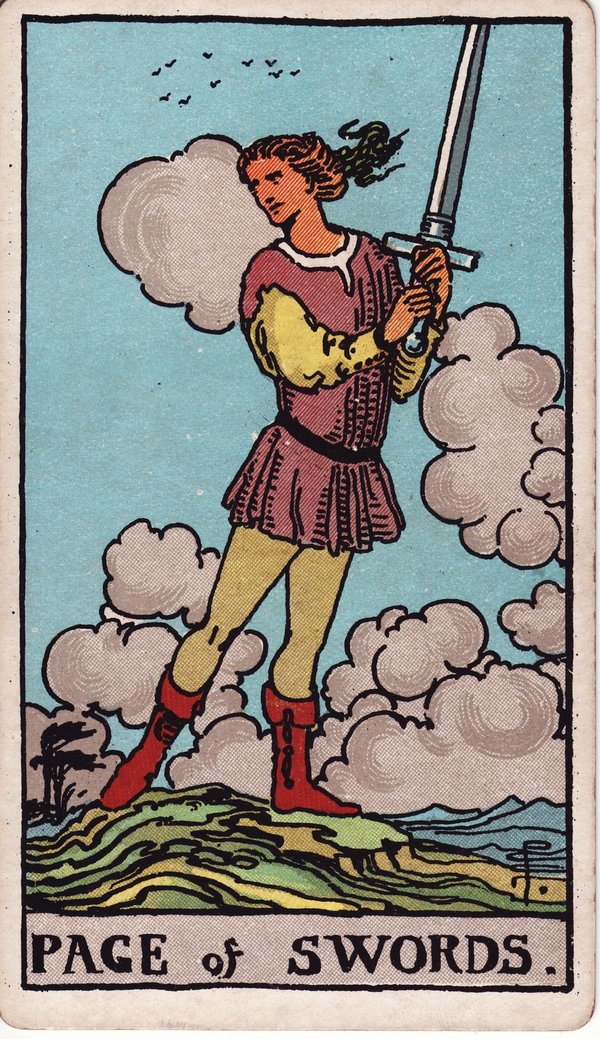
Rider-Waite-Smith (1909): A young figure stands on a windy hilltop, holding an upright sword in both hands. The posture is alert, eager — the sword is held ready, but the grip is two-handed, suggesting that the wielder is still learning how to hold it. The figure gazes upward and outward, scanning the horizon. The sky is turbulent with clouds and birds — the realm of Air in motion, the mind alive with possibilities.
The landscape is elevated but barren — the Page stands apart from the world below, observing rather than participating. This is the distance of the student, the one who studies life before entering it. The wind tosses the Page's hair and clothing — the mind is active, restless, moved by every new idea. The single sword, held upright, echoes the Ace of Swords: the Page carries the potential of the entire suit in unformed, eager hands.
Thoth (Crowley/Harris, 1944): The Thoth Princess of Swords — Princess of the Rushing Winds — is depicted with a Medusa-like crest of serpents (wisdom, the kundalini, the dangerous knowledge of the mind) and holds a sword that points downward toward a barren altar. The Book of Thoth describes her as "the anger of the Gods" — the fierce, uncompromising intelligence that has not yet been tempered by experience. She is Earth of Air: the grounded vessel through which intellectual energy can manifest. Her downward-pointing sword suggests a mind that cuts through to the root, the student who asks the question that dismantles the premise.
Representing a Person
As a person: The Page of Swords is curious, articulate, and intellectually hungry. This person asks questions others avoid, notices details others miss, and brings a freshness of perspective that can be invigorating. They are often young — in years or in spirit — and are in a phase of active learning. Their gift is honest inquiry; their shadow is intellectual arrogance without the substance to back it up. They may talk too much, jump to conclusions, or use their cleverness to deflect intimacy.
As a mode of being: The querent embodying the Page of Swords is being asked to approach their situation with beginner's mind — to ask questions rather than make declarations, to learn rather than to teach, to admit what they don't know. This is the energy of the honest student: curious, humble, willing to be wrong.
Astrological personality traits: Earth of Air gives the Page a practical, grounded intelligence. Venus in the Air signs (Gemini, Libra, Aquarius) lends charm, social grace, and a love of intellectual exchange. The Page has the Gemini curiosity, the Libra desire for balance in dialogue, and the Aquarian willingness to think unconventionally — all expressed through an earthy, methodical temperament.
Thoth court name difference: In the Thoth system, the Page of Swords becomes the Princess of the Rushing Winds — Earth of Air. The shift from "Page" to "Princess" emphasizes her role as the daughter, the receptive vessel who receives the suit's energy and grounds it into practical form. She is the quadrant of space that holds the winds, the earth that gives the air something to blow against.
Advising For / Advising Against
-
If advising FOR: Ask the question. Say the thing you don't know. Approach this situation with the humility of a student — you do not need to have the answers to be valuable; you need to have honest curiosity. The information you need is available if you are willing to seek it with an open mind. This is a beginning, not a conclusion. Let yourself be a beginner.
-
If advising AGAINST: You are talking more than you are listening, and your cleverness is masking your inexperience. The sword is in your hands, but you do not yet know how to use it — and pretending otherwise will cost you credibility. Slow down. Do the reading. Do the practice. Earn the right to speak with authority before you claim it.
Card of the Day
Today, approach the world with curiosity. Ask the question you've been embarrassed to ask. Look up the thing you don't understand. Be willing to be a beginner — because beginners are the only ones who actually learn. If someone offers you information, receive it with gratitude. The student mind is a gift. Use it.
Elemental Dignities Notes
- Strengthened by Fire (Wands): Fire energizes the Page's curiosity into action — the student becomes the explorer, the question becomes the quest. Risk: impatience, rushing ahead before the foundation is laid.
- Strengthened by Air (Swords): Multiple Air cards intensify the intellectual dimension — the mind races, the questions multiply. This can be productive (deep learning) or overwhelming (mental chaos).
- Weakened by Earth (Pentacles): The Page is already Earth of Air — additional Earth deepens the grounding but may slow the intellectual momentum. The student becomes too practical, too cautious, losing the spark of curiosity.
- Neutral with Water (Cups): Water adds emotional intelligence to the Page's intellectual curiosity — the student learns to feel as well as think. This is a growth combination, though the emotions may feel distracting to the purely mental Page.
Deck-Specific Notes
- If using a Thoth deck: The Princess of the Rushing Winds carries the Medusa crest and the downward-pointing sword. Her energy is fiercer than the RWS Page — less the eager student and more the fierce truth-seeker who cuts to the root. The Earth of Air attribution grounds her intellectual ferocity in practical application.
- If using a Marseille-tradition deck: The Page of Swords often appears surprised to find a sword in their scabbard — the discovery of intellectual capacity, the sudden awareness of one's own intelligence. The emphasis is on awakening, not application.
- If using a blended or contemporary deck: The core archetype of the curious beginner applies across traditions. Some decks gender the Page differently or emphasize different aspects of the student-teacher dynamic. The core meaning persists: the mind at the beginning of its journey.
Journaling & Contemplation Prompts
- What am I curious about that I have been too proud to admit I don't understand?
- Where in my life am I still a beginner — and where am I pretending to be an expert?
- What question, if I asked it honestly, would change the conversation?
- How do I use my intellect — to connect or to distance? To learn or to defend?
- If I approached my current challenge with the mind of a student, what would I do differently?
Additional Associations
| Association Type | Value |
|---|---|
| Color(s) | Pale yellow (the light of the curious mind, the dawn of understanding); silver (the blade, the moon's reflection, the student's mirror); light blue (Air, the sky of possibility) |
| Crystals / Stones | Clear Quartz (amplification of learning, the student's crystal); Fluorite (mental organization, the stone of study and focus); Blue Lace Agate (communication, gentle expression of truth, the beginner's voice) |
| Herbs / Plants | Rosemary (memory, mental clarity, the student's herb); Peppermint (alertness, mental energy, the herb of the awake mind); Ginkgo (the living fossil, the tree of memory, resilience through learning) |
| Archetypes (Jungian) | The Student / Apprentice; The Divine Child (Puer/Puella Aeternus — the eternal beginner, for good and ill); The Trickster in training |
| Mythological Figures | Athena as a girl (wisdom before it is earned — the goddess who sprang fully armed from Zeus's head began somewhere); Merlin before Arthur (the magician in training, the student who will become the master); Alice (in Wonderland — the curious girl who asks the questions that unravel the world) |
| Playing Card Equivalent | Jack of Spades — in cartomancy, a young person of intellectual bent, a student, a message-bearer. Sometimes: a warning of gossip or a clever but untrustworthy young person. |
| I Ching Hexagram Parallel | Hexagram 4 — Meng / Youthful Folly. "Youthful Folly has success. It is not I who seek the young fool; the young fool seeks me." The hexagram of the student who must ask the question — the teacher does not chase the student. The eagerness to learn is the prerequisite for being taught. |
| Body / Organ Correspondence | The hands (the instruments of learning, the parts that hold the sword, that write, that gesture with questions); the ears (the organs of listening, the student's primary tool); the neocortex (the brain's learning center, the plastic mind that can still reshape itself) |
Shadow & Integration Message
The Page of Swords' shadow is the clever fool — the person who has learned just enough to be dangerous, who uses intellectual jargon as armor, who confuses reading about something with understanding it. This is the shadow of the beginner: the arrogance that sometimes accompanies the first taste of knowledge, before the complexity of the subject has been fully grasped.
Integration means carrying the Page's curiosity into the Knight's competence without losing the beginner's mind. It means being willing to be wrong, to be corrected, to be a student even after achieving mastery in other areas. The integrated Page of Swords is the lifelong learner — the one whose intelligence is matched by their humility, whose cleverness is in service of genuine understanding rather than self-display.
Elemental Intelligence (Suit Framing)
In the Jungian cognitive function mapping, the Page of Swords is the Thinking function in its earliest, most receptive stage — the mind that is gathering data before it organizes it, the intellect that is asking questions before it makes declarations. The sanguine humour is here in its freshest expression: the bright, eager, optimistic curiosity that has not yet been weighted by the disappointments of the suit. The Page belongs to the student class — those who are learning, who are in formation, who have not yet taken their place in the order of things.
Timing & Manifestation
For timing, the Page of Swords signals the beginning of a learning process — days to weeks, the duration of a course of study or an investigation. The energy is immediate but nascent. What begins now will take time to develop. The Page does not deliver results; she delivers the first question that leads to results. In seasonal timing, the Page is associated with the transitional periods between seasons — the cusps, the in-between times when the old knowledge is passing and the new has not yet arrived.
Yes / No Tendency
The Page of Swords leans toward maybe — more information is needed. The Page is the card of inquiry, not conclusion. Before a yes or no can be given, the question must be refined, the data must be gathered, the learning must happen. In dignified position, the "maybe" is wise — pause and learn. In undignified position, the "maybe" is avoidance — using research as an excuse to delay action.
Common Misreads / Nuances to Know
Misread 1: "The Page of Swords is a gossip or a spy." While the Page can represent the shadow of gossip, her primary meaning is honest intellectual curiosity. The gossip/spy reading is an overlay from cartomancy that should not be the default. Context matters.
Misread 2: "The Page is immature and therefore not to be taken seriously." The Page's beginner status is a strength, not a weakness. The fresh perspective, the question no one else thinks to ask, the willingness to admit not-knowing — these are gifts that the more "mature" court cards often lose.
Misread 3: "The Page is always a literal young person." The Page can represent anyone in a learning phase, regardless of age. A sixty-year-old starting a new career, a retiree learning a language, a veteran in a new field — all are Pages in the relevant domain.