The Poetic Line
The juggler spins between rise and fall — the serpent swallows its own tail, and the dance is the balance.
Keywords
| Aspect | Keywords |
|---|---|
| Upright | Dynamic balance, adaptation, resourcefulness, juggling priorities, financial flux, change management, flexibility, playful resilience |
| Shadow | Overextension, instability, scattered energy, financial disarray, denial of limits, avoidance through busyness, chronic multi-tasking |
| Thoth (Lord of Change) | Constant flux, the harmony of alternation, cyclical transformation, the serpent of infinity, the support of stability through motion |
| RWS Traditional | News and messages, gaiety, recreation, written correspondence, obstacles navigated, agitation, embroilment |
| Astrological (Jupiter in Capricorn) | Expansive discipline, growth through structure, cautious optimism, luck built on hard ground, ambition tempered by patience |
| Kabbalistic | Chokmah of Assiah — Wisdom made manifest in the World of Action; the first true expression of Earth as itself |
| Numerological (2) | Duality, polarity, relationship, decision, the tension of opposites, the first division from unity |
| Elemental (Earth of Earth) | Fixed stability in material matters, the most concrete and grounded expression of earthly energy |
Narrative Description
4a. General Meaning
The Two of Pentacles is the card of resourcefulness — adaptive intelligence applied to finite resources. It does not promise a resolution to life's competing demands; it promises that you possess the skill to navigate them. The juggler does not drop the coins because he has mastered the art of constant correction. The Thoth wheels do not seize because their counter-rotation is perpetual. There is no final rest here — only the rhythm of alternation that underlies all manifest existence.
In readings, the Two of Pentacles most often appears when the querent is actively balancing two or more significant priorities: two jobs, two financial obligations, the demands of work and family, health and ambition. It acknowledges the effort involved while affirming the querent's capacity to manage it. The card rarely signals catastrophe; it signals the strain of equilibrium — the hum of the engine that keeps the system running.
Yet there is a shadow to this balancing act. The same card that praises resourcefulness also warns of overextension. The infinity-shaped lemniscate that binds the pentacles is a beautiful symbol of endless capacity — but endless capacity can become endless burden. The querent may be so adept at juggling that no one, including themselves, notices how close they are to dropping everything. The Two of Pentacles asks: At what cost does this balance come?
The card's Thoth title, Lord of Change, adds a deeper layer. In the Thoth system, change is not merely the shuffling of external circumstances — it is the fundamental nature of reality. Matter itself is a vortex, a standing wave in a field of energy. The apparent solidity of the pentacle (the earth-suit symbol) is revealed as an illusion; the coin is always in motion, always being re-shaped. The Two of Pentacles invites the querent to not just cope with change but to understand that change is the ground of stability. A thing that does not change is a thing that is dead. The serpent that bites its own tail does not devour itself — it renews itself in an eternal circuit.
4b. Symbolism & Imagery
Rider-Waite-Smith (Pamela Colman Smith, 1909)
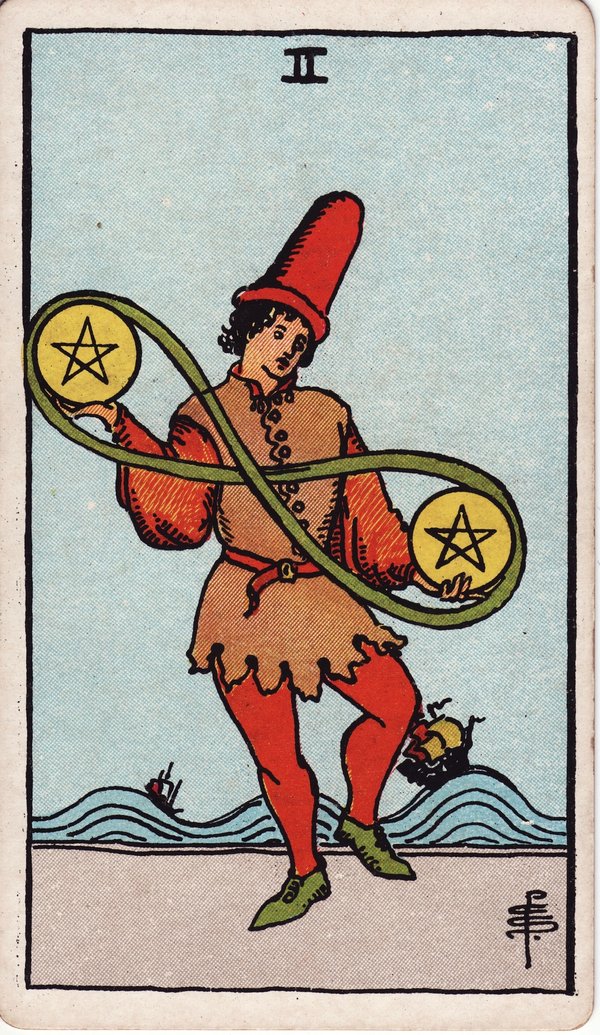
The RWS Two of Pentacles is one of the most narratively rich cards in the deck. A young man in a broad-brimmed hat dances a sort of jig, one foot lifted as though he is moving to music only he can hear. His hands hold two large golden pentacles, each encircled by a green ribbon or cord that loops between them in the shape of a lemniscate — the horizontal figure-eight that signifies infinity. He wears a motley of red, green, and yellow-orange, the colors of life, growth, and vitality. Behind him, two ships ride the crests and troughs of a tumultuous sea, their sails full, their courses uncertain.
Every element of this image rewards close attention. The juggler's stance — one foot in the air, body twisted — conveys that balance is never static; it is a continuous, almost athletic adjustment. He is not standing still and holding; he is dancing while he juggles. The lemniscate is borrowed from the Magician (Atu I), where it hovers above the magician's head as a symbol of infinite spiritual potential. Here it is brought down to the material level, literally binding the pentacles together — the infinity of spirit now channeled through the finite currency of earthly life. The two ships on the choppy water represent the two poles of the duality the juggler navigates: gain and loss, rise and fall, opportunity and risk. One ship rides high on a wave; the other descends into a trough. Both are still sailing. Neither has sunk. The water itself — the unconscious, the emotional life — is anything but calm.
The historical backstory of this image is significant. The juggler figure has been traced to pre-existing artistic designs — notably, an unpublished illustration concept for a "False Mercury" figure who shows sailors delirious visions of home. this recasts the RWS Two of Pentacles as a card of both benign juggling and potential deception: the things we tell ourselves to keep the show going, the messages we send that may not be entirely honest, the "fake it till you make it" performance that, while functional, is still a performance. The card's association with news, letters, and communication in the older traditions makes more sense in this light: not all news is true, not all messages are wholesome.
Thoth Tarot (Lady Frieda Harris, 1944)
The Thoth Two of Disks abandons the human figure entirely in favor of pure symbolic geometry. Two circular disks — one above the other — are bound together by a green serpent whose body loops in an upright figure-eight, his tail held in his mouth. The disks are not identical: one rotates clockwise (dextrorotatory), the other counter-clockwise (laevorotatory). They are the Chinese yang and yin in doubled form, the Hsiang — the complete interplay of all four elements in dynamic relation. Above and below the central motif, small astrological glyphs mark the card's rulers: Jupiter and Capricorn. A White Radiant Angelic Hand — the same hand that reached down from the clouds in the Ace — hovers at the center of the figure-eight, the point of stillness at the heart of the vortex.
The serpent is drawn from Liber LXV (Liber Cordis Cincti Serpente), the Book of the Heart Girt with a Serpent. In the Thoth mystical system, the serpent is the coiled creative energy — Kundalini, the Ouroboros, the spiral of Life itself — that holds the manifest universe in coherence. His tail-in-mouth posture is the equation 0=2: the nothing that contains all, the infinite feedback loop in which beginning and end are the same point. The serpent's green color associates it with Venus and Nature, reminding us that this kind of change is organic, seasonal, biological — not mechanical or imposed.
Crucially, there are no roses in this card — no flowering, no ornament, no grace beyond the bare mechanism of cosmic dynamics. This is the suit of Earth in its harshest, most honest expression. The Two of Disks strips away all narrative comfort and shows us the universe's churning engine. The Angelic Hand does not grip or manipulate; it simply holds the center, the still point of the turning world.
Where the RWS card is human and relatable — a man in a hat trying to make rent — the Thoth card is cosmic and impersonal. Both are true. The Two of Pentacles operates at every scale, from the household budget to the turning of the galactic year.
4c. Astrological & Elemental Layer
Jupiter in Capricorn — 1st Decan of Capricorn (December 22–30)
The astrology of the Two of Pentacles is arguably its most misunderstood dimension. Jupiter — the Greater Benefic, planet of expansion, optimism, generosity, and luck — finds himself in the sign of Capricorn, the Sea-Goat, the most disciplined, cautious, and structure-bound of the zodiacal signs. This is a placement of fundamental tension, described in the esoteric tradition as "most inharmonious." Jupiter wants to grow boundlessly; Capricorn asks, "Where's the ROI?" Jupiter wants to take risks; Capricorn asks for a five-year plan. The result is a restrained kind of good fortune — luck that must be earned, opportunity that comes with conditions attached, growth that requires scaffolding.
In the first decan (22°–30° Capricorn), the influence is particularly sharp. This decan is ruled by Jupiter itself, so the Jupiterean quality is expressed through the most earthy, concrete channel available. The Two of Pentacles does not promise windfalls; it promises that if you manage what you have with discipline and adaptability, the universe will meet you halfway. This is the astrology of the working professional who gets a promotion but has to take on twice the responsibility. It is the small business that grows just fast enough to survive but not so fast that it outruns its infrastructure.
The Jupiter-Capricorn combination also generates a particular psychological texture. There is an optimism here that is not naive — a sense that one can build one's way to good fortune through patient, persistent effort. But there is also the danger of quantitative overreach: trying to expand faster than Capricorn's foundations can support, adding more balls to the juggling act than the hand can hold.
Elementally, this card is Earth of Earth — the number 2 (Chokmah) within the suit of Earth. In the Golden Dawn system, when an element appears in its own suit, the card is "elemental" in the purest sense: the nature of Earth is expressed without admixture. Earth of Earth is the most solid, dense, concrete energy in the deck. Yet the number 2 introduces the principle of duality and motion into this solidity. The result is a paradox: the fixed element in a state of flux. The Two of Pentacles reveals that even the densest matter is, at the quantum level, a dance of particles. Even the most stable-seeming financial situation is a flow of income and expense. There is nothing truly static in the manifest world.
4d. Kabbalistic / Tree of Life
The Two of Pentacles corresponds to Chokmah of Assiah — the second Sephirah (Wisdom) in the fourth World (Assiah, the World of Action).
Chokmah (pronounced Hokh-MAH) means "Wisdom." It is the second Sephirah on the Tree of Life, the first emanation from Kether (the Crown, the undifferentiated point of unity). If Kether is the singularity before the Big Bang, Chokmah is the first impulse of expansion — the primal explosion that sets everything in motion. It is pure, unmixed, masculine energy (the Abba, the Supernal Father), the dynamism that drives creation forward without concern for limitation or form.
In Chokmah, nothing is yet bounded; all possibilities exist simultaneously. This is why the Twos across all four suits tend toward the dynamic, the relational, the polar: they are the first expression of the element in its full, unconstrained form. The Two of Wands is the raw ambition of Fire; the Two of Cups is the overflow of love; the Two of Swords is the clash of intellectual forces. The Two of Pentacles, then, is the raw vitality of the material world — wealth not yet shaped, resources not yet allocated, energy not yet directed.
But this is Chokmah in Assiah — Wisdom in the World of Action. The supernal brilliance of Chokmah is here filtered through the densest of the four worlds, the realm of matter, physicality, and practical results. This is not abstract wisdom; it is the wisdom of knowing how to stretch a dollar, how to keep three projects moving simultaneously, how to balance the demands of the body with the demands of the spirit. It is practical, embodied wisdom — the cunning of the craftsman, the resourcefulness of the skilled tradesperson, the financial intuition of the market navigator.
4g. Sequential Narrative — From Ace to Two to Three
The journey from the Ace of Pentacles to the Two to the Three is the story of material potential becoming material reality.
The Ace of Pentacles is the seed — a single golden disk held in the White Radiant Hand of heaven, descending through the void into the realm of matter. It is the idea of wealth, of health, of embodiment. It contains everything and nothing; it is pure potential, unsullied by the compromises of actual existence.
The Two of Pentacles is the first division of that unity. The single coin becomes two. The seed splits, roots reach down and shoots reach up. The One becomes Two, and with that division comes the entire drama of relationship, balance, tension, and exchange. The Ace is perfect but inert; the Two is flawed but alive. The motion begins. The juggler appears, the wheels start turning, the serpent starts eating its tail. This is the entrance of time, change, and process into the material realm.
The Three of Pentacles then takes the raw dynamism of the Two and gives it form and direction. If the Two is the juggler keeping everything in the air, the Three is the architect who puts the pieces together into a stable structure. The Two asks how to balance; the Three asks how to build. The Two is the rhythm, the breath, the pulse; the Three is the first tangible result — the first stone laid, the first payment received, the first solid shape emerging from the creative dance.
The narrative arc here is profound: from potential (Ace) through dynamic equilibrium (Two) to actualization (Three). The Two is the most precarious and the most alive of these three stages. It has neither the pristine purity of the Ace nor the grounded achievement of the Three. It is the becoming, the process, the work-in-progress. To live in the Two is to live in the question: Can I hold all this together long enough to make something real?
4h. Advising For / Against
The Two of Pentacles advises FOR:
- Adaptive resourcefulness. You have more bandwidth than you think. Trust your ability to juggle competing priorities. The fact that you are busy does not mean you are failing.
- Financial flexibility. Money is a flow, not a pool. Be willing to move resources around, cut spending in one area to invest in another. The ship that adjusts its sails makes port.
- Joyful maintenance. The juggler dances. Treat your responsibilities with lightness when possible. A sense of humor about life's demands is not a luxury — it is a survival strategy.
- Embracing flux. The Lord of Change rules this card. If you feel you are being pulled in multiple directions, you are probably exactly where you need to be. Resistance to change will only amplify the disruption.
- Getting it in writing. Given the card's "False Mercury" associations, ensure that important communications, agreements, and financial transactions are documented.
The Two of Pentacles advises AGAINST:
- Overextension disguised as competence. Being good at juggling does not mean you should take on more balls. The card's shadow is the burnout that comes from believing your capacity is infinite.
- Avoiding decisions through busyness. Sometimes all the juggling is a way of not facing the fact that one of the coins does not belong in the act at all. The Two can be a form of productive procrastination.
- Ignoring the ships in the background. The emotional and unconscious currents that move beneath the surface of your material life are real. You cannot juggle your way out of a depression, a failing relationship, or a spiritual crisis.
- False optimism. Jupiter in Capricorn knows that not all expansion is good expansion. Be wary of plans that promise growth without accounting for the structural costs. If it sounds too good to be true, it probably is.
4i. Card of the Day
Today you are the juggler, and the show must go on. Multiple tasks, competing deadlines, the need to shift resources at a moment's notice. You'll move between domains — work and home, finance and creativity — and you'll need to stay nimble. The good news: you have the skill for this. The warning: don't take on one more thing, no matter how manageable it seems. The day supports dynamic balance, not accumulation. Pay attention to the ships on the water of your emotions. Breathe. Dance. Keep the coins moving, but know when to catch them and rest.
4j. Card of the Year — Shadow Note
If the Two of Pentacles appears as your Card of the Year, the theme is sustainable rhythm. You are entering a year of multiple commitments and competing priorities. It is a year for developing new systems of organization, for learning to say no, for recognizing that grace under pressure is a skill that must be consciously cultivated. The Jupiter-in-Capricorn energy of this card suggests that the year's expansions will come with strings attached. Every gain will require a corresponding adjustment. The question is not whether you can handle the year's demands — you can — but whether you can handle them without losing yourself. The shadow of the Two of Pentacles as a Year Card is the slow erosion of self: the person who becomes so good at managing everything that they forget what they wanted in the first place. Schedule not just your obligations, but your stillness. Let the serpent's tail rest in his mouth for at least a few moments each day.
Elemental Dignities Notes
As Earth of Earth, the Two of Pentacles carries the purest, most fixed expression of the earth element. In the system of elemental dignities (as codified by the Golden Dawn), this card interacts with neighboring cards according to elemental affinity:
- Well-dignified with: Cups (Water) and other Pentacles (Earth). Water and Earth share cold and moist qualities — they nourish each other. The Two of Pentacles next to Cups cards gains emotional depth without losing its practical footing. Next to other Pentacles, its earthy stability is amplified.
- Neutral with: Wands (Fire). Earth and Fire share no elemental qualities, making this a relationship of transformation without conflict: Fire can warm Earth, Earth can temper Fire. The Two of Pentacles next to Wands may indicate material effort driven by passion — sustainable if balanced.
- Ill-dignified with: Swords (Air). Earth and Air are inimical in the Golden Dawn system. Air dries Earth; Earth stills Air. When the Two of Pentacles appears beside Swords cards, the reading warns of instability created by intellectual over-analysis, harsh communication, or decisions made without practical grounding. Plans (Air) that are not rooted in material reality (Earth) will crumble.
Deck-Specific Notes
Rider-Waite-Smith (Pamela Colman Smith): The RWS Two of Pentacles is perhaps the most "alive" card in the suit. Smith's juggler is a theatrical figure — he performs his balancing act on what appears to be a stage, the grey platform separating him from the wild sea of the unconscious behind him. The card invites the interpretation that our material lives are a performance, a controlled dance we do on the surface while the deep waters move beyond our control. The green lemniscate binding the coins is the same green as the natural world — growth, renewal, the organic cycles of life. This card does not pathologize the juggling; it celebrates it as the natural condition of embodied existence.
Thoth (Crowley / Harris): The Thoth Two of Disks is the most philosophically dense version of this card in any deck. By removing the human figure, Harris and Crowley make the card about the principle of change itself, not about any individual's experience of it. The two counter-rotating wheels, the green serpent, the absence of roses, the Angelic Hand at the center — every element is a glyph in a larger grammar of cosmic process. The Thoth Two of Disks is colder, more abstract, and more terrifying than the RWS version: it says that change is not something that happens to us; it is what we are. To read with the Thoth deck is to sit with this truth before interpreting the card in human terms.
TdM (Tarot de Marseille): The Marseille Two of Pentacles typically shows two large coins or disks arranged vertically, often with floral or foliate ornamentation between them. The Marseille tradition emphasizes the numerical and suit qualities without the narrative additions of RWS or Thoth — the card is simply "two coins," the duality of material value, the choice between one thing and another. The balance is more static, less kinetic, than in later decks.
Other Decks: Contemporary decks often combine elements from both the RWS and Thoth traditions: a figure juggling coins (RWS) with an infinity serpent or wheel imagery (Thoth) in the background. Many modern interpretations soften the card's more unsettling implications, emphasizing self-care and boundaries alongside the traditional resourcefulness.
Journaling Prompts
- The juggling inventory. Make a list of every "coin" you are currently trying to keep in the air — financial obligations, work projects, relationships, health routines, creative pursuits. Which of these actually needs to be in the air right now? Which could you set down, even temporarily? What would it cost you to set it down?
- The False Mercury check. Where in your life are you presenting a performance of balance that doesn't match your internal experience? Are you sending messages — to others, to yourself — that are not entirely true? What would it look like to send an honest message instead?
- Jupiter in Capricorn audit. What area of your life is expanding right now? What structure is supporting that expansion? Is the foundation (Capricorn) strong enough for the growth (Jupiter), or are you building a skyscraper on a concrete slab meant for a bungalow?
- The serpent's stillness. The Ouroboros is a closed loop — energy recycling infinitely. Where in your life could you create a closed loop, a cycle of renewal, instead of a linear grind? What would it look like to have your rest and your work feed each other?
- Ships on the water. The Two of Pentacles asks you to look past the juggling to the emotional sea behind it. What are you feeling beneath your busyness? What wave are you riding, and which trough are you afraid of descending into?
Additional Associations
|| Association Type | Value | |---|---| || Color(s) | Deep green (serpent, growth, the organic cycles of life); red (passion, vitality, the life-force); gold (value, illumination, the pentacles themselves); blue-grey (the emotional waters, the unconscious sea behind the juggler) | || Crystals / Stones | Yellow Calcite (financial clarity, energy balancing, absorption of excess); Citrine (abundance, manifestation, the merchant's stone — warming and energizing for financial flow); Malachite (transformation, emotional balance, navigating change with grace — the serpent's stone, echoing the Ouroboros) | || Herbs / Plants | Mint (versatility, adaptability, digestive — the herb of circulation and exchange in all forms); Clover (luck, opportunity, the three-leaf abundance — but for the Two, the finding is only the beginning; it must be managed); Dandelion (resilience, adaptation, the weed that thrives in all conditions — rooted deep, flowering bright, seed carried by every wind) | || Archetypes (Jungian) | The Juggler (the one who keeps all possibilities in motion, the performer of dynamic balance); The Tightrope Walker (the one whose stability is a continuous act of adjustment); The Resource Manager (the adaptive survivor, the one who makes things work with what is available) | || Mythological Figures | Hermes/Mercury (the messenger god, the psychopomp at the crossroads, the trickster who carries both good news and deceptive tidings — the "False Mercury" shadow); Janus (the two-faced god of doorways and transitions, who sees both past and future simultaneously — the duality of the Two made divine); Ouroboros (the serpent that eats its own tail — eternal return, the cycle that sustains itself through perpetual motion) | || Numerological Resonance | 2 — the first number of relationship, the Other, the mirror, the beginning of dialogue. In Chokmah, 2 is the dynamism that drives creation forward, the primal polarity that generates all motion. The Two of Pentacles expresses this as the fundamental rhythm of the material world: gain and loss, inflow and outflow, stability and flux. | || Playing Card Equivalent | Two of Diamonds — the card of change, adaptation, and the need to balance resources. In cartomancy, the Two of Diamonds often indicates the necessity of juggling two financial priorities, managing multiple streams of income, or navigating a period of financial flux. | || I Ching Hexagram Parallel | Hexagram 3 — Chun / Difficulty at the Beginning. "The womb of chaos. Thus the superior man brings order out of confusion." The hexagram of the first sprout pushing through the dark earth — the birth-throes of every new venture. Also: Hexagram 59 — Huan / Dispersion. "The wind drives the clouds." The hexagram of dissipation and reorganization — the scattering that precedes a new gathering, the breaking apart of old structures so that new integration can occur. | || Body / Organ Correspondence | The digestive system (the body's capacity to take in, process, and distribute resources — the metabolic rhythm that mirrors the Two's dynamic balance); the adrenal glands (the stress-response system, the body's adaptive engine — producing the energy for the juggling act, but prone to burnout when the Two's shadow of overextension dominates); the circadian rhythm (the body's master balance system — day and night, rest and activity, the pulse that underlies all physical function) |
Shadow & Integration
The shadow of the Two of Pentacles is the compulsive juggler — the person who has mistaken activity for progress, motion for meaning. This shadow manifests as a chronic state of busyness that is a defense against stillness, against the quiet in which difficult truths might surface. The shadow juggler fears stopping because stopping means feeling the exhaustion, the disappointment, the grief that the constant motion has been holding at bay.
In financial terms, this shadow shows up as the person who is always "just keeping their head above water" — who takes on debt to cover debt, who works two jobs but never addresses the structural reasons for the financial precarity. The juggling becomes a lifestyle, an identity. I am the one who manages becomes a prison.
In health terms, the shadow appears as the person who treats their body like a machine to be optimized — tracking macros, optimizing sleep, scheduling every minute of exercise — but who has lost contact with the body's lived experience. The Two of Pentacles reversed can indicate burnout, adrenal fatigue, the collapse that comes after years of unsustainable balancing.
Integration of the Two of Pentacles shadow requires three moves:
- Stop. Intentionally. The juggler must set down the coins and feel what happens. The world does not end. The silent partner (the One who holds the center, the Angelic Hand) was there all along.
- Choose. Not everything must be balanced indefinitely. The wisdom of Chokmah includes the wisdom of selection — the understanding that the same power that creates duality can also resolve it. Drop one coin. Choose the one that matters.
- Align rhythm with nature. The Earth that rules this suit has its own rhythms — day and night, the seasons, the tidal cycles. The Two of Pentacles shadow juggles against the natural rhythm, insisting on constant output. Integration means finding the pulse of your own life and matching your juggling to its beat.
Elemental Intelligence
In the Jungian system, Pentacles correspond to Sensation — the function that perceives reality through the physical senses. Sensation is the ground of empirical knowledge: it tells us what is actually there, not what we imagine or hope or fear. The Two of Pentacles, as Earth of Earth, is Sensation at its most acute and most challenged.
The question this card poses to the Sensation function is: Can you perceive stability even in motion? The pure Sensation type prefers the solid, the reliable, the repeatable — a table that stays a table, a dollar that holds its value. But the Two of Pentacles presents a world where the table wobbles and the dollar fluctuates. It asks the Sensation function to expand its definition of reality to include process, flow, and dynamic equilibrium alongside static presence.
For those with weaker Sensation in their psychological makeup, the Two of Pentacles can be a difficult card: it forces attention to the body, to money, to the practical details that such types prefer to delegate or ignore. The card's lesson is that ignoring the material world does not make it go away — it just makes the juggling harder when you finally have to pick up the coins.
Timing & Manifestation
The Two of Pentacles corresponds to the first decan of Capricorn, spanning December 22 to December 30 — the days immediately following the Winter Solstice. This is the deep winter of the Northern Hemisphere, the time of longest nights, when the Sun is at its most vulnerable and begins its slow return toward the light. It is a time of contraction, of storage, of the resources that sustain life through the barren months.
This timing deeply informs the card's meaning. The Two of Pentacles is the energy of survival through winter — the careful rationing of grain, the tending of the hearth fire, the knowledge that spring will come but not yet. The Jupiter-in-Capricorn energy here is the optimism that believes the sun will return, paired with the discipline to make the stores last until it does.
For timing in a reading, the Two of Pentacles suggests:
- Short to medium-term (days to weeks, not months to years)
- A period of flux, not resolution — things are still in motion
- Events or outcomes that depend on adaptation to changing circumstances
- For financial matters: the near term (1-4 weeks), especially around the Capricorn new moon
- For decisions: a window of opportunity that is open now but will not remain so
In the rhythm of the seasons, the Two of Pentacles speaks to the liminal period between the solstice and the new year — when the old year's accounts are being settled and the new year's seeds are being catalogued.
Yes / No Tendency
Tendency: Qualified YES — but with significant conditions.
The Two of Pentacles rarely gives a flat yes or no. It says: You can make this work, but it will require continuous adjustment. The answer is yes if you are willing to stay flexible, to monitor your resources, and to adapt as conditions change. This is the "yes, if" card — the conditional approval that puts the responsibility for the outcome on the querent's ongoing effort.
For financial questions specifically, the Two of Pentacles leans cautiously positive — the money will come, but it will need to be managed carefully. For health questions, it suggests improvement through consistent, attentive self-care rather than dramatic intervention. For love questions, it points to a relationship that requires active balancing of priorities rather than a settled state.
The card's "False Mercury" resonance adds a caveat: ensure the information you are acting on is accurate. A yes predicated on incomplete or deceptive data is not a yes at all.
Common Misreads
Mistake #1: "The Two of Pentacles means I am failing at balance." The card does not depict failure; it depicts dynamic balance in action. The juggler has not dropped the coins. The ships have not sunk. The wheels are turning in perfect counter-rhythm. The card acknowledges the strain of equilibrium, but strain is not failure. It is the condition of being alive in a body on a spinning planet.
Mistake #2: "The Two of Pentacles is purely about money." While Pentacles certainly encompass finances, this card's scope is broader. It covers all resources, including time, energy, health, attention, and emotional capacity. The Two of Pentacles can appear for someone juggling caregiving and career, for someone balancing spiritual practice with worldly responsibilities, for someone trying to hold grief and gratitude in the same heart.
Mistake #3: "The infinity symbol means I can handle everything." The lemniscate is an aspiration, not a guarantee. It represents the potential for infinite capacity, but that potential must be actualized through the finite limits of a human body and a human life. The Two of Pentacles warns that believing you can handle everything is the first step toward handling nothing well.
Mistake #4: "The Thoth card is the same as the RWS card." They are related but not identical. The RWS card is human-scale, narrative, theatrical. The Thoth card is cosmic, philosophical, abstract. The former asks "How is your juggling going?" The latter asks "What is the nature of change itself?" Both are valid; neither exhausts the other.
Mistake #5: "Change is bad / change is good." The Lord of Change is neutral. Change is not a blessing or a curse; it is the substrate of reality. The card's lesson is not that change should be welcomed or resisted but that it must be navigated. The quality of the navigation — not the change itself — determines the outcome.