The Poetic Line
"Fire and water in the same vessel — not war, not surrender, but alchemy."
Keywords
| Category | Dignified | Undignified |
|---|---|---|
| General | Balance, moderation, harmony, alchemy, synthesis, blending, patience | Excess, imbalance, discord, extremes, gluttony, addiction, dis-integration |
| Spiritual | Alchemical transformation, the Middle Way, divine timing, sacred synthesis, the solve et coagula | Spiritual bypassing through forced positivity, fake balance, spiritual materialism, impatient forcing of growth |
| Psychological | Emotional regulation, integration of opposites, patience with process, inner calm, creative synthesis of conflicting impulses | Emotional volatility, all-or-nothing thinking, inability to self-regulate, rigid compartmentalization, inner chaos |
| Physical Health | Holistic healing, balanced nutrition, moderation in all physical practices, recovery through steady rhythm | Binge/purge cycles, extreme diets, over-exercising, substance abuse, neglect of the body's need for equilibrium |
| Relationships | Blended families, compromise, finding middle ground, healing through patience, harmony without suppression | Codependency, enmeshment, losing self in relationship, one-sided compromise, conflict avoidance disguised as harmony |
| Financial | Balanced budget, moderate investing, long-term financial planning, blending resources wisely, patience for returns | Overspending, financial extremes, get-rich-quick schemes, refusal to moderate, feast-or-famine cycles |
| Vocational | Balanced workload, sustainable career pacing, integrating multiple skills, mediation, team-building, creative synthesis | Burnout, workaholism, inability to delegate, professional extremism, chaotic work patterns |
| Shadow / Thoth Distinction | Alchemical transmutation (solve et coagula), the arrow of directed will, the Great Work of integrating opposites into a higher unity, the lion and the eagle combined into the griffin — the creature that transcends its components | Splitting, disintegration, the alembic shattered by too much heat, false synthesis that papers over real conflict, the arrow fired without aim, the alchemist who burns the laboratory down |
Narrative Description
General Meaning
Temperance — or, in the Thoth system, Art — is the card of alchemical blending, of the patient integration of opposites, of the middle path that is not mediocrity but mastery. In the Fool's Journey, it arrives after Death: the old form has been dissolved, the ego has been humbled, the dead wood has been cleared. Now, from the scattered elements, something new must be synthesized. Death tears apart; Temperance/Art recombines.
In a reading, Temperance signals that the querent is being called to find the middle way — not as a compromise of values but as an integration of apparent contradictions. Two things that seemed incompatible must now be held together, blended, allowed to transform each other. This may be work and family, masculine and feminine, logic and intuition, the old self and the emerging self. Temperance does not ask you to choose between them. It asks you to pour them into the same vessel and see what they make.
The emotional register of Temperance is calm, steady, unhurried. This is the card of the long game, of the slow cure, of the stew that improves with hours on the stove. The angel on the RWS card pours liquid from one cup to another with infinite patience, never spilling a drop. The fire beneath the Thoth Art card's cauldron heats but does not burn. The energy is focused, directed, measured — the opposite of the frantic, the extreme, the all-or-nothing.
CRITICAL THOTH NOTE: The Thoth card is named Art, not Temperance, and the distinction is profound. "Temperance" in the RWS tradition emphasizes moderation — the restraint of excess, the avoidance of extremes, the cooling of passion. "Art" in the Thoth tradition emphasizes alchemical transmutation — the active, fiery, creative process of combining opposites to produce something greater than either alone. The RWS angel pours water between cups to cool something down. The Thoth Art figure pours fire and water into a cauldron to transform them. This is not the virtue of self-restraint but the practice of spiritual alchemy. In the Thoth frame, the card asks not "what do you need to moderate?" but "what opposites are you being called to combine, and what gold will emerge from their union?"
Symbolism & Imagery
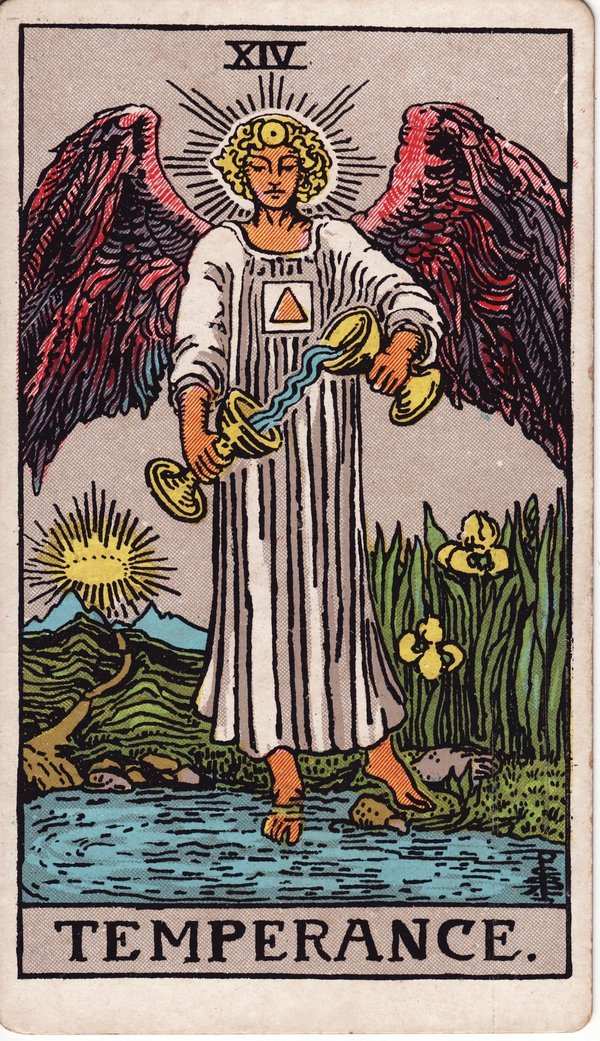
Rider-Waite-Smith (1909): Pamela Colman Smith's Temperance is an androgynous, winged angel standing with one foot on solid ground (the rocky shore representing the material world) and one foot in water (the emotional realm, the unconscious). One foot in each world, the angel embodies the integration of conscious and unconscious, spirit and matter, stability and flow.
The angel pours liquid from a golden cup to a silver cup — a continuous, patient transfer that never spills. The golden cup is the higher, solar, conscious principle; the silver cup is the lower, lunar, unconscious principle. The liquid flows both ways — it is not a one-way transmission from above to below but a circulation, an ongoing exchange. The essence of Temperance is not that the higher controls the lower but that they feed each other.
On the angel's chest is a square with a triangle inscribed — the symbol of spirit (triangle) constrained within matter (square), the divine fire housed in the earthly form. The angel's robe is white (purity) with red trim (life force, the fire that must be regulated). The wings are deep red — passion transmuted, the fire that would consume turned into the fire that carries.
Behind the angel, a winding path leads through a valley toward distant mountains crowned by a radiant golden crown — the path of the middle way, the journey toward integration, the promise that the balanced life leads to the highest illumination. Irises bloom in the foreground — the flower of Iris, the rainbow goddess, the messenger who bridges heaven and earth, the spectrum that appears when light is refracted through water. The rainbow is the symbol of the covenant — the promise that integration is possible, that the flood of chaos will not have the final word.
Thoth (Crowley/Harris, 1944): Lady Frieda Harris's Art is a radical departure from the RWS image, and understanding this difference is essential for Thoth readers. Here there is no gentle angel pouring water between cups. Instead, a powerful, androgynous figure — the Art figure — stands before a great golden cauldron, into which she pours fire from a torch in her right hand and water from a vessel in her left. The opposites do not merely mix; they react. They boil, they churn, they transmute.
The figure is crowned with the horns of the moon and the disk of the sun — the lunar and solar principles united in a single being. Her skin is green — the color of vegetation, the life force, the Green Man / Green Woman of alchemical tradition. Behind her, a rainbow arcs across a geometric background — the same promise of integration as in the RWS card, but rendered in the hard-edged, mathematical language of the Thoth aesthetic.
The cauldron itself is inscribed with the word "Solve et Coagula" — dissolve and recombine — the fundamental formula of alchemy. On either side of the figure, a lion (fire, fixed, the solar principle) and an eagle (water, volatile, the lunar principle) face each other across the cauldron. In the alchemical tradition, the lion and eagle are enemies — they represent opposites that cannot coexist in their raw forms. But in the cauldron, they are combined into the griffin — the mythical creature that is half-lion, half-eagle, the symbol of the integrated self that transcends and includes its opposites.
Key difference between traditions: RWS Temperance is about moderation — cooling, balancing, finding the temperate zone between extremes. Thoth Art is about alchemical transformation — heating, combining, forcing opposites to react until they produce the tertium quid, the third thing that is neither fire nor water but something new. The RWS angel is a serene presence maintaining equilibrium. The Thoth Art figure is an active agent of transmutation. Both are true. The question for the reader is which dimension the querent needs: the cooling of a fever that has burned too hot, or the heating of materials that must be fused.
Astrological & Elemental Layer
Temperance/Art is assigned to Sagittarius, the ninth sign of the zodiac, ruled by Jupiter. Sagittarius is mutable fire — fire that moves, that flies, that aims at a distant target. It is the sign of the archer, the philosopher, the pilgrim, the teacher — the one who seeks wisdom through the widest possible encounter with difference.
Sagittarius's fire is not the fixed, steady flame of Leo (self-expression, creativity) or the initiatory spark of Aries (the first impulse, the beginning). It is the fire of aspiration — the flame that reaches upward, that seeks the transcendent, that is not content with what is already known. Temperance/Art channels this Sagittarian fire into the work of integration: the archer's arrow becomes the directed will that aims at the synthesis of opposites, the philosopher's quest becomes the alchemist's opus.
Jupiter, Sagittarius's ruler, is the planet of expansion, wisdom, abundance, and the higher mind. Jupiter's influence gives Temperance/Art its patience — the planet of the long view, the big picture, the trust that the slow process is the one that produces lasting results. Jupiter does not rush. It expands, it includes, it integrates. This is the planetary energy behind the endless patient pouring of the RWS angel and the steady heating of the Thoth cauldron.
The element of Fire in Temperance/Art is crucial to understanding why both the RWS and Thoth versions are more active than they first appear. Fire is not passive. The angel's pouring requires energy; the cauldron's heating requires fuel. The balance achieved is not stasis — it is dynamic equilibrium, the state of a system that is constantly adjusting, constantly in motion, constantly burning energy to maintain its poise. The bicycle stays upright because the rider is pedaling. The arrow flies true because the bow was drawn.
In the Thoth system, the emphasis on Samekh (the "prop" or support) adds a structural dimension: the support is what holds the process steady while the fire does its work. The samekh is the laboratory bench, the meditation cushion, the daily practice — the stable container without which the volatile alchemy cannot proceed.
Kabbalistic / Tree of Life Layer
On the Tree of Life, Temperance/Art occupies Path 25, the path connecting Tiphareth (Beauty, Harmony, the integrated self) to Yesod (Foundation, the astral matrix, the subconscious). This is the path of Samekh — the prop, the support — the channel through which the conscious harmony of Tiphareth descends into the lunar, dream-soaked realm of Yesod, and through which the raw material of the subconscious is drawn up and refined.
Tiphareth is the sphere of the Sun, of the conscious, integrated self that knows who it is and why. Yesod is the sphere of the Moon, of the subconscious, of dreams, instincts, and the fluid self that shifts with the tides. The path between them is the process by which consciousness informs the unconscious and the unconscious feeds consciousness — the daily, ongoing integration that Jung called individuation.
The Sepher Yetzirah describes this path as the "Trial Intelligence" — the consciousness that tests, that assays, that puts the aspirant through the trial of integration. The test is not "can you resist temptation?" but "can you hold the opposites together without collapsing into one pole or the other?" The trial of Temperance/Art is the trial of complexity — the capacity to include more, to hold ambiguity, to let the opposites churn in the cauldron of the psyche until they produce wisdom.
For the querent, the Kabbalistic layer suggests: the integration you are being called to is not a one-time achievement but an ongoing practice. The path from Tiphareth to Yesod is traveled every night in dreams, every moment of creative insight, every time the conscious mind learns something from the unconscious and vice versa. Temperance/Art is not a state you arrive at; it is a practice you maintain. The angel pours forever. The cauldron is always on the fire.
Archetypal & Life-Stage Themes
Temperance/Art embodies the archetype of the Alchemist — the one who combines, transmutes, and transforms base materials into gold. But the alchemist's gold is not literal; it is the lapis philosophorum, the Philosopher's Stone, the symbol of the integrated Self that has reconciled all opposites within its being.
The Great Work: The alchemical magnum opus proceeds through stages — nigredo (blackening, dissolution), albedo (whitening, purification), citrinitas (yellowing, the dawning of the solar consciousness), and rubedo (reddening, the culmination, the Philosopher's Stone). Death is the nigredo; Temperance/Art is the albedo and citrinitas — the stages of purification and integration that follow dissolution.
Iris / The Rainbow Messenger: The Greek goddess Iris is the messenger between gods and mortals, the personification of the rainbow — the bridge between heaven and earth. Temperance/Art is the Iris card: the messenger that connects the divine and the human, the principle that guarantees that integration is possible, that the flood will not last forever, that the colors of the spectrum can coexist in a single arc.
The Mediator / The Peacemaker: In every conflict, there is a third position that neither side can see from within the conflict. Temperance/Art is the archetype of the one who stands between, who can see both sides, who can hold the tension long enough for a new synthesis to emerge. This is not the peacemaker who suppresses conflict but the peacemaker who transmutes conflict — who lets the friction generate the heat that forges the bond.
Chiron / The Wounded Healer: Sagittarius's ruling centaur is Chiron — the wise teacher who was wounded by a poisoned arrow and, being immortal, could not die but could not be healed. His wound became his wisdom; from his suffering, he learned to heal others. Temperance/Art carries this Chironic quality: the integration it achieves is not the result of avoiding pain but of processing pain, of letting the poison become the medicine.
In the Fool's Journey, Temperance/Art is the recovery after the crisis of Death. The Fool has been stripped, dissolved, brought to the void. Now, from that void, new elements must be gathered and combined. The old self cannot be resurrected — it is gone. But the scattered pieces can be reassembled into a new configuration, a higher synthesis. This is the card of re-membering — literally, putting the dismembered Osiris back together.
Advising For / Advising Against
-
If advising FOR: Find the middle path — not as compromise but as integration. The two things you are holding in tension do not need to be resolved by choosing one; they need to be combined into a third thing that transcends both. Slow down. The angel pours patiently; the cauldron heats slowly. Whatever you are trying to force will break if you rush it; whatever you are trying to suppress will erupt if you ignore it. Trust the process. The alchemical work takes as long as it takes. You are not falling behind; you are in the fire, and the fire has its own timing. Let the opposites sit together in the same vessel and watch what they make.
-
If advising AGAINST: Do not mistake the middle path for the path of least resistance. True balance is dynamic and demanding — it requires constant adjustment, not passive neutrality. Do not use "moderation" as an excuse to avoid taking a stand. Some things should not be moderated — justice, love, truth. And do not use "integration" as a bypass to avoid conflict that genuinely needs to happen. The alchemist's fire is hot. The opposites must react, not politely coexist. If you are calling it "harmony" but what you really mean is "I am afraid of the heat," you are not in Temperance; you are in avoidance.
Card of the Day
Today, find the balance point — not the midpoint between extremes but the dynamic center where opposites can coexist and create. Notice where you are rushing, and slow down. Notice where you are avoiding, and engage. If you feel yourself being pulled toward an extreme, pause and ask: What would it look like to hold both? Today's work is not to solve but to let the ingredients have time to combine.
Card of the Year
A Temperance/Art year — calculated as personal year 14 when your birth month + birth day + current year reduces to 14 — is a year of integration, healing, and creative synthesis. After the upheaval of the previous years (12/Hanged Man and 13/Death), the 14 year offers a period of relative calm — not the calm of stasis but the calm of the laboratory, the calm of the artist's studio, the calm of the meditation hall where deep work is being done.
The themes of a 14/Temperance year: blending, healing, learning to hold complexity, the integration of previously conflicting parts of the self or life, creative collaborations that produce something neither partner could have made alone, the slow maturation of projects that began years ago. This is the year to practice patience, to trust the long arc, to let the cauldron do its work without constantly lifting the lid to check the progress.
The challenge of a Temperance year is to resist the temptation to force resolution. The integration will happen on its own time. Your job is to provide the container — the practices, the structures, the relationships — that hold the process steady.
Elemental Dignities Notes
Temperance/Art is Fire — the element of will, passion, energy, transformation, and directed action. In a spread, its elemental relationship to neighboring cards follows the Golden Dawn system:
-
Strengthened by Fire (Wands): Like element intensifies like element. Additional Fire cards amplify the transformative, creative dimension — Temperance/Art alongside Wands becomes bolder, more active, more willing to risk the heat that the alchemical work requires. The risk is burning the vessel — too much fire can destroy the container that holds the work.
-
Strengthened by Air (Swords): Air supports Fire — intellect feeds inspiration, clarity feeds the will. A Temperance/Art adjacent to Swords gains precision, the capacity to name and direct the alchemical process consciously. The mind becomes the bellows that controls the flame.
-
Weakened by Water (Cups): Water is Fire's enemy in elemental dignity. Cups adjacent to Temperance/Art suggest that emotion, sentiment, or the pull of the unconscious is drowning the fire — the transformative heat is being cooled prematurely, the alchemical process is being interrupted by tears that put out the flame.
-
Neutral / Mixed with Earth (Pentacles): Fire and Earth can be productive if balanced — the fire heats the earth into pottery, the earth gives the fire a hearth. Pentacles provide the practical container that the alchemical work needs. But too much Earth smothers the fire under practicality, and too much Fire scorches the earth into barrenness.
Deck-Specific Notes
-
If using a Thoth deck: This card appears as Art (Trump XIV), not Temperance. The imagery is radically different: a green-skinned, androgynous figure pours fire and water into a golden cauldron inscribed "Solve et Coagula." A lion and an eagle flank the figure, representing opposites to be combined into the griffin. The reading emphasis shifts entirely from "moderate your extremes" to "combine your opposites and let them transmute." The Thoth Art card does not counsel restraint; it counsels active, creative synthesis. This is the laboratory, not the cooling room.
-
If using a Marseille-tradition deck: La Temperance (Trump XIV) is typically depicted as a standing female figure pouring liquid from one vessel to another — simpler than the RWS version, without the wings, the path, the crown, or the square-and-triangle symbol. The Marseille Temperance is more directly about the virtue of moderation, the classical and Christian virtue of tempering one's passions. The esoteric/alchemical interpretation was developed later by occultists.
-
If using a blended or contemporary deck (e.g., Fountain Tarot, Wild Unknown, etc.): The psychological and astrological layers apply across visual traditions. The core archetype — integration, blending, the middle path, alchemical transformation — persists regardless of imagery. Consult your deck's guidebook for whether it leans more toward Temperance (moderation, cooling) or Art (alchemy, transmutation). Some modern decks split the difference beautifully.
Journaling & Contemplation Prompts
- What opposites am I currently holding in tension? What would it look like not to choose between them but to let them combine?
- Where in my life have I mistaken moderation for mediocrity, balance for boredom, the middle path for the path of least resistance?
- What is the "cauldron" in my life right now — the container where transformation is happening? Am I tending the fire, or am I trying to lift the lid every five minutes?
- What have I been trying to force that might need more time? What have I been neglecting that might need more heat?
- If the alchemist's gold is the integrated self, what aspect of myself is currently being transmuted? What is the base metal, and what is the gold it might become?
Additional Associations
| Association Type | Value |
|---|---|
| Color(s) | White (purity, the albedo stage of the Great Work); gold (the citrinitas — the dawning of solar consciousness, the gold of the Philosopher's Stone); red (the rubedo — the culmination, the fire that has been mastered); green (the Thoth Art figure's skin — the life force, the vegetation principle); rainbow spectrum (integration of all colors, the Iris bridge between heaven and earth) |
| Crystals / Stones | Amethyst (the stone of temperance in its original Greek sense — amethystos means "not intoxicated," the stone that was believed to prevent drunkenness and promote clarity); Citrine (the stone of the solar plexus, the will, the fire that warms without burning); Jade (the stone of balance, harmony, and the middle path in Chinese tradition) |
| Herbs / Plants | Iris (the flower of the rainbow goddess, the messenger between realms); Sage (purification, the herb that cleanses the vessel before the alchemical work begins); Valerian (calming, the herb of patience, the root that steadies the nervous system without dulling the mind) |
| Archetypes (Jungian) | The Alchemist; The Mediator; Iris / The Rainbow Messenger; Chiron / The Wounded Healer; The Self (the archetype of wholeness toward which individuation tends) |
| Mythological Figures | Iris (Greek goddess of the rainbow, messenger between gods and mortals); Chiron (the wise centaur who transforms his wound into healing wisdom); Hermes Trismegistus (the mythic founder of alchemy, the union of the Greek Hermes and the Egyptian Thoth); Osiris (the dismembered god reassembled by Isis — the solve et coagula in mythic form) |
| Numerological Resonance | 14 = 2 x 7, the doubling of the mystical number of completion — balance achieved through the union of spiritual (7) and spiritual (7), not spiritual (7) and material. 14 = 1 + 4 = 5, the number of change, instability, and the five senses — the dynamic balance that requires constant adjustment, not static perfection. |
| Playing Card Equivalent | The Temperance card has no direct playing-card equivalent, but thematically it connects to any card combination that requires blending strategy — the art of the long game, the patience to wait for the right moment to play the winning hand. |
| I Ching Hexagram Parallel | Hexagram 11 — T'ai / Peace. "Heaven and earth unite: the image of Peace. Thus the ruler divides and completes heaven and earth, furthers and regulates the gifts of heaven and earth, and so aids the people." The hexagram of harmonious integration of opposites — heaven (the creative) below, earth (the receptive) above, each in the other's proper place, creating the conditions of peace. |
| Body / Organ Correspondence | The liver (the body's alchemical organ — it filters, transforms, stores, processes, and regulates more than 500 metabolic functions, the literal organ of transmutation); the hips and thighs (Sagittarius's rulership — the parts that carry us forward, the archer's stance, the grounded mobility that Temperance requires); the pancreas (the organ of blood sugar regulation — the literal mechanism of the body's "temperance," balancing glucose between extremes). In astrological medicine, Jupiter governs the liver and the principle of expansion/integration. |
Shadow & Integration Message
Temperance/Art's shadow is the false middle — the position that claims to be balanced but is actually avoidance. The person who never takes a stand because "both sides have a point." The harmony that is maintained by suppressing conflict rather than transmuting it. The "moderation" that is really just fear of intensity, fear of commitment, fear of the fire that real transformation requires.
In the Thoth framing, the shadow manifests as the cauldron that never reaches boiling point — the ingredients sit together, politely, never reacting, never transforming. Or as the fire that is fed too much fuel and explodes, shattering the vessel and scattering the work. The alchemist who cannot find the mean between cold and inferno.
The shadow also includes the spiritual bypass of forced positivity — the insistence that everything is "in divine order" when real injustice, real grief, real conflict are being papered over with spiritual language. True Temperance/Art does not deny the fire. It regulates it. It does not pretend the opposites are the same. It combines them into something that honors both.
Integration of Temperance/Art's energy means learning to hold the heat without being consumed — to let the opposites react without letting the reaction destroy the laboratory. The integrated Temperance is not the one who never feels extremes but the one who can feel them fully and still return to center. The integrated Art is the one who has learned that the Philosopher's Stone is not a destination but a practice — the daily work of combining, transmuting, integrating, and beginning again.
Elemental Intelligence (Suit Framing)
In the Jungian cognitive function mapping — which maps the suits to Jungian cognitive functions, humours, and class theory — Temperance/Art as Fire aligns with the Intuition function, but specifically with integrated Intuition: the capacity to see the pattern that connects disparate elements, to perceive the unity beneath the opposites. This is not the raw, explosive Intuition of the Ace of Wands but the refined, directed Intuition of the archer who aims and releases with precision.
The "class" of Temperance/Art is the artist, the alchemist, the mediator, the therapist — those whose social role is to combine, to heal, to find the third path between two apparent dead ends. Its humour is choleric tempered by practice: the hot blood of the Fire signs channeled through the discipline of the Great Work.
In the Jungian cognitive function mapping, Temperance/Art as Fire-mutable (Sagittarius is a mutable Fire sign) represents the adaptability of will — the capacity to adjust the arrow's aim mid-flight, to change course without losing direction, to burn at different temperatures for different stages of the work. This is Fire that does not consume but cooks, that does not destroy but refines.
Timing & Manifestation
For timing in a reading, Temperance/Art suggests a process that unfolds over Sagittarius season (approximately November 22 – December 21) or during a significant Sagittarius transit (Jupiter in Sagittarius, Sun transiting the 9th house, a Sagittarius lunar phase). The second decan of Sagittarius (approximately December 2–11, ruled by Mars) carries a particular Temperance resonance — the fire that is active but controlled, the heat that is hot enough to transform but not hot enough to destroy.
More broadly, Temperance/Art's timing is the timing of process — the event will manifest not suddenly but gradually, as the alchemical work progresses through its stages. This is not the timing of the lightning strike (The Tower) or the sudden beginning (The Fool). It is the timing of the bread rising, the wine aging, the relationship deepening. You cannot rush it, but you can trust it. When the work is done, the gold will be gold.
Yes / No Tendency
Temperance/Art leans toward Yes, with patience and integration. The outcome is favorable, but it requires the querent to find the middle path, to moderate extremes, to let the process unfold without forcing. This is not an immediate yes; it is a yes that manifests through steady, balanced effort over time.
In reversed / ill-dignified position, the tendency shifts toward No, due to imbalance or excess. The querent is leaning too far toward an extreme, or the situation is being forced in a way that will cause it to break rather than blend. The reversal is an invitation to step back, find center, and let the process recalibrate before proceeding.
Common Misreads / Nuances to Know
Misread 1: "Temperance means I should be moderate in everything — never too much, never too little." Temperance/Art is about dynamic balance, not static mediocrity. Some moments call for intensity — love, grief, creative passion, righteous anger. The card is not asking you to flatten your life into a beige average. It is asking you to regulate your fire — to let it burn hot when appropriate and cool when appropriate, to know the difference, and to adjust continuously.
Misread 2: "If I'm patient and balanced, everything will work out." Temperance/Art is a card of practice, not magic. The angel pours forever; the cauldron is always on the fire. The integration does not happen once and stay achieved — it requires daily maintenance. You will fall out of balance. You will lean too far toward one extreme and then the other. The card's promise is not that you will never wobble but that the wobble, if corrected, is what keeps you upright.
Misread 3: "Art (Thoth) is just a different name for the same thing." No. The Thoth Art card reframes the entire meaning of the 14th Trump from "moderation" to "alchemical transmutation." This is not a cosmetic change; it is a fundamental reorientation. The RWS card asks "what needs to cool down?" The Thoth card asks "what needs to be combined in the fire?" Both are valid paths, but they lead to different places. Know which tradition you are reading.
Misread 4: "Reversed Temperance just means I'm out of balance." Deeper than that — reversed Temperance often signals addiction, the complete loss of the capacity to self-regulate. Whether the addiction is to substances, to work, to another person, to drama, or to the high of extremes, the reversal suggests that the angel has dropped the cups and the cauldron is boiling over. This is not a gentle nudge toward moderation; it is a crisis of regulation that requires intervention.