The Poetic Line
"The steeds pull in opposite directions — and that is how you move forward."
Keywords
| Category | Dignified | Undignified |
|---|---|---|
| General | Victory, determination, willpower, forward momentum, mastery over opposing forces, focused ambition | Loss of control, scattered energy, defeatism, stalled progress, aggression without direction, burnout |
| Spiritual | The will as vehicle of spirit, disciplined devotion, the holy work of proceeding, Mars-blessed courage on the path | Spiritual ego, forcing outcomes against divine timing, using will in place of surrender, the chariot without a destination |
| Psychological | Self-discipline, integration of conflicting drives, confidence born of competence, the mature ego as servant of the Self | Inner fragmentation, the armor becoming the identity, megalomania, controlling others to avoid controlling oneself |
| Physical Health | Recovery through determination, disciplined health regimen, physical victory over illness, vitality in motion | Exhaustion from overdrive, accidents from recklessness, stress-related illness from constant pushing, adrenal burnout |
| Relationships | Shared direction, partnership as vehicle for mutual growth, protecting the relationship's forward movement, healthy boundaries | Dominance, one partner driving while the other is dragged, relationship as conquest, using the relationship to avoid inner work |
| Financial | Financial victory through sustained effort, strategic investment, disciplined savings, career breakthrough | Gambling on momentum, financial recklessness, spending to project an image of success, debt from uncontrolled ambition |
| Vocational | Career advancement, promotion, entrepreneurial drive, taking the reins, leading a team to success, project completion | Career burnout, toxic ambition, stepping on others to advance, the workaholic whose armor has become a prison |
| Shadow / Thoth Distinction | The Holy Grail as cargo — the charioteer's true purpose is to bear what is sacred, not to conquer for conquest's sake | The armor mistaken for the self — violence as the "will of flesh dressed in metal," the driver who has forgotten why they began |
Narrative Description
General Meaning
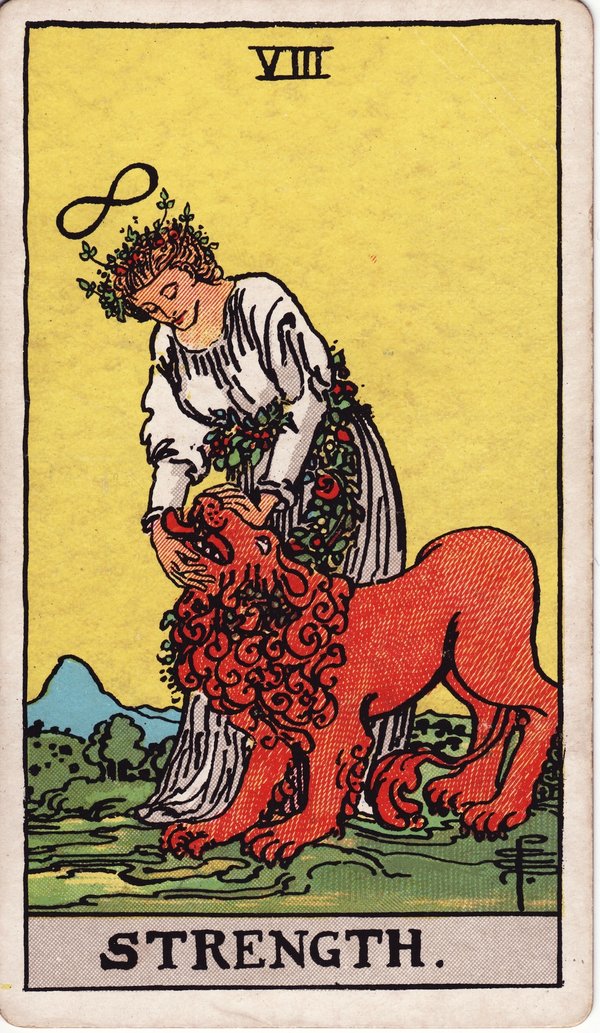
The Chariot is the card of the will in motion. It follows The Lovers as action follows choice: once you have decided what you love, what you value, what you are committed to, the question becomes how will you pursue it? The Chariot answers: with everything you have. Victory through focused determination — not the victory that falls into your lap but the victory you wrest from circumstance through sustained effort and unwavering intent.
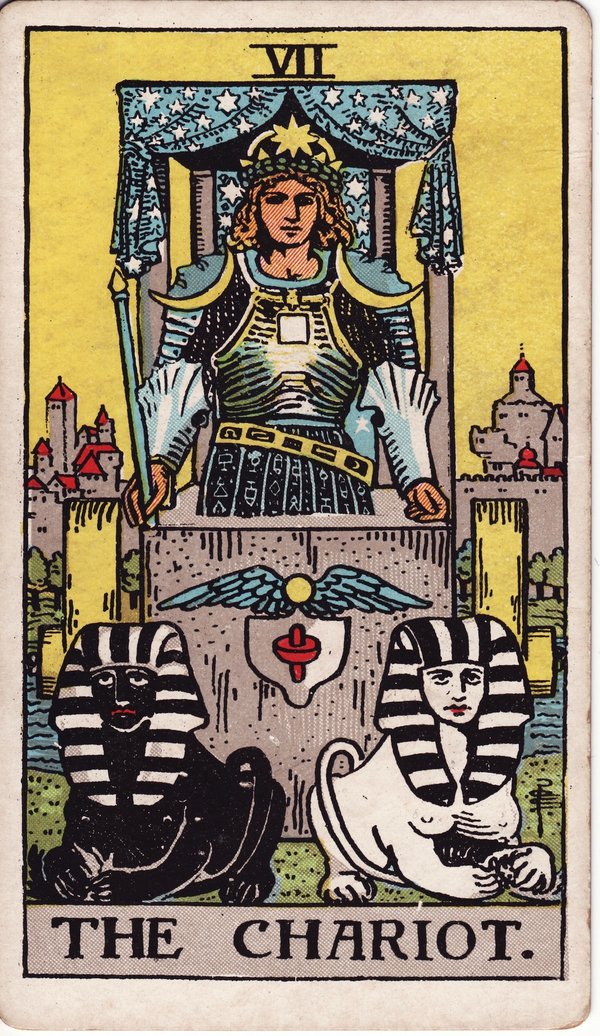
But The Chariot is more complex than simple triumph. The charioteer drives two beasts — in RWS, two sphinxes, one black and one white — that pull in different directions. Victory is not the absence of conflict but the mastery of it. The opposing forces within you — ambition and fear, discipline and desire, the person you are and the person you are becoming — do not disappear. They are harnessed, channeled, made to serve a direction greater than either could achieve alone.
The astrological influence of Cancer adds depth to what might otherwise seem a purely martial card. Cancer is the sign of the shell, the protector, the one who carries home within. The Charioteer's armor is not just for battle — it is the shell that protects something vulnerable. Beneath the breastplate is a heart, and that heart is what the chariot is carrying forward. In the Thoth deck, this is made explicit: the charioteer's only function is to bear the Holy Grail.
In a reading, The Chariot signals a period of forward momentum, of breaking through barriers, of achieving what you set out to achieve. But it also asks: what are you carrying forward? Speed without purpose is just flight. Conquest without meaning is just violence. The Chariot's victory is only as valuable as the cause it serves.
Symbolism & Imagery
Rider-Waite-Smith (1909): The charioteer stands tall in his stone chariot — he does not sit, for there is no rest in the midst of forward motion. His armor is decorated with crescent moons (what is coming into being), alchemical symbols (spiritual transformation), and a square on his chest (strength of will, the four-square foundation of purpose). A star-studded canopy arches above him, connecting his earthly journey to celestial intent — he moves under heaven's gaze.
Two sphinxes — one black, one white — pull the chariot. Unlike horses, sphinxes are creatures of riddle and wisdom; they represent the opposing forces that can only be directed by one who understands them. They pull in contrary directions, and the charioteer holds no reins. Control is achieved through will alone — through the wand in his hand, which echoes the Magician's tool. He steers by mind, not by muscle.
Behind him flows a river — the element of Water, of Cancer, of the emotional depths from which true will must arise. A city stands in the background, suggesting civilization, the structures from which he departs and toward which he rides. The chariot is in motion, but whether charging forward or holding strategic ground is deliberately ambiguous — both states require the same intensity of focus.
Thoth (Crowley/Harris, 1944): Harris's Chariot is a vastly more esoteric image. The charioteer sits enthroned within a night-blue canopy representing Binah, the Great Mother. He wears amber-colored armor appropriate to Cancer and bears the Holy Grail — a cup of pure amethyst, shaped like a full moon, containing radiant, revolving blood that represents spiritual life, the light in darkness.
Four pillars frame the chariot — the Tetragrammaton, the fourfold name of God that is the structure of all manifestation. Four sphinxes draw the vehicle: the Bull, the Lion, the Eagle, and the Man — the four Kerubs of the fixed zodiac, "counterchanged" to represent the sixteen sub-elements. The wheels are scarlet, the color of Geburah, the sphere of severity and motion.
The charioteer's vizor is lowered because "no man may look upon his face and live." Ten stars of Assiah (the material world) adorn his armor, representing the celestial dew that descends from his mother Binah. This charioteer is not a warrior — he is a bearer, a guardian of the sacred. His victory is not conquest but faithful transport.
Astrological & Elemental Layer
The Chariot is assigned to Cancer, the sign of the Crab — cardinal Water, the initiator of the emotional realm. Cancer is the sign of the mother, of origins, of the tide that pulls ceaselessly toward home. At first glance, the martial energy of The Chariot seems at odds with the softness of Cancer, but the pairing is precise: Cancer's protective instinct is the root of all courage. We fight for what we love, for the home we carry within, for the ones who depend on us.
Cancer's ruling planet is the Moon, and the lunar influence gives The Chariot its emotional depth. This is not the cold, mechanical drive of ambition — it is the hot, tidal drive of the heart, the will that rises from deep feeling. The charioteer is not a detached strategist but a devoted guardian whose strength comes from what he protects.
The elemental attribution is Water — the element of emotion, intuition, and the unconscious. Water drives the Chariot: this is the will that flows, that adapts, that finds the path of least resistance not from weakness but from wisdom. The Water element softens what could be a brittle card, adding the fluidity that prevents the charioteer from shattering against obstacles.
In the Thoth system, the Cancer attribution deepens: the path from Binah to Geburah represents the "influence of the Supernals descending through the Veil of Water (which is blood) upon the energy of man." The Great Mother's understanding pours through the blood into the human will, sanctifying it. The number of Cheth is 418 — ABRAHADABRA — the word that is the Great Work itself.
Kabbalistic / Tree of Life Layer
Path 18 connects Binah, the Great Mother, the third Sephirah of form and understanding, to Geburah, the fifth Sephirah of severity, discipline, and Mars-force. This is the path by which the oceanic, containing wisdom of the feminine divine becomes the focused, cutting power of righteous action.
Binah is the sea from which all forms arise; Geburah is the sword that shapes them. The Chariot path between them represents the channeling of boundless emotional depth into directed force. The mother's love becomes the warrior's courage. The tide becomes the current.
The Hebrew letter Cheth means "fence" or "enclosure" — the boundary that defines a space, the wall that protects what is within. The chariot itself is such an enclosure: a container that holds the driver safe while moving through dangerous territory. Psychologically, Cheth represents the ego-structure that contains the self — healthy boundaries, the "armor" that allows us to function in the world without being destroyed by it.
But the danger of Cheth is that the fence can become a prison, the armor can become mistaken for the self. When the Chariot is ill-dignified, the protective boundary becomes a wall that prevents connection, and the driver forgets that he is more than the vehicle he rides.
Archetypal & Life-Stage Themes
The Victorious Hero: The Charioteer is the hero who has trained, who has prepared, who has overcome obstacles through discipline and determination. This is Odysseus sailing home, Jason claiming the Golden Fleece, the Christ entering Jerusalem in triumph. The Hero archetype in its active, achieving mode — not the wounded wanderer but the warrior who wins.
The Charioteer (Platonic): In Plato's Phaedrus, the soul is a charioteer driving two horses — one noble and obedient, one wild and defiant. The charioteer's task is not to kill the wild horse but to train it, to make both horses pull together toward the Good. This is the psychological work of The Chariot: integrating the unruly drives rather than suppressing them.
The Protector: The Cancerian dimension of The Chariot is the archetype of the guardian — the one who builds walls not from fear but from love, who fights not for glory but for the home behind them. This is the parent who works three jobs, the activist who shields the vulnerable, the soldier who holds the line.
In the Fool's Journey, The Chariot follows The Lovers as the "first act climax." The Fool has made a choice; now the Fool must pursue it through the world, which resists. The Chariot is the stage of the journey where external obstacles arise and must be overcome through will and skill. It is the first major test of whether the Fool's commitment can survive contact with reality.
In myth and culture: Phaeton, who stole his father Helios's chariot and nearly burned the world — the Chariot's shadow as hubris. Bellerophon, who rode Pegasus to great victories and then tried to fly to Olympus, only to be thrown down — the warning that the charioteer must know his limits. And in modern culture, the race car driver, the CEO, the athlete — anyone whose identity is fused with their vehicle of achievement.
Advising For / Advising Against
-
If advising FOR: Take the reins. You have prepared for this. The opposing forces in your life — the conflicting obligations, the mixed feelings, the competing priorities — are not going to resolve themselves. Your task is to hold them in tension and drive forward anyway. Be bold. Set boundaries. The destination is worthy, and you have what it takes to reach it. Remember: the chariot moves not by eliminating resistance but by channeling it.
-
If advising AGAINST: You are driving too hard, or you have mistaken the vehicle for the destination. Check whether your ambition is serving something real or whether the winning itself has become the only point. If the armor is becoming your face — if you cannot put down the wand, step out of the chariot, let someone else drive — you are in danger of the Chariot's shadow. Sometimes victory is knowing when to stop.
Card of the Day
Today is a day for forward motion. Something you have been working toward is ready to break through — but it needs your will to do so. Take the step, make the call, claim the territory. The opposing forces within you will both speak. Your task is not to silence either voice but to let them both pull you toward decisive, integrated action. The road is open.
Card of the Year
A Chariot year — when your personal year number reduces to 7 — is a year of significant forward movement, career breakthrough, and the testing of will. This is a year to set ambitious goals and pursue them with discipline. The challenge is to maintain direction without becoming rigid, to accept victory without arrogance, and to remember that the Chariot is a vehicle, not a home. You may travel far this year. You may achieve what you set out to achieve. But at year's end, ask yourself: what was I carrying forward all this time, and did it survive the journey?
Elemental Dignities Notes
The Chariot is Water — the element of emotion, intuition, and flow. In a spread, its elemental relationships follow the Golden Dawn system:
- Strengthened by Fire (Wands): Fire heats Water into steam — passion energizes emotion, creative drive gives the will its motive force. A Chariot adjacent to Wands becomes bolder, more dynamic, more likely to act decisively on its feelings.
- Strengthened by Water (Cups): Like element deepens like element. Multiple Water cards intensify the intuitive and emotional dimension — the charioteer's drive is powered by deep feeling, though at risk of being swamped by it.
- Weakened by Air (Swords): Air is Water's enemy. Swords adjacent to The Chariot suggest that overthinking, analysis paralysis, or intellectual detachment is draining the will's emotional fuel. The mind is talking the heart out of the journey.
- Neutral / Mixed with Earth (Pentacles): Earth can give form to Water's flow — practical concerns channel emotional drive into tangible results. But too much Earth can dam the flow entirely, turning the chariot's momentum into stagnation.
Deck-Specific Notes
-
If using a Thoth deck: The Chariot appears as a hieratic figure enthroned within a night-blue canopy, bearing the Holy Grail. Four sphinxes — not two — draw the chariot. The reading emphasis shifts from "willpower overcoming obstacles" to "bearing what is sacred through the world." The charioteer's function is custodial, not martial. The number 418 (Cheth) adds the layer of the Great Work: this is the vehicle by which the divine is carried into manifestation.
-
If using a Marseille-tradition deck: Le Chariot typically shows a crowned figure driving two horses (not sphinxes), often in opposing colors. The canopy is typically simpler. The Marseille Chariot emphasizes external victory and social triumph more than the internal integration of opposites.
-
If using a blended or contemporary deck: The psychological and astrological layers apply across visual traditions. The core archetype — focused will, forward momentum, mastery of opposing forces — persists. Consult your deck's guidebook.
Journaling & Contemplation Prompts
- Where in my life am I being pulled in two directions? Can I hold both and still move forward?
- What am I protecting with my armor — and is the armor still serving its purpose, or has it become my prison?
- What is my "Holy Grail" — the sacred thing I am carrying through the battles of daily life?
- Where have I achieved victory but lost touch with why I was fighting in the first place?
- If I stepped out of the chariot and let someone else drive, what would I fear losing? What might I gain?
Additional Associations
| Association Type | Value |
|---|---|
| Color(s) | Amber (Cancer, the charioteer's armor in Thoth); scarlet (Geburah, the wheels of motion, Mars-force); silver-white (the Moon, Cancer's ruler, the lunar canopy) |
| Crystals / Stones | Carnelian (courage, willpower, Mars energy); Moonstone (Cancer, emotional balance, the inner tide); Red Jasper (stamina, endurance, grounding the will in the body) |
| Herbs / Plants | Ginger (fire-in-water, the will that warms from within); Mugwort (the Moon, the intuitive drive, dreams that steer the waking self); Bay Laurel (victory, the wreath of the champion) |
| Archetypes (Jungian) | The Hero (in its achieving mode); The Charioteer (Platonic); The Protector; The Warrior |
| Mythological Figures | Odysseus (the long journey home); Jason (the quest for the Grail-like Fleece); Arjuna with Krishna as charioteer (the divine will directing the human); Phaeton (hubris); Bellerophon (overreach and fall) |
| Numerological Resonance | 7 = the union of 3 (spirit) and 4 (matter), the sacred pause between completion and rebirth. Seven is the seeker's number, the number of the charioteer who has traveled far and must integrate before the next journey. |
| Playing Card Equivalent | 7 of Hearts — emotional victory, the heart's triumph, the tide of feeling turning decisively toward action |
| I Ching Hexagram Parallel | Hexagram 4 — Meng / Youthful Folly. The hexagram of the inexperienced seeker who must learn through doing. "It is not I who seek the young fool; the young fool seeks me." The Chariot as the first bold, imperfect forward motion — the willingness to learn by moving. |
| Body / Organ Correspondence | Stomach and breasts (Cancer's rulership — the organs of nurturing, the shell that protects and feeds); the solar plexus (the seat of will in the body); the adrenal glands (the fight response that powers the chariot's charge) |
Shadow & Integration Message
The Chariot's shadow is not simple cowardice — it is the confusion of the vehicle with the self. The person who has won so many battles that they have forgotten what they were fighting for, who has worn armor so long that they cannot feel touch, who drives forward because stopping would mean facing the emptiness inside. This is the workaholic, the adrenaline addict, the one who treats life as a series of conquests and wonders why they feel hollow at every summit.
In the Thoth framing, the shadow manifests as the "will of flesh dressed in metal" — violence that has forgotten its sacred purpose. The charioteer who bears the Grail must never forget that the cup is the point; the armor and the speed are only the means of transport.
Integration of The Chariot means being able to drive with full commitment while staying in contact with the vulnerable heart that the chariot protects. It means victory without cruelty, protection without isolation, forward motion that is always oriented toward a home worth returning to.
Elemental Intelligence (Suit Framing)
In the Jungian cognitive function mapping, The Chariot as Water aligns with the Feeling function, the phlegmatic humour, and the nurturing/caretaking class. But The Chariot is Water in motion — it is not the still pool of reflection but the river in flood, the tide that surges. Its Feeling is not passive receptivity but active devotion, the love that moves mountains (or chariots).
The Chariot's "class" is the knight — the one who serves a cause greater than self, whose power is lent by the lord (or Lady, or Grail) they serve. Its phlegmatic humour is transformed by fire into the temperament of the fierce guardian: calm on the surface, driven by deep currents below.
Timing & Manifestation
For timing, The Chariot signals a period of rapid forward movement — weeks to months, not years. Chronologically, it corresponds to the Cancer season (approximately June 21 – July 22). Events influenced by The Chariot tend to have a decisive quality: the breakthrough comes, the obstacle is overcome, the promotion is won. The card's timing answer is: soon, and suddenly — but not without your effort.
Yes / No Tendency
The Chariot leans toward Yes, if you commit fully. The circumstances are favorable, the momentum is present, but the outcome depends on your willingness to take the reins and drive. Half-hearted effort will not suffice. In a yes/no spread, The Chariot says: the path exists, the vehicle is ready — will you drive it?
In reversed / ill-dignified position, the tendency shifts toward not yet, or not this way. The will is scattered, the chariot is stalled, or you are driving in the wrong direction. Pause. Reassess. The victory is not available through force alone.
Common Misreads / Nuances to Know
Misread 1: "The Chariot is only about external victory." The card's deepest work is internal — the integration of opposing forces within the psyche. External success without internal integration will eventually collapse. The charioteer who has not reconciled with their own sphinxes will be thrown.
Misread 2: "The Chariot means charge ahead at all costs." The card's Water element and Cancer rulership temper the martial drive. Sometimes the right action is to hold position, to protect, to wait for the tide to turn. The charioteer who never pauses is not strong — they are fleeing.
Misread 3: "The Chariot reversed means failure." More often, it means the need to change direction or to address inner division before outer action can succeed. The reversed Chariot is often wisdom disguised as setback: the universe saying not that way.
Nuance for Thoth readers: The Thoth Chariot's Holy Grail transforms the card's meaning. The charioteer is not a warrior but a priest, a bearer of the sacred. Victory is not conquest but faithful delivery. When reading Thoth, always ask: what is being carried? The answer to that question determines whether the forward motion is holy or hollow.