The Poetic Line
"To love is not to merge — it is to stand whole and choose across the space we will always be."
Keywords
| Category | Dignified | Undignified |
|---|---|---|
| General | Love, conscious union, meaningful choice, values alignment, sacred partnership, integration of opposites | Disharmony, misalignment, poor choices, inner conflict, avoidance of commitment, disconnection |
| Spiritual | Sacred marriage, divine love, union with the Beloved, choosing the path of the heart, the soul's "yes" | Spiritual bypassing through relationship, avoiding the inner work by seeking external union, fear of divine intimacy |
| Psychological | Integration of anima/animus, conscious relationship to desire, values clarification, authenticity | Inner division, self-betrayal, projecting the missing self onto others, inability to choose |
| Physical Health | Heart health, balanced hormones, healing through love and touch, harmony in the body's dual systems | Stress-related illness from indecision, heartache manifesting physically, sexual dysfunction from disconnection |
| Relationships | Soul partnership, authentic communication, mutual vulnerability, love rooted in choice not need, deepening commitment | Codependency, staying in misaligned relationships, fear of being alone overriding discernment, love triangles |
| Financial | Values-aligned investments, partnership ventures, ethical financial choices, merging resources wisely | Financial entanglement through poor relationship choices, compromising values for money, divided loyalties in business |
| Vocational | Career choices aligned with passion, creative partnership, finding work that expresses love, collaborative success | Career indecision, choosing security over calling, workplace relationships complicating professional judgment |
| Shadow / Thoth Distinction | Alchemical marriage, the Chymical Wedding, dissolution and coagulation, the ecstasy of union as cosmic principle | The Brothers (Cain and Abel) — love's shadow as rivalry, the sword that divides rather than integrates, the blood cost of initiation |
Narrative Description
General Meaning
The Lovers is the card of the great Yes — but a Yes that requires a No. To choose one path, one person, one way of being, is to close the door on others, and this is the card's deeper truth. It is not simply about romantic love, though it certainly includes it. It is about the moment when values become action, when what you believe becomes what you choose, when the theoretical becomes lived.
In the Fool's Journey, The Lovers marks the transition out of the Hierophant's received tradition into personal conscience. After absorbing the teachings of culture, family, and institution, the Fool is now asked: What do YOU believe? What do YOU choose? The Lovers is the card of emerging moral agency — the moment when one stops doing what one was told and begins doing what one knows to be true.
Astrologically, Gemini's influence gives this card a mercurial quality of communication, duality, and the meeting of minds. This is not merely passion (though passion is present) — it is the alignment of intellect and heart, the decision made with full awareness of its consequences. The Lovers asks: Do you know what you are choosing? And are you choosing it with your whole being?
In the Thoth tradition, the card is framed as the "Alchemical Wedding" or "Chymical Marriage" — the union of opposing principles (King and Queen, Sun and Moon, Sulphur and Salt) that generates a third thing greater than either. This is the card's esoteric heart: love is not just a feeling but a transmutation, a creation of something that did not exist before the two came together.
Symbolism & Imagery
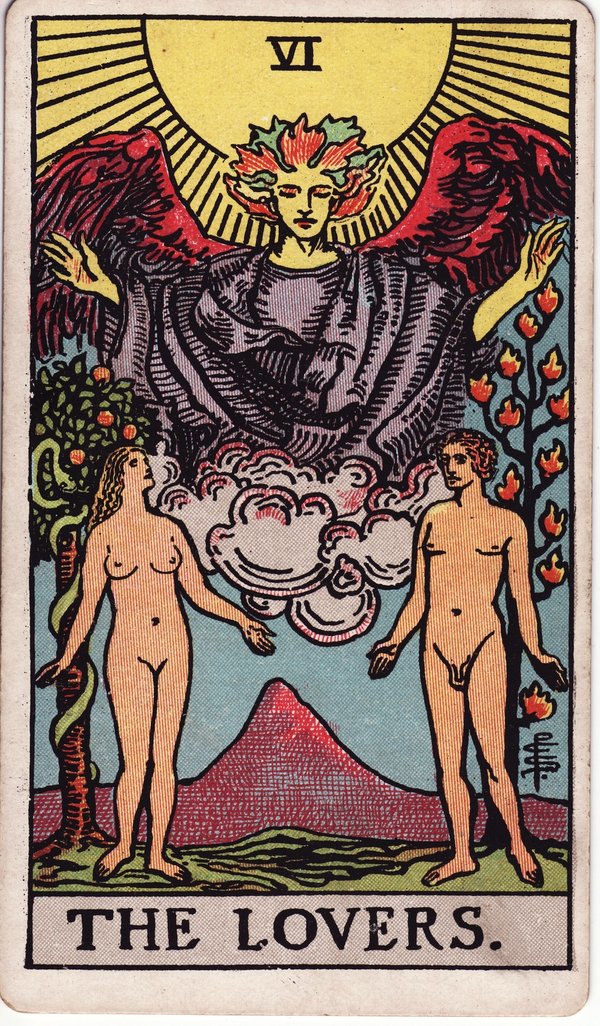
Rider-Waite-Smith (1909): Pamela Colman Smith sets the scene in the Garden of Eden, but crucially, this is before the Fall — the man and woman are naked and unashamed, standing in original innocence. The angel Raphael (whose name means "God heals") spreads great wings above them, arms extended in blessing. The sun radiates golden light behind the angel — divine witness to the human covenant.
The man gazes at the woman, who gazes at the angel — a three-tiered path of consciousness: from the physical (man looking at woman), through the subconscious (woman looking to the divine), toward the super-conscious (the angel looking outward, encompassing all). Behind the woman stands the Tree of the Knowledge of Good and Evil, its fruit ripe, a serpent coiled around its trunk — reminding us that every choice has consequences, that knowledge and loss are intertwined. Behind the man stands the Tree of Life, bearing twelve flames representing the zodiac — the full circle of human experience, the eternal within the temporal.
A mountain rises between them — a volcanic peak, phallic, suggesting the eruption of passion that is both creative and potentially destructive. The entire image is charged with the tension of what is about to happen: a choice, a covenant, a crossing of thresholds from which there is no return.
Thoth (Crowley/Harris, 1944): Lady Frieda Harris's Lovers is radically different from the RWS Garden scene. Here, the image is dominated by a Hermetic wedding, framed by an arch of swords (the letter Zain). Before the arch stands a hooded figure — Mercury, the Hermit, the Initiator — performing the Sign of the Enterer, projecting creative force into the ceremony.
The Royal Pair face each other: the Black King (accompanied by the Red Lion of Sulphur, holding the Sacred Lance) and the White Queen (accompanied by the White Eagle of Salt, holding the Holy Grail). Two children support their weapons, their attributes "counterchanged" — the white child holds the cup, the black child holds the lance — showing that the principles have already begun to intermingle.
Above them all, blindfolded Cupid (Eros) draws his bow, his quiver inscribed with the word Thelema (Will). He is not the cute cherub of greeting cards but the intelligent, unconscious will of the soul to unite itself with all. His arrow is spiritual direction, the quantum of will that pierces through division.
At the base of the image lies the winged Orphic Egg, wrapped in a serpent — the essence of life that results from the alchemical marriage. Its grey color signifies the cooperation of the three Supernal Sephiroth.
Crowley originally conceived this card as "The Brothers" — depicting Cain and Abel, with Cain holding the bloodied Hammer of Thor after slaying his brother. This darker reading reminds us that love and violence are not opposites but often tangled: the same passion that creates union can destroy. The Thoth Lovers contains both the wedding and the fratricide, the ecstasy and the cost.
Astrological & Elemental Layer
The Lovers is ruled by Gemini, the sign of the Twins, governed by Mercury — the planet of communication, intellect, and the swift movement between poles. Gemini is the sign of duality made conscious: the two are not enemies but complementary halves seeking wholeness. The Lovers inherits Gemini's gift for seeing both sides, for dialogue, for the meeting of mind with mind.
But Gemini also carries the shadow of indecision — the paralysis that comes from seeing too many options, the temptation to remain uncommitted so that all possibilities stay open. The Lovers, however, insists that the mature response to duality is not endless vacillation but conscious choice. Gemini's gift is the awareness of alternatives; The Lovers' demand is the courage to select one.
The elemental attribution is Air — the suit of Swords, of mind, of discrimination. Air gives The Lovers its intellectual edge: this is not blind passion but conscious love, love that has thought about what it is doing and why. The sword of Zain cuts through illusion, through convenient self-deceptions, through the stories we tell ourselves to avoid making hard choices.
In the Thoth system, the assignment deepens: the card represents the union of Venus and Mars (on the personal level) and Sun and Moon (on the cosmic level). The Alchemical Marriage is the solve et coagula — dissolve and coagulate — the endless process of breaking apart to understand and reuniting at a higher level.
Kabbalistic / Tree of Life Layer
Path 17 connects Binah (Understanding, the Great Mother, the third Sephirah) to Tiphareth (Beauty, the Heart, the sixth Sephirah). This is the path by which abstract divine understanding descends into the personal heart — truth becoming love, concept becoming relationship.
Binah is the sphere of form, of limitation, of the vessel that receives the limitless light of Chokmah. Tiphareth is the sphere of the sacrificed and resurrected god, the heart center of the Tree, the place where the human and divine meet in beauty. The Lovers path between them suggests that love is the mechanism by which cosmic understanding becomes personal meaning.
The Hebrew letter Zain (Sword) assigned to this path carries the dual nature of the sword: it divides, and it protects. The sword represents analysis — the breaking of wholes into parts so that they can be understood. But The Lovers card insists that analysis must be followed by synthesis, that the sword must eventually be sheathed so that the hands can join.
On Tiphareth, all the Sephiroth are reflected — the six is the number of harmony, the first point in the Tree where the descending light achieves a stable, beautiful form. The Lovers on this path tells us that love is not a feeling we have but a structure we build — a temple in the heart where the divine can dwell.
Archetypal & Life-Stage Themes
The Lovers embodies several archetypes that illuminate the card's depth:
The Anima/Animus in Union: The Lovers represents the hieros gamos — the sacred marriage of the masculine and feminine principles within the psyche. The man who integrates his anima, the woman who integrates her animus, achieves a wholeness that external relationship can reflect but not create. This is the card of psychological androgyny — the capacity to hold both poles within.
The Lover: In its most recognizable form, this is the archetype of romantic love, of Eros, of the force that draws two separate beings into one. The Lover archetype is characterized by passion, devotion, and the willingness to risk everything for the beloved. Its shadow is obsession, possession, and the loss of self in the other.
The Chooser: Beyond romance, The Lovers is about moral agency — the moment when one must decide what kind of person one will be. This is the archetype of the crossroads, of the fork in the path, of the decision that defines character. The Chooser does not merely select among options but creates identity through selection.
The Alchemical Coniunctio (Thoth): The union of King and Queen, Sun and Moon, that generates the Philosopher's Stone. This is not about finding the right person but about the transformation that occurs when opposites are held in conscious tension and allowed to create something new.
In the Fool's Journey, The Lovers is the first major test of values. The Fool has been taught (Hierophant) and must now decide what of those teachings to keep and what to leave behind. This is the emergence of individual conscience — the moment the Fool stops being a child of the culture and becomes an adult with a personal moral compass.
In myth and literature: Tristan and Isolde, whose love defied every social law. Paris, whose choice between three goddesses launched the Trojan War. The alchemical Rosarium Philosophorum, whose woodcuts depict the Coniunctio in stages of death, putrefaction, and rebirth. And in a darker register, Cain and Abel — the brothers whose story Crowley insisted was the true origin of this card, the love that turns murderous when one feels unchosen by God.
Advising For / Advising Against
-
If advising FOR: Make the choice. The waiting is costing you more than the choosing ever will. This is the moment when values must become action, when what you believe must become what you do. Choose with your whole heart, and then stand by your choice. The door that closes behind you is not a loss — it is the architecture of a life that has direction. Let love — for a person, for a calling, for a truth — be the compass.
-
If advising AGAINST: Do not choose for the sake of choosing. If you are divided, honor the division — it is telling you something real. Do not force a union that your soul has not authorized. Do not let the fear of being alone drive you into a relationship, a career, or a commitment that violates your deeper knowing. And if you have already chosen, do not stay in a choice that is killing you. The Lovers reversed is not failure — it is integrity refusing to pretend.
Card of the Day
Today asks you to choose — not between right and wrong, which is easy, but between two goods, or two difficults, or two selves you could become. Notice where you feel divided, and ask whether the division is wisdom or fear. You are standing at a threshold. Step through it with your eyes open and your heart fully present.
Card of the Year
A Lovers year — calculated when your birth month + birth day + current year sum reduces to 6 — is a year of significant relationship choices and value clarification. This year will ask you to decide what (and whom) you truly love, and to align your life accordingly. Romantic partnerships may deepen, end, or transform. Career paths may be clarified by the question: Does this work express what I care about? The challenge is to avoid the Gemini shadow of endless deliberation — to actually choose, and to live with the consequences of choosing. This is a year when your relationships will teach you who you are. Pay attention.
Elemental Dignities Notes
The Lovers is Air — the element of intellect, communication, and discrimination. In a spread, its elemental relationships follow the Golden Dawn system:
- Strengthened by Fire (Wands): Fire supports Air — passion fuels conscious choice, creative energy warms intellectual clarity. A Lovers adjacent to Wands becomes more decisive, more willing to act on its values.
- Strengthened by Air (Swords): Like element intensifies. Multiple Air cards sharpen the analytical dimension — the choice becomes more considered, though at risk of overthinking what should be felt.
- Weakened by Earth (Pentacles): Earth is Air's enemy. Pentacles adjacent to The Lovers suggest that material considerations, security needs, or practical obstacles are blocking the heart's choice. The spirit wants to fly; gravity says no.
- Neutral / Mixed with Water (Cups): Air and Water can create a loving storm — the intellect gains emotional depth, feeling gains articulation. But too much Water can drown the clarity Air needs, and too much Air can agitate placid emotional waters.
Deck-Specific Notes
-
If using a Thoth deck: The Lovers appears as the Hermetic Wedding beneath the Arch of Swords, with the hooded Hermit-Mercury figure performing the ceremony and blind Cupid presiding. The reading emphasis shifts from "romantic choice" to "alchemical transformation through union." The card is considered one of the two most difficult in the Thoth deck (paired with Atu XIV, Art). The shadow dimension — the Cain and Abel origin — should be held in awareness: this is not only the wedding but also the blood cost of initiation, the sacrifice that love sometimes demands.
-
If using a Marseille-tradition deck: L'Amoureux typically depicts a young man standing between two women — one young, one older — with Cupid aiming his arrow from above. This framing emphasizes choice more than union: the querent is at a crossroads, and love (or desire) is the force that will tip the balance. The Marseille Lovers is less about sacred partnership and more about the consequences of desire-driven decisions.
-
If using a blended or contemporary deck: The psychological and astrological layers of this entry apply across visual traditions. The core archetype — conscious choice, values alignment, the union of opposites — persists. Consult your deck's guidebook for specific departures from the RWS/Thoth framework.
Journaling & Contemplation Prompts
- What choice am I avoiding? What would I choose if I trusted myself completely?
- Where in my life am I living by someone else's values rather than my own?
- What qualities do I admire in those I love — and how might those qualities be unrecognized aspects of myself?
- If love is not just a feeling but a decision, what am I deciding every day through my actions?
- What would have to die in me for a deeper love to be born?
Additional Associations
| Association Type | Value |
|---|---|
| Color(s) | Green (Venus, the heart chakra, the Garden); gold (divine light, the angel's radiance); red and white (alchemical Sulphur and Salt, passion and purity) |
| Crystals / Stones | Rose Quartz (unconditional love, heart opening); Emerald (Venus stone, heart wisdom, harmonious union); Rhodochrosite (integration of the inner masculine and feminine) |
| Herbs / Plants | Rose (love, the heart, the Rosarium); Apple (the fruit of choice, knowledge, and consequence); Lavender (calming the nervous system so the heart can speak) |
| Archetypes (Jungian) | The Lover; The Anima/Animus in Union; The Chooser; The Alchemical Coniunctio |
| Mythological Figures | Eros and Psyche (love that must pass through trials); Tristan and Isolde (love that defies law); Paris (the choice that launches a war); The Chymical Wedding of Christian Rosenkreutz; Cain and Abel (Thoth — the Brothers, love's violent shadow) |
| Numerological Resonance | 6 = harmony, the first perfect number, Tiphareth on the Tree of Life. Six is the number of days of creation before the Sabbath rest — the work of making a world is done, and now it must be loved. |
| Playing Card Equivalent | 6 of Hearts — the card of emotional harmony, deepening affection, the choice of the heart |
| I Ching Hexagram Parallel | Hexagram 8 — Pi / Holding Together (Union). "Holding together brings good fortune." The hexagram of unity that arises from sincere attraction, not force. The image: water on the earth — the natural, inevitable flowing together of what belongs together. |
| Body / Organ Correspondence | Heart (the organ of Tiphareth, the center of love and circulation); lungs (Gemini/Air — the breath that carries the word of love); arms and hands (Gemini's rulership — the parts that reach out and touch). In astrological medicine, Gemini governs the nervous system and the coordination of dual body systems. |
Shadow & Integration Message
The shadow of The Lovers is not simple infidelity or dishonesty — it is the refusal to become a self that can choose. The person who stays perpetually at the crossroads, who keeps every option open so that no option has to be risked, who uses the language of love while avoiding its demands. This is the Gemini shadow of the eternal adolescent: the one who can see every side and therefore commits to none.
In the Thoth framing, the shadow is darker: the Brother who kills what he cannot possess, the love that becomes violence when it is refused. The Cain archetype reminds us that every choice for one thing is a rejection of another, and the rejected may not go quietly. Integration of The Lovers means the capacity to choose with full awareness of what is being lost, and to bear that loss without turning it into poison. It means loving without possessing, choosing without killing the alternatives with resentment.
Elemental Intelligence (Suit Framing)
In the Jungian cognitive function mapping — mapping the four suits to Jungian cognitive functions, humours, and class theory — The Lovers as Air aligns with the Thinking function and the sanguine humour. But unlike the analytical, separating Thinking of the Swords, The Lovers' Air is integrative: it is the Thinking that brings together, that sees how seemingly opposite ideas can coexist, that builds bridges between worldviews.
The Lovers' "class" is the courtly lover, the troubadour — the one who belongs to the aristocracy of the heart. Its sanguine humour expresses as warmth, social grace, and the optimism that genuine connection is possible across difference. In its shadow, the sanguine becomes the dilettante — the one who loves everyone deeply and no one long enough to be transformed.
Timing & Manifestation
For timing, The Lovers signals a period when choice is imminent — not the long arc of development but the pivotal moment of decision. Chronologically, it corresponds to the Gemini season (approximately May 21 – June 20), and within that, to the window when a significant decision must be made. The card's timing answer is: when you stop deliberating and choose.
Events influenced by The Lovers tend to unfold in pairs, in dialogues, in meetings. This is not a card of solitary development but of what happens between people. The manifestation window is often tied to a specific conversation, a specific encounter, or a specific crossing of paths.
Yes / No Tendency
The Lovers leans toward Yes, but it depends on you. The opportunity, the connection, the alignment is present — but the card does not guarantee the outcome because the outcome depends on the choice you make. In a yes/no spread, The Lovers says: the door is open, the person is available, the path is viable — will you walk through? It is one of the most agency-centered cards in the deck: the universe has done its part; now you must do yours.
In reversed / ill-dignified position, the tendency shifts toward not now, or not this way. The alignment is off, the values don't match, or you are not ready to choose with the commitment the situation requires. It is not a permanent no but a redirection: get clear on what you truly want before you choose again.
Common Misreads / Nuances to Know
Misread 1: "The Lovers always means romance." The card frequently appears for decisions about career, values, creative direction, and lifestyle — any situation where the querent must choose in alignment with their authentic self. Reducing it to romance flattens its moral and existential dimension.
Misread 2: "The Lovers means you've found your soulmate." The card indicates a significant connection, but significance is not the same as permanence. Some Lovers relationships are catalytic — they are meant to transform you, not to last forever. The soulmate question is better answered by whether the connection calls you toward your highest self.
Misread 3: "The Lovers reversed means break-up." While it can signal relationship difficulty, the reversal more commonly indicates internal division — the querent is at war with themselves, unable to choose because they have not clarified their values. The external relationship trouble is often a symptom of internal misalignment.
Nuance for Thoth readers: Crowley's insistence on "The Brothers" as the card's original meaning adds a layer entirely absent from RWS interpretations. The Thoth Lovers contains the possibility of rivalry, jealousy, and the violence of the unchosen. When reading with the Thoth deck, always ask: what is being sacrificed for this union? What rival claim is being denied?