The Poetic Line
"The wheel turns. You are not the turning — you are the axle at the still center."
Keywords
| Category | Dignified | Undignified |
|---|---|---|
| General | Destiny, turning points, cycles, good fortune, unexpected change, the hand of fate, karmic unfolding, the right place at the right time | Bad luck, resistance to change, feeling stuck, the wheel turning against you, repeating destructive cycles, fatalism |
| Spiritual | Trust in divine timing, the wheel of dharma, synchronicity, the larger pattern becoming visible, surrender to the Tao, the wisdom of "what goes around comes around" | Spiritual fatalism, passivity disguised as faith, blaming karma for refusing to act, the dark night that feels permanent, loss of faith in the universe's benevolence |
| Psychological | Perspective shift, seeing the larger pattern of one's life, the insight that comes from distance, acceptance of life's rhythm, resilience through cycles | Learned helplessness, the victim story, refusing to take responsibility because "it's fate," depression from perceived powerlessness |
| Physical Health | Cycles of health and illness understood as natural, recovery from the low point of a cycle, the body's rhythm restoring itself, timing medical interventions well | Chronic cycling without resolution, health crises that feel random and cruel, the body's natural rhythms disrupted, illness as "bad luck" rather than addressable |
| Relationships | Destiny-driven connection, the relationship that arrives "by chance," the natural turning of relationship cycles, timing aligning for union or separation | Relationships stuck in destructive loops, the "on again, off again" pattern, feeling fated to repeat relationship mistakes, the partner who comes and goes with the wheel |
| Financial | Windfall, fortunate timing, the investment that pays off at the right moment, the cyclical nature of markets understood and navigated | Financial loss from forces beyond control, gambling addiction, the boom-and-bust cycle, relying on luck rather than planning |
| Vocational | Career breakthrough at the right moment, being in the right place, the promotion that feels destined, riding the wave of industry cycles, the lucky break | Career stagnation despite effort, opportunities missed by bad timing, the job that feels like a hamster wheel, watching others advance while you spin |
| Shadow / Thoth Distinction | The Gunas in balance — Sattvas (intelligence at the summit), Rajas (energy climbing), Tamas (inertia descending). The wheel as cosmic law, not fate but physics of the soul. | The wheel as indifferent machinery — the giant hand that spins it "for amusement," the Deceiver (Lamb and Flag) who seduces the elect with false innocence, the wheel that grinds without mercy |
Narrative Description
General Meaning
The Wheel of Fortune is the card of the great turn — the moment when everything changes, not because of anything you did but because the cycle has reached its pivot point. It is the most impersonally personal card in the Tarot: impersonal because it represents forces far beyond individual will, personal because it touches the most intimate details of a life.
After The Hermit's long withdrawal, the Fool re-enters the world — and discovers that the world has not been waiting. The wheel has turned. What was up is down, what was hidden is revealed, what seemed permanent is revealed as phase. The Fool learns the central lesson of the second half of the Major Arcana: you are not in control, and that is not the same as being powerless.
The Wheel is not simply "good luck." It contains the rise and the fall, the summit and the descent, the Sphinx at the top and the snake slithering down. It is the card of karma — not in the popular sense of punishment and reward but in the deeper sense of cause and effect unfolding across time, the consequences of choices made in one season ripening in another.
Astrologically, Jupiter's influence gives the Wheel its expansive, optimistic quality — the sense that even the difficult turn is ultimately benevolent, that the universe is a system of growth and wisdom rather than of random cruelty. Jupiter is the planet of faith, and the Wheel asks for faith precisely when the evidence for it is absent.
In the Thoth tradition, the Wheel is framed more explicitly as the machinery of continual change. Crowley emphasizes the three Gunas of Hindu philosophy — Sattvas (intelligence, lucidity, the Sphinx at the top), Rajas (energy, restlessness, Hermanubis climbing the left side), and Tamas (darkness, inertia, Typhon precipitating downward). These three qualities govern all phenomena, and the Wheel's turning is their eternal dance. This framing strips away the comfort of "luck" and replaces it with the clarity of law: everything changes because everything must change. Nothing can remain fixed because the Gunas revolve.
Symbolism & Imagery
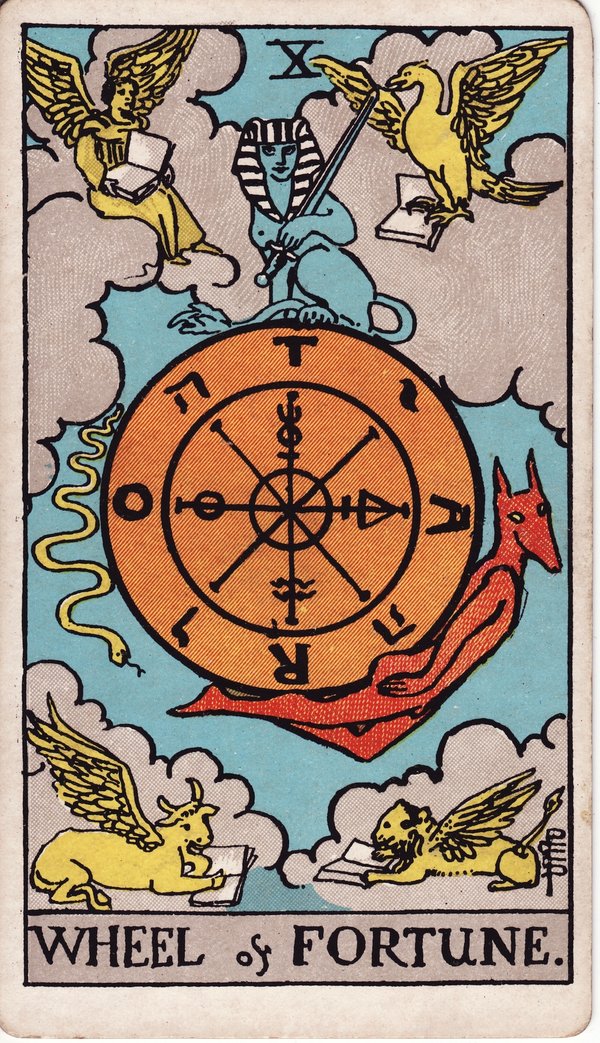
Rider-Waite-Smith (1909): The central image is a great wheel, suspended in the sky, inscribed with letters and symbols. On the wheel's face, the four Hebrew letters YHVH — the Tetragrammaton, the unpronounceable name of God — alternate with the letters T-A-R-O, read by some as TAROT, by others as ROTA (Latin for "wheel"), and by others as TORA (the Law). The anagrammatic resonance — TAROT / ROTA / TORA / ATOR (Hathor) — suggests that the wheel is a text, a scripture, a message that can be read from multiple angles.
Three figures occupy the wheel's outer edge: a snake (sometimes identified as Typhon or Set) descends on the left, representing the life force moving downward into darkness and transformation; Hermanubis (a composite of Hermes and Anubis, the guide of souls) climbs on the right, carrying the caduceus of wisdom; and a Sphinx sits at the summit, holding a sword, representing the poised intelligence that has reached the top of the cycle and surveys all that has been and will be.
In the four corners, the four Kerubs appear as winged creatures — Angel (Aquarius), Eagle (Scorpio), Lion (Leo), and Bull (Taurus) — each holding a book. These are the four fixed signs of the zodiac, the stable anchors at the corners of the turning sky. They read from the Torah (or the Book of Life), suggesting that the wheel's motion is not chaos but pattern — a text being read by eternal witnesses.
Thoth (Crowley/Harris, 1944): Harris's Fortune is a cosmic maelstrom. The wheel has ten spokes (the Sephiroth) and is suspended in a firmament of stars, churned by lightnings. The three figures on the wheel are rendered with explicit alchemical and Hindu symbolism: the Sworded Sphinx (Sulphur/Sattvas) at the summit, Hermanubis (Mercury/Rajas) climbing, Typhon (Salt/Tamas) descending.
The entire wheel is surrounded by a field of electric blue and violet — the colors of the third eye, of visionary experience, of the lightning flash that reveals the whole pattern in an instant. The Sphinx is composed of the four Kerubs themselves, representing the four magical virtues: To Know (Bull), To Will (Lion), To Dare (Eagle), and To Keep Silence (Man). These are summed in a fifth element, Spirit, corresponding to the virtue "To Go" — the token of Godhead, the movement that is the wheel itself.
In Crowley's visionary account (Liber 418), the wheel becomes a sphere of 49 wheels, each with 49 spokes, spinning with incredible velocity — "one wheel within another" — spun by a giant hand for "pleasure" or "amusement." At the center is a scarlet heart; the rim is an emerald snake. This vision deepens the card's fatalistic quality: the forces that turn our lives are vast beyond comprehension, and their purposes may not be legible in human terms.
Astrological & Elemental Layer
Jupiter, the Greater Benefic, rules the Wheel of Fortune. Jupiter is the planet of expansion, opportunity, wisdom, and the long view. Where Mercury analyzes and Saturn restricts, Jupiter enlarges — it takes the single event and places it within the largest possible context. The Wheel's Jupiterian quality is the gift of perspective: from the top of the wheel, you can see how everything fits, how the descent you feared was actually the beginning of the next ascent.
Jupiter rules Sagittarius (in traditional astrology) and Pisces (in modern), both signs associated with faith, meaning, and the journey beyond the known. The Wheel inherits Jupiter's optimism — its insistence that the story is not over, that the apparent disaster is a chapter, not the ending.
The elemental attribution is Fire — the element of spirit, transformation, and creative energy. Fire burns away what is no longer needed and illuminates what is. The Wheel as Fire is the heat of change, the friction of the turning, the light that reveals the pattern. Fire does not comfort — it transforms. The Wheel of Fortune, despite its reputation as a "lucky" card, is ultimately a fire card: it changes you, and change is not always comfortable.
In the Thoth system, Crowley adds the transpersonal planets — Saturn, Uranus, Neptune, Pluto — as the "masters of Karma." This deepens the Jupiterian framing: Jupiter may be the Greater Fortune, but the wheel itself is turned by forces older and stranger than any single planet's benevolence.
Kabbalistic / Tree of Life Layer
Path 21 connects Chesed (the fourth Sephirah, the expansive mercy of Jupiter) to Netzach (the seventh Sephirah, the sphere of victory, desire, instinct, and the beautiful forms of Venus). This is the path of fortune descending from divine generosity into the realm of personal experience — the love of the universe becoming the specific luck, the specific turn, the specific opportunity that changes a life.
Chesed is the sphere of unconditioned giving — the love that pours forth without calculating worthiness. Netzach is the sphere of desire, of what we want, of the beautiful forms that attract and move us. The Wheel path between them represents the translation of cosmic abundance into personal fortune — the way the universe's infinite generosity manifests as the specific things that happen to us.
But Netzach is also the sphere of instinct, and its Venusian quality is not always comfortable. The Wheel's path reminds us that fortune includes both what we want and what we need but do not want — both the gift and the lesson, both the ascent and the fall.
The Hebrew letter Kaph means "palm of the hand" — the open hand that receives. In some traditions, the lines of the palm are said to reveal the destiny of the owner. Kaph as the Wheel's letter suggests that fortune is not something we grasp but something we receive. The closed fist cannot catch what the wheel throws; the open palm can.
Archetypal & Life-Stage Themes
The Fates / The Moirai: In Greek mythology, three sisters — Clotho (who spins the thread), Lachesis (who measures it), and Atropos (who cuts it) — determine the destiny of every mortal. The Wheel of Fortune is their visible mechanism, the loom on which all lives are woven. This archetype speaks to the dimension of life that is simply given, the cards we are dealt, the timing we do not choose.
Fortuna: The Roman goddess of luck, often depicted blindfolded, turning a great wheel. Fortuna reminds us that fortune is not merit — the wheel turns for the wicked and the righteous alike. Her blindfold emphasizes the impersonality of fate; she does not see who she lifts up or casts down.
The Trickster: In the Thoth framing, there is a trickster dimension to Fortune. Crowley's vision includes the "Deceiver" — the Lamb and Flag who claims to be the greatest deceiver because its apparent purity "seduces the elect," while the Wolf (lust) and Raven (melancholy) only betray the greedy or dishonest. Fortune can appear to bless while setting a trap; what looks like luck may be a test, and what looks like disaster may be a liberation.
The Eternal Return: The Wheel embodies the archetype of cyclical time — the myth of the eternal return, the seasons that circle, the ages that rise and fall. This is the Wheel of the Year in Wicca, the Yugas of Hindu cosmology, the Ouroboros that devours its own tail. Everything that rises will fall; everything that falls will rise again.
In the Fool's Journey, the Wheel of Fortune marks the halfway point — the turn from the outward, constructing phase of the first ten cards to the inward, deconstructing phase of the second ten. After this card, nothing the Fool encounters will be what it seems. The Wheel is the gate through which the conscious mind passes into the mysteries.
Advising For / Advising Against
-
If advising FOR: Ride the wheel. The turn that is happening — whether it looks like good fortune or bad — is part of a larger pattern that you cannot yet see. Your task is not to control the wheel (you cannot) but to stay centered as it turns. What is rising in your life deserves your attention and gratitude. What is falling deserves your release. Neither is permanent. The Sphinx at the summit does not cling; it surveys and knows. Be the Sphinx. And if you are at the bottom: take heart. The wheel only turns one direction, and you are already on your way up.
-
If advising AGAINST: Do not mistake passivity for faith. Yes, the wheel turns — but you are not a passenger; you are a participant. If you have been telling yourself "it's fate" as a way of avoiding the hard work of change, you are in the Wheel's shadow. Karma is not an excuse for inaction; it is the field in which action becomes meaningful. And if you are clinging to a summit that has already begun to crumble — let go. The wheel will take you down whether you cooperate or not. Better to descend with grace than to be dragged.
Card of the Day
Today, something is turning. You may feel it as a shift in energy, an unexpected call, a door opening or closing. Do not try to hold the wheel still. Find your center — the still point within you that watches the motion without being moved by it. From that center, you can receive whatever the wheel brings with equanimity.
Card of the Year
A Wheel of Fortune year — when your personal year number reduces to 10 (which itself reduces to 1) — is a year of significant, sometimes dramatic, change. This is the year when the cycle turns: old chapters close, new ones open, and events beyond your control reshape your circumstances. You may experience a career shift, a relocation, a relationship transformation, or a spiritual awakening that reorders your priorities. The challenge is to stay centered through the changes — to find the hub rather than clinging to any single spoke. At the end of this year, you will not be where you started, and the person you have become will be the seed of the next nine-year cycle. Plant that seed with intention.
Elemental Dignities Notes
The Wheel of Fortune is Fire — the element of transformation, spirit, and creative energy. In a spread, its elemental relationships follow the Golden Dawn system:
- Strengthened by Air (Swords): Air feeds Fire — clarity of thought fuels the understanding of life's patterns. A Wheel adjacent to Swords gains intellectual perspective; the seemingly random events reveal their logic.
- Strengthened by Fire (Wands): Like element intensifies. Multiple Fire cards amplify the transformative and dynamic quality — change accelerates, though at risk of becoming overwhelming or chaotic.
- Weakened by Water (Cups): Water quenches Fire. Cups adjacent to the Wheel may suggest that emotional overwhelm is preventing the clear seeing needed to navigate change. Feelings are flooding the pattern-recognition.
- Neutral / Mixed with Earth (Pentacles): Earth can contain Fire — practical structures channel transformation into tangible results. But too much Earth can resist the turning altogether, trying to hold still what must move.
Deck-Specific Notes
-
If using a Thoth deck: Fortune appears as a cosmic wheel of ten spokes suspended in a star-field stirred by lightnings. The three Gunas are prominently figured. The reading emphasis shifts from "luck" to "cosmic law" — the wheel is not a slot machine but the machinery of karma. Crowley's insistence on the "continual change" inherent in all phenomena strips away sentimentality: fortune is what happens when the Gunas revolve, and nothing — not joy, not sorrow — can remain fixed.
-
If using a Marseille-tradition deck: La Roue de Fortune typically shows three figures on a wheel, with a crowned figure at the top and two figures climbing and falling. The Marseille Wheel often emphasizes the social dimension — the rise and fall of kings, the wheel of fortune that determines worldly status. Some versions include a crank, suggesting that someone (or something) is actively turning the wheel.
-
If using a blended or contemporary deck: The astrological and elemental layers apply across visual traditions. The core archetype — cyclical change, destiny, the larger pattern — persists. Consult your deck's guidebook.
Journaling & Contemplation Prompts
- What cycle in my life is currently turning? Where am I on the wheel — rising, at the summit, descending, or at the bottom?
- What pattern am I finally able to see now that I couldn't see when I was in the middle of it?
- Where have I been blaming "luck" or "fate" for something that is actually within my power to change?
- What am I clinging to that the wheel is trying to take from me? What would happen if I let go?
- If everything that is happening is part of a larger pattern I cannot yet see, what might that pattern be teaching me?
Additional Associations
| Association Type | Value |
|---|---|
| Color(s) | Royal blue (the night sky of Fortune, Jupiter's expansive canopy); violet and electric blue (Thoth — the third eye, visionary perception); gold (the wheel itself, the solar metal of consciousness); silver (the moon's cycles, reflected in the wheel's turning) |
| Crystals / Stones | Amethyst (Jupiter's stone, spiritual perspective, the crown chakra that sees the pattern); Lapis Lazuli (ancient stone of wisdom, the starry sky, the third eye); Tiger's Eye (the wheel's movement, the capacity to stay centered while everything changes) |
| Herbs / Plants | Sage (Jupiter's herb, wisdom and clearing, seeing the larger pattern); Dandelion (the wheel in miniature, wishes carried on the wind, fortune's unexpected arrivals); Oak (Jupiter's tree, strength through cycles, the deep roots that survive every season) |
| Archetypes (Jungian) | The Fates (Moirai); Fortuna; The Trickster (Thoth); The Wheel / Eternal Return; The Synchronicity (meaningful coincidence as archetypal experience) |
| Mythological Figures | Fortuna and her wheel; The Moirai (Clotho, Lachesis, Atropos); Hermes Trismegistus (the wisdom that reads the pattern); Tyche (Greek goddess of fortune); The Hindu Trimurti (Brahma creating, Vishnu preserving, Shiva destroying — the three Gunas in divine form) |
| Numerological Resonance | 10 = completion, the full expression, the decade. The Roman numeral X is also the mark, the signature, the kiss — fortune sealing the cycle with its sign. Cross sum 1 = the Magician, the new beginning, the seed that contains the next wheel's turning. |
| Playing Card Equivalent | 10 of Hearts — emotional fulfillment, the heart's cycle completing, the love that has turned full circle |
| I Ching Hexagram Parallel | Hexagram 50 — Ting / The Cauldron. "The cauldron. Supreme good fortune. Success." The hexagram of the vessel that transforms — raw food becomes nourishment through the application of fire. The cauldron, like the wheel, is a container for change. |
| Body / Organ Correspondence | Liver (Jupiter's organ — the body's largest internal organ, responsible for regeneration and processing, the physical wheel that turns nutrients into life); hips and thighs (Sagittarius, Jupiter's sign — the parts that carry us forward, the body's locomotion); the pineal gland (the third eye that perceives the pattern, Thoth's visionary blue) |
Shadow & Integration Message
The Wheel's shadow is not simply bad luck — it is the surrender of agency to fate. The person who says "it was meant to be" about everything, who has stopped making choices because "the wheel will turn as it turns," who has confused acceptance with passivity. This is the Wheel's shadow as fatalism: the abdication of responsibility dressed in spiritual language.
The Thoth tradition adds a darker shadow: the wheel as indifferent machinery, spun by a giant hand "for pleasure." The possibility that the forces governing our lives are not benevolent, not malevolent, but merely entertained — the universe as a game whose players we are, without ever having been asked if we wanted to play. The Deceiver at the center — the Lamb and Flag — who seduces with apparent innocence while hiding the true nature of the game.
Integration of the Wheel means finding the center: the still point within where you are not the figure on the rim (rising, falling, clinging) but the hub around which the wheel turns. From the center, you can participate in the motion without being destroyed by it. You can receive fortune without attachment to either the gift or the loss. This is not detachment in the cold sense but equanimity — the capacity to be fully present with whatever the wheel brings, knowing that it will pass.
Elemental Intelligence (Suit Framing)
In the Jungian cognitive function mapping, the Wheel of Fortune as Fire aligns with the Intuition function, the choleric humour, and the priestly/philosophical class. But the Wheel's Fire is not the personal fire of Wands — it is cosmic fire, the fire of the stars, of the lightning that reveals the pattern in a flash. Its Intuition is not the hunch about a situation but the direct perception of universal law — the gnosis that sees through time.
The Wheel's "class" is the oracular, the prophetic — the one who reads the signs, who understands that events are not random but patterned, who can see the wheel turning while others only feel the motion. Its choleric humour is transformed by Jupiter into the temperament of the philosopher-king: decisive yet wise, active yet patient, fully engaged in the game while knowing it is a game.
Timing & Manifestation
For timing, the Wheel of Fortune signals that the event will happen in "its own time" — which is to say, at the turning of the cycle you cannot accelerate or delay. Chronologically, it corresponds to Jupiter's cycle (approximately 12 years) or to the turning of a personal cycle (the completion of a 9- or 10-year period). In practical terms, the Wheel often indicates a period of weeks to months when sudden change is likely.
The timing answer of the Wheel is: when the cycle completes — which may be soon, or which may be the work of years. What you can know is that it is turning. Pay attention to the signs.
Yes / No Tendency
The Wheel of Fortune leans toward Yes, but the outcome will change. The favorable turn is real, but it is not permanent. In a yes/no spread, the Wheel says: yes, for now — but understand that this is a phase, not a final state. Enjoy the summit while you are there, and do not be surprised when the wheel continues its turning. This is perhaps the most honest yes in the Tarot — the yes that comes with a built-in awareness of impermanence.
In reversed / ill-dignified position, the tendency shifts toward not now, or not as you hope. The wheel is turning against you, or you are at the bottom of the cycle. But the reversed Wheel's message is ultimately hopeful: the bottom is not the end. The wheel will turn again. What you can do now is prepare, learn, and position yourself for the ascent when it comes.
Common Misreads / Nuances to Know
Misread 1: "The Wheel of Fortune means great luck is coming." The Wheel includes both the ascent and the descent. A "fortunate" reading of this card should always be tempered with the awareness that fortune is seasonal. The Sphinx at the top knows it will not stay there forever.
Misread 2: "The Wheel reversed means terrible luck." The reversal often indicates resistance to change rather than objectively bad fortune. The querent is fighting the turn, clinging to a phase that has passed, refusing to descend when descent is the only way to the next ascent. The "bad luck" is self-created through rigidity.
Misread 3: "The Wheel means you can't do anything — it's all fate." The card represents forces beyond your control, but your response to those forces is always yours. The Sphinx chooses how to hold the sword; Hermanubis chooses how to climb. Fate sets the stage; you play the part. The question is not can you control the wheel? (you cannot) but how will you ride it?
Nuance for Thoth readers: The three Gunas framework transforms the reading of Fortune. Rather than asking "is this good luck or bad luck?" the Thoth reader asks: what quality of energy is dominant right now? Sattvas (calm intelligence at the summit), Rajas (restless energy climbing), or Tamas (inertia and darkness descending)? Each Guna has its purpose, its gift, and its cost. The goal is not to stay at the top but to move through all three with awareness.