The Poetic Line
"The lantern reveals nothing but the hand that holds it — and that is everything."
Keywords
| Category | Dignified | Undignified |
|---|---|---|
| General | Solitude, introspection, inner guidance, wisdom, seeking, patient withdrawal, the teacher who appears when the student is ready | Isolation, loneliness, withdrawal from life, fear of connection, bitter seclusion, the guru who needs an audience |
| Spiritual | Contemplation, meditation, the dark night of the soul as sacred passage, listening to the inner voice, spiritual direction, the path of the mystic | Spiritual bypassing through isolation, using solitude to avoid the work of relationship, the hermit whose cave has become a prison, false enlightenment |
| Psychological | Self-reflection, integration through stillness, the examined life, healthy boundaries, knowing when to withdraw and when to return | Morbid introspection, rumination, avoiding the world out of fear, the inner critic masquerading as wisdom, analysis paralysis |
| Physical Health | Restorative solitude, the body's need for retreat, healing through stillness, listening to the body's quiet signals, sleep as medicine | Neglect of the body through withdrawal, depression manifesting as physical stagnation, isolation-induced illness, refusal of touch |
| Relationships | Sacred solitude within partnership, healthy independence, the wisdom to know when distance serves love, the mentor who empowers rather than controls | Emotional unavailability, fear of intimacy, abandonment of relationships, the partner who is always "somewhere else," using solitude to punish |
| Financial | Prudent saving, financial independence, the wealth of simplicity, the wisdom to know "enough," slow and careful investment | Hoarding, financial isolation, poverty as identity, fear-driven frugality, the miser's lonely fortune |
| Vocational | The specialist's deep expertise, the craft perfected through years of solitary practice, the consultant called in for wisdom, meaningful sabbatical | Career stagnation through withdrawal, refusing collaboration, the expert who cannot share knowledge, irrelevance through isolation |
| Shadow / Thoth Distinction | The Logos — the Hermit as the creative spermatozoon, the "Hand" (Yod) that is the instrument of manifestation, wisdom that generates rather than merely preserves | Cerberus untamed — the three-headed hound of hell guarding a wisdom that cannot be accessed, the gatekeeper who has forgotten what lies beyond the gate |
Narrative Description
General Meaning
The Hermit is the card of the inward turn. After the ecstatic release of Strength/Lust, the Fool withdraws — not from defeat but from the recognition that the next stage of the journey requires a different kind of movement. The Chariot drove outward; Strength integrated inward; now The Hermit goes deeper still, into the cave of the self where the only light is what you carry.
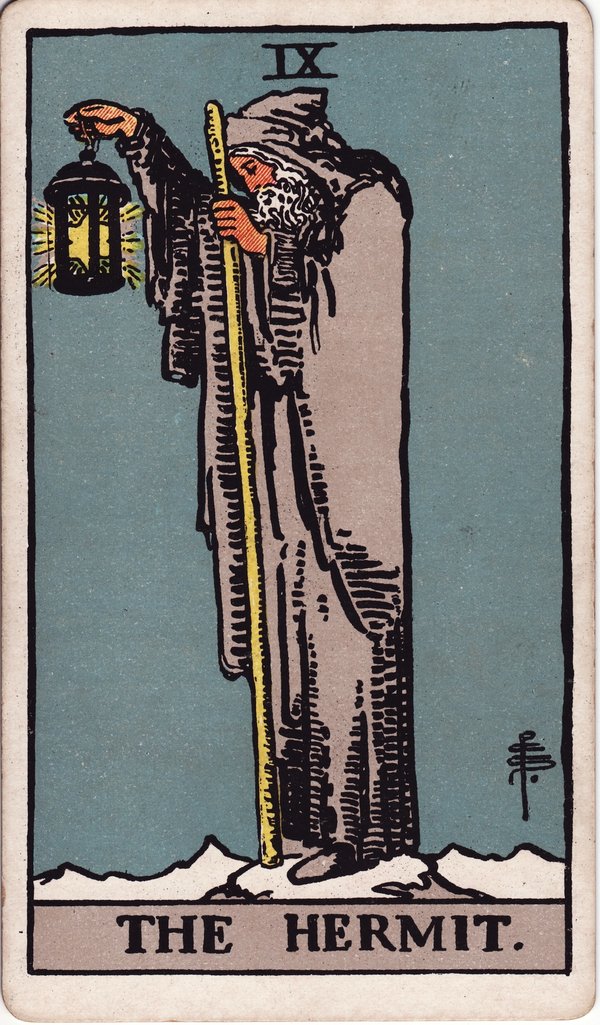
The Hermit stands at the summit of a mountain, holding a lantern that contains a six-pointed star — the Seal of Solomon, the union of fire and water, masculine and feminine, above and below. The light illuminates only the next few steps, not the whole path. This is the card's essential teaching: wisdom is not the ability to see the entire journey but the willingness to take each step in the light you have, trusting that the next step will reveal the light for the one after.
Astrologically, Virgo gives The Hermit its quality of discernment, of patient analysis, of the harvest that comes only after the long work of cultivation. Virgo is the sign of the craftsman, the healer, the one who perfects through attention to detail. The Hermit's wisdom is not the flash of revelation (The Tower) or the ecstatic vision (The Star) but the slow accumulation of insight through sustained practice and honest self-examination.
In the Thoth tradition, The Hermit is framed more explicitly as a creative force — not merely the wise elder withdrawing from the world but the active principle of manifestation. The Hebrew letter Yod means "Hand" — the hand that writes, creates, shapes. The Hermit in Thoth holds not only the lamp but the Orphic Egg, the seed of the universe. He is attended by Cerberus, the three-headed hound of hell, whom he has tamed — suggesting that the journey inward requires passing through the gates of the underworld and facing what guards them.
In a reading, The Hermit signals a need for solitude, for stepping back from the noise of daily life to hear the quieter voice within. It may indicate a period of retreat, a need for mentorship (as either student or teacher), or the arrival of a phase of life where outer activity must yield to inner reflection. The Hermit does not say abandon the world forever — it says the world will still be there when you return, and you will return with something you could not have found in the crowd.
Symbolism & Imagery
Rider-Waite-Smith (1909): An old man in a gray cloak stands alone at the peak of a snow-covered mountain. In his right hand, he holds a lantern raised high — the conscious mind illuminating the path of spirit. Inside the lantern burns a six-pointed star, the Seal of Solomon, representing wisdom that integrates all dualities. The light is modest, casting only enough glow to see the immediate next step — this is the light of humility, the wisdom that knows it cannot know everything.
In his left hand, he holds a staff — not the wand of the Magician or the scepter of the Emperor but a simple walking stick, the support of the pilgrim. The staff in his hand is authority earned through experience, the groundedness that comes from having walked many roads. His left hand is the subconscious side; the staff in this hand suggests that his wisdom is not purely intellectual but embodied, intuitive, rooted in the body's knowing.
The snow beneath his feet suggests both the heights of spiritual attainment and the coldness of isolation — the summit is a lonely place. The gray of his cloak is the color of neutrality, of the sage who has moved beyond the passions of youth without disowning them. He looks downward, not outward — his attention is on the path, on the step, on the work of the present moment.
Thoth (Crowley/Harris, 1944): Harris's Hermit is a radically esoteric image. The central figure resembles a spermatozoon — the seed of life, the Logos — descending through a cosmic field of wheat (Virgo's harvest). The Hermit carries the Orphic Egg wrapped in a rainbow-colored serpent (the iridescence of Mercury), representing the universe in potential, the life force that contains all forms.
At the center of the Hermit's lamp burns the Sun itself — the "secret Fire," the fluidic essence of Light. The lamp is held by a disembodied Hand (Yod) emerging from clouds, emphasizing the Hermit as the instrument of divine creative will.
Below him, Cerberus — the three-headed hound of Hades — waits, tamed. The Hermit has passed through the underworld and returned, and the guardian now serves rather than threatens. The wheat in the background signifies Virgo, the harvest, the fruits of long cultivation — but also Persephone, the grain goddess who descends into the underworld and returns, bringing spring.
The theological link is Persephone and Mercury as Psychopompos — the guide of souls through the lower regions. The Hermit in Thoth is not merely the wise old man on the mountain; he is the initiate who has died to the old self and been reborn, the shaman who travels between worlds.
Astrological & Elemental Layer
Virgo, the sign of the Virgin, governs The Hermit. Virgo is mutable Earth — the soil that receives the seed, the ground of manifestation, the body as the vessel of spirit. Virgo's ruling planet (in modern astrology) is Mercury, the messenger, giving The Hermit its quality of analysis, discrimination, and the careful articulation of wisdom.
But Virgo's deeper association is with the harvest — the gathering of what has been grown, the patient work of separating wheat from chaff. The Hermit is the harvester of the soul: the one who, after the long season of experience, sits in stillness and sorts through everything that has happened, keeping what nourishes and releasing what does not.
The elemental attribution is Earth — the element of the body, of practicality, of groundedness. An Earth card signals that wisdom is not ethereal but practical, not abstract but embodied. The Hermit's wisdom is not a philosophy to be contemplated but a practice to be lived. The lantern is held in a hand; the staff touches the ground.
In the Thoth system, Virgo is deepened by the Saturnian attribution (Saturn as the keeper of the gate). Saturn is the planet of limits, time, discipline, and the hard-won wisdom of age. The Hermit's Saturnian quality is the understanding that comes only through the passage of years, through mistakes made and learned from, through the patient accumulation of days.
Kabbalistic / Tree of Life Layer
Path 20 connects Chesed (the fourth Sephirah, the expansive love of Jupiter) to Tiphareth (the sixth Sephirah, the heart of beauty and harmony). This is the path by which divine love becomes personal wisdom — the love that is too vast to be comprehended condenses into the lantern-light that can be carried by a single human hand.
Chesed is the sphere of mercy, of unconditional giving, of the love that pours forth without asking worthiness. Tiphareth is the sphere of the sacrificed and resurrected god, the heart center where the human and divine meet in balance. The Hermit on this path is the vessel through which infinite love passes into finite form — the hand that catches the light and holds it steady enough for others to see.
The Hebrew letter Yod is the smallest of the letters, a mere point — yet it is the foundation of all other letters. Every Hebrew letter can be analyzed as a combination of Yods. The Yod is the spark, the seed, the first movement of will from which all manifestation proceeds. It is the first letter of the Tetragrammaton, the unutterable Name. The Hermit, walking with Yod, carries the seed of divinity itself.
This is the esoteric meaning of the Hermit's solitude: it is not escape but incubation. The seed must spend time in darkness before it can sprout. The wisdom of the Hermit is the wisdom of the seed — containing the whole tree in a form that is invisible to the outer eye.
Archetypal & Life-Stage Themes
The Wise Elder (Senex): The Hermit is the archetype of the sage, the mentor, the one who has lived long enough to see patterns that are invisible to the young. This is Dumbledore, Yoda, the old man on the mountain who the hero must seek out. The Senex archetype represents the accumulated wisdom of a lifetime, the perspective that comes from having survived many seasons.
The Seeker: The Hermit is also the one who is still seeking — the pilgrim whose destination is not a place but a state of understanding. This is the archetype of the spiritual quest, the inward journey, the "dark night of the soul" described by St. John of the Cross. The Seeker does not have the answers but knows how to ask the questions.
The Hermit / The Solitary: In its most literal form, this is the archetype of the one who withdraws from society to find truth. The Desert Fathers, the Zen monk in his mountain hut, Thoreau at Walden Pond. The Solitary teaches that some knowledge cannot be acquired in company — it requires silence, requires the absence of other voices, requires the courage to be alone with oneself.
The Psychopomp (Thoth): The Thoth Hermit adds the archetype of the guide of souls — Mercury/Hermes conducting the dead through the underworld, the shaman who travels between worlds and returns with healing. This Hermit has faced Cerberus, descended into darkness, and emerged carrying the egg of new life.
In the Fool's Journey, The Hermit appears after the fiery integration of Strength/Lust. The Fool has tasted power, has ridden the Beast, has discovered the force of passion — and now must withdraw to understand what all of that means. The Hermit is the card of the second half of the journey — the turn from external adventure to internal integration, from doing to being, from achieving to understanding.
Advising For / Advising Against
-
If advising FOR: Withdraw. Not forever — but now, for this season, the most productive thing you can do is step back and go within. The answers you are seeking from others, from books, from the noise of the world, are already present in the quieter parts of yourself. Create the silence that allows you to hear them. Light your own lantern — even if it only shows you the next step. That is enough. The mountain is not climbed all at once.
-
If advising AGAINST: Your solitude has become a hiding place rather than a sanctuary. If you are withdrawing not to find yourself but to avoid the difficulty of relationship, of engagement, of being seen — that is not the Hermit's wisdom, it is the shadow of fear wearing a wise man's cloak. Come down from the mountain. The world needs what you have learned in solitude, and you need the world to keep your wisdom honest. The lantern is meant to be shared.
Card of the Day
Today, step into stillness. The noise of the world — notifications, obligations, demands — is not going to give you the guidance you need. That guidance is already within you, but it speaks in a whisper, not a shout. Find even a few minutes of genuine solitude. Ask yourself: What do I already know that I have been too busy to hear? The answer may not be what you expected, but it will be true.
Card of the Year
A Hermit year — when your personal year number reduces to 9 — is the final year of a nine-year cycle, a year of completion, reflection, and preparation for the new beginning that awaits at 10 (which reduces to 1). This is a year for solitude, for sabbatical, for finishing what you started nine years ago and releasing what does not need to come with you into the next cycle. You may feel a strong pull toward spiritual practice, therapy, journaling, or any form of deep self-examination. Relationships may shift — some will deepen through the honesty that solitude enables, others may fall away because they cannot survive the truth you are finally willing to tell yourself. At the end of this year, you will not be the person who entered it. You will be lighter, clearer, and ready for the next Fool's leap.
Elemental Dignities Notes
The Hermit is Earth — the element of the body, practicality, and groundedness. In a spread, its elemental relationships follow the Golden Dawn system:
- Strengthened by Water (Cups): Water nourishes Earth — emotional depth feeds practical wisdom. A Hermit adjacent to Cups gains emotional richness; the solitude becomes fecund rather than barren.
- Strengthened by Earth (Pentacles): Like element deepens. Multiple Earth cards intensify the grounded, practical dimension — the Hermit's wisdom becomes more applicable, more embodied, though at risk of becoming overly cautious or materialistic.
- Weakened by Air (Swords): Air is Earth's enemy. Swords adjacent to The Hermit suggest that overthinking, intellectual detachment, or anxious mental activity is disrupting the stillness needed for genuine reflection. The mind is chattering when it should be silent.
- Neutral / Mixed with Fire (Wands): Fire can warm Earth — creative passion can give the Hermit's wisdom vitality and direction. But too much Fire can scorch the receptive ground, turning patient reflection into restless urgency.
Deck-Specific Notes
-
If using a Thoth deck: The Hermit appears as a spermatozoon-like figure descending through a field of wheat, carrying the Orphic Egg and accompanied by Cerberus. The reading emphasis shifts from "wise withdrawal" to "creative descent" — the Hermit as the Logos entering matter, the seed of consciousness planting itself in the dark soil of the unconscious. The hand (Yod) holding the lamp from the clouds emphasizes that the Hermit's wisdom is not personal but transpersonal — it flows through him, not from him.
-
If using a Marseille-tradition deck: L'Hermite typically shows an old man with a lantern and staff, often with a hooded cloak. The Marseille Hermit sometimes carries an hourglass, emphasizing the Saturnian dimension of time and mortality. The lantern may be partially concealed by the cloak, suggesting that wisdom is always partly hidden.
-
If using a blended or contemporary deck: The astrological and elemental layers apply across visual traditions. The core archetype — solitude, introspection, inner guidance — persists. Consult your deck's guidebook.
Journaling & Contemplation Prompts
- Where in my life am I being called to slow down and listen within?
- What wisdom am I carrying that others need, but that I have been keeping private — perhaps even from myself?
- Is my solitude chosen and sacred, or has it become isolation born of fear?
- What would I hear if I turned off every external voice for a day? A week? Am I willing to find out?
- What am I harvesting from the last cycle of my life? What needs to be released to make room for the next planting?
Additional Associations
| Association Type | Value |
|---|---|
| Color(s) | Gray (neutrality, the sage's cloak, the integration of all colors); deep blue (the night sky, the inner darkness where the lantern shines); gold (the lantern's light, the inner sun); wheat-gold (Virgo's harvest) |
| Crystals / Stones | Clear Quartz (amplification of inner wisdom, the lantern's star); Selenite (Virgo's purity, the light of the moon in the dark); Labradorite (the shaman's stone, the journey through the underworld); Sapphire (Saturnian wisdom, the stone of the sage) |
| Herbs / Plants | Sage (clearing, wisdom, the herb of the elder); Lavender (calming the mind for introspection, the scent of solitude); Valerian (the herb of sleep and dreams, the descent into the unconscious); Wheat (Virgo's grain, the harvest, Persephone's promise of return) |
| Archetypes (Jungian) | The Wise Elder (Senex); The Seeker; The Hermit/Solitary; The Psychopomp (Thoth); The Crone (feminine parallel) |
| Mythological Figures | Hermes/Mercury as guide of souls; Diogenes with his lantern searching for an honest man; the Buddha under the Bodhi tree; Moses on Sinai receiving the Law; Persephone descending and returning; St. John of the Cross in the dark night; Thoreau at Walden |
| Numerological Resonance | 9 = the final single digit, the culmination, the initiate. Nine is the number of months of gestation, the time it takes for a soul to form a body. The Hermit's 9 is the labor of birthing wisdom — long, private, and irreversible. |
| Playing Card Equivalent | 9 of Hearts — the wish card, the heart's deepest desire revealed in solitude, the emotional culmination of the suit |
| I Ching Hexagram Parallel | Hexagram 52 — Ken / Keeping Still, Mountain. "Keeping still. Keeping his back still so that he no longer feels his body. He goes into his courtyard and does not see his people." The hexagram of meditation, of the stillness that allows the mud to settle so the water becomes clear. |
| Body / Organ Correspondence | Intestines (Virgo's rulership — the organs of assimilation and elimination, the body's wisdom of keeping what nourishes and releasing what does not); the spine (the mountain, the vertical axis, the staff); the pineal gland (the "third eye," the inner lantern) |
Shadow & Integration Message
The Hermit's shadow is the loneliness that curdles into bitterness, the solitude that becomes a prison, the withdrawal that is really a refusal. The person who has been alone so long they have forgotten how to connect, who uses their "wisdom" as a shield against intimacy, who looks down from the mountain with contempt for those still struggling in the valley below. This is the Hermit as the bitter old man, the guru who needs disciples more than they need him, the "expert" whose expertise has become a way of never having to learn anything new.
The Thoth shadow adds the dimension of Cerberus untamed — the gatekeeper of the unconscious that cannot be passed, the wisdom that is guarded but never accessed. The Hermit who has descended but not returned, who is lost in the underworld because they forgot the way back to the living.
Integration means the capacity to be alone without being lonely, to withdraw without abandoning, to carry wisdom without requiring an audience. It means descending into the dark and returning with the lantern still burning — and then sharing the light.
Elemental Intelligence (Suit Framing)
In the Jungian cognitive function mapping, The Hermit as Earth aligns with the Sensation function, the melancholic humour, and the laborer/farmer class. The Earth of The Hermit is cultivated soil — the ground that has been worked, turned, enriched by the compost of experience. Its Sensation is not the raw data of the senses but the refined perception that comes from long practice: the craftsman who can feel the flaw in the wood before seeing it, the therapist who hears the pause between words that contains the truth.
The Hermit's "class" is the monastic, the scholar, the one whose wealth is not material but intellectual and spiritual. Its melancholic humour in its healthy expression is thoughtful, thorough, and capable of sustained attention. In its shadow, the melancholic becomes the depressive — the one whose inward turn has become a spiral, whose self-examination has become self-obsession.
Timing & Manifestation
For timing, The Hermit signals a period of slower, more deliberate unfolding. This is not the sudden breakthrough but the gradual ripening, the wisdom that comes "in due season." Chronologically, it corresponds to the Virgo season (approximately August 23 – September 22), and more broadly to the final phase of any cycle — the gathering-in before the new beginning.
Events influenced by The Hermit tend to require patience. The answer, the insight, the resolution is forming, but it cannot be forced. The timing answer is: when you stop looking for it — or when you have sat with the question long enough that the question itself transforms.
Yes / No Tendency
The Hermit leans toward not yet — more reflection is needed. The card rarely gives a straightforward yes or no because its function is to redirect the question inward. In a yes/no spread, The Hermit says: the answer you are seeking from the external world is actually within you, and you have not yet sat still long enough to hear it.
In reversed / ill-dignified position, the tendency shifts toward you already know the answer, and you are avoiding it. The solitude has become a way of postponing a decision that your heart has already made. Come out of the cave. The truth is waiting.
Common Misreads / Nuances to Know
Misread 1: "The Hermit means you should be alone." The card counsels solitude, not isolation. True solitude is chosen, purposeful, and temporary — it is a withdrawal for the sake of return. If your solitude has no end in sight and no purpose beyond avoidance, it is not the Hermit's wisdom but the Hermit's shadow.
Misread 2: "The Hermit means you are wise." The card more often indicates the seeking of wisdom than its possession. The Hermit is still climbing the mountain, still holding the lantern, still taking one step at a time. Wisdom is a direction, not a destination.
Misread 3: "The Hermit reversed means you're not spiritual enough." The reversal often points to the opposite problem: too much inwardness, too much withdrawal, a spiritual practice that has become an escape from life rather than an engagement with it. The reversed Hermit may be calling you back into the world.
Nuance for Thoth readers: The Thoth Hermit's spermlike form and the Orphic Egg transform the card from "withdrawal" to "gestation." The Hermit is not merely retreating — he is incubating new life. When reading Thoth, ask: what is being conceived in this solitude? The answer may be a creative project, a new phase of identity, or a deeper relationship to the divine that has not yet taken form.