The Poetic Line
"The seed does not earn the garden — it becomes it."
Keywords
| Category | Dignified | Undignified |
|---|---|---|
| General | Abundance, fertility, nurturing, sensuality, creativity, connection to nature, the mother principle | Overindulgence, smothering, creative block, neglect of self, dependence, emptiness masked by consumption |
| Spiritual | Sacred embodiment, the divine feminine, creation as spiritual practice, gratitude as a state of being, earth-based spirituality | Spiritual materialism, using "abundance mindset" to bypass real work, the goddess as performance, disconnection from body as temple |
| Psychological | Self-nurturing, healthy attachment, emotional warmth, body positivity, secure self-worth | Codependency, over-mothering, smothering love, creative paralysis from perfectionism, body hatred, fear of emptiness |
| Physical Health | Vitality, pregnancy (literal or metaphoric), body as source of pleasure, healing through nature and sensuality | Overindulgence in food/drink/pleasure, neglect of physical needs through over-giving to others, fertility challenges, body image disorders |
| Relationships | Warm, nurturing partnership, physical affection, creating a home, sexual fulfillment, generous love | Codependent attachment, the mother who won't let the child grow up, controlling through care, smothering the partner, relationship as identity |
| Financial | Financial abundance, investing in comfort and beauty, generous sharing of resources, prosperity from creative work | Overspending on luxury, financial dependence, using money to fill emotional voids, hoarding resources out of fear of scarcity |
| Vocational | Creative professions, work that nurtures others, business growth, bringing ideas to harvest, hospitality, design, the arts | Creative blocks, work that depletes without replenishing, perfectionism preventing completion, unfulfilling work that pays the bills but starves the soul |
| Shadow / Thoth Distinction | The Empress as alchemical matrix: the vessel of the Great Work, the vas Hermeticum in which base matter is transmuted to gold — creativity not as production but as transformation; Venus in Taurus — the pleasure that is sacred, the body that is holy | Possession by the material: greed, gluttony, the mother who devours what she has birthed, nature untamed becoming nature destructive — the flood instead of the garden |
Narrative Description
General Meaning
The Empress is the card of embodied abundance. She is the Great Mother — not the abstract divine feminine of the High Priestess but the tangible, fertile, sensory principle that brings life into form and nurtures it to fullness. Numbered 3, she completes the first triad of the Major Arcana: the Fool's leap of faith, the Magician's focused will, and now the Empress's generative love. The proof that creation works — the harvest that follows the planting, the child that follows the pregnancy, the garden that follows the tilling.
Where the High Priestess guards the threshold of the inner world, the Empress throws open the doors of the outer world and says: Come in. Eat. Rest. Grow. She is not concerned with hidden knowledge or spiritual initiation — her domain is the radiant surface of life, the world of the senses, the joy of being in a body on a living planet. She is the card of the gardener, the mother, the artist, the lover — anyone who creates and sustains life through love.
In a reading, the Empress signals a time of growth, abundance, and creative fertility. Projects begun in the Magician phase are now bearing fruit. Relationships are deepening. The body is vital and well. This is not a card of striving — it is a card of receiving. The Empress does not chase abundance; she attracts it by being what she is. The querent who pulls this card is being invited to relax into their own generative power — to trust that they are enough, that their natural creativity will produce results without desperate effort, that life wants to grow through them.
The emotional register of the Empress is warmth, pleasure, and deep satisfaction — the feeling of sun on skin, of good food shared, of a garden blooming, of a child sleeping against your chest. There is no urgency in this card. The Empress is unhurried because she knows that natural processes cannot be rushed. The seed takes the time the seed takes. The pregnancy lasts as long as the pregnancy lasts. The fruit ripens when it ripens. Her wisdom is the wisdom of organic timing.
In the Thoth tradition, the Empress is the alchemical matrix — the vessel of transformation, the vas Hermeticum in which the Great Work is accomplished. She is not merely the mother of children but the mother of gold — the container in which base matter is transmuted. This deepens the card's meaning for practitioners of any creative or transformative art: you are the vessel. Trust the process happening within you, even when you cannot see the results.
Symbolism & Imagery
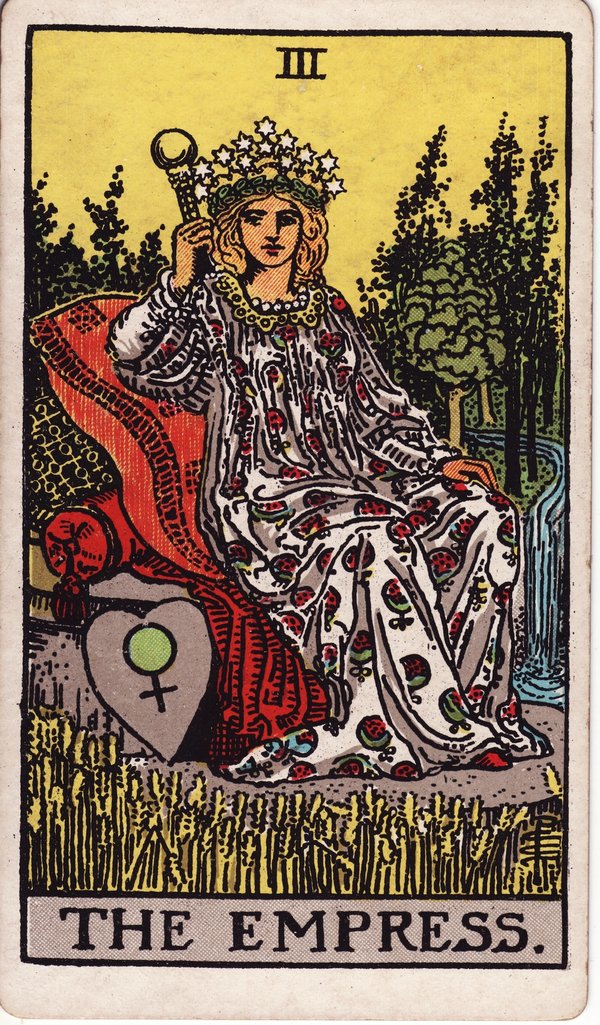
Rider-Waite-Smith (1909): Pamela Colman Smith's Empress sits on a cushioned throne in the midst of a lush landscape — golden wheat ripening at her feet, a forest rising behind her, a stream winding through the scene. Unlike the High Priestess's still, reflective pool, the Empress's water is a flowing cascade — intuition in motion, creativity in action.
Her crown holds twelve stars, linking her to the zodiac, the twelve months of the year, and the Woman of the Apocalypse clothed with the sun and crowned with stars. This is not a mortal queen but an archetype — the feminine principle that governs the cycles of nature and time itself. Her robe is decorated with pomegranates, the fruit of Persephone and the symbol of fertility, the descent, and the life that renews itself underground. The heart-shaped shield beside her bears the symbol of Venus (♀) — the planet of love, beauty, and attraction. The shield is not held defensively; it leans against her throne, a statement of identity more than a weapon: I am Venus. I am love. I am the force that draws things together.
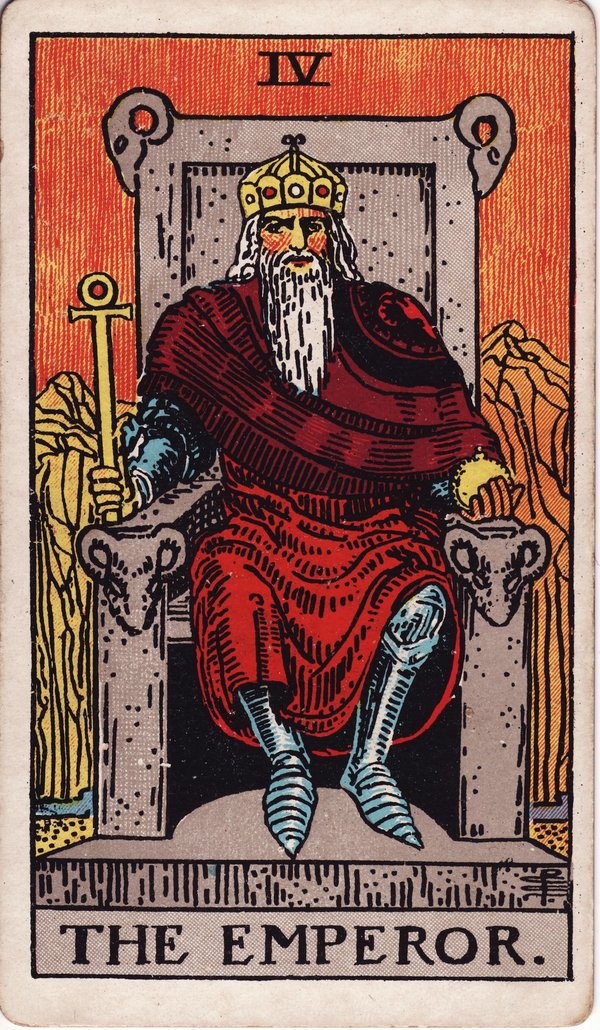
Her posture is relaxed, open, receptive. She faces forward, meeting the gaze of the querent directly — she is not withholding or mysterious. She is present, available, generous. The cushion beneath her speaks of comfort, luxury, the pleasure of the body. This is not the austere authority of the Emperor's stone throne (coming next in the sequence) but the authority of warmth — the power that rules through love rather than law.
Thoth (Crowley/Harris, 1944): Lady Frieda Harris's Empress for the Thoth deck is a figure of luminous, almost overwhelming feminine power. She is often depicted with the moon at her feet and a crown of stars, but the Thoth Empress adds the dimension of the alchemical queen — the Soror Mystica of the alchemical tradition, the sacred feminine partner without whom the Great Work cannot be completed. Her colors shift through the spectrum of Venus: rose, green, turquoise, the hues of spring and love.
The key difference between traditions: RWS emphasizes the natural Empress — the mother in the garden, the earthly queen of abundance. Thoth emphasizes the alchemical Empress — the vessel of transmutation, the matrix in which consciousness itself evolves. Both are true. The Empress is simultaneously the most grounded and the most esoteric of the early Major Arcana: she is the proof that the spiritual manifests in the physical, that the sacred is not elsewhere but here — in the body, in the earth, in the fruit that grows from the seed.
Astrological & Elemental Layer
The Empress is governed by Venus, the planet of love, beauty, harmony, attraction, and pleasure. Venus rules Taurus and Libra — the sign of embodied sensuality (Taurus) and the sign of relational harmony (Libra). Both are present in the Empress: she is the pleasure of the senses (Taurus) and the beauty of balanced relationship (Libra).
In the astrological tradition, Venus is the lesser benefic — the planet that brings good things, that softens harsh aspects, that draws people together. The Empress as Venus is the principle of attraction itself: she does not chase; she draws. She does not demand; she invites. Her mode of power is magnetic rather than directive — she rules through love because love is the most powerful force in the universe.
In the Thoth system, Venus in Taurus deepens this association: Venus is at home in Taurus (it rules the sign), and in this placement the Venusian qualities of pleasure, stability, and sensual abundance are maximized. The Empress as Venus in Taurus is the principle of embodied love — not abstract affection but love made visible in food, touch, shelter, beauty, and the slow, steady growth of living things.
The elemental assignment is Earth, the element of substance, the body, the material world, the ground. Earth receives, Earth nurtures, Earth makes tangible. The Empress as Earth is the ground that accepts the seed and returns it multiplied. Earth's shadow is heaviness, stagnation, over-attachment to material security — the Empress must remember that the garden requires both roots and air, both stability and change.
Kabbalistic / Tree of Life Layer
On the Tree of Life, the Empress occupies Path 14, connecting Chokmah (Wisdom, the Father, the second Sephirah) to Binah (Understanding, the Mother, the third Sephirah). This is the path of the Supernal Triangle — the union of the two highest Sephiroth below Kether, the cosmic marriage of the masculine and feminine principles at the level of pure archetype.
Chokmah is the first emanation, the flash of creative impulse, the seed. Binah is the great sea, the womb, the vessel that receives the seed and shapes it into form. The Empress, as the path between them, is the act of union itself — the love that draws Father and Mother together, the attraction that precipitates creation. She is not merely the child of this union but its living principle: life emerges through love.
The Hebrew letter Daleth assigned to this path means "door." The Empress is the door through which life enters the world — the birth canal, the portal, the threshold between the unmanifest and the manifest. Every living thing that has ever existed passed through a door like this. The Empress is the guardian not of secret knowledge (like the High Priestess) but of the mystery of incarnation itself: the miracle by which spirit takes on flesh.
The Sepher Yetzirah describes this path as the "Luminous Intelligence" — the consciousness that illuminates, that reveals, that makes visible what was hidden. The Empress, as the Luminous Intelligence, is the light by which creation sees itself and declares itself good.
Archetypal & Life-Stage Themes
The Empress embodies several archetypes:
The Great Mother: The universal archetype of the nurturing, life-giving feminine — present in every culture as Mother Earth, the Goddess, the fertile queen. The Great Mother is both life-giver and, in her shadow, life-taker (the mother who devours her children). The integrated Empress is the life-giving aspect; her shadow is the mother who cannot release what she has birthed.
The Queen: The feminine counterpart to the Emperor — she rules not by decree but by presence, not by force but by love. The Queen archetype represents sovereignty earned through relationship rather than conquest — she is the center that holds the kingdom together because she loves it, not because she fears losing it.
The Lover / Aphrodite: The Empress is the archetype of embodied love — the love that is physical, sensual, pleasurable. She is Aphrodite rising from the sea, Venus in her garden. She reminds us that love is not only a spiritual principle but a physical one — that the body is not an obstacle to the sacred but its instrument.
The Creator / Artist: The Empress is the archetype of the creative process — the mysterious alchemy by which inner vision becomes outer form. She does not force creation; she gestates it, nurtures it, and brings it forth in its own time. Every artist who has ever trusted the process knows the Empress.
In the Fool's Journey, the Empress is the third stage — after the Magician's focused will and the High Priestess's intuitive receptivity, the Empress arrives to teach the Fool that life is not only willed or contemplated but lived — in the body, in the garden, in the pleasure of the senses. She is the Fool's first encounter with abundance, and the lesson is simple: you are allowed to enjoy being alive.
In myth and culture: Gaia, the Greek goddess of the Earth, the ground of all being; Demeter, whose grief for her daughter Persephone causes winter and whose joy brings spring; Ishtar/Inanna, the Sumerian queen of heaven and earth, whose descent and return mirrors the cycle of the seasons; Freyja, the Norse goddess of love, fertility, and beauty; and in Christian imagery, the Virgin Mary as the Mother of God — though the Empress is more explicitly sensual and earth-centered than the Marian archetype.
Advising For / Advising Against
-
If advising FOR: Receive. You do not need to earn the right to exist — you are already here, already enough, already worthy of love and pleasure and abundance. Connect with nature — walk barefoot, tend a garden, sit under a tree, put your hands in soil. Nurture something: a plant, a child, a project, a relationship, your own body. Create without judgment — sing off-key, paint badly, write the imperfect draft. The Empress does not ask you to be good; she asks you to be alive. Trust your body. It knows things your mind has forgotten.
-
If advising AGAINST: Guard against over-giving. The Empress's shadow is the mother who gives until she is empty, and then resents what she has given. Are you nurturing others at the expense of yourself? Are you buying things to fill a creative or emotional void? The Empress's abundance is not consumerism — it is the natural overflow of a life that is rooted and fed. Also: be careful of the temptation to control through care. Love that demands gratitude is not love; it is a transaction. Give freely or not at all.
Card of the Day
Today, lean into pleasure. Genuine, embodied pleasure. Eat something that tastes like joy. Touch something beautiful. Spend time outside and notice what is growing. Your body is not an obstacle — it is the vehicle. If you have been pushing, pause. Today is for the garden, not the factory. Let things grow at their own pace.
Card of the Year
An Empress year (personal year 3) is a year of creativity, growth, and abundance. After the inward turn of a High Priestess year, the Empress year asks you to bring what you have discovered into form. This is a year for making things — art, children, gardens, businesses, homes. The energy supports expansion and manifestation. The challenge of an Empress year is to trust organic timing — to nurture without forcing, to create without grasping at outcomes. The seeds you plant this year will bear fruit for years to come, but they will do so in their own season, not yours. Practice the discipline of patience — it is an Empress art. And above all, let yourself enjoy this year. The Empress does not apologize for her pleasure. Neither should you.
Elemental Dignities Notes
The Empress is Earth (with Venus as planetary ruler). In a spread, her elemental relationship to neighboring cards follows the Golden Dawn system:
- Strengthened by Earth (Pentacles): Like element deepens like element. Multiple Earth cards ground the Empress's abundance into material reality — what she nurtures becomes tangible and lasting. But excess Earth risks stagnation and over-attachment to the material.
- Strengthened by Water (Cups): Water supports Earth — emotion nourishes the creative process, love waters the garden. The Empress adjacent to Cups suggests her abundance is flowing through relationships and emotional connection.
- Weakened by Air (Swords): Air is Earth's enemy in elemental dignity. Adjacent Swords cards suggest that over-intellectualization, criticism, or mental turbulence is disrupting the natural creative flow. The garden is being analyzed instead of tended.
- Neutral / Mixed with Fire (Wands): Earth and Fire have a complicated relationship — Fire can warm the earth and stimulate growth, but too much Fire scorches and exhausts. Adjacent Wands cards bring energy and passion to the Empress's projects, but must be balanced with rest and replenishment.
Deck-Specific Notes
-
If using a Thoth deck: The Empress appears as the alchemical queen — luminous, radiant, more explicitly the vessel of transformation than the mother in the garden. The Thoth Empress is the Soror Mystica of the alchemical tradition, the sacred feminine without whom the Great Work stalls. Her association with Venus in Taurus emphasizes the sacred dimension of pleasure: the body as temple, sensuality as spiritual practice.
-
If using a Marseille-tradition deck: L'Impératrice is depicted as a crowned, enthroned woman holding a scepter and a shield bearing the imperial eagle — symbols of temporal power and the Holy Roman Empire. The Marseille Empress carries slightly more of the "queen of the material world" energy and slightly less of the nature/garden emphasis that Waite introduced. Her power is political as well as natural.
-
If using a blended or contemporary deck (e.g., Fountain Tarot, Wild Unknown, etc.): The psychological and astrological layers apply across visual traditions. The core archetype — embodied creativity, nurturing abundance, the generative feminine — persists regardless of specific imagery. Consult your deck's guidebook for any departures from the RWS/Thoth framework.
Journaling & Contemplation Prompts
- What wants to be born through me right now — a project, a relationship, a way of being?
- How do I relate to my own body? Do I treat it as a temple, a tool, an enemy, or an afterthought?
- Where in my life am I over-giving, and what would it look like to receive instead?
- What does abundance mean to me — beyond money, beyond accumulation?
- If I trusted that life wants to grow through me, what would I stop forcing?
Additional Associations
| Association Type | Value |
|---|---|
| Color(s) | Green (Earth, growth, the garden, the heart chakra); Rose/Pink (Venus, love, the feminine); Gold (the harvest, abundance, the crown of stars); in Thoth, also turquoise and pearl tones suggesting the alchemical vessel |
| Crystals / Stones | Rose Quartz (unconditional love, self-love, heart healing); Emerald (Venus, fertility, abundance, growth); Aventurine (prosperity, creativity, connection to nature) |
| Herbs / Plants | Rose (Venus, love, the heart, beauty); Wheat (abundance, the harvest, the staff of life); Raspberry leaf (fertility, the womb, the female body); Myrtle (Venus, love, sacred to Aphrodite) |
| Archetypes (Jungian) | The Great Mother; The Queen; The Lover/Aphrodite; The Creator/Artist |
| Mythological Figures | Gaia (Earth Mother); Demeter (goddess of the harvest, mother of Persephone); Aphrodite/Venus (goddess of love and beauty); Ishtar/Inanna (queen of heaven, goddess of fertility); Freyja (Norse goddess of love and abundance); Green Tara (Vajrayana Buddhism — the compassionate mother who acts) |
| Numerological Resonance | 3 = creation, growth, synthesis. Daleth = 4, the number of manifestation and material completion. The Empress bridges 3 (the birth of form) and 4 (the stable world): she is the process by which the new becomes the established. |
| Playing Card Equivalent | The Queen of Hearts — the card of the loving, nurturing feminine, the emotional center of the deck. But the Empress is above all Queens: she is the Queen who rules nature itself. |
| I Ching Hexagram Parallel | Hexagram 46 — Shêng / Pushing Upward. "Pushing upward has supreme success. One must see the great man. Fear not. Departure toward the south brings good fortune." The hexagram of organic growth — the tree that rises from the earth not by force but by nature, the career that advances not by scheming but by steady cultivation. Like the Empress, Shêng teaches that true growth is gradual, rooted, and irresistible. |
| Body / Organ Correspondence | The womb, ovaries, and entire reproductive system (the matrix of life); the heart (Venus's organ, the center of love and circulation); the skin (the boundary of the body, the organ of touch and sensuality); the breasts (nurturing, sustenance, the body's capacity to feed life) |
Shadow & Integration Message
The Empress's shadow is not simple laziness or indulgence — it is the mother who devours what she births. This is the principle of fertility without release: the garden that grows so thick it chokes itself, the parent who cannot let the child become an adult, the artist who revises forever and never publishes. The shadow Empress is attachment mistaken for love — the grasping that suffocates what it claims to nurture.
In the Thoth tradition, this shadow manifests as the failed vas Hermeticum — the alchemical vessel that breaks under pressure, the matrix that cannot contain the transformative fire. Creation miscarries not because the impulse was wrong but because the container was not strong enough, patient enough, or whole enough to hold the process through to completion.
Integration of the Empress energy means learning to nurture without possessing, to create without clutching, to love without demanding that love look a certain way. The integrated Empress gives life and then steps back to let it live. She tends the garden but does not pull up the seedlings to check their roots. She trusts the organic process — in nature, in creativity, in love — and her trust is what allows the process to complete itself. This is the Empress as wisdom rather than mere instinct: the mother who knows that the highest form of care is sometimes release.
Elemental Intelligence (Suit Framing)
In the Jungian cognitive function mapping, the Empress as Earth aligns with the Sensation function (Jungian), the melancholic humour (in its balanced form), and the agricultural/merchant class. But the Empress is not the practical Sensation of the Pentacles — she is Sensation as the sacred experience of embodiment, the sensory world not as utility but as revelation.
Her "class" is the cultivator, the gardener, the artist whose medium is life itself. Her humour is melancholic transformed: the depth that is not depression but rootedness, the seriousness that is not gloom but the gravity of genuine care. In a reading, this framing suggests that the querent's power comes from their connection to the tangible — the body, the earth, the material world — and that this connection, far from being "unspiritual," is the ground of genuine spirituality.
Timing & Manifestation
For timing in a reading, the Empress suggests a period of gestation — approximately nine months for a major creative birth, or the growing season (spring through harvest) for projects. She is associated with the earth signs (Taurus, Virgo, Capricorn) as seasonal windows, and specifically with spring (the season of planting and new growth) and early summer (the first fruits).
In predictive readings, the Empress indicates that things are growing but cannot be rushed. The process is organic. You cannot make the tree grow faster by pulling on its branches — you can only water, feed, and protect it.
Yes / No Tendency
The Empress leans toward Yes — especially for questions about creative projects, relationships, health, and material abundance. She is the most affirmatively generative card in the Major Arcana. Her "yes" is not the Magician's conditional "yes — if you act" but a warmer, more encompassing affirmation: Yes, life wants this for you. Yes, the conditions are fertile. Yes, it will grow.
In reversed / ill-dignified position, the tendency shifts toward not yet, and check your motives. The fertility is still present, but something is blocking its expression — over-control, self-neglect, creative perfectionism, or attachment to outcome. The answer is not "no" but "the garden needs tending before it can bear fruit."
Common Misreads / Nuances to Know
Misread 1: "The Empress means literal pregnancy." She can, especially in combination with the Ace of Cups, the Page of Cups, or the Sun, but more often she signals a creative pregnancy — a project, an idea, a phase of life that is gestating and will be born in its own time. Treat the literal interpretation as one possibility among many.
Misread 2: "The Empress is only about women or the feminine." The Empress represents the feminine principle — creativity, receptivity, nurturing, embodiment — that exists in all people regardless of gender. A male querent pulling the Empress is being called to connect with these qualities in himself, not being told he is literally female.
Misread 3: "The Empress reversed means you're not creative/feminine/nurturing enough." The reversed Empress is almost never about deficiency. It is about blockage — creativity dammed up, nurturing distorted into smothering or withheld entirely, the feminine principle rejected or weaponized. The work is not to become something new but to clear what is obstructing what already exists.
Nuance for Thoth readers: The Thoth Empress is the alchemical vessel — the container of transformation. If you read primarily with the Thoth deck, her appearance signals that something is being alchemized within you or within the situation. The question is whether the vessel is sound — whether you have the capacity, the patience, and the structural integrity to hold the process to completion. The fire is lit. The work is to contain it without breaking.