The Poetic Line
"The teacher does not hand you the truth — only the lantern for the door you must open yourself."
Keywords
| Category | Dignified | Undignified |
|---|---|---|
| General | Tradition, spiritual guidance, teaching, ritual, mentorship, shared belief, institutional wisdom | Dogma, blind conformity, empty ritual, the corrupt institution, hypocrisy, using tradition to exclude |
| Spiritual | Sacred tradition, initiatory teaching, the wisdom lineage, ritual as transformation, faith as lived practice, the guru who liberates | Spiritual authoritarianism, the cult leader, using "tradition" to silence questions, religious abuse, the priest who has lost his own faith, esoteric gatekeeping |
| Psychological | Inner teacher, integration of belief and behavior, moral clarity, the examined life, mentorship as developmental necessity | Rigid belief systems, outsourcing moral decisions to authority, the inner critic as dogmatic inquisitor, spiritual bypassing through religiosity |
| Physical Health | Health through disciplined practice, traditional healing modalities, the ritual of self-care, body as temple | Dogmatic health regimes, ignoring medical advice for "alternative" dogma, the guru who claims to heal without training, neglecting the body in pursuit of spiritual purity |
| Relationships | Committed partnership sanctified by ritual, mentorship in love, shared values as foundation, marriage as sacred container | Controlling relationship justified by "tradition," spiritual inequality in partnership, the partner who plays guru, avoiding intimacy through religious formalism |
| Financial | Ethical investment aligned with values, tithing/sharing resources with community, financial mentorship, institutional wealth managed responsibly | Financial exploitation by religious/spiritual leaders, prosperity gospel, using "tradition" to justify economic inequality, the institution that hoards while preaching charity |
| Vocational | Teaching, ministry, counseling, coaching, any role transmitting wisdom or skill, work in institutions with strong traditions | Institutional bureaucracy that crushes innovation, the tenured incompetent, using position to control rather than teach, the advisor who needs to be needed |
| Shadow / Thoth Distinction | The Hierophant as initiator: the one who transmits not merely information but transformation — the priest who has undergone the mysteries and can guide others through; Sun in Sagittarius — the teacher whose wisdom is not borrowed but lived, whose faith is not inherited but won | The Hierophant as inquisitor: the keeper of orthodoxy who punishes heresy, the tradition that has forgotten its living source, the bridge (Vau) that has become a wall; Jupiter in Pisces distorted — spiritual inflation, the delusion of being the sole channel of truth |
Narrative Description
General Meaning
The Hierophant is the card of spiritual tradition, formal teaching, and the transmission of wisdom through established channels. He is the fifth card of the Major Arcana, positioned after the Emperor — the one who gives meaning to the order the Emperor has built. If the Emperor establishes the law of the land, the Hierophant establishes the law of the heart — the beliefs, rituals, and shared values that make a society more than a collection of individuals.
Numbered 5, the Hierophant breaks the stability of the Emperor's 4 by introducing the vertical dimension: not just horizontal order (the kingdom) but vertical order (the relationship between the human and the divine). The Hierophant is the priest, the pope, the teacher, the mentor — the figure who stands between the people and the mystery, translating eternal truths into forms that human beings can receive. His name comes from the Greek hierophantes — the one who reveals the sacred, the priest who interpreted the Eleusinian Mysteries.
In a reading, the Hierophant signals that tradition, formal learning, or spiritual guidance is relevant to the situation. The querent may need to seek a teacher, honor a ritual, or examine the belief systems that shape their choices. Alternatively, the card may point to an institution — a church, a school, a professional body — whose values and practices must be reckoned with. The Hierophant asks: What do you believe, and who taught you to believe it?
The emotional register of the Hierophant is reverence, gravity, and a certain comfort — the feeling of participating in something larger than yourself, the peace of knowing that you are part of a lineage, the security of a shared vocabulary for the sacred. For querents who are alienated from organized religion, this card can be challenging — it may point to unhealed wounds around spiritual authority. For those who crave structure and guidance, the Hierophant is a welcome presence: the teacher who says, "You don't have to figure this out alone."
In the Thoth tradition, the Hierophant is deepened by the additional astrological layer of Sun in Sagittarius (the teacher of inner values as a lived, radiant wisdom) and Jupiter in Pisces (the expansive, mystical dimension of faith). The Thoth Hierophant is not merely the functionary of an institution but the initiate who has undergone the mysteries and can now transmit them — the priest whose authority comes not from his title but from his transformation.
Symbolism & Imagery
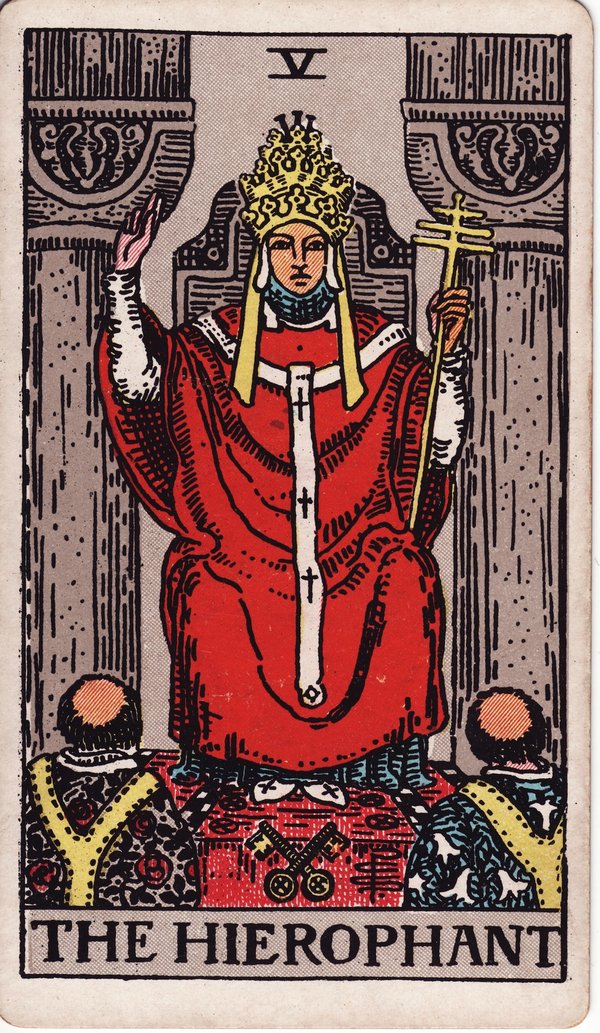
Rider-Waite-Smith (1909): Pamela Colman Smith's Hierophant sits between two pillars — the same gray pillars that frame the High Priestess, but here they represent the institutional church rather than the temple of inner wisdom. The crown of the Hierophant — the triple-tiered papal tiara — is said to represent his authority over the three worlds: the conscious, the subconscious, and the superconscious. His right hand is raised in the gesture of blessing — two fingers pointing up (toward heaven) and two down (toward earth), the esoteric sign of "as above, so below."
Two acolytes kneel before him, their robes embroidered with roses and lilies — the same flowers that bloom in the Magician's garden. The roses (desire/passion) and lilies (purity/devotion) on the acolytes' robes suggest that the Hierophant's teaching involves the integration of these forces — the spiritual discipline that channels desire rather than repressing it. The acolytes receive his blessing; they are initiates being brought into a tradition.
Thoth (Crowley/Harris, 1944): Lady Frieda Harris's Hierophant for the Thoth deck is a figure of solar radiance, embodying Sun in Sagittarius — the teacher whose wisdom is not learned from books but won through direct encounter with truth. The Thoth Hierophant is often depicted with the bull of Taurus at his feet and the arrow of Sagittarius aimed toward the infinite, combining the groundedness of Earth with the aspiration of Fire.
The key difference between traditions: RWS emphasizes institutional authority — the Hierophant as the representative of an established religious tradition, the pope who administers the sacraments. Thoth emphasizes initiatory authority — the Hierophant as the one who has undergone the mysteries and can now guide others through, the teacher whose credentials are written not on parchment but in the transformation of his own being. Both are true. The Hierophant encompasses both the outer form of tradition (the church, the school, the lineage) and the inner fire of initiation (the direct encounter with the sacred that tradition is meant to preserve and transmit).
Astrological & Elemental Layer
The Hierophant is governed by Taurus, the fixed earth sign ruled by Venus. Taurus is the sign of stability, patience, sensuality, and devotion. It is the builder, the preserver, the one who values what lasts. Taurus energy is slow, deliberate, and resistant to change — qualities that serve the Hierophant's function as the preserver of tradition. The wisdom he guards has been tested by time; he does not abandon it for every new spiritual fad.
Venus, the ruler of Taurus, adds the dimension of love, beauty, and attraction to the Hierophant's otherwise austere profile. The Hierophant as Taurus/Venus suggests that tradition, at its best, is not a cold set of rules but a form of love — the love of the ancestors for their descendants, the love of the teacher for the student, the love that preserves what is precious across generations. The sensual dimension of Taurus/Venus also reminds us that spiritual life is not anti-body — the Hierophant blesses with his hands, performs rituals with incense and bells and bread and wine, teaches through embodied practice.
In the Thoth system, the additional associations deepen the card:
- Sun in Sagittarius: The teacher as radiant source — the Hierophant's wisdom is not merely passed down but is alive, experienced, radiating from his own being. Sagittarius is the sign of the seeker, the philosopher, the one who aims the arrow at the far horizon — this is the Hierophant as the perpetual student who has become the teacher.
- Jupiter in Pisces: The visionary of the eternal — Jupiter (expansion, wisdom, benevolence) in Pisces (mysticism, unity consciousness, the oceanic feeling). This is the Hierophant whose tradition is not a box but a doorway to the infinite.
The elemental assignment is Earth (Taurus Earth specifically — fertile, stable, sensual Earth rather than the barren mountain Earth of Capricorn). The Hierophant as Earth is the ground of spiritual practice — the temple, the altar, the body kneeling in prayer, the bread and wine of the Eucharist. Earth's shadow in this context is the institution that becomes more attached to its property than its purpose.
Kabbalistic / Tree of Life Layer
On the Tree of Life, the Hierophant occupies Path 16, connecting Chokmah (Wisdom, the Father, the second Sephirah) to Chesed (Mercy, the fourth Sephirah). This path channels the primal creative wisdom of Chokmah into the expansive, generous, ordered love of Chesed — the Sephirah of rulership, benevolence, and the merciful father.
Chokmah is the flash of pure wisdom — the "I know" that precedes any particular knowledge. Chesed is the Sephirah of Jupiter — expansion, generosity, the ruler who builds the kingdom and provides for its citizens. The Hierophant, on the path between them, is the transmission of wisdom through the structures of love: the teacher who makes the ineffable accessible, the tradition that embodies cosmic wisdom in forms that human beings can practice.
The Hebrew letter Vau assigned to this path means "nail" or "spike." Vau is the connector — the nail that joins two pieces of wood, the bridge between separate things, the conjunction "and" in Hebrew grammar. The Hierophant as Vau is the one who connects heaven and earth, spirit and matter, the wisdom of the ages and the needs of the present moment. He does not originate truth (that is Chokmah's function) or administer love (that is Chesed's function) — he transmits truth through love. He is the nail that fastens the divine to the human.
The Sepher Yetzirah describes this path as the "Triumphal and Eternal Intelligence" — the consciousness of victory that endures, the pleasure of the divine in its own creation. The Hierophant, as this intelligence, is the celebration of wisdom made accessible — the joy that comes from participating in a tradition that connects you to the eternal.
Archetypal & Life-Stage Themes
The Hierophant embodies several archetypes:
The Wise Old Man / Senex: The archetype of the spiritual elder, the teacher, the guide who has walked the path and can now show the way. In Jungian terms, the Wise Old Man represents the Self's capacity to guide the ego toward wholeness — he appears in dreams and myths as the mentor (Gandalf, Dumbledore, Yoda) who provides the knowledge the hero needs. The shadow Senex is the rigid, dogmatic elder who has stopped learning and now merely enforces.
The Priest / Pontifex: The word "pontiff" comes from the Latin pontifex — "bridge-maker." The Hierophant is the bridge between worlds — the one who mediates between the human and the divine. This archetype appears in shamanic, priestly, and oracular roles across cultures: the shaman, the oracle, the priest, the minister, the spiritual director. The shadow priest is the one who exploits his position as intermediary — who makes himself indispensable to a relationship that should ultimately become direct.
The Guardian of Tradition: The Hierophant is the keeper of the flame — the one who preserves the teachings, rituals, and stories that constitute a spiritual lineage. This archetype understands that not everything new is good, and not everything old is obsolete. The shadow guardian becomes the inquisitor — one who guards so rigidly that the flame cannot breathe, who punishes the new interpretation that the tradition needs to stay alive.
The Mentor: In the Fool's Journey, the Hierophant appears after the Emperor has established the social order. Now the question becomes: What does this order mean? What values animate it? What wisdom does it embody? The Hierophant is the mentor who answers these questions — the teacher who initiates the seeker into the meaning behind the structure. In life-stage terms, the Hierophant corresponds to the period of formal education, apprenticeship, and spiritual formation — the years when we learn from those who have gone before.
In myth and culture: The Christ as teacher and initiator; the Buddha as the one who found the path and taught it to others; Hermes Trismegistus, the legendary source of Hermetic wisdom; Moses receiving the Law and transmitting it to the people; the Druid instructing the next generation of priests; the guru bestowing initiation on the disciple; and, in historical terms, the Pope — not merely the administrator of the Church but the successor to Peter, the keeper of the keys, the hierophant who reveals the sacred mysteries.
Advising For / Advising Against
-
If advising FOR: Seek a teacher. You do not have to figure everything out on your own. There is wisdom that has been accumulated over generations, and the appropriate humility is to learn from it rather than trying to reinvent it. Honor the rituals that connect you to your lineage — attend the service, say the prayer, keep the holiday, practice the form. These things are not empty if you fill them with your presence. Commit to a path. The spiritual supermarket, where you take a little from this tradition and a little from that, may feel free, but depth requires commitment. The Hierophant blesses your willingness to be taught.
-
If advising AGAINST: Examine whether you have outsourced your spiritual authority. Do you believe something because you have tested it and found it true, or because someone in a robe told you to? The Hierophant's shadow is the institution that demands loyalty to itself rather than to the truth it claims to serve. Also: are you using tradition to avoid change? The forms of the past were created by people who were willing to innovate in their own time. Honoring tradition does not mean freezing it. The living tradition grows; only the dead one is unchanging.
Card of the Day
Today, honor something larger than yourself. Attend a service, practice a ritual, read a sacred text, or sit in silence with the intention of listening. If you have been resisting formal learning — a class, a mentor, a structured practice — consider whether that resistance is pride. The teacher appears when the student is ready. What are you being called to learn today?
Card of the Year
A Hierophant year (personal year 5) is a year of spiritual formation, formal learning, and the integration of belief and behavior. This is a year for committing to a practice, seeking a teacher, or deepening your relationship with a tradition. The energy supports structured learning — returning to school, pursuing certification, entering a mentorship. The challenge of a Hierophant year is to honor tradition without becoming rigid — to learn the rules well enough to know when and how to break them. This year, the question is not just "What do I believe?" but "How do I live what I believe?" Let your actions become a ritual. Let your life become a teaching.
Elemental Dignities Notes
The Hierophant is Earth (Taurus Earth, specifically). In a spread, his elemental relationship to neighboring cards follows the Golden Dawn system:
- Strengthened by Earth (Pentacles): Like element deepens like element. Multiple Earth cards ground the Hierophant's teaching into practical, tangible form — the wisdom is not abstract but embodied in practice, ritual, and community structure.
- Strengthened by Water (Cups): Water supports Earth — emotion nourishes tradition, devotion waters the ritual. The Hierophant adjacent to Cups suggests that the teachings are being received with the heart, not merely the head.
- Weakened by Air (Swords): Air is Earth's enemy in elemental dignity. Adjacent Swords cards suggest that intellectual critique, over-analysis, or rebellious questioning is disrupting the Hierophant's transmission. The student is arguing rather than receiving.
- Neutral / Mixed with Fire (Wands): Fire and Earth have a productive tension — Fire can warm Earth and stimulate growth, but too much Fire cracks dry Earth. The Hierophant adjacent to Wands suggests that passion and initiative are being brought to tradition — perhaps reforming it, perhaps challenging it.
Deck-Specific Notes
-
If using a Thoth deck: The Hierophant appears with additional astrological depth: Sun in Sagittarius (the radiant teacher) and Jupiter in Pisces (the cosmic visionary). The Thoth Hierophant is less the ecclesiastical functionary and more the initiatory priest — the one whose authority comes from having undergone transformation, not from having been appointed. His triple scepter in the Thoth deck is said to represent three distinct aeons (Isis, Osiris, Horus), with the age of Horus representing the abandonment of old beliefs when they have served their purpose — a more dynamic, evolutionary view of tradition than the RWS version typically suggests.
-
If using a Marseille-tradition deck: Le Pape (The Pope) is depicted in full papal regalia, often with two acolytes kneeling before him. The Marseille Pope carries stronger Christian ecclesiastical connotations and was originally conceived as part of the triumphal/religious hierarchy of the medieval and Renaissance world. The esoteric and initiatory layers developed later through occult traditions.
-
If using a blended or contemporary deck (e.g., Fountain Tarot, Wild Unknown, etc.): The psychological and astrological layers apply across visual traditions. The core archetype — spiritual tradition, formal teaching, the bridge between worlds — persists regardless of specific imagery. Contemporary decks may soften or challenge the institutional associations of the Hierophant; consult your deck's guidebook.
Journaling & Contemplation Prompts
- What do I believe, and where did those beliefs come from? Have I ever examined them critically?
- Who has been my most important teacher, and what did they teach me that I still carry?
- Where in my life am I the student — and where am I the teacher? Am I comfortable in both roles?
- Is there a tradition I have rejected that might still have something to offer me, if I approached it with fresh eyes?
- What ritual or practice, if I committed to it daily, might transform my relationship with the sacred?
Additional Associations
| Association Type | Value |
|---|---|
| Color(s) | Red, White, Blue (the robes of the RWS Hierophant — passion, purity, devotion); Gold (the crown, the keys, the treasure of tradition); Brown/Green (Taurus Earth — the grounded, fertile soil from which spiritual life grows); in Thoth, also solar gold and Sagittarian purple suggesting the radiance of lived wisdom |
| Crystals / Stones | Lapis Lazuli (wisdom, truth, the priestly stone of ancient Egypt, connection to the divine); Sodalite (logic, intuition balanced, the stone of the philosopher and teacher); Clear Calcite (amplification of spiritual transmission, clarity in teaching and learning) |
| Herbs / Plants | Frankincense (the incense of the temple, the smoke that rises, consecration); Myrrh (anointing, initiation, the oil of priests and kings); Sage (cleansing ritual, the herb of wisdom and purification); Oak (the Druid's tree, strength through time, the wood that outlasts empires) |
| Archetypes (Jungian) | The Wise Old Man/Senex; The Priest/Pontifex; The Guardian of Tradition; The Mentor |
| Mythological Figures | The Christ as teacher and initiator; The Buddha (the one who found the path and taught it); Hermes Trismegistus (the legendary source of Hermetic wisdom); Moses (the lawgiver who received the tablets and taught the people); Saint Peter (the keeper of the keys); Melchizedek (the priest-king of Salem, the archetypal priest who precedes all traditions) |
| Numerological Resonance | 5 = the quintessence, the human, the microcosm, the pentagram. Five is also the number of instability — the Hierophant's challenge is to find eternal truth within changing forms. Vau = 6, the number of Tiphareth (harmony, beauty, the heart center). The Hierophant as Vau is the nail that fastens 5 (the human) to 6 (the divine harmony) — he bridges the tension between temporal form and eternal truth. |
| Playing Card Equivalent | The King of Clubs (in some systems) — the card of the mature, authoritative masculine energy channeled through the suit of Wands (spirit, inspiration). But the Hierophant transcends any single suit: he is the bridge between all four suits, the one who gives spiritual meaning to the entire deck. |
| I Ching Hexagram Parallel | Hexagram 20 — Kuan / Contemplation. "Contemplation. The ablution has been made, but not yet the offering. Full of trust they look up to him." The hexagram of the sacred observer — the one who stands above the people and contemplates the divine order, the tower from which the ruler surveys the land, the priest who has purified himself and now awaits the descent of spirit. Like the Hierophant, Kuan teaches that authority comes not from force but from the quality of attention — the one who truly sees becomes the one whom others look to. |
| Body / Organ Correspondence | The throat and voice (Taurus rules the throat — the Hierophant as the voice of tradition, the teacher who speaks eternal truths); the ears (the organ of the student, the one who receives the teaching); the knees (the body at prayer, the posture of humility before the sacred); the thyroid (Taurus rulership — the regulator of metabolism, the biological "teacher" that sets the pace of bodily life) |
Shadow & Integration Message
The Hierophant's shadow has two expressions: the Inquisitor and the Hollow Priest. The Inquisitor is the Hierophant who has confused the form with the substance — who enforces orthodoxy with violence, who punishes questions, who believes that protecting the institution is more important than serving the truth the institution was created to transmit. This is the religious abuse survivor's Hierophant — the priest whose hands that should bless have instead wounded.
The Hollow Priest is the Hierophant who goes through the motions — who performs the rituals without believing in them, who teaches without having learned, whose authority is a costume rather than a credential. This is the Hierophant of the empty church, the rote classroom, the mentorship that has become mere monitoring. The ritual has become a habit, and the habit has become a cage.
Integration of the Hierophant energy means finding the living center of tradition — the fire that the forms were built to contain. The integrated Hierophant knows that rituals are vessels, not destinations; that teachers are guides, not gods; that the purpose of a spiritual lineage is not to perpetuate itself but to transmit the transformative power that founded it. He can honor the old while welcoming the new. He can teach with authority while remaining a student. He can bless with hands that have themselves been blessed — not by an institution but by an encounter with the sacred that the institution exists to serve.
Elemental Intelligence (Suit Framing)
In the Jungian cognitive function mapping, the Hierophant as Earth (Taurus) aligns with the Sensation function (Jungian), the melancholic humour (in its devotional aspect), and the priestly/teaching class. But the Hierophant is not the practical Sensation of the Pentacles — he is Sensation as ritual, as embodied wisdom, as the sacred made tangible through gesture, object, and practice.
His "class" is the priest, the teacher, the keeper of the tradition — not the ruler (that is the Emperor's domain) but the one who gives the ruler's order its meaning. His humour is melancholic transformed: the gravity that is not depression but depth, the seriousness that is not joylessness but reverence. In a reading, this framing suggests that the querent's spiritual life requires embodiment — not just beliefs but practices, not just ideas but rituals, not just private spirituality but participation in a community of shared meaning.
Timing & Manifestation
For timing in a reading, the Hierophant is associated with Taurus season (approximately April 20 to May 20) — the season of the fixed earth, the time when spring's new growth stabilizes and roots deepen. More broadly, the Hierophant suggests a timeframe measured in seasons or academic semesters — long enough for real learning to occur, for a practice to become established, for a teaching to be absorbed. The Hierophant is patient; his timing is the timing of education, not emergency.
In predictive readings, the Hierophant indicates that the outcome depends on teaching or guidance — either receiving it or offering it. The situation requires not more action (Magician) or more structure (Emperor) but more understanding — the wisdom that comes from study, mentorship, or spiritual practice.
Yes / No Tendency
The Hierophant leans toward Yes, through established channels. This is not the innovative yes of the Magician or the organic yes of the Empress — it is the yes of the tried and true. The path exists. Others have walked it successfully. Follow the established method, seek the qualified teacher, trust the tradition that has endured. The Hierophant's yes is a yes to the way things are done — and for querents seeking stability, legitimacy, and authentication, this is a profoundly reassuring answer.
In reversed / ill-dignified position, the tendency shifts toward question the channel. The tradition may be corrupt, the teacher may be unworthy, or the established method may be inappropriate for this situation. The Hierophant reversed does not necessarily mean "no" — it means "not through these means." Seek a different teacher, question the dogma, find the living truth beneath the dead form.
Common Misreads / Nuances to Know
Misread 1: "The Hierophant is just about organized religion." The Hierophant can represent any formal system of teaching and transmission — a university, a professional mentorship, a therapeutic tradition, a martial arts lineage, a craft apprenticeship. The card points to the principle of formal transmission of wisdom through established channels — religion is the most visible example but far from the only one.
Misread 2: "The Hierophant means I should blindly follow tradition." The Hierophant represents tradition as a source of wisdom, not a demand for blind obedience. The card invites you to learn the tradition deeply — and then to determine, from that depth, what is living and what is dead. The Hierophant who has never questioned his tradition is not a sage; he is a functionary. The Hierophant who has questioned and returned is the true initiate.
Misread 3: "The Hierophant reversed just means rebellion against authority." Sometimes it means that, but more often it signals that the querent's own relationship with spiritual authority needs examination. The reversed Hierophant may indicate that you have become your own dogma — that your rebellion against tradition has itself become a rigid orthodoxy, that your rejection of teachers has left you without the guidance you genuinely need. The reversal invites not simple rebellion but discernment: what authority is legitimate, and what authority have you rejected that might actually serve you?
Nuance for Thoth readers: The Thoth Hierophant carries the radiant, questing energy of Sun in Sagittarius and the cosmic vision of Jupiter in Pisces. This is a more dynamic, evolutionary Hierophant — the teacher whose authority comes from having sought and found, not from having been appointed. If you read primarily with the Thoth deck, the Hierophant appearing in a spread may signal that the querent is being called not merely to learn a tradition but to become a tradition — to embody wisdom so fully that others can learn from the life itself, not just the words.