The Poetic Line
"The cliff is not a warning — it is the place where flying begins."
Keywords
| Category | Dignified | Undignified |
|---|---|---|
| General | New beginnings, leap of faith, spontaneity, innocence, trust in the universe, freedom | Recklessness, naivety, hesitation, paralysis, holding back, foolish risk-taking |
| Spiritual | Beginner's mind, divine trust, sacred innocence, openness to grace, the leap into the unknown | Spiritual bypassing, refusal of the call, false innocence masking fear, shallow faith without grounding |
| Psychological | Open-mindedness, curiosity, wonder, play, childlike presence, ego flexibility | Impulsivity without reflection, gullibility, delusional optimism, inability to commit, Peter Pan syndrome |
| Physical Health | Fresh start, renewed vitality, spontaneous movement, listening to the body's instincts | Risk-taking endangering the body, neglect of physical limits, accident-prone behavior, ignoring warning signs |
| Relationships | New romance approached with openness, playfulness in partnership, taking an emotional leap | Fear of commitment disguised as freedom, recklessness with others' hearts, inability to take relationships seriously |
| Financial | Calculated risk, entrepreneurial leap, trusting the process, minimalist approach to resources | Gambling, financial naivety, ignoring due diligence, throwing money at unvetted opportunities |
| Vocational | Career pivot, new venture, creative initiative, answering a calling, embracing the unconventional path | Job-hopping without purpose, abandoning responsibilities impulsively, failing to prepare for the leap |
| Shadow / Thoth Distinction | Ecstatic madness, divine intoxication, Dionysian freedom, the courage to be the fool of the abyss | Possession by impulse, loss of self in the void, the crocodile of fear consuming the leap, the tiger of desire devouring wisdom |
Narrative Description
General Meaning
The Fool is the unnumbered beginning — a blank page before any story is written. Numbered 0, it sits outside the sequence: first card and last, departure and return, the one who sets out and the one who has completed the journey and chooses to begin again.
When the Fool arrives in a reading, something new is being born — a project, perhaps, or a whole phase of life — and the circumstances do not yet provide a map. The real distinction is recklessness vs. willingness. Recklessness ignores consequences. Willingness acknowledges uncertainty and steps forward anyway. The Fool trusts that the path appears as you walk it.
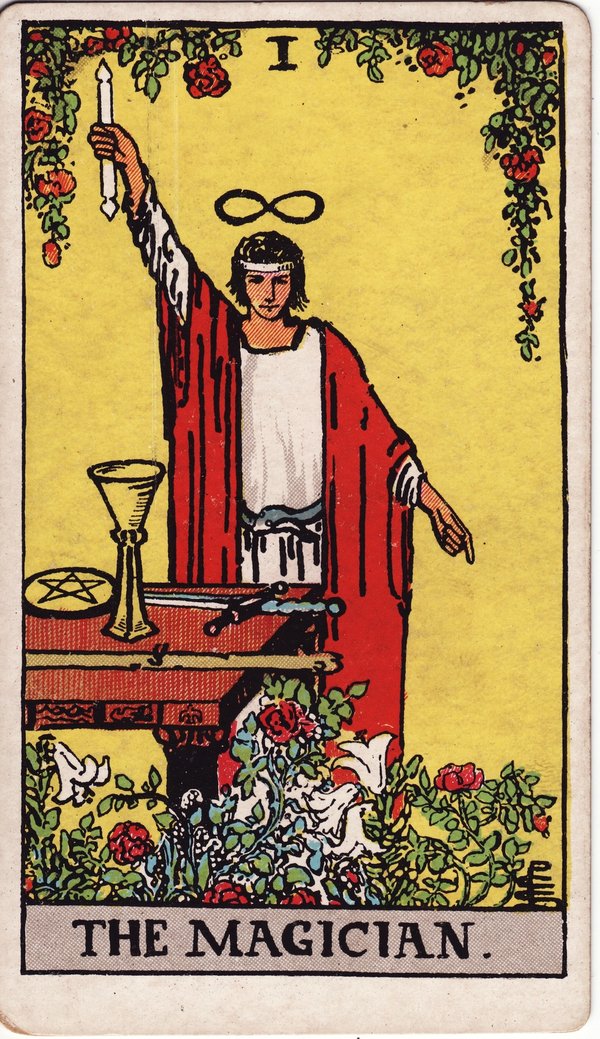
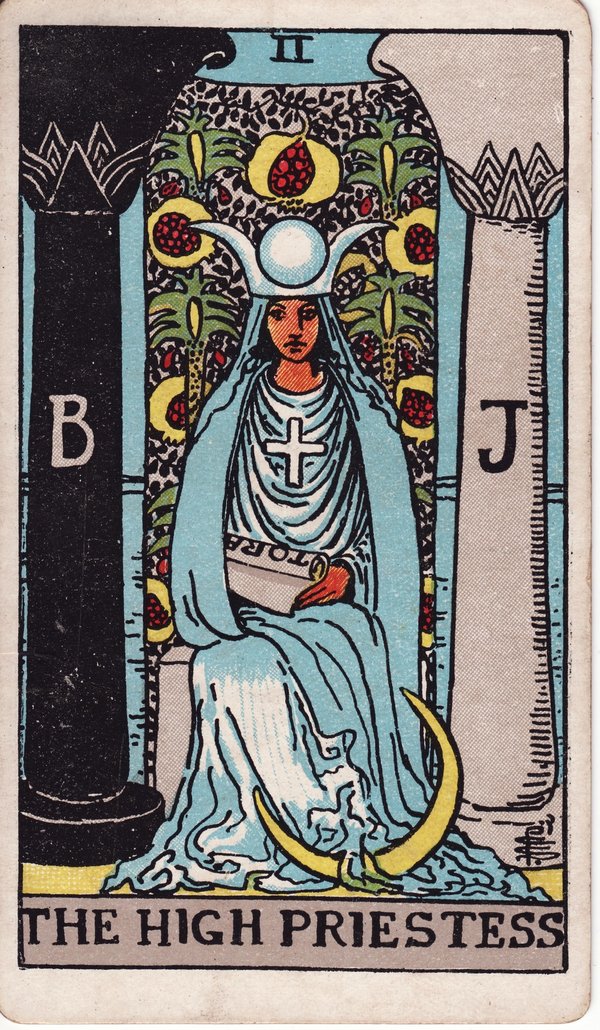
This is lightness, excitement — the flutter in the chest before something unknown. The Fool carries none of the weight of later cards: no discipline (Magician), no hidden knowledge (High Priestess), no structure (Emperor). Pure potential energy, the inhale before the first word. It often arrives when the question beneath the question is: What would you do if you were not afraid?
In the Fool's Journey, this card is the protagonist before the plot begins. Every subsequent Major Arcana card is the Fool in a different costume — encountering love, power, crisis, revelation, and integration. The Fool is the through-line, the one who undergoes the entire arc. To pull The Fool is to be reminded that you are always, at some level, beginning.
Symbolism & Imagery
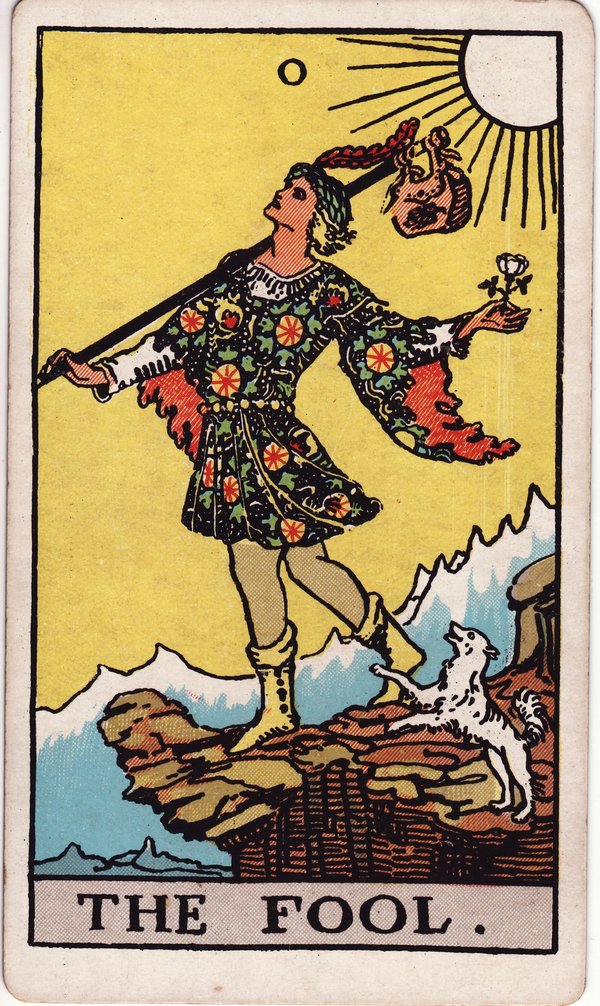
Rider-Waite-Smith (1909): Pamela Colman Smith's Fool is a young figure in a flowered tunic, poised at the edge of a cliff with one foot extended as if about to step into open air. He gazes upward, not downward — his attention is on the sky, the horizon, the beyond, not on the precipice beneath him.
The small white dog at his heels barks and leaps — warning or encouragement, maybe both. Either way, instinct. The animal knowing that can smell the cliff and still run toward life. The white rose in the Fool's left hand — purity, but not the purity of ignorance. The alchemical kind. The self that has been stripped clean. The small bindle over his shoulder carries his few possessions, lightly. He needs almost nothing for the journey ahead.
Behind him, a bright yellow sun fills the sky — warmth, clarity, the sense that something is blessing this. Snow-capped mountains rise in the distance — the challenges ahead — but they are far away; the Fool is focused on the immediate step, not the distant obstacle. His tunic is patterned with circles — ten of them, if you count, arranged like the Sephiroth.
Thoth (Crowley/Harris, 1944): Lady Frieda Harris's Fool for the Thoth deck is radically different. Here the Fool is not a youth at a cliff but a naked, green-skinned figure suspended within three interlocking circles of nothingness — the Qabalistic veils of negative existence. He has the horns of Dionysus Zagreus, the god of ecstasy, madness, and rebirth, and between the horns rises a phallic cone of white light representing the creative consciousness, the seed of life.
Two animals flank him: a tiger biting his right leg (animal desire, lust, the labyrinth of identity, the ego's hunger) and a crocodile at his feet (the fear of death, the reptilian brain, the primordial terror that freezes action). The Fool of the Thoth deck is not innocent of these forces — he moves through them, containing them. He holds a cluster of grapes (Dionysian ecstasy), a flame (divine spark), and coins bearing the signs of the zodiac. The sun behind him is dark — the black sun of the Abyss, the light that shines in the void before creation. This Fool is the Green Man, the eternal spring, the holy madman who has passed through nothingness and returned carrying the seed of all things.
The key difference between traditions: RWS emphasizes the beginning — the innocent step into a fresh world. Thoth emphasizes the state — the ecstatic condition of being outside all systems, the divine madness that is the source of all systems. Both are true. The Fool is both the one who has not yet learned and the one who has learned everything and chosen to forget.
Astrological & Elemental Layer
The Fool is assigned to the element of Air in both systems, but the assignment operates differently in each.
In the RWS/Golden Dawn tradition, Air is the element of mind, intellect, communication, and movement. The Fool as Air reflects the quality of thought before it crystallizes into belief — the free, roaming, associative mind that has not yet fixated. The modern attribution of Uranus to The Fool adds the dimension of sudden insight, breakthrough, rebellion against convention, and the willingness to be radically original. Uranus is the planet that shatters structures, and The Fool steps off the cliff of the known before any new structure has been built.
In the Thoth system, the Fool is Air — not a planet operating within the element but the element itself. This is unique among the Trumps and reflects Crowley's understanding of the Fool as the "pre-manifestation" state, the medium of spirit itself. Air is the breath (ruach in Hebrew, which also means "spirit"), and the Fool is the first breath of the cosmos. There is no planetary dignity or debility here — the Fool transcends such categories.
The elemental nature of Air gives the Fool a quality of lightness, detachment, and freedom. Air cards do not cling, do not fix, do not weigh down. The Fool's wisdom is the wisdom of non-attachment — not because it has renounced the world but because it has not yet entered it. This is the beginner's mind that Zen Buddhism speaks of: the mind that is empty and therefore capable of receiving everything.
Kabbalistic / Tree of Life Layer
On the Tree of Life, The Fool occupies Path 11, the path that connects Kether (the Crown, the first Sephirah, pure unity) to Chokmah (Wisdom, the second Sephirah, the first emanation into polarity). This is the first path, the primal channel through which the undifferentiated light of the Infinite (Ain Soph Aur) pours into the first vessel of form.
The Hebrew letter Aleph (א) assigned to this path carries deep significance. Aleph is a silent letter — it has no sound of its own but is the vehicle through which all other letters can be pronounced. It is formed, in its calligraphic shape, by two Yods (the smallest letter, representing the spark of divinity) separated by a diagonal Vav (the connector). In gematria, this configuration yields 26, the same value as the Tetragrammaton (YHVH), the unpronounceable name of God. The Fool, silently, bears the divine name.
The Sepher Yetzirah describes this path as the "Scintillating Intelligence" — the flashing, sparkling consciousness that stands before the Face of the Cause of Causes. It is the intelligence of pure potential, the curtain between the unmanifest and the manifest, the membrane through which creation must pass. The Fool is the traveler on this path, the one who crosses the Abyss between Nothing and Something and returns to tell of both.
For the querent, the Kabbalistic layer suggests: whatever you are beginning has its origin not in your planning but in a direct emanation from Source. The impulse you feel is not random — it is the Scintillating Intelligence making contact with your life.
Archetypal & Life-Stage Themes
The Fool embodies several archetypes that illuminate different facets of the card:
The Divine Child (Puer Aeternus): The eternal youth, the one who never grows old, the archetype of potential before it has been shaped by the world. The Divine Child carries the promise of renewal — every new beginning is the child being born again. In its shadow form, the Puer becomes the one who refuses to grow up, who flees commitment and responsibility in the name of freedom.
The Wanderer: The Fool is the archetypal wayfarer — Parsifal seeking the Grail, Dorothy following the yellow brick road, the Zen monk with his bowl and staff. The Wanderer does not know the destination but trusts the journey. This is the archetype of pilgrimage, of life as a sacred wandering rather than a fixed itinerary.
The Trickster / Jester: In the royal court, the Fool was the one permitted to speak truth to power. The jester's apparent foolishness concealed profound wisdom — he could say what no one else could say because he was not taken seriously. The Tarot Fool inherits this function: it speaks the truth that the dignified cards cannot, the truth that we must sometimes be willing to look foolish to be free.
The Self (pre-differentiation): In Jungian terms, The Fool represents the Self before it has differentiated into ego and shadow, persona and anima/animus. It is the wholeness that exists before the fractures of identity, the unity that we spend the rest of the Major Arcana journey trying to recover.
In the Fool's Journey narrative, this card is the departure — the moment the hero leaves the ordinary world. It corresponds to the call to adventure in the monomyth. The Fool is Bilbo running out his door without a handkerchief, Luke Skywalker looking at the twin suns of Tatooine, the moment before the story irrevocably begins.
In cultural and mythic parallels: Dionysus, the twice-born god of ecstasy and wine, who is torn apart and reborn. The Green Man of European folklore, the spirit of vegetation who dies each winter and returns each spring. Coyote and Raven in Native American traditions — trickster-creators whose foolishness births the world. And in a Christian frame, the holy fool, the "fool for Christ" who abandons worldly wisdom for divine madness.
Advising For / Advising Against
-
If advising FOR: Say yes before you are ready. The preparation you think you need is often the very thing preventing the leap. The universe is not asking for your credentials — it is asking for your willingness. Take the step. The ground will appear under your foot, or you will learn to fly. There is no "ready" — there is only "now."
-
If advising AGAINST: Look before you leap. Not every cliff edge is an invitation — some are warnings. Your desire for freedom may be a flight from responsibility. Your "trust in the universe" may be an excuse for not doing the work. Ask yourself: Is this the Fool's sacred innocence, or is it naivety dressed in spiritual language? If you cannot honestly distinguish, wait.
Card of the Day
Something wants to start today. You know which thing — the one you keep not starting because you can't get ready for it. The Fool doesn't care about your readiness. It wants your willingness. Step. You'll find the path by walking it.
Card of the Year
A Fool year — calculated as personal year 0 when your birth month + birth day + current year sum reduces to 22 (which becomes 0 in the Major Arcana cycle) — is rare. Most people will see one or two in a lifetime, if that. This is a year of total initiation, a blank slate, the beginning of a new nine-year cycle. The themes of a Fool year: unprecedented new beginnings, a sense of being unmoored from previous identity structures, encounters with the unexpected, the necessity of trust over planning. You may change careers, end or begin major relationships, relocate, or undergo a spiritual awakening that reorders everything. The challenge is not to cling to what is dissolving. This year plants seeds whose harvest you will not see for a decade. Plant them anyway.
Elemental Dignities Notes
The Fool is Air — the element of mind, intellect, breath, and movement. In a spread, its elemental relationship to neighboring cards follows the Golden Dawn system:
- Strengthened by Fire (Wands): Fire supports Air — passion feeds thought, action fuels the leap. A Fool adjacent to Wands becomes bolder, more courageous, more likely to act on impulse in a creative or generative way.
- Strengthened by Air (Swords): Like element intensifies like element. Multiple Air cards sharpen the intellectual and communicative dimension — the Fool's leap becomes more considered, more strategic, though at risk of overthinking what should be instinctual.
- Weakened by Earth (Pentacles): Earth is Air's enemy in elemental dignity. The presence of Pentacles adjacent to The Fool suggests the leap is being blocked by material concerns, practicality, or fear of losing security. The free spirit meets the gravity of the physical world.
- Neutral / Mixed with Water (Cups): Air and Water can make a loving couple if balanced — the rational mind gains emotional depth, the leap gains heart. But too much Water can drown the Fool's lightness in sentiment, and too much Air can agitate placid emotional waters into storm.
Deck-Specific Notes
-
If using a Thoth deck: The Fool appears as the Green Man/Dionysus suspended in the circles of nothingness, flanked by tiger and crocodile, under a black sun. The reading emphasis shifts from "innocent beginning" to "ecstatic transcendence of all categories." The Thoth Fool has already passed through the Abyss — he is not the beginner but the master who has returned to beginner's mind. His "foolishness" is the divine madness of the mystic, not the naivety of the newcomer.
-
If using a Marseille-tradition deck: Le Mat (The Fool) is typically depicted as a wandering beggar or vagabond, often with a dog biting at his legs, carrying a bundle on a stick. He is frequently unnumbered, placed outside the sequence of trumps. In the Marseille tradition, The Fool carries stronger connotations of marginality, poverty, and social exclusion — the one who exists outside all structures. The spiritual interpretation of this outsider status (the holy fool, the renunciate) developed later.
-
If using a blended or contemporary deck (e.g., Fountain Tarot, Wild Unknown, etc.): The psychological and astrological layers of this entry apply across visual traditions. The core archetype — the leap into the unknown, the beginner's mind, the courage of starting — persists regardless of specific imagery. Consult your deck's guidebook for any departures from the RWS/Thoth framework, particularly regarding astrological attributions or the card's position in the sequence.
Journaling & Contemplation Prompts
- What would I do if I felt entirely free — not free from consequences, but free from the fear of them?
- Where in my life am I hesitating at the edge? What am I waiting for? Is it wisdom, or is it fear dressed as wisdom?
- How willing am I to be seen as foolish — to say the wrong thing, try the wrong path, look inexperienced — in service of something real?
- What am I carrying that I don't actually need? What would it look like to travel lighter?
- If zero is not nothing but the space where everything can begin, what wants to begin in my life right now?
Additional Associations
| Association Type | Value |
|---|---|
| Color(s) | Bright yellow (solar illumination, divine light); white (purity, innocence); green (Thoth — spring, Dionysian life force, the Green Man) |
| Crystals / Stones | Clear Quartz (amplification of new beginnings, clarity); Labradorite (the leap into the unknown, magical journeying); Turquoise (protection for the traveler) |
| Herbs / Plants | White Rose (innocence, purified self); Ivy / Vine (Dionysian ecstasy, the Green Man's crown); Ginkgo (resilience, the survivor that remembers the beginning) |
| Archetypes (Jungian) | The Divine Child (Puer Aeternus); The Trickster; The Wanderer; The Self before ego-differentiation |
| Mythological Figures | Dionysus Zagreus (ecstatic death and rebirth); Parsifal (the holy fool seeking the Grail); Coyote (trickster-creator); The Green Man (eternal spring); Dorothy (the innocent on the quest) |
| Numerological Resonance | 0 = the unmanifest, the void, the circle without beginning or end. Qabalistically: 0 = 2, the polarity out of which all existence arises. Aleph = 1, the first. The paradox: the Fool is both nothing and the seed of everything. |
| Playing Card Equivalent | The Joker — the card outside the suit system, wild, unconstrained, capable of being anything |
| I Ching Hexagram Parallel | Hexagram 25 — Wu Wang / Innocence (The Unexpected). "Innocence. Supreme success. Perseverance furthers." The hexagram of natural spontaneity, acting without ulterior motive, the freedom that comes from alignment with the flow of heaven. |
| Body / Organ Correspondence | Lungs (the organs of breath, Air); the vagus nerve (the wanderer nerve, connecting brain to body); ankles and feet (the parts that take the step, that carry the Fool forward). In astrological medicine, Uranus governs the nervous system and the sudden impulses that move the body. |
Shadow & Integration Message
The Fool's shadow is the refusal to become — the one who makes freedom into an identity that prevents commitment, who uses "trusting the universe" as a spiritual bypass to avoid the hard work of building a life. This is the Puer Aeternus in its pathological form: the eternal adolescent who mistakes avoidance for wisdom. In the Thoth framing, the shadow manifests as possession by the tiger (desire ruling choice) or paralysis before the crocodile (fear of death preventing life).
Integration of the Fool's energy means carrying the willingness to leap while also carrying the wisdom earned from all the cards that follow. It means being able to return to zero without losing what you have learned — to begin again without becoming a beginner in the pejorative sense. The integrated Fool is not the one who never grew up but the one who, having grown, can still access the child's openness, the beginner's mind, the courage to step off solid ground.
Elemental Intelligence (Suit Framing)
In the Jungian cognitive function mapping — which maps the four suits to Jungian cognitive functions, humours, and class theory — The Fool as Air aligns with the Thinking function, the sanguine humour, and the intellectual/scholarly class. But The Fool is not the developed Thinking of the Swords — it is Thought before it has a subject, Mind before it has an object. It is the pure cognitive capacity that precedes all particular cognitions.
The Fool's "class" is, fittingly, outside class — it is the wandering ascetic, the court jester who belongs to no estate, the artist who lives at the edge of the social order. Its humour is sanguine turned to its most extreme: the overflowing life-force that has not yet been channeled into productive form, the spring that floods before it irrigates.
Timing & Manifestation
For timing in a reading, The Fool's answer is the least chronos-bound of any card: "Unexpectedly, if at all." The Fool operates in kairos — the opportune moment, the rupture in ordinary time — rather than chronos, the sequential ticking of the clock. When The Fool appears in a timing position, it signals that the event will arrive not on schedule but through a breakthrough, a sudden opening, a moment when the normal rules of timing are suspended.
If pressed for a timeframe within the year: the Fool is associated with the spring equinox (new beginnings, the start of the astrological year around March 20), and with the Air signs (Gemini, Libra, Aquarius) as seasonal windows. But these are approximations. The Fool's truest timing answer is simply: when you are ready to leap.
Yes / No Tendency
The Fool leans toward Yes, but conditionally. It is not a simple affirmative — the Fool does not guarantee outcomes; it guarantees possibility. The "yes" of The Fool is: the opportunity exists, the door is open, something wants to begin. Whether you step through and what happens after is not foretold by this card. In a yes/no spread, treat The Fool as a green light with a question mark attached: The path is open — will you walk it?
In reversed / ill-dignified position, the tendency shifts toward not now — not no, but a redirection. The energy of beginning is blocked by fear, by lack of preparation, by genuine danger ahead, or by the need to complete something else first. The leap is still available, but the timing is off.
Common Misreads / Nuances to Know
Misread 1: "The Fool is stupid or naive." The Fool is not unintelligent — it is unprejudiced. It does not carry the accumulated conclusions that make us "smart" but also make us rigid. The Fool's wisdom is the wisdom of the empty cup. It is not that the Fool knows nothing; it is that the Fool is willing to know in a new way.
Misread 2: "The cliff means danger — don't jump." In the RWS imagery, the cliff edge is low and the Fool gazes upward, not down. The card is not a warning but an invitation. The cliff is the threshold between the known and the unknown, and every significant beginning requires crossing such a threshold. The dog barks, but the dog also accompanies.
Misread 3: "The Fool reversed means you're being reckless." The reversed Fool is more commonly about hesitation than recklessness. The blocked Fool is the one who cannot begin — not the one who begins badly. Recklessness is a possible reading of the reversal, but the more frequent message is: You are holding yourself back. What are you afraid of?
Nuance for Thoth readers: The Thoth Fool is a card of profound mystical attainment, not beginner's luck. If you read primarily with the Thoth deck, the "innocent beginning" interpretation should be tempered by the understanding that this Fool has passed through the Abyss. He is innocent because he has burned away everything that was not essential — not because he has never encountered the fire.