The Poetic Line
"The universe bends toward a hand that knows what it holds."
Keywords
| Category | Dignified | Undignified |
|---|---|---|
| General | Manifestation, willpower, resourcefulness, focused action, skillful means, conscious creation | Manipulation, trickery, scattered energy, blocked potential, misuse of talent, all talk no action |
| Spiritual | Channeling divine will, conscious co-creation, alignment of spirit and action, the Word made flesh | Spiritual bypassing, using spiritual language to deceive, the guru who has lost his own connection, ego inflation |
| Psychological | Confidence born of competence, clear intention, mental focus, self-trust, integrated will | Grandiosity, imposter syndrome masked by bravado, overcompensation, mental fragmentation, delusional thinking |
| Physical Health | Vitality channeled productively, mind-body coordination, disciplined practice, healing through focused intent | Nervous exhaustion, burnout from scattered effort, psychosomatic illness from unexpressed energy, substance abuse masking creative blocks |
| Relationships | Clear communication, magnetic attraction, taking initiative, relationship as conscious creation | Manipulation, love-bombing, using charm to control, the charismatic partner who leaves chaos in their wake |
| Financial | Entrepreneurial initiative, resource gathering, skillful investment of energy and capital, making something from nothing | Get-rich-quick schemes, financial deception, the con artist, spending before earning, speculative gambling |
| Vocational | Mastery of craft, leadership through competence, bringing ideas to market, the skilled professional | The charlatan, the unqualified person in a position of power, office politics as manipulation, shortcuts that undermine quality |
| Shadow / Thoth Distinction | The Magus as Logos: will as cosmic principle, Mercury as alchemical Mercurius — the fluid intelligence that transmutes base matter into gold; the Word that creates reality | The black magician: will severed from ethics, power without wisdom, ego usurping the divine channel; in Thoth terms, the abuse of magical force — using the Word to enslave rather than liberate |
Narrative Description
General Meaning
The Magician is the card of conscious creation. Where the Fool represents pure potential — the willingness to begin — the Magician is what happens when willingness meets competence. This is the card of the person who not only dreams but builds, who not only wishes but manifests, who understands that power is not something you wait for but something you channel.
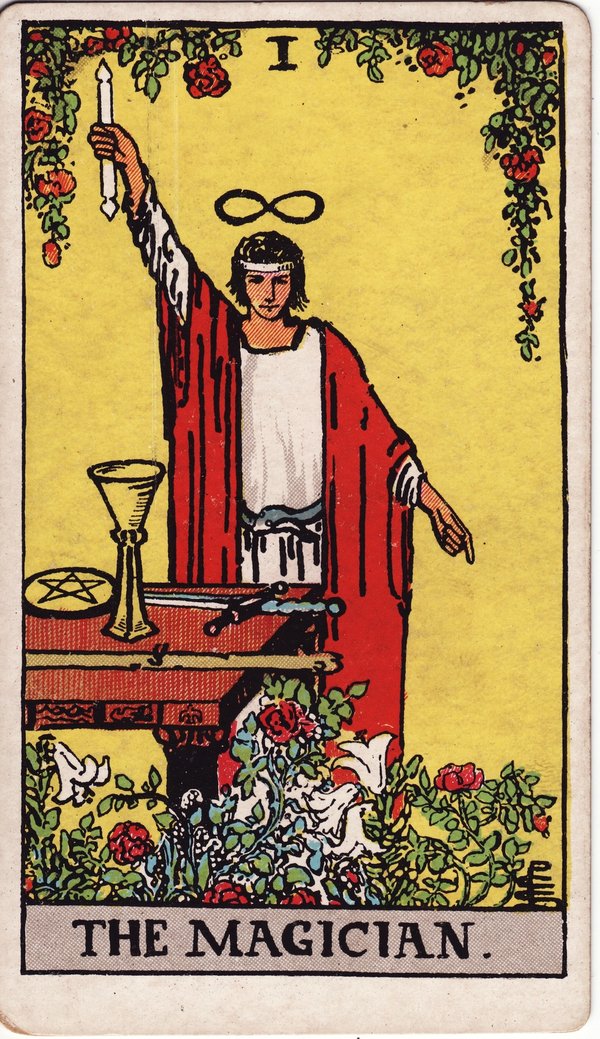
Numbered 1, the Magician sits at the first position after the unnumbered Fool. In the sequence of the Major Arcana, this is the moment when the traveler realizes they are not merely drifting through experience but actively shaping it. The Magician's table holds four tools — wand, cup, sword, and pentacle — the four elements, the four suits, the four domains: passion, emotion, intellect, material reality. The message: you have everything you need.
In a reading, the Magician signals that the circumstances are aligned for action. The energy is present, the tools are available, and what is required now is focus and will. This is not a card of passive reception — it is a card of active engagement. The Magician does not ask "What will happen to me?" but "What will I make happen?" — the difference between fate and destiny, between being a character in someone else's story and becoming the author of your own.
The emotional register of the Magician is confidence, clarity, and a certain electric charge — the feeling of being "in the zone," when skills match challenge and time seems to bend around intention. There is no anxiety in the Magician because anxiety is the child of uncertainty, and the Magician has chosen. In the Thoth tradition, the Magus deepens this: he is not merely a skilled operator but an initiate who understands that will itself is a cosmic force. The Magus channels the Logos — the creative word — participating in the ongoing creation of reality.
The shadow of this card is significant and must be named. Power without wisdom is destruction. Skill without ethics is predation. The Magician reversed or ill-dignified is the con artist, the manipulator, the one who uses charisma to deceive. The proximity of this card to the shadow is what gives it its charge — the same electricity that can illuminate a city can also burn it down.
Symbolism & Imagery
Rider-Waite-Smith (1909): Pamela Colman Smith's Magician stands before a table bearing the four elemental tools: a wand (Fire, will, creative energy), a cup (Water, emotion, intuition), a sword (Air, intellect, discernment), and a pentacle (Earth, material reality, body). His right hand holds a wand raised toward the heavens; his left hand points toward the earth. This is the gesture of "As above, so below" — the Hermetic axiom that the macrocosm and microcosm reflect one another, and that the Magician is the living conduit between them.
Above his head floats the lemniscate (∞) — access to unlimited potential. Around his waist is the ouroboros, the serpent devouring its own tail — the eternal cycle of creation, destruction, and renewal, the alchemical principle of self-transformation. His robe is white (purity of intention, the blank slate of beginner's mind), over which he wears a red mantle (passion, will, the fire of action). The garden around him bursts with roses and lilies — the roses of desire and the lilies of purity, the alchemical marriage of opposites that produces the Philosopher's Stone.
The table is significant: it is not cluttered. Only four items rest upon it, and they are arranged with intention. The Magician does not need more tools; he needs to use the ones he has. Every querent who pulls this card already possesses what is necessary. The question is only whether they will pick up the tools and begin.
Thoth (Crowley/Harris, 1944): Lady Frieda Harris's Magus for the Thoth deck is radically different from the RWS Magician — less a human figure than a divine principle rendered visible. The Magus appears as a winged, androgynous figure — Mercury as the fluid, boundary-dissolving intelligence that moves between all worlds. He holds the caduceus (the serpent-entwined staff of Hermes), and his posture suggests not demonstration but transmission — he is not showing you his tools; he is transmitting the Word.
Behind him, the image is filled with swirling, dynamic energy — the raw creative force of the will before it has been channeled into specific forms. The Thoth Magus is less "here is what I can do" and more "here is what the universe can do through a focused will." Crowley emphasized the Magus as Mercury in the highest sense: the alchemical Mercurius, the fluid principle that dissolves fixed structures and recombines them into higher forms. This is not the craft of the artisan but the magic of the adept — the will aligned with cosmic law.
The key difference between traditions: RWS emphasizes competence — the Magician as someone who has developed skills and gathered resources. Thoth emphasizes will — the Magus as someone who has purified and aligned their intention to the point where it becomes a creative force in its own right. Both readings are valid. The Magician who has skill but no will is a technician; the Magus who has will but no skill is a dreamer. The integrated truth is both: will directed through competence, spirit channeled through form.
Astrological & Elemental Layer
The Magician is governed by Mercury, the planet of intellect, communication, dexterity, and mediation. In astrology, Mercury rules Gemini and Virgo — the sign of information exchange and the sign of practical craft. Both are present in the Magician's nature: he is the quick mind that synthesizes information (Gemini) and the skilled hand that executes with precision (Virgo).
Mercury is also the psychopomp — the guide who travels between worlds, carrying messages between gods and mortals, between the living and the dead. This is the Magician's essential function: to be a bridge. He connects heaven and earth, spirit and matter, intention and manifestation. He does not create ex nihilo; he translates what already exists in potential into actual form. Mercury's speed is also relevant — the Magician acts with swiftness and precision, not hesitation. When this card appears, the time for deliberation is ending and the time for action has arrived.
In the Thoth system, the Magus is also associated with the Sun in Aries — adding the dimension of solar charisma, leadership, and initiatory fire. This combination (Mercury + Sun in Aries) produces a figure of tremendous personal magnetism and creative force. The Magus does not merely communicate — he declares. His word has power because it is aligned with the solar principle of consciousness itself.
The elemental assignment is Air, the element of mind, breath, and communication. Air cards are about thought, language, and the movement of information. The Magician as Air is the mind that has learned to focus — not the scattered breeze but the directed wind. Air's shadow is detachment and over-intellectualization; the Magician must remember that the tools include a cup (Water/emotion) and a pentacle (Earth/body), not just the sword of intellect alone.
Kabbalistic / Tree of Life Layer
On the Tree of Life, the Magician occupies Path 12, which connects Kether (the Crown, the first Sephirah, pure unity) to Binah (Understanding, the third Sephirah, the great womb of form). This is the path through which the undifferentiated light of the One pours into the first vessel capable of structuring it.
Kether is the point of pure being — the "I am" before any predicate. Binah is the great sea of understanding, the feminine principle that receives the seed of Kether and gestates it into form. The Magician, positioned on the path between these two, is the act of translation. He receives the impulse of pure being (Kether) and begins the process of giving it shape (Binah). He is the first breath drawn into the lungs of creation.
The Hebrew letter Beth assigned to this path means "house." Beth is the container, the vessel, the architecture that makes habitation possible. In Genesis, the first letter of the Torah is Beth — "Bereshit" (In the beginning). The Magician, as Beth, is the house that divine energy builds for itself in order to dwell in the world. Without the house, the energy disperses; without the energy, the house is empty. The Magician is the marriage of container and content.
The Sepher Yetzirah describes this path as the "Transparent Intelligence" — the consciousness that clarifies, that makes the obscure visible. The Magician does not invent truth; he illuminates what was always present but hidden. His magic is not the creation of illusions but the dispelling of them.
Archetypal & Life-Stage Themes
The Magician embodies several Jungian archetypes that illuminate different facets of the card:
The Ego / The Self as Agent: In Jungian terms, the Magician represents the ego in its most constructive aspect — not the inflated ego of narcissism but the integrated ego that can act effectively in the world. This is the "I" that says "I will" and means it — the conscious self taking responsibility for its own becoming.
The Alchemist: The Magician is the practitioner of the Great Work — the transmutation of base matter into gold, of raw experience into wisdom, of unconscious impulse into conscious creation. The alchemical motto solve et coagula (dissolve and coagulate) is the Magician's rhythm: break down what is rigid, recombine what has been scattered.
The Trickster (integrated): Every Magician carries a trace of the Trickster — the boundary-crosser, the rule-bender, the one who uses cleverness to navigate systems. In its light aspect, this is Hermes, the divine messenger who steals from Apollo and then charms his way to forgiveness. In shadow, this is the con artist. The integrated Magician knows how to work the system without becoming the system's servant.
The Mentor: In the Fool's Journey, the Magician appears early — he is the first figure the Fool encounters after stepping off the cliff. He is the teacher who says, "You have everything you need. Now learn to use it." In life-stage terms, the Magician corresponds to young adulthood — the period when one discovers their capacities, develops skills, and begins to wield power in the world consciously.
In myth and culture, the Magician appears as: Hermes/Mercury, the winged messenger; Thoth, the Egyptian god of writing and magic who records the weighing of souls; Väinämöinen, the Finnish wizard whose songs create mountains and seas; Merlin, the advisor who shapes the destiny of a kingdom; and in modern form, the entrepreneur who builds something from nothing, the artist who transforms pain into beauty, the teacher who sees potential in a student and draws it forth.
Advising For / Advising Against
-
If advising FOR: Act now. The energy is aligned, the tools are at hand, and further deliberation will only dissipate the charge. Trust your competence — you have prepared for this, perhaps more than you know. Pick one tool and begin. Do not try to use all four at once; the Magician's power is in focused application, not frantic multitasking. Speak your intention clearly, to yourself and to the world. The word is the first act of creation.
-
If advising AGAINST: Examine your intention. Are you building or are you merely impressing? The line between the Magician and the charlatan is thin, and it is drawn by the honesty of your purpose. If your goal serves only your ego, the energy you are channeling will eventually turn against you. Also: do not mistake readiness for omnipotence. You have the tools, but tools require skill, and skill requires practice. If you have not done the work, do not pretend you have. The universe is not fooled by stage magic.
Card of the Day
Today, you shape things. Not by force — by focus. Where your attention goes, energy follows. Pick one thing — one intention, one task — and bring your full presence to it. The power is in the focus. You have what you need. Begin.
Card of the Year
A Magician year (calculated as personal year 1) is a year of new beginnings, initiative, and self-definition. After the dissolution of a Fool year (or the completion of a previous cycle), the Magician year asks: What will you build? This is a year for starting projects, developing skills, and stepping into your authority. The challenge is to maintain focus — the Magician's energy can scatter into a dozen started-but-unfinished ventures if not disciplined. Cultivate the art of completion. Say no to opportunities that diffuse your core intention. This year, more than most, your choices will have downstream consequences — plant seeds carefully, because they will grow.
Elemental Dignities Notes
The Magician is Air (with Mercury as planetary ruler). In a spread, its elemental relationship to neighboring cards follows the Golden Dawn system:
- Strengthened by Fire (Wands): Fire supports Air — passion feeds thought, action amplifies the Magician's ability to manifest. Adjacent Wands cards suggest the Magician's projects will have the drive and energy to reach completion.
- Strengthened by Air (Swords): Like element intensifies like element. Multiple Air cards sharpen the intellectual and communicative dimensions — the Magician becomes more strategic, more articulate, though at risk of overthinking what should be instinctual.
- Weakened by Earth (Pentacles): Earth is Air's enemy in elemental dignity. Adjacent Pentacles may indicate that material concerns, practicality, or bureaucratic obstacles are blocking the Magician's creative flow. The spirit wants to fly; the body and its circumstances resist.
- Neutral / Mixed with Water (Cups): Air and Water can complement — intellect gains emotional depth, communication gains heart. But excess Water can drown the Magician's clarity in sentiment, and too much Air can agitate Water into storm.
Deck-Specific Notes
-
If using a Thoth deck: The Magus replaces the Magician. The imagery shifts from a human operator demonstrating tools to a winged, androgynous figure transmitting divine will. The reading emphasis moves from "skillful manifestation" to "will as cosmic principle." The Thoth Magus has undergone initiation — he does not merely use power; he is the channel through which power moves. His relationship to Mercury is alchemical: he is the Mercurius that dissolves fixed structures and recombines them at a higher order. The caduceus replaces the raised wand — the serpents of polarity have been integrated into a single staff of healing and wisdom.
-
If using a Marseille-tradition deck: Le Bateleur (The Juggler) is depicted as a street performer at a temporary table, often with cups and balls — a practitioner of sleight of hand. The Marseille Magician carries stronger connotations of skill as performance, dexterity as showmanship. The spiritual interpretation (the Magician as divine channel) developed later, through the Golden Dawn and occult traditions. Reading a Marseille deck, honor both layers: the card may point to literal skill, craft, and the need to "perform" a role skillfully.
-
If using a blended or contemporary deck (e.g., Fountain Tarot, Wild Unknown, etc.): The psychological and astrological layers of this entry apply across visual traditions. The core archetype — focused will channeled through competence — persists regardless of specific imagery. Consult your deck's guidebook for departures from the RWS/Thoth framework, particularly regarding planetary attributions.
Journaling & Contemplation Prompts
- What tools have I been given — skills, resources, relationships, knowledge — that I am not fully using?
- Where in my life am I hesitating when the energy is clearly present? What am I afraid will happen if I actually commit?
- Am I building something real, or am I performing competence? Who would know the difference?
- If my will were perfectly aligned with my highest values, what would I create today?
- What in me resists being a channel — what part of me wants to be the source rather than the conduit?
Additional Associations
| Association Type | Value |
|---|---|
| Color(s) | Yellow (Mercury, intellect, solar consciousness); Red (will, passion, Mars energy); White (purity of intention); in Thoth, also iridescent/mercurial colors suggesting the fluidity of the alchemical Mercurius |
| Crystals / Stones | Citrine (manifestation, will, abundance); Clear Quartz (amplification, clarity, programmable intention); Tiger's Eye (focused will, grounding, protection during action) |
| Herbs / Plants | Rosemary (memory, mental clarity, consecration); Cinnamon (fire of will, success, action); Lavender (communication, calming the mind for focused intent) |
| Archetypes (Jungian) | The Alchemist; The Trickster (integrated); The Mentor; The Ego as Agent; The Magus |
| Mythological Figures | Hermes/Mercury (messenger, psychopomp, god of boundaries and crossings); Thoth (Egyptian god of writing, magic, and measurement); Väinämöinen (Finnish shaman-bard); Merlin (the wizard behind the king); Prometheus (the one who brings divine fire to humanity) |
| Numerological Resonance | 1 = the monad, the principle of individuation, the commencement of all sequences. Beth = 2, the house, the container. The paradox of the Magician: 1 (unity, will) expressed through 2 (form, vessel, duality). Creation requires both the impulse (1) and the structure (2). |
| Playing Card Equivalent | The Ace — the first of its suit, the pure potential of the element in its most concentrated form. But the Magician contains all four Aces: he is the Ace of all suits simultaneously. |
| I Ching Hexagram Parallel | Hexagram 1 — Ch'ien / The Creative. "The Creative works sublime success, furthering through perseverance." The hexagram of pure yang energy, the primal power of heaven, the principle of action without hesitation. Like the Magician, Ch'ien represents the moment when force meets direction and creation becomes inevitable. |
| Body / Organ Correspondence | The hands (the instruments of skill and making); the nervous system (Mercury governs neural transmission, the body's own communication network); the lungs and breath (Air, the element of life and speech); the throat chakra (Vishuddha — the center of expression, the Word made audible) |
Shadow & Integration Message
The Magician's shadow is not simple deception — it is the confusion of will with Self. The Magician who forgets he is a channel and begins to believe he is the source becomes the black magician: power without wisdom, skill without ethic, charisma without heart. This is the con artist who believes his own con, the guru who has fallen in love with his own reflection, the leader who can no longer distinguish between serving a vision and serving his ego.
The distinction between RWS and Thoth traditions is illuminating here: the RWS Magician is more susceptible to the shadow of incompetence (pretending to have skills, taking shortcuts, bluffing), while the Thoth Magus is more susceptible to the shadow of inflation (believing one's will is identical to divine will, using "spiritual" language to justify manipulation).
Integration of the Magician's energy means holding power with humility — remembering that you are the channel, not the source; the instrument, not the composer. The integrated Magician can wield tremendous force because they are not attached to being the one who wields it. They act, and then they release. They speak, and then they listen. They create, and they allow what they have created to have a life independent of their ego. This is the Magician as servant — the adept who has learned that the highest magic is indistinguishable from service.
Elemental Intelligence (Suit Framing)
In the Jungian cognitive function mapping — which maps the four suits to Jungian cognitive functions, humours, and class theory — the Magician as Air aligns with the Thinking function, the sanguine humour, and the intellectual/scholarly class. But the Magician is not the specialized Thinking of the Swords — he is Thinking as universal capacity, the cognitive faculty before it has been specialized into a particular discipline. He is the mind that can learn anything because it has not yet narrowed itself.
The Magician's "class" is the craftsman, the artisan, the skilled professional — not the aristocracy of inherited power but the meritocracy of demonstrated competence. His humour is sanguine turned productive: the quickness of mind and hand that produces results, the optimism that is not naivety but confidence born of preparation. In a reading, this framing suggests that the querent's power comes not from position or inheritance but from genuine skill — and that skill, unlike position, cannot be taken away.
Timing & Manifestation
For timing in a reading, the Magician suggests swiftness — this is a Mercury-ruled card, and Mercury moves quickly. Events may unfold within days or weeks rather than months or years. The Magician is associated with the spring season (new beginnings, the surge of life force), and more specifically with the sign of Gemini (late May through late June) as a seasonal window.
In predictive readings, the Magician indicates that the timing is now — not because external circumstances are perfect but because the internal alignment is ready. The Magician does not wait for the stars to align; he aligns them. If the Magician appears in a timing position, the answer is: as soon as you decide to act. Delay is not written in the stars; it is written in hesitation.
Yes / No Tendency
The Magician leans strongly toward Yes, but with a crucial condition: the Yes depends on you. This is not a passive affirmative — the Magician does not predict that good things will happen to you. It prophesies that you have the power to make good things happen, and the circumstances are aligned for your action to succeed. The "yes" of the Magician is: yes, the tools are on the table; yes, the energy is present; yes, you are capable. The question the card asks in return is: Will you act?
In reversed / ill-dignified position, the tendency shifts toward not yet or not in this way. The power is present but blocked — the channel is clogged by ego, by fear, by scattered intention, or by unethical motive. The Magician reversed is not a "no" but a "clear the channel first." The tools are still on the table. The question is whether you will pick them up with clean hands.
Common Misreads / Nuances to Know
Misread 1: "The Magician means I have unlimited power." The Magician has unlimited access — to energy, to tools, to potential — but access is not the same as limitless capacity. A channel can carry only so much at once. The Magician's real power is in focus and sequence, not in attempting everything simultaneously. The infinity symbol above his head is an invitation to connection with the infinite, not a promise of omnipotence.
Misread 2: "The Magician is always positive." The Magician is powerfully positive when dignified, but the shadow of this card is among the most dangerous in the deck. An ill-dignified Magician represents manipulation, deception, and the abuse of talent. If the Magician appears with cards like The Devil, The Moon reversed, or the Seven of Swords, treat it as a red flag — someone (possibly the querent) is using their gifts to harm rather than help.
Misread 3: "The Magician reversed just means you lack skills." More commonly, the reversed Magician means the skills exist but are being misapplied or blocked. The reversed Magician often feels the energy, knows the power is present, but cannot get it to flow into form. This is more frustrating than simple incompetence — it is competence trapped behind a dam. The work is to clear the blockage, not to acquire new tools.
Nuance for Thoth readers: The Thoth Magus is a card of profound spiritual attainment, not merely practical skill. If you read primarily with the Thoth deck, the Magus appearing in a spread signals that the querent (or the situation) involves will at a cosmic level — the alignment of personal intention with universal law. This is a weightier card in the Thoth system; treat its appearance with the gravity it deserves.