The Poetic Line
"The world looks different upside down because it is."
Keywords
| Category | Dignified | Undignified |
|---|---|---|
| General | Surrender, new perspective, pause, sacrifice, suspension, letting go | Stagnation, resistance, refusal to release, pointless delay, martyr complex |
| Spiritual | Spiritual initiation through surrender, the dark night of the soul, ego death, mystical insight through inversion, the willing sacrifice | Spiritual bypassing through victimhood, false martyrdom, refusal to do inner work, using spirituality to avoid action |
| Psychological | Radical perspective shift, release of control, acceptance of what is, patience born of wisdom, the ego's willing suspension | Rumination without resolution, paralysis by analysis, learned helplessness, inability to commit, self-sabotage through inaction |
| Physical Health | Rest and recovery, the body's forced pause for healing, alternative therapies, inversion practices, surrendering to the healing process | Chronic illness from unaddressed stress, ignoring the body's call to rest, self-neglect disguised as patience, addiction to suffering |
| Relationships | Willing sacrifice for the relationship, seeing the partner's perspective, waiting for the right moment, releasing control in love | Codependency disguised as sacrifice, staying stuck in a dead relationship, refusing to see the other's view, emotional martyrdom |
| Financial | Strategic pause, waiting for the right investment timing, accepting temporary loss for long-term gain, releasing attachment to outcomes | Financial paralysis, refusal to make necessary changes, throwing good money after bad, financial victimhood |
| Vocational | Career pause for redirection, sabbatical, seeing work from a new angle, sacrificing short-term gain for long-term purpose | Career stagnation, refusal to leave a dead-end job, inability to make a professional decision, professional martyr complex |
| Shadow / Thoth Distinction | Dying god archetype — Odin on the tree, Christ on the cross; the willing sacrifice that transforms the world; baptismal immersion and rebirth; the alchemical nigredo stage of dissolution before renewal | Refusal of the call to sacrifice; the victim who blames the cosmos; false surrender that is actually passivity; the crocodile of the Thoth Fool reappearing as the fear that prevents the leap into trust |
Narrative Description
General Meaning
The Hanged Man is the card of the willing suspension — the moment when forward motion ceases not because something is wrong but because something is being reorganized at a depth that action would only disturb. In the Fool's Journey, it follows Justice: the reckoning has occurred, the balance has been weighed, and now the Fool must pause to absorb what has been revealed. You cannot integrate a life-changing truth while running.
In a reading, The Hanged Man signals that the current impasse is not a punishment but a necessary recalibration. The querent is being asked to stop pushing, stop forcing, stop trying to think their way through — and instead to surrender to the pause. This is deeply countercultural. We are trained to believe that any problem can be solved by more effort, more action, more will. The Hanged Man is the card that says: No. This one requires your stillness. Your effort is the obstacle.
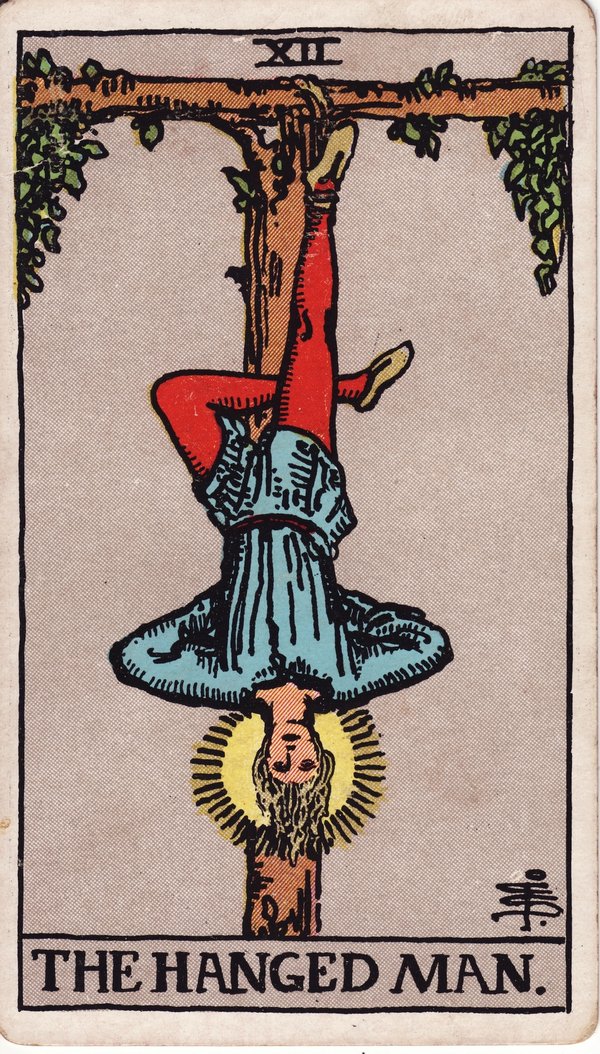
The emotional register of The Hanged Man is paradoxical. On the surface, suspension is uncomfortable — the body wants to move, the mind wants to solve, the ego wants to control. But beneath that surface agitation is a profound serenity, visible in the RWS figure's calm face. He is not suffering. He is seeing. His halo is not a crown of thorns but a crown of light — the illumination that comes only when the ordinary orientation of the self has been inverted.
The key distinction the card makes is between chosen and imposed suspension. The Hanged Man upright suggests that the pause is — at some level — voluntary. The self has consented to be still, even if the circumstances feel externally imposed. The reversed card suggests resistance: fighting the pause, filling the silence with busywork, refusing the lesson that stillness is trying to teach.
Symbolism & Imagery
Rider-Waite-Smith (1909): Pamela Colman Smith's Hanged Man hangs upside-down from a T-shaped cross made of living wood — the Tau cross, a symbol of life and resurrection, not the instrument of execution. The wood is living, sprouting leaves — this is not a dead tree but a tree that is still growing, still connected to the root of life. The cross is set between two trunks, forming a doorway: the Hanged Man hangs in a threshold between worlds.
His right foot is bound to the cross; his left leg is free, bent at the knee, forming an inverted triangle with his torso. This posture — the leg making the shape of the number 4, the alchemical symbol for Jupiter and the cross of matter — suggests voluntary bondage. One foot is tied, but the other is free. He could, if he chose, release himself. He stays because he has chosen to.
His arms are bent behind his back, forming another inverted triangle — the alchemical symbol for Water, the element of the card. The combination of these two triangles (the leg and the arms) creates a hexagram, the Seal of Solomon, the union of fire (upward triangle) and water (downward triangle) — the marriage of will and surrender.
His red pants represent human passion and the physical body; his blue vest represents knowledge and the higher mind. His expression is not of pain but of deep, serene contemplation. A golden halo surrounds his head — the halo of the martyr, yes, but more accurately the halo of the initiate. He is not being punished. He is being initiated into a wisdom that can only be received upside-down.
Thoth (Crowley/Harris, 1944): Lady Frieda Harris's Hanged Man for the Thoth deck is even more explicitly alchemical and sacrificial. The figure hangs from an ankh (the Egyptian symbol of life) suspended from a geometric framework, his body rendered in green — the color of vegetation, of the dying-and-rising god, of the Green Man who is sacrificed each winter and reborn each spring.
His posture forms the alchemical sign of the solve — dissolution, the first stage of the Great Work, in which the fixed matter of the self is dissolved into its constituent elements so that it can be recombined at a higher level. Around him, serpentine energies coil — the kundalini force that rises when the ordinary orientation of consciousness is reversed.
In the background, a grid of squares suggests the rigidity of ordinary perception. The Hanged Man hangs outside this grid, his perspective no longer constrained by its coordinates. The Thoth Hanged Man is the initiate suspended in the Abyss — the Qabalistic void where all fixed identities dissolve and the only ground is surrender.
Key difference between traditions: RWS emphasizes the voluntary, serene nature of the suspension — the calm face, the halo, the living tree. Thoth emphasizes the alchemical and initiatory dimension — the solve, the dissolution of the ego in the waters of the unconscious as a necessary stage of spiritual transformation. Both traditions agree on the essential point: this is not punishment. This is passage.
Astrological & Elemental Layer
The Hanged Man is assigned to the element of Water — the element of emotion, intuition, the unconscious, and the dissolution of boundaries. Water does not push; it receives. It does not climb; it sinks to the lowest point and fills it. The Hanged Man's wisdom is Water wisdom: the wisdom of yielding, of letting the current carry you, of finding the path of least resistance not as weakness but as strategy.
Neptune, the modern planetary ruler of the card, deepens this Watery character. Neptune is the planet of dissolution, mysticism, illusion, sacrifice, and the transcendence of ego boundaries. Under Neptune's influence, the sharp edges of identity soften. The "I" that wants, that plans, that controls — that "I" discovers that it is not the whole self. There is a deeper self, a Water self, that knows how to wait, how to receive, how to be remade.
The 12th house — associated with The Hanged Man in many esoteric systems — is the house of isolation, institutions, the unconscious, and the dissolution of self. It is the house of monasteries and prisons, of retreats and hospitals, of any place where the ordinary business of life is suspended and the soul is left alone with itself. The 12th house is not comfortable, but it is transformative — the necessary confinement that precedes liberation.
In the Thoth system, the additional attribution of Uranus as "neutralization and inversion" adds a layer of sudden, radical perspective shift. The Hanged Man does not just slowly change his mind — he is flipped, inverted, forced to see everything from the opposite angle, and in that instant of reversal, reality reorganizes itself.
Kabbalistic / Tree of Life Layer
On the Tree of Life, The Hanged Man occupies Path 23, the path connecting Geburah (Severity, Judgment, Mars) to Hod (Splendor, Intellect, Mercury). This is the path of Mem — Water — the channel through which the harsh, cutting energies of Geburah are softened, dissolved, and transmuted into the luminous understanding of Hod.
Geburah is the Sephirah of Mars — the warrior, the judge, the force that destroys what is false. Its energy is necessary but severe. Hod is the Sephirah of Mercury — the intellect, communication, the capacity to name and understand. The path between them is the process by which the sword of judgment becomes the word of wisdom. But this transmutation cannot happen through more force. It can only happen through Water — through dissolution, surrender, the willingness to let the hard forms of the self be softened.
The Sepher Yetzirah describes this path as the "Stable Intelligence" — the consciousness that maintains stability through change, that finds constancy not in rigid form but in the capacity to flow. Water is the only element that can take any shape while remaining itself. The Hanged Man teaches this kind of stability: not the stability of the rock but the stability of the river, which is always moving and always there.
For the querent, the Kabbalistic layer suggests: whatever harsh judgment you are experiencing — whether from others or from your own inner critic — will not be resolved by fighting it. The way through is immersion. Let the judgment dissolve in the waters of surrender. What remains after the dissolution is the truth that the judgment was obscuring.
Archetypal & Life-Stage Themes
The Hanged Man embodies one of humanity's most ancient and potent archetypes: the Dying God. Across cultures, the pattern repeats: the god who is sacrificed, who descends into the underworld, who hangs on the tree, and who returns transformed, bringing gifts to humanity.
Odin: The Norse All-Father hung himself on Yggdrasil, the World Tree, for nine days and nine nights — pierced by his own spear, gazing into the waters below — to receive the runes, the secret alphabet of reality. "I know that I hung on a windy tree nine long nights, wounded with a spear, dedicated to Odin, myself to myself." The Hanged Man is the Odin card: the self-sacrifice of the self to the Self, the wisdom that cannot be learned but only received through ordeal.
Christ: The crucifixion is the central Hanged Man story of the Western tradition — the willing sacrifice of the divine for the redemption of the world. But the Hanged Man is not about the resurrection (that is Judgment / The Aeon). It is about the moment on the cross — the moment of ultimate suspension, when heaven and earth are held apart, when the old order dies and the new has not yet been born.
Dionysus Zagreus: The dismembered god, torn apart by the Titans and reborn — the archetype of the self that must be dissolved before it can be reconstituted. The Thoth deck's Hanged Man, with its serpentine energies and green skin, explicitly invokes this Dionysian current.
The Initiatory Ordeal: In mystery traditions worldwide, initiation involves a symbolic death — the candidate is enclosed, submerged, suspended, buried — and then reborn into a new identity. The Hanged Man is the card of that initiatory suspension: the candidate in the dark, waiting, not yet reborn but no longer who they were.
In the Fool's Journey, The Hanged Man arrives after Justice — after the moral reckoning, the Fool must now undergo a deeper transformation. Justice was about external accountability; The Hanged Man is about internal dissolution. The structures of the self that made the mistakes Justice identified must now be dissolved so that a new self can be built. This is the dark night of the soul in the middle of the journey — the point where forward motion ceases and the Fool simply hangs, suspended between what was and what will be.
Advising For / Advising Against
-
If advising FOR: Stop. Whatever you are pushing against, stop pushing. Whatever you are trying to solve, stop solving. The answer you need will not come from more effort — it will come from the stillness that effort is preventing. Let yourself be suspended. Let the old orientation dissolve. The perspective you need is not available from where you are standing; you must be inverted to see it. Trust that the pause is productive, even though it does not look like productivity. The seed germinates in darkness. The initiate is transformed in the sealed chamber. You are in that darkness, that chamber. Let it work.
-
If advising AGAINST: Do not mistake passivity for surrender. The Hanged Man upright is a willing suspension — chosen, conscious, oriented toward insight. If you are simply avoiding action out of fear, calling it "patience," you are not in the Hanged Man; you are in its shadow. Do not martyr yourself unnecessarily — the card honors sacrifice that serves transformation, not sacrifice that serves the ego's need to suffer. If you have been hanging for a long time and nothing is changing, ask yourself: Am I surrendered, or am I stuck? Am I waiting for wisdom, or am I waiting for permission?
Card of the Day
Today, pause and see differently. Something you have been pushing against needs you to stop pushing. Turn your perspective upside-down — literally, if it helps. Lie on the floor. Walk somewhere new. Ask: If everything I believe about this situation were inverted, what would I see? The answer will come when you are still enough to receive it.
Card of the Year
A Hanged Man year — calculated as personal year 12 when your birth month + birth day + current year reduces to 12 — is a year of profound suspension and spiritual reorganization. This is a year when forward motion in the outer life may slow to a crawl while the inner life undergoes seismic transformation. The external stasis is not a mistake — it is the necessary container for the internal work.
The themes of a 12/Hanged Man year: waiting, uncertainty, the dissolution of old identities, spiritual initiation, the dark night of the soul made temporal. Career changes may stall. Relationships may enter a holding pattern. Plans may be delayed. The challenge is not to panic, not to force, not to fill the silence with busywork. The invitation is to use the pause as a retreat — to see the world upside-down, to receive the wisdom that only comes to those who have stopped chasing it.
This is not an easy year, but it is a sacred one. The harvest comes not within the year but after it — the clarity, the new direction, the reconstituted self that emerges from the waters of suspension. Surrender to the process. You are not being punished. You are being prepared.
Elemental Dignities Notes
The Hanged Man is Water — the element of emotion, intuition, the unconscious, and dissolution. In a spread, its elemental relationship to neighboring cards follows the Golden Dawn system:
-
Strengthened by Water (Cups): Like element intensifies like element. Additional Water cards deepen the emotional and intuitive dimension — The Hanged Man alongside Cups becomes profoundly still, profoundly receptive, a deep pool of psychic waiting. The risk is drowning in feeling without insight.
-
Strengthened by Earth (Pentacles): Earth supports Water — material stability provides the container for emotional transformation. A Hanged Man adjacent to Pentacles suggests that the pause has practical support; the material world is holding space for the inner work.
-
Weakened by Fire (Wands): Fire is Water's enemy in elemental dignity. Wands adjacent to The Hanged Man suggest that the impulse to act, to initiate, to push forward is disrupting the necessary stillness. The fire boils the water into steam — agitation without transformation.
-
Neutral / Mixed with Air (Swords): Air and Water can be productive if balanced — the intellect illuminating the emotional depths, the mind making sense of the surrender. But too much Air agitates Water into anxiety storms, and too much Water drowns clear thought in murky feeling.
Deck-Specific Notes
-
If using a Thoth deck: The Hanged Man appears in green, suspended from an ankh within a geometric framework, with serpentine energies coiling around him. The reading emphasis shifts from "serene voluntary pause" to "alchemical dissolution — the solve stage of the Great Work." The Thoth Hanged Man is more explicitly initiatory, more explicitly about the death of the ego that precedes spiritual rebirth. The serpent suggests kundalini energy — the life force that rises when the ordinary orientation of consciousness is inverted.
-
If using a Marseille-tradition deck: Le Pendu (The Hanged Man) is typically depicted as a man suspended by one foot from a simple wooden gibbet, his free leg crossed behind, his hands sometimes in his pockets or at his sides. The Marseille Hanged Man carries stronger connotations of punishment and public shame — the original Renaissance context of hanging by one foot as a punishment for traitors. The spiritual interpretation (voluntary sacrifice, perspective shift) was developed later by occultists.
-
If using a blended or contemporary deck (e.g., Fountain Tarot, Wild Unknown, etc.): The psychological and astrological layers apply across visual traditions. The core archetype — suspension, surrender, perspective shift — persists regardless of imagery. Consult your deck's guidebook for specific departures, particularly regarding the figure's emotional expression (serene vs. anguished) and the context of the suspension (punishment vs. initiation).
Journaling & Contemplation Prompts
- What am I pushing against that might be asking me to stop pushing? Where in my life is effort the obstacle rather than the solution?
- If I turned my current understanding of this situation completely upside-down — if everything I believed were inverted — what would I see?
- What am I afraid will happen if I stop trying to control this? Is that fear realistic, or is it the ego's terror of surrender?
- Have I been mistaking martyrdom for sacrifice? Am I suffering unnecessarily in a way that serves no transformation?
- If this pause is a gestation, what is being gestated? What wants to be born from this stillness?
Additional Associations
| Association Type | Value |
|---|---|
| Color(s) | Deep blue (Water, the unconscious, the depths); red (passion, the life force that is being surrendered, not extinguished); gold (the halo of illumination, the wisdom that comes through suspension) |
| Crystals / Stones | Aquamarine (surrender, trust in the flow, the stone of letting go); Amethyst (spiritual insight, the crown chakra activation of inverted perspective); Moonstone (the cycles of dissolution and return, the wisdom of the deep feminine) |
| Herbs / Plants | Willow (flexibility, the tree that bends rather than breaks, associated with Water and the moon); Lotus (the flower that rises from mud, the symbol of enlightenment through immersion); Mistletoe (the plant that grows between earth and sky, sacred to the Druids, the "golden bough" of the hanged god) |
| Archetypes (Jungian) | The Dying God; The Martyr; The Initiate; The Sacrificial Victim; Odin / Christ / Dionysus |
| Mythological Figures | Odin (hanging on Yggdrasil for the runes); Christ (the crucifixion); Dionysus Zagreus (dismemberment and rebirth); Inanna (descent to the underworld, hung on a hook); Prometheus (bound to the rock for the gift of fire) |
| Numerological Resonance | 12 = 3 x 4, the completion of a cycle, the zodiac, the fullness of time. 12 = 1 + 2 = 3 — creation, expression, the fruit of sacrifice. The Hanged Man's reduction to 3 reveals that apparent stasis is generative: something is being created in the stillness. |
| Playing Card Equivalent | The Hanged Man has no direct playing-card equivalent, but thematically it connects to the suspended cards — any hand where the player must wait, sacrifice a trick, or hold position rather than advance. |
| I Ching Hexagram Parallel | Hexagram 36 — Ming I / Darkening of the Light. "The light has sunk into the earth. Through adversity, persevere." The hexagram of the good person in a dark time, who must conceal their light and wait — not out of cowardice but out of wisdom. The patience that preserves what cannot yet be expressed. |
| Body / Organ Correspondence | The lymphatic system (the body's Water system, the fluid of immune response and purification); the feet (the point of suspension, the connection to earth inverted); the pineal gland (the "third eye" activated by inverted postures in yoga, the seat of spiritual vision). In esoteric anatomy, inversion practices (headstands, downward dog, hanging) stimulate the crown chakra and alter consciousness. |
Shadow & Integration Message
The Hanged Man's shadow is the refusal to surrender — and its twin, the performance of surrender that is actually passivity. The first form is straightforward: the querent fights the pause, fills the silence with distractions, insists on forward motion even as the universe is applying the brakes. The second form is subtler: the querent adopts the posture of the martyr, claiming to be "surrendered" while actually being stuck, using spiritual language to avoid the terrifying work of change.
In the Thoth framing, the shadow appears as the serpent that devours rather than illuminates — the kundalini turned destructive because the ego has not truly released its grip. The green man who hangs not in willing sacrifice but in frozen terror, unable to dissolve and unable to return.
Integration of The Hanged Man's energy means learning the difference between surrender and passivity, between sacrifice and self-harm, between waiting with attention and waiting in avoidance. The integrated Hanged Man is the one who can be still while fully present — not checked out, not numbed, not hiding, but alert within the suspension, receiving what the stillness has to teach. This is the Odin who hung for nine nights and received the runes — not the one who simply hung.
Elemental Intelligence (Suit Framing)
In the Jungian cognitive function mapping — which maps the suits to Jungian cognitive functions, humours, and class theory — The Hanged Man as Water aligns with the Feeling function, the phlegmatic humour, and the spiritual/monastic class. But The Hanged Man is not the ordinary Feeling of daily emotional life — it is Feeling turned inward to the point of dissolution, the emotional capacity operating at the level of mysticism and ego-death.
The "class" of The Hanged Man is the monk, the mystic, the retreatant — those whose social role is to withdraw from the ordinary flow of life in order to access a deeper current. Its humour is phlegmatic intensified to the point of stillness: the waters that do not flow because they are too deep, the lake that reflects the sky because it is undisturbed.
In the Jungian cognitive function mapping, The Hanged Man as Water-mutable (the card spans multiple astrological attributions — Water/Neptune/Uranus/12th house) represents the ultimate adaptability of consciousness — the capacity to take any shape, to flow into any vessel, to dissolve any fixed form. This is Water that does not just feel but becomes — the mystic's union with the beloved.
Timing & Manifestation
For timing in a reading, The Hanged Man's answer is the most temporally ambiguous of any card: "When you stop needing to know when." The Hanged Man operates outside chronos (clock time) and entirely within kairos (the opportune moment, the ripening of readiness). The event will not arrive on schedule; it will arrive when the suspension has done its work — when the ego has genuinely surrendered its attachment to a timeline.
If pressed for a seasonal window: The Hanged Man is associated with the Water signs (Cancer, Scorpio, Pisces) — the seasons of emotional depth, descent, and dissolution. The period around the winter solstice (the longest night, the sun's apparent suspension before its return) carries Hanged Man energy. But these are loose correlations. The Hanged Man's truest timing answer is: wait. Not passively — attentively. The waiting is the work.
Yes / No Tendency
The Hanged Man is a No, or not yet — but it is among the gentlest no's in the deck. It does not reject; it delays. The answer is not "never" but "not from the orientation you currently hold." The situation requires a perspective shift before it can resolve. In a yes/no spread, treat The Hanged Man as: The question you are asking is not the question you need to be asking. Reframe, and ask again from a different angle.
In reversed / ill-dignified position, the tendency shifts toward forced delay with resistance. The pause continues, but the querent is fighting it, making the suspension painful rather than productive. The no becomes harsher — not because the universe is cruel but because the querent is exhausting themselves against an immovable pause.
Common Misreads / Nuances to Know
Misread 1: "The Hanged Man means I'm stuck and nothing I do matters." The Hanged Man is not passive helplessness — it is active surrender. The RWS figure's face is serene, his halo bright. He is not suffering; he is receiving. The stuckness is productive if you let it be.
Misread 2: "This card means sacrifice — I should give up what I love." The Hanged Man's sacrifice is of the ego's attachment to control, not of life's genuine goods. You are not being asked to abandon what matters; you are being asked to release your death-grip on how it must unfold. The sacrifice is of the demand, not the beloved.
Misread 3: "Reversed Hanged Man means the waiting is finally over." Sometimes, but more often the reversal indicates resistance to the necessary pause. The querent is fighting the stillness, filling it with busywork, refusing to let the suspension do its transformative work. The reversal is a warning: stop resisting the pause, or the pause will intensify.
Nuance for Thoth readers: The Thoth Hanged Man is the alchemical solve — the dissolution of the fixed ego in the waters of the unconscious. This is a card of profound mystical attainment, not beginner's patience. The green figure suspended from the ankh is the initiate in the Abyss, undergoing the death of the self that precedes the birth of the adept. Read with the Thoth deck, the card's "surrender" is not psychological coping — it is spiritual alchemy.