The Poetic Line
"The scales do not judge — they reveal the weight you are already carrying."
Keywords
| Category | Dignified | Undignified |
|---|---|---|
| General | Fairness, accountability, truth, cause and effect, karmic balance, integrity | Unfairness, dishonesty, bias, avoiding responsibility, injustice, corruption |
| Spiritual | Divine law, karmic reckoning, moral clarity, the feather and the heart, alignment with cosmic order | Spiritual bypassing of consequences, self-righteousness, confusing punishment with justice, denial of shadow |
| Psychological | Objective self-assessment, clear conscience, owning one's choices, mature accountability, rational clarity | Harsh inner critic, guilt without resolution, blame-shifting, refusal to examine one's role, cognitive dissonance |
| Physical Health | Balanced health practices, legal resolution of medical disputes, cause-and-effect healing (treating root causes) | Stress-related illness from unacknowledged wrongdoing, legal complications in health matters, imbalance from neglected self-care |
| Relationships | Fair partnership, honest communication, mutual accountability, resolving conflicts with equity, clear agreements | Unequal relationships, score-keeping, blame, inability to take responsibility for one's part, relationship as courtroom |
| Financial | Fair settlement, ethical business, balanced budgets, legal resolution of financial disputes, honest accounting | Financial dishonesty, unfair contracts, legal costs, debts of karma coming due, imbalance between earning and spending |
| Vocational | Ethical leadership, fair hiring/promotion, legal profession, mediator, quality assurance, regulatory compliance | Workplace bias, wrongful termination, toxic accountability culture, cutting corners, whistleblower retaliation |
| Shadow / Thoth Distinction | Karmic equilibrium (Ma'at), cosmic balance beyond human law, the solve et coagula of action and consequence, Venusian harmony of right relationship, the feather's lightness | Rigidity mistaken for righteousness, the mask of fairness concealing revenge, spiritual bypassing through legalism, denial of the law of cause and effect |
Narrative Description
General Meaning
Justice is the card of moral accounting — the moment when cause meets effect and the ledger is balanced. In the Fool's Journey, it arrives after the Wheel of Fortune: the Wheel turns and redistributes fate; Justice asks what you did with what the Wheel gave you. This is the card of karma made visible — not supernatural punishment but the ordinary, implacable way that actions generate consequences that return to their source.
In a reading, Justice signals that a decision is coming, a reckoning is at hand, or that the querent's own conduct needs examination with unflinching honesty. The card does not promise the outcome you want — it promises the outcome that is true, given the totality of causes and effects in play. If you have acted with integrity, Justice is a profoundly reassuring card. If you have cut corners, betrayed trust, or lied to yourself, Justice is a demand to make things right before the universe makes them right for you — and the universe, the card gently reminds us, is less forgiving than honest amends.
The emotional register of Justice is cool, clear, and unsentimental. This is not the warmth of the Empress or the mystical embrace of the High Priestess. It is the clean, sharp air of a courtroom or a meditation hall where nothing can be hidden. The card asks: Can you stand in the light of what you have done and not flinch?
The distinction between RWS Justice and Thoth Adjustment matters profoundly. RWS frames Justice in the language of human institutions — the courtroom, the judge, the legal code, the blindfold that promises impartiality. Thoth frames Adjustment in the language of cosmic law — Ma'at weighing the heart against the feather, the diamond of interlocking forces, equilibrium as the fundamental structure of reality rather than a human invention. In Thoth, you are not being judged by an external authority; you are being adjusted — brought back into alignment with the pattern of what is real. The question is not "what will the judge decide?" but "what is true, and are you aligned with it?"
Symbolism & Imagery
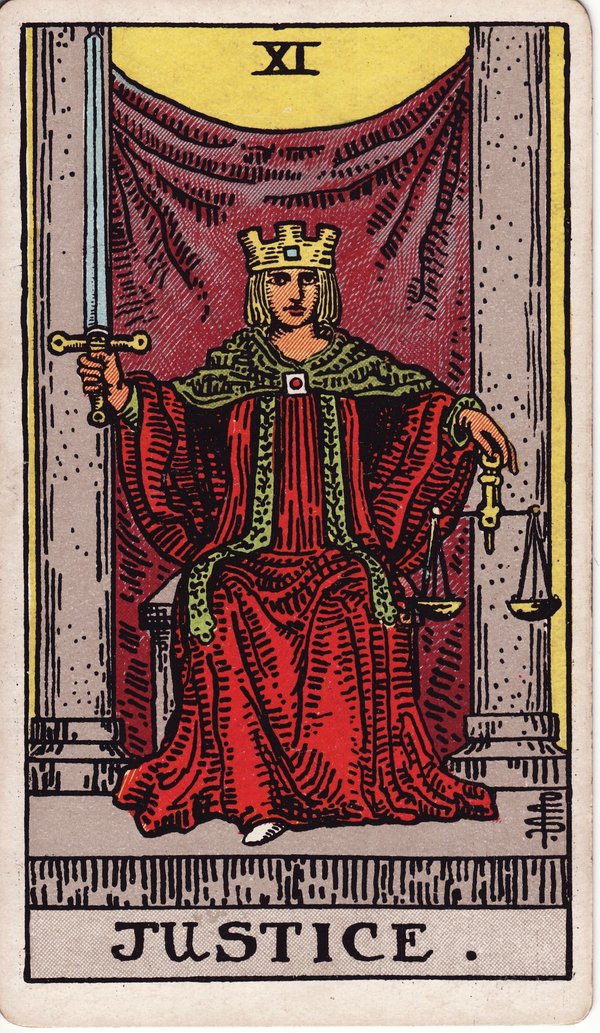
Rider-Waite-Smith (1909): Pamela Colman Smith's Justice sits on a stone throne between two gray pillars — the same pillars of Boaz and Jachin that frame the High Priestess and the Hierophant, linking Justice to both inner wisdom and outer tradition. She wears a red robe (passion and action) over a white undergarment (purity of motive), with a green mantle (growth and healing) and a crown with a small square — the symbol of ordered, rational thought.
In her right hand she holds an upright sword — the double-edged blade of discernment that cuts both ways. The sword points upward, toward heaven, indicating that justice draws its authority from a higher source than human opinion. In her left hand — the intuitive hand — she holds the scales, perfectly balanced. The left-handed holding of the scales is significant: true justice requires intuition, not just logic. Facts alone do not make fairness; the heart must weigh what the mind measures.
Her foot peeks from beneath her robe, a single white shoe visible — a reminder of the spiritual consequences of physical actions. The purple veil behind her softens the severity of the scene, representing the compassion that must temper judgment. Most crucially in RWS: there is no blindfold. Unlike the conventional image of Justice, Pamela Colman Smith's figure sees clearly. She does not need to be blind to be impartial — she is impartial because she sees everything, including what the querent would rather hide.
Thoth (Crowley/Harris, 1944): Lady Frieda Harris's Adjustment is radically different and more esoteric. Here the figure is androgynous, masked, and poised on tiptoe within a diamond formed by interlocking circles and squares — a visual meditation on the reconciliation of opposites (curve and angle, feminine and masculine, circle and line). The figure wears a harness of spheres that maps to the Sephiroth on the Tree of Life, suggesting that cosmic balance is the architecture of all being, not a human imposition.
She holds the Sword of Discernment between her thighs — a placement that Crowley intended to represent the creative, generative power of clear judgment. The sword is not a weapon but a tool of precision. Her mask suggests impersonality — not coldness but the transcendence of personal bias. She is not a person judging you; she is the principle of judgment itself, operating through you.
Above her, scales are balanced within a circle, crowned by the Greek letter Alpha (beginning) — cosmic justice is the alpha, the origin, the first principle. The entire composition is a mandala of dynamic equilibrium. Where RWS Justice sits in stillness, Thoth Adjustment is suspended in a state of perpetual, active balance — equilibrium as ongoing dance, not settled verdict.
Key difference between traditions: RWS emphasizes human justice — the external process of accountability, law, and fair outcome. Thoth emphasizes cosmic equilibrium — the internal state of being aligned with universal law, which manifests externally as fair outcome but originates in the soul's own attunement to truth.
Astrological & Elemental Layer
Justice/Adjustment is assigned to Libra, the seventh sign of the zodiac, ruled by Venus. Libra is the sign of balance, partnership, aesthetics, law, and social harmony — the first sign of the zodiac that is not about the individual self (Aries through Virgo) but about the self in relationship to others. Libra's glyph is the scales, and its core question is: What is fair? What restores balance between us?
Venus as Libra's ruler adds a crucial dimension often overlooked in Justice readings. Venus is the planet of love, beauty, value, and relationship. This means that true justice is not mechanical — it is relational. It is not about punishing wrongdoing but about restoring right relationship. A Libra Venus does not want the defendant executed; it wants the rupture healed. This softens the card's reputation for severity: Justice wants the scales balanced not for the satisfaction of punishment but for the restoration of harmony.
As an Air card (Libra is an Air sign), Justice operates through intellect, communication, and principle. Air is the element of objectivity — the capacity to step back from emotional entanglement and see clearly. This is why Justice can feel cold: it prioritizes truth over comfort. But Air is also the element that connects — through speech, through law, through shared understanding. Justice's Air nature is not about isolation but about the kind of connection that is only possible when everyone is being honest.
In the Thoth system, the attribution of Venus in Libra deepens the feminine-natured, Ma'at-like character of Adjustment. Venus is the planetary expression of the Goddess, and in Libra she operates through the harmonious ordering of relationships. Adjustment is not a father-god handing down commandments but the cosmic Mother restoring equilibrium — as natural, as inevitable, and as implacable as gravity.
Kabbalistic / Tree of Life Layer
On the Tree of Life, Justice/Adjustment occupies Path 22, the path connecting Geburah (Severity, Strength, Judgment) to Tiphareth (Beauty, Harmony, the Christ-center). This is the path of Lamed, the ox-goad — the instrument that drives the ox forward, that corrects its course, that teaches through applied pressure.
Geburah is the fifth Sephirah — the sphere of Mars, of severity, of the necessary destruction of what is false or imbalanced. Tiphareth is the sixth Sephirah — the sphere of the Sun, of harmony, beauty, and the integrated self. The path between them describes the process by which harsh judgment (Geburah) is transmuted into balanced harmony (Tiphareth) — not by softening the judgment but by integrating it into a larger pattern of meaning.
The Sepher Yetzirah describes this path as the "Faithful Intelligence" — the consciousness that multiplies spiritual virtues, that raises up what has been cast down, that restores the right order of things. The ox-goad of Lamed is the instrument of this restoration: it pricks, it corrects, it guides. It is not the punishment but the teaching that follows from error.
For the querent, the Kabbalistic layer suggests: whatever reckoning you are facing is not an endpoint but a passage. Geburah's severity is not the destination — Tiphareth's harmony is. The judgment you experience now is the ox-goad driving you toward integration. Accept the correction and you will arrive at a deeper beauty than you could have reached without it.
Archetypal & Life-Stage Themes
Justice/Adjustment embodies several archetypes central to the human experience of moral order:
The Judge / The Arbiter: The archetype of the one who weighs, who discerns, who separates truth from falsehood. In its integrated form, the Judge is wise, impartial, and oriented toward restoration rather than punishment. In its shadow form, the Judge becomes the harsh inner critic, the scold, the one who mistakes cruelty for righteousness.
Ma'at: The Egyptian goddess of truth, justice, and cosmic order, who weighs the heart of the deceased against the feather of truth. If the heart is lighter than the feather, the soul proceeds to the afterlife. If heavier, it is devoured. Ma'at is not a judge in the human sense — she is the principle of truth itself, the fabric of reality against which all actions are measured. The Thoth deck's Adjustment card is explicitly Ma'atian.
Themis: The Greek Titaness of divine law and order, who precedes the Olympian gods and represents law that is older than human institutions. Unlike her daughter Dike (human justice), Themis embodies the natural order of things — the law that governs the stars, the seasons, and the deep structure of time. Justice in its Themis aspect is not a social convention but a cosmic fact.
Nemesis: The goddess of retribution, but originally of proportionate response — she ensures that good fortune does not exceed its proper bounds any more than misfortune. Nemesis is the principle of "nothing in excess," the force that corrects hubris. Her name shares a root with the Greek word for "distribution" — justice as the fair apportionment of what is due.
In the Fool's Journey, Justice/Adjustment represents the moment when the Fool's actions catch up to them. After the ecstatic beginnings (Fool through Chariot), after the acquisition of inner strength (Strength) and wisdom (Hermit), after encountering the cycles of fate (Wheel of Fortune), the Fool must now face the consequences of every choice made along the way. This is the card of moral maturity — the recognition that freedom is not the absence of constraints but the acceptance of responsibility for one's freedom.
Culturally, Justice appears wherever the question "what is fair?" arises: in the Magna Carta, in the Nuremberg Trials, in every courtroom drama and every family argument about whose turn it is to do the dishes. It is the archetype behind the scales on every law book, the sword on every coat of arms, the promise that the arc of the moral universe bends — slowly, imperfectly, but inexorably — toward balance.
Advising For / Advising Against
-
If advising FOR: Tell the truth — to yourself first, then to others. If there is an amends to make, make it now, before the universe makes it in a way you will not choose. If there is a decision before you, choose the option that you could explain with a clear conscience to someone you respect. If there is a contract, agreement, or commitment, honor it — or renegotiate it honestly. This card counsels: act now with integrity, and the outcome will be fair.
-
If advising AGAINST: Do not cut corners. Do not lie to yourself about your own motives. Do not evade responsibility by blaming circumstances, other people, or bad luck — the card suggests that the cause of the situation you are in is closer to home than you want to admit. Do not seek revenge while calling it justice — the distinction is whether you want the scales balanced or your enemy punished. If you cannot honestly tell the difference, wait until you can.
Card of the Day
Today asks you to be accountable. There is a decision to make, a truth to tell, or a balance to restore. Notice where you are tempted to cast yourself as the victim — and then ask, honestly, what your own choices contributed. This is not a day for self-flagellation. The small honesty you practice today will ripple outward in ways you may never see but will always feel.
Card of the Year
A Justice/Adjustment year — calculated as personal year 11 (or 8 in the Thoth system) when your birth month + birth day + current year reduces to 11 — is a year of karmic reckoning and moral clarification. This is not a gentle year. It is the year when past choices return for review, when unresolved conflicts demand resolution, when the ledger gets balanced whether you are ready or not.
The themes of an 11/Justice year: legal matters (settlements, contracts, court cases), decisions with long-term consequences, the resolution of old debts (literal and metaphorical), the clarification of values, and the experience of cause and effect made visible. Relationships that have been out of balance will either be recalibrated or released. Career paths that have been ethically compromised will face scrutiny or correction. This is the year to get your affairs in order — not out of fear but out of integrity.
The challenge of a Justice year is to accept correction without resentment and to offer amends without expectation of forgiveness. The harvest of this year is a conscience so clear it becomes a source of strength rather than a burden of guilt.
Elemental Dignities Notes
Justice/Adjustment is Air — the element of intellect, discernment, objectivity, and communication. In a spread, its elemental relationship to neighboring cards follows the Golden Dawn system:
-
Strengthened by Fire (Wands): Fire supports Air — passion fuels clarity, action feeds principle. A Justice adjacent to Wands becomes more active, more willing to take the decisive step that integrity demands. The scales tip toward action rather than deliberation.
-
Strengthened by Air (Swords): Like element intensifies. Multiple Air cards sharpen the intellectual and analytical dimension — Justice alongside Swords becomes a formidable force of truth-telling and clear judgment, though at risk of becoming clinical and unfeeling.
-
Weakened by Earth (Pentacles): Earth is Air's enemy in elemental dignity. Pentacles adjacent to Justice suggest that material concerns, financial interests, or practical obstacles are impeding fairness. The truth may be inconvenient or expensive; the temptation to look away is strong.
-
Neutral / Mixed with Water (Cups): Air and Water can temper each other — the rational mind gains emotional depth, judgment gains compassion. But too much Water drowns objectivity in sentiment, and too much Air agitates emotional waters into anxious overthinking. The balance between head and heart is the work of this elemental pairing.
Deck-Specific Notes
-
If using a Thoth deck: This card appears as Adjustment (Trump VIII), not Justice. The imagery shifts entirely: no courtroom, no throne, no legal trappings. Instead, a masked, androgynous figure balances on tiptoe within a diamond mandala, holding a sword between her thighs, surrounded by spheres of the Sephiroth. The reading emphasis shifts from "a fair verdict will be rendered" to "are you in alignment with cosmic law?" The Thoth Adjustment is not about external judgment but internal attunement. The question is not "am I in trouble?" but "am I in truth?"
-
If using a Marseille-tradition deck: La Justice (Trump VIII in the Marseille tradition — the original numbering that Crowley restored) typically shows a seated figure with sword and scales, often without the pillars and sometimes without the full symbolic apparatus of the RWS card. The Marseille Justice is more austere, more directly about earthly judgment. In the Marseille tradition, Justice has always been VIII — Waite's renumbering to XI was the departure, not the original.
-
If using a blended or contemporary deck (e.g., Fountain Tarot, Wild Unknown, etc.): The psychological and astrological layers apply across visual traditions. The core archetype — accountability, truth, the balance of action and consequence — persists regardless of imagery. Consult your deck's guidebook for specific departures, particularly regarding the card's number (VIII vs. XI) and whether it leans more toward the legal/judgment framing (RWS) or the cosmic/equilibrium framing (Thoth).
Journaling & Contemplation Prompts
- Where in my life am I avoiding accountability — to myself or to others? What am I afraid would happen if I owned my choices fully?
- If I imagined my conscience as a courtroom, what case is currently being tried there? What is the verdict I fear? What is the verdict I secretly know is true?
- What relationship in my life is out of balance? What would it take to restore equity — not revenge, not capitulation, but genuine fairness?
- Have I been mistaking punishment for justice? Or mercy for evasion? Can I hold both accountability AND compassion in the same hand?
- If Ma'at weighed my heart against a feather right now, what would tip the scales? What could I do today to lighten the heart?
Additional Associations
| Association Type | Value |
|---|---|
| Color(s) | Deep red (passion, the life force that must be regulated); royal purple (wisdom tempered by compassion); green (Venusian healing and growth); gray (neutrality, the space between black and white) |
| Crystals / Stones | Hematite (grounding, clarity of thought, the iron of Mars in Geburah's severity); Lapis Lazuli (truth-speaking, the stone of Ma'at, used in Egyptian judgment scenes); Clear Quartz (amplification of clarity, the sword's transparent edge) |
| Herbs / Plants | Oak (strength, durability, the wood of courtroom benches and ancient law); Sage (clarity, purification, truth-speaking); Ivy (fidelity, the binding nature of contracts and commitments) |
| Archetypes (Jungian) | The Judge; The Superego; Ma'at / Themis / Nemesis; The Inner Critic; The Mediator |
| Mythological Figures | Ma'at (Egyptian goddess of truth and cosmic order); Themis (Greek Titaness of divine law); Athena (wisdom that judges justly); King Solomon (the wisdom to discern true from false); the Sword of Damocles (the weight of judgment suspended over those in power) |
| Numerological Resonance | 11 = master number, the gateway between personal and universal, action and karmic echo. 11 = 1 + 1 = 2, the number of duality, partnership, and reflection — justice as the mirror that shows the self to the self. In Thoth, 8 = the number of Mercury/Hod, swift discernment; the ∞ of infinite balance; completion and new beginning. |
| Playing Card Equivalent | The Justice card has no direct playing-card equivalent, but thematically it resonates with the Ace of Spades (the sword of decision, the cut that clarifies) and any card where fairness and rules are at stake. |
| I Ching Hexagram Parallel | Hexagram 6 — Sung / Conflict. "Conflict. You are sincere and are being obstructed. A cautious halt halfway brings good fortune. Going through to the end brings misfortune." The hexagram of dispute that is best resolved before it reaches the court — the wisdom of settling accounts before the universe settles them for you. |
| Body / Organ Correspondence | Kidneys (the organs of filtration and balance, ruled by Libra in medical astrology); the lower back / lumbar region (Libra's rulership, the structural balance of the spine); the adrenal glands (the body's stress-response system, the physiological cost of unresolved moral conflict). In astrological medicine, Venus governs the venous system and the body's capacity for equilibrium and restoration. |
Shadow & Integration Message
Justice's shadow is not simple unfairness — it is the weaponization of righteousness. The inner critic who never rests, who holds every mistake against you without offering any path to repair. The external judge who applies standards to others that they would never apply to themselves. The spiritual bypass that says "karma will take care of it" to avoid the discomfort of direct confrontation.
In the Thoth framing, Adjustment's shadow is rigidity mistaken for balance — the figure frozen in the diamond, unable to move because any movement would disrupt a precarious equilibrium that was never actually stable. The mask of impartiality becomes a prison when it prevents genuine engagement with the mess of real life.
Integration of Justice's energy means learning to hold accountability and compassion simultaneously — to weigh the heart against the feather without demanding that the heart be weightless. A heart entirely without weight is a heart that has never loved, never risked, never grieved. The integrated Justice knows this. It does not demand perfection; it demands honesty. It does not punish error; it insists on learning from error. The voice of integrated Justice says: I see what you did. I see why you did it. I see the consequences. Now — what will you do differently?
Elemental Intelligence (Suit Framing)
In the Jungian cognitive function mapping — which maps the suits to Jungian cognitive functions, humours, and class theory — Justice/Adjustment as Air aligns with the Thinking function, the sanguine humour, and the intellectual/legal class. But Justice is not the ordinary Thinking of daily problem-solving — it is Thinking elevated to principle, the cognitive function operating at the level of moral philosophy and law.
The "class" of Justice is the judiciary, the legal profession, the ethicist — those whose social role is to formalize and enforce the rules of fair conduct. Its humour is sanguine cooled to deliberation: the warm blood of human passion channeled through the cooling structures of principle and precedent.
In the Jungian cognitive function mapping, Justice as Air-cardinal (Libra is a cardinal Air sign) represents the initiating force of mind — the capacity to begin moral action, to establish right order rather than merely contemplate it. This is Air that does not just think but rules — the intellect as legislator.
Timing & Manifestation
For timing in a reading, Justice/Adjustment suggests a resolution that arrives when all factors are in balance — which is to say, when the time is right, not when the time is convenient. Libra season (approximately September 23 – October 22) is the natural window, particularly when the Sun transits Libra's degrees associated with Justice (the third decan, approximately October 13–22, ruled by Mercury — the planet of decisions and legal proceedings).
More broadly, Justice timing is the timing of cause and effect: the outcome will manifest when the chain of causation has completed its work. This cannot be rushed and cannot be evaded. If you are waiting for a legal decision, a moral reckoning, or the resolution of a karmic debt, Justice counsels patience — not passive waiting but active preparation. Use the interval to get your own house in order so that when the outcome arrives, you meet it with integrity.
Yes / No Tendency
Justice leans toward Yes, conditionally — if you have acted with integrity. This is perhaps the most conditional card in the deck for yes/no questions. It does not grant wishes; it delivers consequences. If your question is about whether you will get what you deserve — yes, you will, and Justice makes no distinction between what you want to deserve and what you actually deserve based on your actions.
In a legal context, Justice as a "yes" suggests a fair outcome — which may or may not be the outcome you want. The card promises fairness, not victory. In reversed / ill-dignified position, the tendency shifts toward delays, unfair outcomes, or the exposure of dishonesty. The process is corrupted, or the querent's own lack of integrity is undermining the result.
Common Misreads / Nuances to Know
Misread 1: "Justice means I'll win my court case." Justice promises fairness, not victory. If you are in the wrong, Justice upright is actually a warning — the fair outcome will not be in your favor, and you would be wise to settle or make amends before the verdict.
Misread 2: "Justice is cold and unfeeling." RWS Justice wears no blindfold and stands before a purple veil of compassion. The scales are held in the left (intuitive) hand. True justice integrates heart and head; the image is of mercy within accountability, not the absence of mercy.
Misread 3: "Reversed Justice means someone is being unfair to me." While this is possible, the more frequent message of reversed Justice is that the querent is avoiding responsibility. The card asks: Where are you blaming others for a situation your own choices created?
Nuance for Thoth readers: Adjustment (Trump VIII) is not about external judgment at all. It is about internal alignment with cosmic law — the Ma'atian equilibrium that precedes any human verdict. If you read Thoth, the question is never "will I be punished?" but "am I in truth?" The shift from courtroom to mandala is the shift from moral anxiety to spiritual clarity.