The Poetic Line
"The knight rests — not because the war is over, but because even swords need a moment of stillness."
Keywords
| Category | Dignified | Undignified |
|---|---|---|
| General | Rest, recuperation, contemplation, sanctuary, strategic withdrawal, mental stillness | Stagnation, procrastination disguised as rest, forced isolation, refusing to re-engage, the truce that becomes a tomb |
| Spiritual | Meditation, retreat, sacred silence, listening for the still small voice, monastic pause | Spiritual bypassing through withdrawal, using meditation to avoid life, the hermit who is hiding |
| Psychological | Integration after crisis, the mind processing what it has learned, healthy compartmentalization, self-protection | Depression, dissociation, mental numbness, refusing to process, the rest that is really collapse |
| Physical Health | Recovery, convalescence, rest as medicine, the body's demand for stillness, sleep healing | Chronic fatigue from unprocessed stress, bedrest becoming bedridden, the body shutting down where the mind won't face truth |
| Relationships | Taking space to gain perspective, temporary separation for healing, the truce after a fight | Avoidance disguised as "needing space," emotional withdrawal, the relationship that survives on distance rather than connection |
| Financial | Strategic pause in spending, consolidating resources, financial rest and recovery | Financial stagnation, avoiding money reality by not looking, the rest that costs more than action would |
| Vocational | Sabbatical, planned retreat, strategic thinking time, post-crisis recovery | Burnout, quiet quitting without intention, the career that has been paused so long it has stopped |
| Shadow / Thoth Distinction | The Lord of Truce: Jupiter in Libra's gift of spacious recovery — the rest that is granted, the mercy that follows severity, the expansion of consciousness through stillness | Jupiter's shadow in Libra: the truce that becomes permanent avoidance, the rest that is really flight, the mercy one grants oneself that is actually cowardice |
Narrative Description
General Meaning
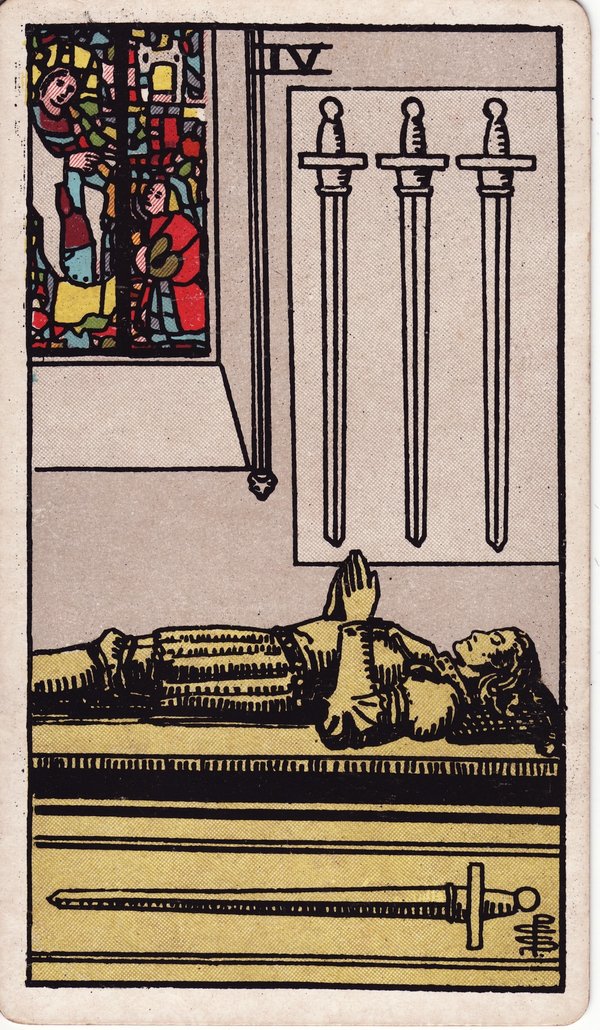
The Four of Swords is the card of the necessary pause — the moment after the crisis when the only sane action is to stop. In the RWS image, a knight lies in repose on a stone tomb, hands folded in prayer, three swords hanging on the wall above him and one laid along his side. A stained-glass window depicts a figure of peace. The battle is over — or at least suspended. The knight is not dead. He is resting with intention.
When the Four of Swords appears, the mind needs time to recover. It has been through the stalemate of the Two and the heartbreak of the Three, and now it asks for quiet. This is not avoidance — it is the wisdom of knowing when to stop. The swords are still present (one is literally within reach), but they are not in use. The threat is remembered, not engaged.
The emotional register of this card is stillness — not the stillness of numbness but the stillness of deliberate rest. Jupiter in Libra brings a quality of spacious benevolence to the otherwise severe suit of Swords: the universe grants a reprieve. The question is whether the querent will accept it or whether they will, like many, feel guilty for resting and rush back into battle before they are ready.
Symbolism & Imagery
Rider-Waite-Smith (1909): A knight in full armor lies on a stone tomb — a sarcophagus, perhaps, or an altar — hands folded in prayer. One sword lies along his side, within reach; three swords hang on the wall behind him, arranged in a pattern that suggests they are stored, not brandished. A stained-glass window above him depicts a woman and child — an image of peace, of the nurturing principle, of the gentleness that the armored knight is now receiving.
The figure is often mistaken for a corpse. He is not — his posture is one of rest, not death. The hands in prayer suggest that this rest is sacred, intentional, a communion with something beyond the self. The armor remains on, suggesting that the rest is temporary, a tactical withdrawal rather than a surrender. The one sword at his side says: I am still a warrior. I have not forgotten. But now is not the time for fighting.
The three swords on the wall form a kind of canopy — they are no longer piercing (as in the Three) but suspended, contained, transformed from weapons into architecture. The stained-glass window brings color and light into the grey stone chamber: the spirit has not been extinguished, only quieted. The overall composition is one of the most peaceful in the Swords suit — almost monastic in its invitation to stillness.
Thoth (Crowley/Harris, 1944): The Thoth Four of Swords — Lord of Truce — presents four swords arranged in a geometric pattern, with the blades crossing at a central point. The composition is balanced, symmetrical, almost meditative. The swords do not threaten; they form a mandala-like structure that suggests mental order restored after chaos. Crowley emphasized that the truce is not permanent — it is a suspension of hostilities, not a treaty — but that within this suspension, the mind can regain its strength.
The Thoth version emphasizes the intellectual dimension of the rest: the mind, having passed through the sorrow of Binah (Three of Swords), arrives at Chesed's mercy and can see its situation from a higher, more organized perspective. The truce is the space in which wisdom consolidates.
Astrological & Elemental Layer
Jupiter in Libra. Jupiter is the planet of expansion, benevolence, wisdom, and grace. In Libra, the sign of balance and relationship, it offers a spacious, generous equilibrium — not the tense balance of the Two but a genuine peace that allows for recovery. The third decan of Libra (approximately October 13 through October 22) is the decan of integration — the scales have been used, the weighing has been done, and now there is space to absorb what has been learned.
Jupiter in Libra does not pretend the conflict didn't happen. It offers mercy after the judgment. The card is not a denial of the Three's sorrow but a response to it: the universe provides a pause. The question is whether the querent can accept the pause without guilt — whether they can trust that rest is not laziness and that the battle will still be there when they are ready to return.
This is the most benevolent of the early Swords cards — a genuine gift in a suit that does not give many gifts. Jupiter's influence lightens Saturn's gravity (Three) and the Moon's rumination (Two). For a moment, the mind can stop.
Kabbalistic / Tree of Life Layer
The Four of Swords sits in Chesed — the fourth Sephirah, Mercy, the sphere of expansive benevolence and structured order. Chesed is the first Sephirah on the Pillar of Mercy and represents the grace that follows severity. After Binah's limitation (the Three), Chesed opens — it is the divine quality of love that builds worlds, the generous impulse that says: rest now.
In the Swords suit, Chesed manifests as the mind's capacity for ordered stillness. This is not the blankness of ignorance but the cultivated quiet of a mind that has processed its material and can now hold it in perspective. The four swords form a square — the number of stability, of the four directions, of the foundation stone. Chesed provides the architecture within which healing can occur.
For the querent, the Kabbalistic layer suggests: the rest you need is not a luxury. It is Chesed's mercy — the grace that the universe extends after difficulty. Accepting it is not weakness; it is wisdom. The truce is real, but it is temporary. Chesed asks you to use this time not for escape but for integration — to let what you have learned settle into your bones before you rise again.
Sequential Narrative: Position in the Suit Story
The Four of Swords follows the Three of Swords — the pierced heart, the storm of grief — and represents the direct response to that wound: rest. The knight has been through the battle (the Two's stalemate and the Three's piercing) and now lies down. He is not dead; he is recuperating. The swords that wounded him in the Three are now hung on the wall — contained, remembered, integrated into the architecture of consciousness.
The Four flows into the Five of Swords — the Lord of Defeat — where the truce ends and conflict resumes, this time with higher stakes. The rest of the Four is preparation, not escape. The knight will rise again, and when he does, the battle will be different — more complex, more consequential. The Four asks: have you rested enough? Have you learned what the rest was meant to teach?
The arc from Two through Four is a complete mini-narrative of conflict, wounding, and recovery — and the Four is the resolution of that first cycle. But the suit is not over. The recovery is real, but it is also the foundation for what comes next. Chesed's mercy is always followed by Geburah's severity — the Five. Rest well. You will need it.
Advising For / Advising Against
-
If advising FOR: Stop. Lie down. The battle will wait. You have been fighting — with others, with yourself, with the truth — and you are exhausted in a way that more fighting will not fix. The Four of Swords grants you permission to withdraw, to be still, to let your mind go quiet. This is not avoidance; this is maintenance. The warrior who never rests becomes a casualty. Take the truce. Use it well.
-
If advising AGAINST: You have rested long enough. The truce has become a tomb — the stillness that was meant to restore you is now draining you. The swords are still on the wall; the battle is still real. If you stay horizontal much longer, you will forget that you are a knight and not a corpse. Rise. The mercy of Chesed was meant to prepare you, not to replace you. It is time to re-engage.
Card of the Day
Today, rest. If you can manage it, carve out time for genuine stillness — not scrolling, not planning, not even productive meditation. Just rest. Your mind has been working whether you noticed or not. Give it a truce. If the world won't grant you one, declare it yourself: an hour, an evening, a boundary that says "not now." The battle will still be there tomorrow. Today, be still.
Elemental Dignities Notes
- Strengthened by Fire (Wands): Fire may feel disruptive to the Four's stillness, but used wisely it can warm the rest into genuine renewal — the fire of the hearth, not the fire of the battlefield.
- Strengthened by Air (Swords): Additional Air cards deepen the contemplative quality — the rest becomes more intellectual, more strategic. Risk: overthinking during what should be genuine rest.
- Weakened by Earth (Pentacles): Earth may ground the rest into productive recovery (rest with purpose) or may make the stillness feel like stagnation. Pentacles ask: is this rest serving your body and resources, or depleting them?
- Neutral with Water (Cups): Water can bring the emotions that the rest is meant to process — dreams, feelings, the grief of the Three revisiting in gentler form. This can be healing or destabilizing, depending on the querent's readiness.
Deck-Specific Notes
- If using a Thoth deck: The Lord of Truce presents four swords in geometric meditation. The emphasis is on mental order restored, the mind's architecture rebuilt after crisis. The "truce" is explicitly temporary — a strategic pause, not a permanent peace. Jupiter in Libra offers spaciousness for intellectual and spiritual recovery.
- If using a Marseille-tradition deck: The Four of Swords in the Marseille tradition shows four curved blades forming a protective enclosure around a central flower or organic form. This emphasizes the nurturing, protective dimension of the rest — the mind creating a sanctuary within which new growth can begin.
- If using a blended or contemporary deck: The psychological layer of necessary rest, strategic withdrawal, and post-crisis integration applies across traditions. Some decks emphasize the knight's aliveness more than others. The core meaning persists: after wounding, rest.
Journaling & Contemplation Prompts
- When was the last time I let myself rest without guilt?
- Is my current stillness recovery, or is it avoidance dressed in spiritual language?
- What have I learned from the battles I have been through that I haven't yet integrated?
- If I gave myself permission to truly pause for one week, what would I discover?
- What would I need to feel safe enough to put the swords on the wall?
Additional Associations
| Association Type | Value |
|---|---|
| Color(s) | Deep blue (Chesed's color, the mercy of the sky, the depth of stillness); grey (stone, the quiet of the tomb that is not a grave); gold (the stained-glass light, the sacred dimension of rest) |
| Crystals / Stones | Amethyst (spiritual rest, calming the mind, dream integration); Selenite (stillness, cleansing, the light of the moon that does not demand action); Lepidolite (stress relief, the stone of transition and recuperation) |
| Herbs / Plants | Valerian (sleep, deep rest, the nerve-soothing root); Skullcap (quieting mental chatter, the herb of the overactive mind); Passionflower (restorative sleep, calming without sedation) |
| Archetypes (Jungian) | The Hermit (withdrawal for wisdom); The Wounded Healer in recovery; The Monk (sacred stillness, the discipline of silence) |
| Mythological Figures | King Arthur in Avalon (the wounded king taken to the isle of healing, not dead but resting until needed); Merlin in his crystal cave (withdrawal after defeat, the preparation for return); Jonah in the whale (forced retreat, the reluctant rest that becomes transformation) |
| Numerological Resonance | 4 = stability, the four directions, the foundation stone. In Swords, 4 is the mind's stability after upheaval — the ordered rest that makes further growth possible. The square of the four swords is a sacred geometry of recovery. |
| Playing Card Equivalent | Four of Spades — in cartomancy, rest, convalescence, a hospital stay or period of bedrest. Sometimes: a truce, an armistice, a pause in hostilities. |
| I Ching Hexagram Parallel | Hexagram 52 — Ken / Keeping Still, Mountain. "Keeping still. He rests in his rest. He does not permit his thoughts to go beyond his situation." The hexagram of meditation, of the mountain that does not move — stillness as a spiritual practice, not a passive state. |
| Body / Organ Correspondence | The spine (the structural axis of rest, the horizontal line of the knight); the parasympathetic nervous system (rest-and-digest, the body's recovery mode); sleep architecture (REM and deep sleep, the night's work of integration). Jupiter governs the liver — the organ of processing and detoxification. |
Shadow & Integration Message
The Four of Swords' shadow is the rest that becomes a grave — the withdrawal that started as wisdom and hardened into avoidance. The knight who lies down for too long forgets he is a knight. The swords on the wall gather dust. The truce, extended indefinitely, becomes not mercy but cowardice — not Chesed's grace but a refusal of Geburah's necessary severity.
Integration of the Four's energy means knowing when to rest and when to rise. It is the capacity to accept the truce without making peace with what should be fought. The integrated Four of Swords is the warrior who rests deeply, recovers fully, and returns to the field not out of anxiety but out of readiness — the one who can be still without being stuck, who can withdraw without disappearing.
Elemental Intelligence (Suit Framing)
In the Jungian cognitive function mapping, the Four of Swords is the Thinking function in its most contemplative mode — the mind that has processed its material and now rests in the structure of what it has understood. The sanguine humour is subdued here, almost melancholic in its quietness: the natural buoyancy of Air has been weighted by experience into something deeper. This is the scholar after the disputation, the strategist after the campaign, the thinker who has learned that the mind, like the body, requires Sabbath.
Timing & Manifestation
For timing in a reading, the Four of Swords suggests a period of rest measured in weeks to a month — long enough for genuine recovery but not so long that the rest becomes stagnation. The third decan of Libra corresponds approximately to October 13 through October 22 — the final phase of Libra, when the scales have been used and the results are being absorbed. The event will manifest after the querent has genuinely rested, not before.
Yes / No Tendency
The Four of Swords leans toward not now — not a permanent no, but a postponement. The conditions for a clear yes are not present because the querent is not yet ready to act. Rest first. The yes or no will be clearer after the pause. In undignified position, the "not now" has become "never" — avoidance, not wisdom.
Common Misreads / Nuances to Know
Misread 1: "The Four of Swords means death or a funeral." The knight is not dead — he is resting. The tomb is a place of stillness, not a grave. The card is about recuperation, not mortality. Confusing it with the Death card (Trump XIII) misses the Four's specific message of temporary, chosen rest.
Misread 2: "This card means you should avoid all conflict." The Four grants a truce, not a surrender. The swords are still present, still available. The rest is preparation for re-engagement, not a permanent withdrawal from the world. The knight will rise.
Misread 3: "Rest is passive — just do nothing." The Four's rest is intentional. The hands are folded in prayer — this is an active stillness, a chosen quiet, not a collapse into inertia. The quality of the rest matters. Mindless distraction is not the Four of Swords.