The Poetic Line
"The boat moves through dark water. The far shore promises nothing — only that this shore is behind you."
Keywords
| Category | Dignified | Undignified |
|---|---|---|
| General | Transition, passage, moving on, gradual healing, calmer waters, necessary journey | Stuck in the past, reluctance to move, unresolved grief, prolonged journey, resistance to change |
| Spiritual | Spiritual passage, crossing a threshold, leaving an old paradigm, seeking clarity in new territory | Spiritual avoidance, unwillingness to release old beliefs, the journey that is really flight |
| Psychological | Integration of past wounds, releasing mental turmoil, perspective shift, the mind finding new ground | Emotional baggage, rumination, carrying what should be left behind, resistance to healing |
| Physical Health | Recovery, convalescence, travel therapy, gradual improvement, moving toward wellness | Chronic illness, slow healing, travel-related illness, the body still carrying the crisis |
| Relationships | Moving on from a difficult relationship, peaceful distance, necessary separation, the relationship that transitions to a new phase | Avoidance, ghosting, inability to leave, bringing old wounds into new connections |
| Financial | Transferring funds, gradual financial recovery, moving to a more stable situation, financial transition | Financial baggage, debt following you, poor financial transitions, the cost of moving |
| Vocational | Career transition, relocation for work, moving away from a toxic work environment, the post-crisis career | Reluctance to change jobs, carrying workplace trauma, avoiding necessary career moves |
| Shadow / Thoth Distinction | The Lord of Science: Mercury in Aquarius's gift of analytical clarity — the mind that can study its own passage with detachment, the intellectual precision that navigates by understanding rather than emotion | Mercury in Aquarius shadow: cold analysis of pain, the mind that intellectualizes the journey rather than feeling it, detachment that becomes dissociation |
Narrative Description
General Meaning
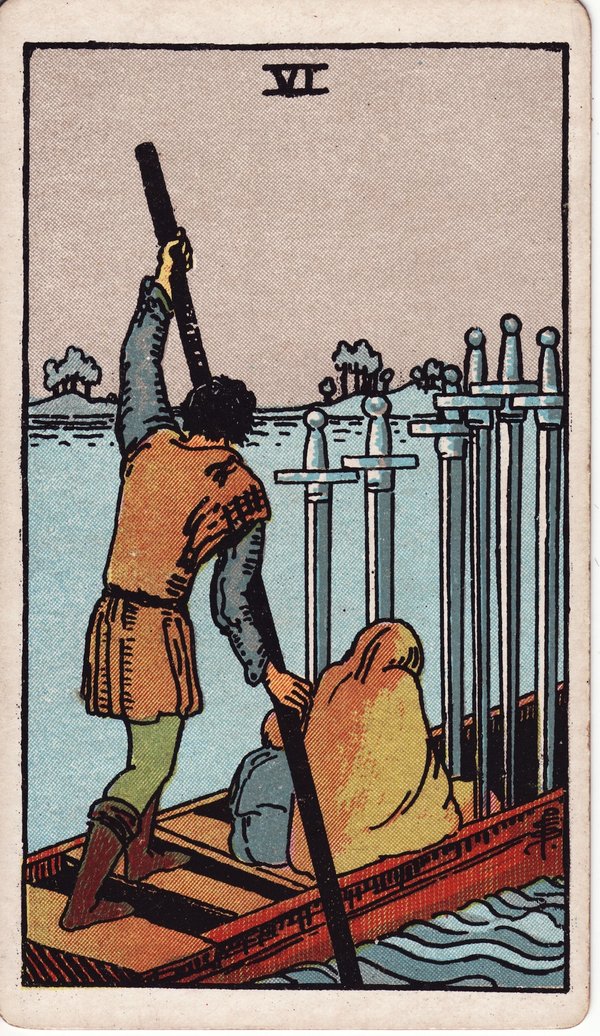
The Six of Swords is the card of necessary passage — the journey from rough water to calm, from what was to what will be. In the RWS image, a ferryman poles a boat carrying a cloaked woman and child across a body of water. Six swords stand embedded in the hull. Behind them, the water is choppy and dark; ahead, the water is still. They are in the middle of the crossing, committed to the journey, with no way back to the near shore and no guarantee about the far one.
In a reading, the Six of Swords signals transition, movement, and the slow work of leaving behind what has been. It is not the dramatic leap of the Fool or the definitive ending of Death — it is quieter, sadder, more mundane. It is the morning after the breakup when you pack your things. It is the flight to a new city after the job has ended. It is the walk away from the battlefield of the Five of Swords, carrying what remains.
The emotional register of this card is melancholy but not despairing. The figures in the boat are huddled, cloaked, perhaps grieving — but they are moving. The ferryman is doing his work. The swords are carried, not wielded; they are cargo now, not weapons. The worst is behind, or at least the worst of this phase. What lies ahead is unknown, but it is not what lies behind. Sometimes that is enough.
Symbolism & Imagery
Rider-Waite-Smith (1909): A ferryman poles a flat-bottomed boat from right to left across a body of water. In the boat sit a woman and a child, both cloaked and hooded, their faces hidden. Six swords stand embedded upright in the hull — they do not threaten the passengers; they are being transported, carried from one shore to another. The water on the right (the near shore, the past) is rough and dark. The water on the left (the far shore, the future) is calm and glassy. The sky is grey but lightening.
Every element of the image speaks to transition. The swords are not in use — they are cargo, the mental material being carried forward. The woman and child represent the vulnerable self and its future (the child as potential, as what is being protected and carried). The ferryman is the agent of passage — the part of the self that handles logistics, that does what must be done even when the heart is not in it. The direction of travel (toward the left, the side of the receptive, the unconscious) suggests a movement inward as much as outward — a psychological passage as much as a physical one.
The embedded swords are the card's quietest detail and its most important. They are six — Tiphareth's number — and they are not removed from the boat. The past is being carried forward. The question is not whether to bring it (you must; the boat needs the ballast) but how to carry it so that it does not sink you.
Thoth (Crowley/Harris, 1944): The Thoth Six of Swords — Lord of Science — replaces the narrative scene with six swords arranged in a geometric pattern of balanced intersection, at the center of which is a rose of five petals (Tiphareth's rose). The composition is mathematical, precise, almost scientific. Mercury in Aquarius is rendered visible as pure analytical intelligence — the mind that studies the passage, that navigates by understanding. The swords form a cross within a circle — the Rose Cross, the symbol of synthesis, the marriage of intellect and spirit that Tiphareth represents.
The Thoth version emphasizes the mental dimension of transition: the passage is not merely physical or emotional but intellectual. The mind is reorganizing itself. The defeat of the Five has been processed into understanding. The Lord of Science is the one who learns from the journey.
Astrological & Elemental Layer
Mercury in Aquarius. Mercury is the planet of thought, communication, travel, and analysis. In Aquarius — the sign of innovation, detachment, and the collective mind — Mercury operates with extraordinary clarity and precision. This is the astrological signature of scientific insight, of the mind that can step back from emotional investment and see the pattern. The second decan of Aquarius (approximately January 30 through February 8) is Mercury's own decan in some systems, doubling the Mercurial quality.
In the Six of Swords, Mercury in Aquarius provides the capacity to navigate transition with intelligence rather than pure emotion. The mind can study its own passage — can map the journey, understand what is being left and why, and steer toward the calmer shore with something like objectivity. This is not coldness; it is the gift of perspective. The pain is real, but it is not the whole story. Mercury in Aquarius can see the whole story.
The decan's association with scientific discovery also points to the card's deeper meaning: The Six of Swords is about both moving on and understanding what you are moving on from. The journey is a research expedition into the self.
Kabbalistic / Tree of Life Layer
The Six of Swords sits in Tiphareth — the central Sephirah on the Tree of Life, the sphere of beauty, harmony, and consciousness. Tiphareth is the heart of the tree, the reconciling point where the Pillar of Mercy (Chesed) and the Pillar of Severity (Geburah) meet. It is the Christ-center, the sacrificed and reborn god, the consciousness that integrates suffering into meaning.
In the Swords suit, Tiphareth is the mind's moment of equilibrium after the crisis of Geburah (the Five). The defeat has been absorbed. The mind has passed through severity and arrived at understanding — not the forced rest of the Four (Chesed) but the genuine peace that comes from having weathered the storm. The six swords are no longer weapons; they are navigational instruments, balanced in the boat, pointed toward the future.
For the querent, the Kabbalistic layer suggests: the passage you are making is not escape. It is Tiphareth's work — the integration of painful experience into a larger pattern of meaning. You are not leaving the past behind; you are carrying it forward in a new form. The far shore is not the promised land; it is simply the next place. But the journey itself is sacred, and the consciousness with which you make it is what transforms passage into pilgrimage.
Sequential Narrative: Position in the Suit Story
The Six of Swords follows the Five of Swords — the battlefield, the pyrrhic victory, the hollow triumph. The Five is the crisis that makes the Six necessary. You cannot stay on the battlefield; there is nothing left to fight for, and no one left to fight with. The only option is to get in the boat and leave.
The Six flows into the Seven of Swords — the Lord of Futility, the card of cunning, deception, and strategic withdrawal. The new territory that the Six reaches is not necessarily safe. The challenges of the far shore will require new skills — the stealth of the Seven, the ability to navigate without full transparency. The Six is the passage; the Seven is what happens after arrival. The transition is not the end of the story.
The arc from Five through Six to Seven is one of the most narratively coherent sequences in the suit: defeat → passage → the complications of the new world. The Six is the bridge — the liminal space between what was destroyed and what will be built.
Advising For / Advising Against
-
If advising FOR: Get in the boat. The water behind you is too rough to stay, and the water ahead, however uncertain, is calmer. You do not need to know where you are going — you need to know that you cannot stay where you are. Bring what matters. Leave what you can. The journey itself is the medicine. Trust the ferryman — the part of you that handles logistics, that puts one foot in front of the other even when the heart is heavy. You are moving. That is enough.
-
If advising AGAINST: You are leaving too soon, or you are leaving for the wrong reasons. Not every rough water demands a boat. Sometimes the passage is flight — avoidance dressed as transition — and the far shore will not solve what the near shore could have addressed. Ask yourself: am I moving toward something, or running from something? Am I carrying what needs to be carried, or abandoning what I should have stayed to repair?
Card of the Day
Today calls for mindful passage. Something is being released — let it. You may be moving through something that feels unresolved, but forward movement is the medicine. Be gentle with yourself and with others in the middle of their own crossings. The ferry does not ask whether you are ready. It asks whether you will board.
Elemental Dignities Notes
- Strengthened by Fire (Wands): Fire supports Air — passion gives the journey purpose and momentum. The boat moves faster. Risk: the passage becomes urgent, rushed, the destination chosen impulsively.
- Strengthened by Air (Swords): Multiple Air cards intellectualize the journey — the mind studies its own passage, maps it, analyzes it. This can be clarifying or can prevent the emotional processing the journey requires.
- Weakened by Earth (Pentacles): Earth grounds the transition in practical concerns — the cost of moving, the logistics of relocation, the weight of material baggage. This can delay or complicate the passage.
- Neutral with Water (Cups): Water supports the emotional dimension of the journey — grief, hope, the feeling of passage. The boat moves through feeling rather than despite it.
Deck-Specific Notes
- If using a Thoth deck: The Lord of Science presents geometric swords around a central rose — Tiphareth's rose, the symbol of integrated consciousness. The emphasis is on intellectual clarity earned through passage: the mind that navigates by understanding. The "science" is not laboratory science but the science of the self — systematic self-knowledge gained through the discipline of transition.
- If using a Marseille-tradition deck: The Six of Swords in the Marseille tradition shows six curved blades forming a tight lattice — a structure of careful collaboration. The emphasis is on the constructed nature of the passage: the journey requires intentional arrangement, the cooperation of multiple mental faculties.
- If using a blended or contemporary deck: The psychological layer of transition, passage, and gradual healing applies across traditions. Some decks emphasize the sadness of the journey, others the hope of the far shore. The core meaning persists: you are moving from rough water to calm.
Journaling & Contemplation Prompts
- What am I carrying from the past that I need — and what am I carrying that is sinking the boat?
- Where in my life am I in passage — between what was and what will be?
- Is my journey toward something, or away from something? Does the distinction matter?
- What would the far shore look like if I could imagine it clearly?
- Who or what is the ferryman in my life right now — the force that is moving me even when I feel passive?
Additional Associations
| Association Type | Value |
|---|---|
| Color(s) | Blue-grey (the water, the sky of passage); gold (Tiphareth's color, the sun that breaks through clouds); pale green (the far shore, the promise of new growth) |
| Crystals / Stones | Aquamarine (the stone of sea travel, calm passage, emotional clarity); Citrine (Tiphareth's stone, the sun's light, hope in transition); Moonstone (the journey by water, the reflective passage) |
| Herbs / Plants | Mugwort (the traveler's herb, protection during journeys, dreaming the destination); Comfrey (knit-bone, the herb of healing, the repair of what was broken); Willow (the tree of water and grief, the graceful bending without breaking) |
| Archetypes (Jungian) | The Refugee (involuntary passage, the journey not chosen); The Pilgrim (sacred passage, the journey as devotion); Charon the Ferryman (the psychopomp, the guide across thresholds) |
| Mythological Figures | Odysseus (the long journey home, the passage through many trials); Inanna returning from the underworld (the passage back to life after death); Moses leading through the Red Sea (passage that is also liberation) |
| Numerological Resonance | 6 = harmony, the hexagram, the balanced triangle pointing up and down. In Swords, 6 is the mind's equilibrium after the disruption of 5 — the peace that is earned through passage. Tiphareth's number, the number of the heart of the tree. |
| Playing Card Equivalent | Six of Spades — in cartomancy, a journey over water, a change of scene, gradual improvement. Sometimes: a letter from afar, news that changes plans. |
| I Ching Hexagram Parallel | Hexagram 56 — Lu / The Wanderer. "The Wanderer. Success through smallness. Perseverance brings good fortune to the wanderer." The hexagram of the stranger in a strange land, the traveler who must adapt, the one who finds home in movement itself. |
| Body / Organ Correspondence | The feet (the parts that carry you forward, the step into the boat); the inner ear (balance, equilibrium, the organ of passage through changing environments); the legs (the propulsion of the ferryman's pole, the steady rhythm of forward motion) |
Shadow & Integration Message
The Six of Swords' shadow is the journey that never ends — the perpetual passage, the refusal to arrive. The person who is always "in transition," always "moving on," never landing anywhere long enough to build. This is the shadow of Mercury in Aquarius: the mind that is so comfortable with movement that it has forgotten how to rest, the traveler who has confused the journey with the destination and forgotten that both matter.
Integration of the Six's energy means making the passage — fully, honestly — and then arriving. It means knowing when the far shore has been reached and it is time to step out of the boat. The integrated Six of Swords is the one who can move through grief into new life, who carries the past without being defined by it, who crosses the water and plants a flag on the other side.
Elemental Intelligence (Suit Framing)
In the Jungian cognitive function mapping, the Six of Swords is the Thinking function in its most adaptive mode — the mind that can process change, that can navigate transition with intelligence and perspective. The sanguine humour is returning after the severity of the Five: the natural buoyancy of Air reasserts itself as the journey progresses. This is the mind as navigator, the intellect as compass, the consciousness that can hold the grief of the past and the hope of the future in the same boat.
Timing & Manifestation
For timing, the Six of Swords suggests a period of weeks to months — the duration of a meaningful journey, the time it takes to cross from one state to another. The second decan of Aquarius corresponds approximately to January 30 through February 8. The transition is already underway; the question is not when it will begin but when the far shore will be reached. The passage cannot be rushed, only navigated.
Yes / No Tendency
The Six of Swords leans toward a qualified yes — yes, improvement is coming; yes, you will reach calmer water; yes, the transition is possible. But the yes is conditional on the journey being made. In undignified position, the yes is delayed or refused — the boat is stuck in the harbor, or you are trying to travel with too much baggage.
Common Misreads / Nuances to Know
Misread 1: "The Six of Swords means everything will be fine now." The Six is a card of transition, not resolution. The far shore is calmer but not necessarily safe. The journey is medicine, but it is not a cure. The card promises movement, not arrival.
Misread 2: "Leave everything behind." The swords are in the boat. The past is carried forward. The Six asks you to transport what matters and release what doesn't — not to abandon your history but to carry it differently.
Misread 3: "The journey is passive — you're being ferried." The ferryman is poling the boat. Action is being taken, even if it is quiet, steady, unglamorous action. The Six is not about waiting to be rescued; it is about cooperating with the force that is already moving you.