The Poetic Line
"He holds the spoils. The field is empty. Victory alone does not warm the victor."
Keywords
| Category | Dignified | Undignified |
|---|---|---|
| General | Conflict, defeat, winning at a cost, standing your ground, strategic withdrawal, pyrrhic victory | Bullying, gloating, dishonorable tactics, scorched-earth victory, humiliation, refusing to lose gracefully |
| Spiritual | The dark night of the ego, necessary humbling, the pride that must be broken for growth | Spiritual arrogance, using belief as a weapon, the crusader who has forgotten the sacred |
| Psychological | Recognizing toxic patterns, confronting what must be released, the ego's defeat as liberation | Bullying mentality, narcissistic wounding, refusing to admit error, intellectual intimidation |
| Physical Health | The body signaling limits, stress-induced crisis forcing rest, the health scare that changes behavior | Self-destructive behavior, ignoring body's warnings until crisis, the cost of winning arguments on the body |
| Relationships | Necessary ending of a toxic dynamic, walking away from unwinnable conflict, choosing peace over being right | Emotional abuse, winning arguments at the cost of connection, humiliation, the relationship as battleground |
| Financial | Cutting losses, recognizing a bad investment, the defeat that protects further loss | Financial bullying, winning a settlement at the cost of reputation, destructive competition |
| Vocational | Leaving a hostile workplace, learning from professional defeat, the career loss that redirects | Office politics as warfare, sabotaging colleagues, the victory that makes enemies of everyone |
| Shadow / Thoth Distinction | The Lord of Defeat: Venus in Aquarius's gift of detached assessment — the ability to see where an intellectual position has failed and to release it without self-destruction | Venus in Aquarius shadow: the cold victory, the ideal detached from humanity, winning the argument by destroying the person |
Narrative Description
General Meaning
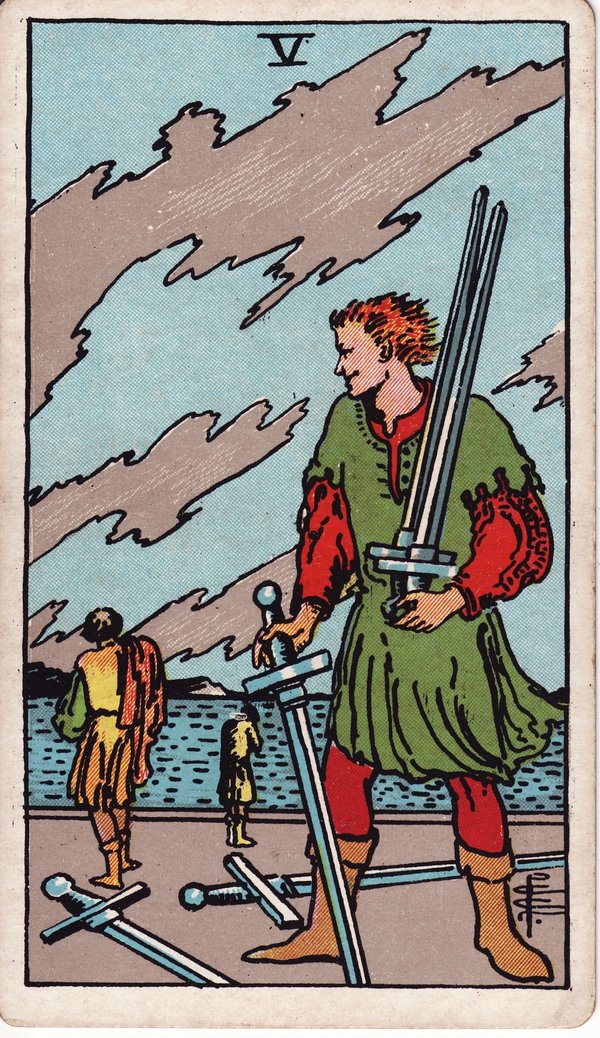
The Five of Swords is the card of conflict that has been resolved — but at what cost? In the RWS image, a smirking figure gathers up three swords while two defeated opponents walk away, shoulders slumped. The sky is grey and turbulent. The victor has won, but the field is empty. The question — not "who won?" but "was it worth it?" — hangs over the scene.
When the Five of Swords appears, someone has won at someone's expense. Victory through domination. Conflict that leaves everyone smaller. The argument you won that cost you the relationship. The workplace battle that secured your position and made you enemies. The intellectual victory that left you isolated.
But the Five of Swords is not always about being the aggressor. Sometimes the querent is one of the defeated figures — the one who lost and is walking away, humiliated but intact. In either position, the card's message is the same: this is not the end of the story. The Five is Geburah's severity — a necessary crisis that clears the ground for what comes next. The defeat, whether dealt or received, is a teacher. The question is whether you will learn or whether you will simply nurse the wound.
Symbolism & Imagery
Rider-Waite-Smith (1909): The foreground figure stands with a smirk — not the smile of satisfaction but the smirk of gloating. He holds three swords: two in one hand, one in the other. Two more swords lie on the ground. In the background, two figures walk away, their backs turned, their postures communicating defeat and humiliation. One covers his face. The sky is ragged with clouds; the wind is up. The whole scene is desolate.
The five swords represent the destabilization of the Four's ordered rest. The square has been broken; the containment has failed. The number 5, Geburah's number, brings the conflict that the Four held at bay. The smirking victor has won the swords — but at the cost of community. His victory is solitary. No one remains to celebrate with him.
The two defeated figures are often overlooked in readings that focus on the victor. They are equally important: they represent the part of the self that has been humiliated, the relationships that have been sacrificed, the inner figures that walk away when the ego insists on winning at all costs. The card asks: which figure are you? And whichever you are — what have you learned?
Thoth (Crowley/Harris, 1944): The Thoth Five of Swords — Lord of Defeat — presents five swords in a disrupted geometric pattern. The symmetry of the Four has been broken; the swords tilt and clash at irregular angles. The composition conveys intellectual crisis — the beautiful theory that has been destroyed by an ugly fact. Crowley framed this as a necessary stage: the defeat of a false hypothesis is the prerequisite for a truer understanding. Venus in Aquarius suggests that the defeat, while painful, is ultimately clarifying — the ideal that couldn't survive the test should not have been held.
Astrological & Elemental Layer
Venus in Aquarius. Venus is the planet of love, harmony, values, and attraction. In Aquarius — the sign of detachment, innovation, and intellectual independence — Venus operates with a certain coolness. The combination is paradoxical: the planet of connection in the sign of distance. This is the astrological signature of the Five of Swords' central tension: the desire to connect (Venus) expressed through the medium of intellectual superiority or detachment (Aquarius).
The first decan of Aquarius (approximately January 20 through January 29) is the decan of initiation — the Aquarian energy is just beginning to manifest. Ideas are fresh, intense, and uncompromising. Venus here can become the love of being right, the attachment to one's own ideas at the expense of others'. The card's challenge is to separate the value of the idea from the ego's investment in it.
Kabbalistic / Tree of Life Layer
The Five of Swords sits in Geburah — the fifth Sephirah, Severity, the sphere of judgment, discipline, and necessary destruction. Geburah is the surgeon: it cuts away what is diseased, nonviable, or false. On the Tree of Life, it balances Chesed (the Four's mercy) with the hard question: what must be released?
In the Swords suit, Geburah is the intellectual crisis — the moment when a belief, a position, or a mental construct is tested against reality and fails. This is not pleasant. The mind that has identified with its ideas (the Four's restful consolidation) now faces the destruction of those ideas. But Geburah's severity is never arbitrary — it cuts only what cannot survive. The Lord of Defeat is also, paradoxically, the Lord of Purification. What is defeated is what needed to be defeated. The defeat clears space for something truer.
For the querent, the Kabbalistic layer suggests: the loss you are experiencing — whether it is an argument lost, a position abandoned, or a relationship severed by conflict — may be Geburah's surgery. Ask not "how do I win this?" but "what is being cut away, and what remains?"
Sequential Narrative: Position in the Suit Story
The Five of Swords follows the Four of Swords — the knight's rest, the truce, the strategic withdrawal. The truce is over. The knight has risen from the tomb, and the battle has resumed — but now with higher stakes. The Four asked: have you rested enough? The Five answers: it doesn't matter — the fight is here anyway.
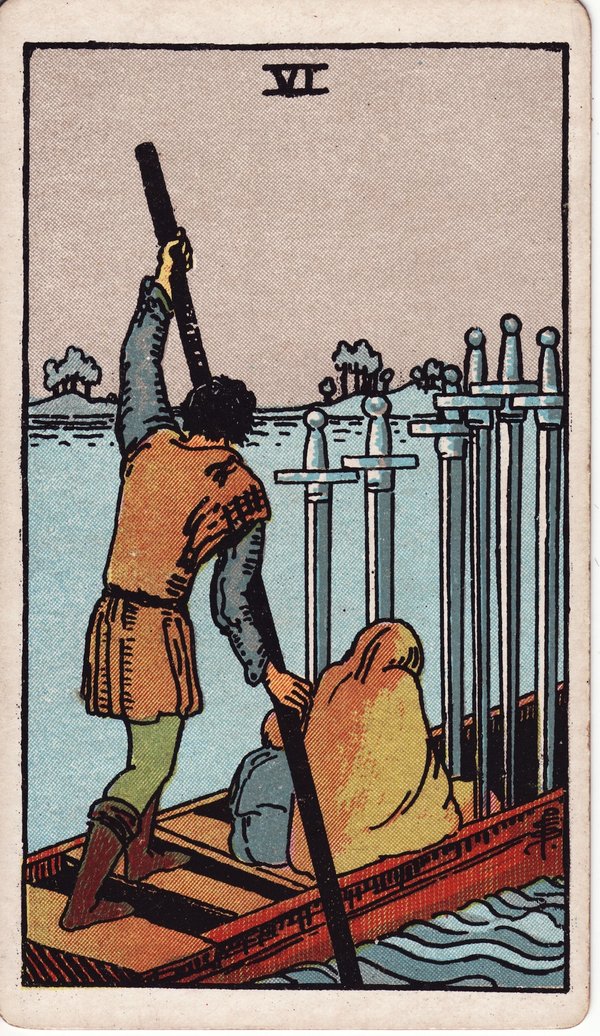
The Five flows into the Six of Swords — the Lord of Science, the card of transition across troubled waters. The defeat of the Five is the event that makes the Six necessary. You cannot stay on the battlefield; there is nothing left to fight for. The only option is to get in the boat, gather what remains, and move toward calmer waters. The Five is the crisis; the Six is the response. Together, they form the suit's central arc: conflict → aftermath → passage.
Advising For / Advising Against
-
If advising FOR: Sometimes you have to fight. Sometimes winning matters — not for the ego but for the principle, the boundary, the truth. The Five of Swords in its advising-for position says: stand your ground. Accept that this victory may cost you — relationships, comfort, the good opinion of others — and decide whether the cost is worth it. If it is, fight clean. Win with as much grace as the situation allows. And do not gloat.
-
If advising AGAINST: You are winning an argument and losing a relationship. You are proving your point and alienating everyone who might have listened. The victory you are pursuing is pyrrhic — by the time you hold the swords, the field will be empty. Ask yourself: what do I actually want? To be right, or to be connected? To win, or to be whole? Put down the sword. Walk away. Some battles are not worth fighting, and some victories are just defeats in disguise.
Card of the Day
Conflict may find you today — an argument, a power struggle, a situation where not everyone can win. Before you engage, ask yourself what the victory would actually cost. If you fight, fight clean. If you walk away, do it without resentment. Either way, the question is: what kind of winner — or loser — are you willing to be?
Elemental Dignities Notes
- Strengthened by Fire (Wands): Fire intensifies the conflict — the battle becomes more passionate, more volatile. The victory or defeat cuts deeper. The combination can be creative (fire forges) or destructive (fire consumes).
- Strengthened by Air (Swords): Multiple Air cards sharpen the intellectual dimension — the conflict becomes a battle of ideas, words, and positions. Risk: the fight becomes abstract, depersonalized, crueler for its detachment.
- Weakened by Earth (Pentacles): Earth may ground the conflict in practical consequences — the material cost of winning becomes visible. This can either restrain the querent or intensify their desperation.
- Neutral with Water (Cups): Water brings emotions to the surface — the hurt behind the argument, the grief beneath the gloating. This can humanize the conflict or flood it with additional complexity.
Deck-Specific Notes
- If using a Thoth deck: The Lord of Defeat appears as disrupted geometry — the intellectual crisis of a failed hypothesis. The Thoth framing emphasizes defeat as a necessary stage of learning: the idea that cannot survive testing should not survive. Venus in Aquarius adds the layer of values tested against ideals.
- If using a Marseille-tradition deck: The Five of Swords shows a central sword cutting through the protective enclosure of the Four. The growth that was nurtured in the Four's rest is destroyed. The Marseille tradition emphasizes the consequence of a decision — the Five as the result of the Four's choice to rise from rest.
- If using a blended or contemporary deck: The psychological layer of conflict, victory, and cost applies across traditions. Some decks soften the gloating victor; others intensify the desolation. The core meaning persists: what does winning cost?
Journaling & Contemplation Prompts
- When have I won an argument and later wished I hadn't?
- What am I fighting for that, if I won, would leave me alone?
- Am I the victor, the defeated, or both in different areas of my life?
- What belief or position am I defending that may need to be defeated for me to grow?
- How do I behave when I win? What does that say about my character?
Additional Associations
| Association Type | Value |
|---|---|
| Color(s) | Grey (the sky of conflict, moral ambiguity); red-orange (Geburah's color, severity, the fire of judgment); dark blue (the turbulent sky of Aquarius) |
| Crystals / Stones | Hematite (grounding during conflict, the stone of the warrior); Ruby (Geburah's stone, the fire of righteous action); Black Tourmaline (protection from psychic attack, the stone of boundaries) |
| Herbs / Plants | Nettle (the sting of necessary confrontation, the herb that protects as it wounds); Thistle (defensiveness, the prickly boundary); Garlic (protection, the warrior's herb) |
| Archetypes (Jungian) | The Bully; The Warrior (shadow form — the warrior who fights for ego rather than principle); The Scapegoat (the defeated figure, the one who carries the collective shadow) |
| Mythological Figures | Achilles (the victorious warrior whose pride isolates him); Icarus (the defeat that follows hubris); The Prodigal Son's brother (the one who stayed and resented — a different kind of Five of Swords defeat) |
| Numerological Resonance | 5 = instability, disruption, the pentagram. In Swords, 5 is the intellectual crisis — the mind's encounter with its own limits. Geburah's severity breaks what Chesed built, but only to clear ground for Tiphareth's harmony (the Six). |
| Playing Card Equivalent | Five of Spades — in cartomancy, a quarrel, a defeat, a loss. Sometimes: a legal battle, an argument that changes alliances. |
| I Ching Hexagram Parallel | Hexagram 6 — Sung / Conflict. "Conflict. You are sincere and are being obstructed. A cautious halt halfway brings good fortune. Going through to the end brings misfortune." The hexagram of litigation, of the argument that is better abandoned than pursued to conclusion. |
| Body / Organ Correspondence | Adrenal glands (the fight-or-flight response, the body in conflict); the solar plexus (the seat of power, the gut that knows when a fight is wrong); the voice (the instrument of argument, the weapon of words) |
Shadow & Integration Message
The Five of Swords' shadow is the addiction to winning — the ego that needs to be right at any cost, the personality that has confused domination with strength. This is the shadow of Geburah: severity without mercy, judgment without wisdom, the sword that cuts indiscriminately because cutting feels powerful.
Integration of the Five's energy means learning to fight for what matters and release what doesn't. It means being able to lose without being destroyed, and to win without destroying others. The integrated Five of Swords is the person who can enter conflict with clarity about what is at stake, fight with integrity, and walk away — whether victorious or defeated — with their humanity intact.
Elemental Intelligence (Suit Framing)
In the Jungian cognitive function mapping, the Five of Swords is the Thinking function in crisis — the mind that has become adversarial, the intellect that has turned every conversation into a debate and every relationship into a competition. The sanguine humour is corrupted here into intellectual arrogance — the bright optimism of Air twisted into the certainty of being right. This is the scholar as polemicist, the thinker as bully, the mind that has forgotten that truth is discovered, not imposed.
Timing & Manifestation
For timing, the Five of Swords suggests a sudden crisis that resolves quickly but leaves lasting consequences. The first decan of Aquarius corresponds approximately to January 20 through January 29. The conflict is already present or imminent; its resolution comes not through patience but through the crisis itself — the defeat that clears the field.
Yes / No Tendency
The Five of Swords leans toward no — but a qualified no. The outcome you seek may be achieved, but at a cost that makes the victory hollow. In questions of conflict, the question becomes: is this battle worth winning? In dignified position, the no may be protective — the defeat that saves you from a worse entanglement. In undignified position, the no is bitter: you will win, and you will regret it.
Common Misreads / Nuances to Know
Misread 1: "The Five of Swords means you will be defeated." The card can indicate victory as often as defeat — but the victory is problematic, and the defeat is clarifying. The card's focus is not on the outcome but on the cost. Who are you becoming in this conflict?
Misread 2: "Walk away from every fight." The Five of Swords does not uniformly counsel avoidance. Some battles must be fought. The card asks you to choose your battles with consciousness, not to abandon the field entirely.
Misread 3: "Geburah is punishment." Geburah is severity, not cruelty. The defeat of the Five is a correction, not a punishment — the destruction of what cannot survive so that what is truer can take its place.