The Poetic Line
"Your grip has become the cage — and the key is already in your hand, if you could only uncurl your fingers."
Keywords
| Category | Dignified | Undignified |
|---|---|---|
| General | Security, conservation, saving, prudent boundaries, holding ground, wise stewardship | Hoarding, miserliness, fear-driven control, stagnation, clutching, refusal to share or release |
| Spiritual | Sacred containment, honoring what has been given, the discipline of gratitude, spiritual boundaries | Spiritual miserliness, refusing to share wisdom or gifts, mistaking accumulation for abundance, the closed heart that calls itself protected |
| Psychological | Self-possession, emotional regulation, groundedness, knowing what is yours and what is not, healthy attachment | Insecurity masked as control, fear of loss driving compulsive behavior, rigidity as defense against change, inability to trust |
| Physical Health | Body as temple, disciplined health maintenance, protective self-care, physical boundaries, stability of constitution | Tension from constant vigilance, digestive issues from holding on, armoring that becomes illness, neglect of flexibility for the sake of "safety" |
| Relationships | Loyalty, commitment, protecting the relationship, guarding intimacy, emotional fidelity | Possessiveness, jealousy, controlling a partner, withholding affection as power, treating people as property |
| Financial | Saving, investing conservatively, building reserves, financial planning, living within means | Greed, refusal to spend when spending is needed, penny-wise pound-foolish, financial paranoia, the poverty mentality of the rich |
| Vocational | Protecting resources, maintaining standards, preserving institutional knowledge, steady reliable work | Territoriality, refusing to delegate, hoarding information, the bureaucrat who protects process at the expense of purpose |
| Shadow / Thoth Distinction | Power held in trust, the strength to protect without possessing, Sun in Capricorn — the vitality that builds enduring structures | Power wielded as possession, the fortress that becomes a tomb, solar radiance trapped behind walls — the king who dies on his throne surrounded by gold he never spent |
Narrative Description
General Meaning
The Four of Pentacles is the card of holding on — the instinct to protect, preserve, and secure what has been earned. After the expansive collaborative energy of the Three of Pentacles (the apprentice, the guild, the shared creation), the Four arrives as a necessary consolidation: what has been built must now be defended, what has been earned must now be stewarded. This is not greed — not yet. It is the primal and legitimate impulse to hold what is precious against a world that takes.
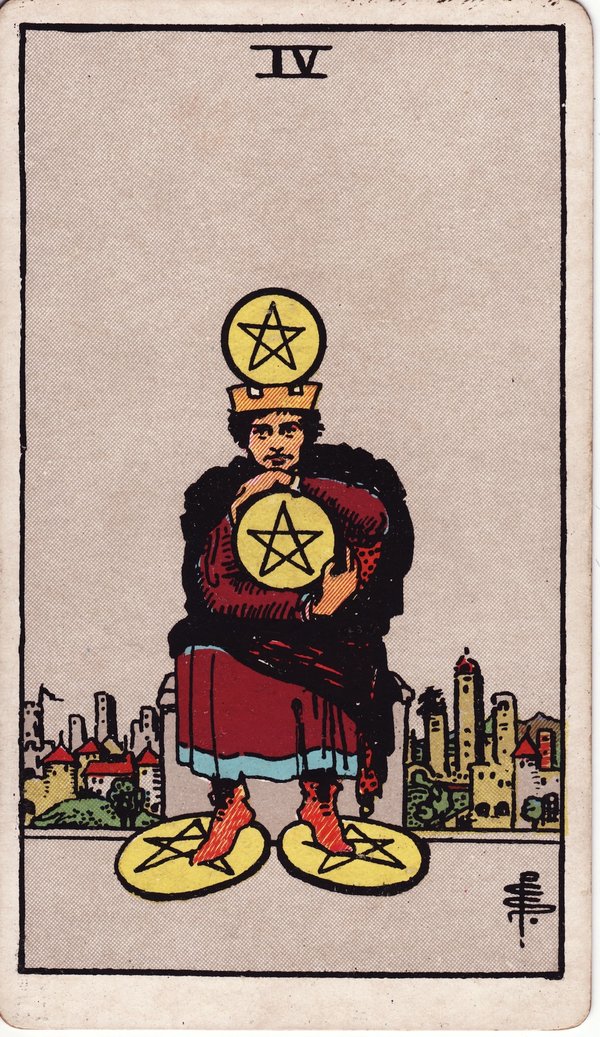
The figure in the RWS card embodies this energy with uncomfortable precision: a crowned man clutching a pentacle to his chest, another balanced on his head, two more beneath his feet. He is surrounded by his wealth, anchored to it, defined by it — and yet the image is not triumphant. There is something pinched in his posture, something worried in his grip. He has achieved security, but at what cost to his freedom? He is protected, but is he alive?
In a reading, the Four of Pentacles often appears when the question of boundaries, resources, or attachment is central. It may celebrate the wisdom of saving, the discipline of conservation, the maturity of protecting what matters. It may also issue a warning: your grip has become a cage. What you are protecting may be protecting you from life itself.
The astrological layer deepens the card's meaning. The Sun in Capricorn — the life-force (Sun) expressing through the sign of structure, ambition, and material mastery (Capricorn) — suggests that there is genuine vitality in building and maintaining. This is not dead accumulation; it is the Sun's warmth given form. But the third decan of Capricorn, ruled by Saturn in the Chaldean system, adds a note of severity: structure can become rigidity, and the walls we build to keep danger out can also keep life out. The Lord of Power may rule a kingdom — or a prison.
Symbolism & Imagery
Rider-Waite-Smith (1909): The RWS Four of Pentacles depicts a crowned figure seated on a simple block or throne, isolated against a dark background. He holds one pentacle pressed tightly to his chest — closest to his heart, the thing he most protects. A second pentacle is balanced on his head, suggesting that his thoughts are consumed by his possessions, that his crown of authority is indistinguishable from his wealth. Two more pentacles are positioned beneath his feet, rooting him to the material world, anchoring him — and also immobilizing him. He cannot walk without stepping away from what he owns.
Behind him, in the far distance, a city is visible — community, commerce, connection — but he faces away from it. He is self-contained, self-concerned, turned inward toward his holdings. The sky is dark, the atmosphere heavy. This is not the joyful security of the Ten of Pentacles (the family, the inheritance, the village) but the isolated security of the one who trusts only what can be held.
His clothing is rich — red robes, blue tunic — suggesting status and accomplishment. He has earned what he clutches. The tragedy is not that he has nothing but that what he has has become an obstacle to having more: more connection, more life, more love.
Thoth (Crowley/Harris, 1944): The Thoth Four of Disks (Pentacles) is titled Lord of Power and presents a very different visual world. Here, four disks are arranged in a square, each containing a tower or fortress — the four towers of the material world, the citadels of earthly power. The disks are connected by lines of force, forming a stable, defended structure. The color palette is earthy — browns, ochres, deep greens — with gold accents that convey the warmth of the Sun in Capricorn: power that is not cold but generative, the life-force channeled into durable form.
The Thoth card emphasizes structure over possession. Where the RWS card focuses on the psychological state of the person who holds, the Thoth card focuses on the system of holding itself — the fortress, the treasury, the architecture of power. The question shifts from "What are you clutching?" to "What have you built, and who does it serve?"
The key difference between traditions: RWS emphasizes the inner experience of the Four — the anxiety, the isolation, the grip. Thoth emphasizes the outer manifestation — the power structure, the defended position, the material achievement that demands recognition. Both are true: the Four of Pentacles is simultaneously the feeling of clutching and the fact of being fortified.
Astrological & Elemental Layer
The Four of Pentacles is astrologically attributed to the Sun in Capricorn — specifically the third decan of Capricorn, approximately January 10–19 in the solar calendar. This is one of the more potent and revealing attributions in the minor arcana, because the Sun and Capricorn are in a certain productive tension.
The Sun is the source of life, vitality, radiance, and generosity. It gives without counting, shines without discriminating, warms without asking permission. Capricorn is the sign of structure, ambition, material achievement, and the long, slow climb. It is the architect, the builder, the strategist who plays the long game — and it is also the sign most associated with worldly status, reputation, and the fear of losing what has been earned.
When the Sun enters Capricorn, the life-force is channeled into structure. This can be magnificent: the solar vitality becomes the energy that builds civilizations, that turns vision into institution, that makes the dream durable. But it can also be constricting: the Sun's warmth, trapped inside Capricorn's walls, becomes a kind of pressure — the pressure to achieve, to secure, to hold. The generosity of the Sun can curdle into the miserliness of the hoarder who has forgotten that the Sun itself gives freely.
The third decan of Capricorn is ruled by Saturn in the Chaldean decan system — adding a double dose of Saturnine energy (Capricorn is already ruled by Saturn) to the Sun's placement. This is the decan of maximal structure: the walls are thickest here, the defenses most complete. The Sun in this decan is the vitality of the old king who has built his fortress and now must ask: am I protecting my treasure, or am I entombing myself with it?
In elemental terms, the Four of Pentacles is Earth in its most concentrated, defended expression — Earth at the point where its virtues (stability, security, patience) begin to become its vices (rigidity, fear of change, the refusal to flow). The Chesed influence should temper this (Chesed is mercy, generosity, loving-kindness), and in the dignified reading, it does: the Four as wise stewardship, the protector who holds in trust. But when Chesed's generosity is blocked, the Four becomes the miser, the hoarder, the one who has forgotten that Earth's purpose is not to hold but to nurture.
Kabbalistic / Tree of Life Layer
The Four of Pentacles sits in Chesed, the fourth Sephirah on the Tree of Life — the sphere of Mercy, Loving-kindness, and Benevolent Order. Chesed is the first Sephirah below the Abyss (the great division between the purely divine and the manifest), and it represents the first stable container for the creative force that has descended from Kether through Chokmah and Binah.
Chesed's essential quality is expansion through structure — the ruler who builds a kingdom not for personal aggrandizement but so that the kingdom's people may flourish. In its highest expression, Chesed is the open hand, the generous father, the ruler who gives. In its lowest (the Qliphothic distortion), Chesed becomes the tyrant who has forgotten that power is a trust, not a possession.
In the suit of Pentacles (Assiah — the material world of action and manifestation), Chesed's energy expresses as material security and worldly power. The Four of Pentacles is Chesed in its most physically concrete form: the treasury, the storehouse, the savings account, the body's reserves of health and energy. The question the card poses is whether this Chesed energy is flowing (generosity through structure) or frozen (structure that strangles generosity).
The path that flows into Chesed from Chokmah carries the raw wisdom of the beginning — the first idea, the seed of manifestation. The Four of Pentacles, when dignified, honors this lineage by protecting the seed until it can grow. When undignified, it hoards the seed and refuses to plant it, mistaking the potential for the fulfillment.
For the querent, the Kabbalistic layer asks: Is what you are holding being held in trust, or has trust become fear? Is your security enabling generosity, or has security become an end in itself? The Chesed principle is fundamentally generous — and the Four of Pentacles, in its truest form, is the protector who protects so that others may receive.
Sequential Narrative: Position in the Suit Story
The suit of Pentacles tells the story of material manifestation — the journey from seed (Ace) to harvest and legacy (Ten), with each number representing a stage in the development of physical, financial, and embodied wisdom.
From the Three of Pentacles: The Three is the card of collaboration, apprenticeship, and shared creation — the cathedral being built by many hands, the guild at work, the project that requires diverse skills. The energy of the Three is expansive, outward-facing, communal. The Four emerges from the Three's completion: the work has been done, the creation exists, and now it must be protected. The transition from Three to Four is the transition from building to owning — and this is where the shadow of the Four is born. When the creator becomes the possessor, something is gained (security) and something is lost (the open, collaborative spirit that made the creation possible).
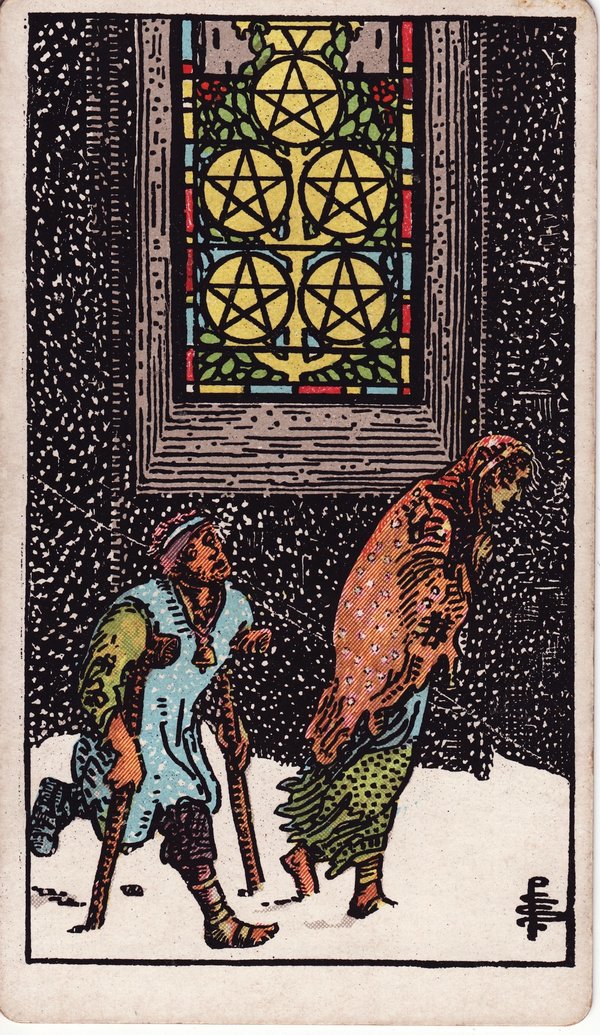
Toward the Five of Pentacles: The Five is the card of material crisis, poverty, and spiritual destitution — the figures freezing outside the church window. The Four's tight grip on its resources sets the stage for this crisis: the energy of holding has become so constricted that it generates its own opposite. What the Four refuses to share, the Five loses. What the Four walls out, the Five becomes — the outsider, the one who is cold while others are warm inside. The shadow of the Four is the direct parent of the suffering of the Five: hoarding creates scarcity, protection without generosity creates vulnerability. Yet the transition from Four to Five is not inevitable — the dignified Four, who holds as a steward rather than a miser, can avoid the Five's severity altogether.
The overall arc: Within the Pentacles journey, the Four occupies the critical inflection point between building and possessing. The Ace through Three are about bringing something into being. The Five through Seven are about the challenges of maintaining what has been built. The Eight through Ten are about mastery and legacy. The Four sits at the hinge: will what has been built become a gift or a cage?
Advising For / Advising Against
-
If advising FOR: Hold your ground. Not every battle is won by advancing — some are won by standing firm. The resources you have are real, and protecting them is wise. Save the money. Guard the boundary. Maintain the discipline. The Four of Pentacles counsels conservation, consolidation, and the quiet power of having reserves. Trust that there are seasons for holding and seasons for releasing, and this is a season for holding. Build the fortress. Stock the larder. Let your security become your platform for future generosity.
-
If advising AGAINST: Let go. Whatever you are clutching — money, control, a grudge, a person, an identity built on what you own — is costing you more than it is worth. The grip that was meant to protect has become a prison, and the only way out is to open your hands. The Four reversed warns: your fear of loss is creating the very stagnation you dread. Release something — not recklessly, but deliberately. Give something away. Take a risk. Trust that what is truly yours cannot be lost, and what can be lost was never meant to be held forever.
Card of the Day
Today, notice where you are holding on too tightly. Something in your life — a possession, a position, a pattern, a person — that you are gripping so hard your knuckles have gone white. Ask yourself: is this grip protecting something precious, or preventing something new from entering? The Four of Pentacles invites a single act of release today — not grand renunciation but a small, deliberate letting-go. Unclench one fist and see what flows into the space you create. Security is real, but so is the cost of never opening the door.
Card of the Year
Note: Year cards are calculated from Major Arcana numbers (0–21). This Minor Arcana card does not function as a primary year card. However, as a Personal Year Shadow Card, the Four of Pentacles may appear as a recurring theme within a larger year-card energy — particularly in years governed by The Emperor (IV), which shares the number 4, or The Hermit (IX), which echoes the Four's theme of withdrawal and conservation. In such a year, the Four of Pentacles manifests as: repeated lessons around attachment and release, financial situations that demand careful stewardship rather than bold risk, the slow work of learning that security is a means, not an end. The invitation is to examine where your grip has become a cage and to practice the generosity that the dignified Four makes possible.
Elemental Dignities Notes
The Four of Pentacles is Earth — the element of stability, materiality, the body, and the physical world. In a spread, its elemental relationship to neighboring cards follows the Golden Dawn system:
- Strengthened by Earth (Pentacles): Like element intensifies like element. Adjacent Pentacles cards deepen the Four's stability — what is being held becomes more solid, more permanent. But multiple Earth cards accumulated can become a landslide: the weight of security crushing the impulse to move.
- Strengthened by Water (Cups): Water supports Earth in the elemental system. Adjacent Cups cards soften the Four — the hoarder's grip loosens when love or emotional awareness enters the picture. Emotional security (Cups) supports material security (Pentacles) without the rigidity.
- Weakened by Air (Swords): Air and Earth are enemies in elemental dignity. Adjacent Swords cards challenge the Four's defenses — intellect cuts through the hoarder's rationalizations, analysis exposes the fear beneath the grip. This can be liberating or destabilizing, depending on the Four's dignity.
- Weakened by Fire (Wands): Fire and Earth are enemies in elemental dignity. Adjacent Wands cards burn against the Four's stasis — passion, initiative, and the impulse to act threaten the Four's careful preservation. The fire may destroy what the Earth has built, or it may warm the frozen ground back to fertility.
Deck-Specific Notes
-
If using a Thoth deck: The card appears as the Four of Disks, titled Lord of Power. The imagery emphasizes geometric structure and defensive architecture — four towers within four disks, connected by lines of force — rather than the psychological portrait of the clutching figure. The Thoth reading emphasizes power as a structure (the citadel, the treasury, the defended position) rather than power as a psychological state (anxiety, greed, the grip). The dignifying question of the Thoth card is: what have you built, and who does it protect?
-
If using a Marseille-tradition deck: In the Marseille tradition, the Four of Coins typically shows four coins arranged around a central emblem or flower, often with a formal, heraldic quality. The emphasis is on stability, order, and the containment of value within a structure — less psychological than RWS, less architectural than Thoth, more purely emblematic.
-
If using a blended or contemporary deck (e.g., Fountain Tarot, Wild Unknown, etc.): The psychological and astrological layers of this entry apply across visual traditions. The core archetype — the tension between protection and possession, security and stagnation — persists regardless of specific imagery. Consult your deck's guidebook for any departures from the RWS/Thoth framework.
Journaling & Contemplation Prompts
- What am I holding onto that I am afraid to lose — and what would actually happen if I lost it? What would become possible?
- Where in my life has security become an obstacle rather than a foundation? What have I stopped risking because I have too much to lose?
- If my resources were held in trust rather than in ownership — if they belonged to life, not to me — would I use them differently? How?
- What is the difference between saving wisely and hoarding fearfully? Where on that spectrum do my financial, emotional, and energetic habits fall?
- What have I been given that I am meant to give forward? What am I clutching that is meant to flow?
Additional Associations
| Association Type | Value |
|---|---|
| Color(s) | Deep red (Capricorn's ambition, the life-force of the Sun held in form); dark brown / ochre (Earth, stability, the material); gold (the pentacles themselves — wealth, value, the solar radiance contained); black (the isolating background, the void outside the fortress) |
| Crystals / Stones | Black Tourmaline (protective grounding, boundary-setting); Pyrite (wealth, abundance, the capacity to hold — and also the capacity to mistake glitter for gold); Hematite (stability, anchoring, but also inflexibility when overused) |
| Herbs / Plants | Comfrey (the healer that knits and binds — protective, restorative); Oak (the tree of kings, stability, endurance across centuries); Patchouli (grounding, the scent of earth and material prosperity) |
| Archetypes (Jungian) | The Miser (Scrooge before the ghosts — the shadow who has confused wealth with life); The Steward (the dignified expression — the one who holds in trust); The Hoarder (the shadow deepened into pathology — the inability to release anything) |
| Mythological Figures | King Midas (the wish for gold becomes the curse of isolation — everything he touches turns to wealth, including his food and his daughter); Fafnir (the dwarf who became a dragon to guard his hoard — and lost his humanity in the process); Joseph in Egypt (the steward who stored grain during the years of plenty to feed the people during the years of famine — the Four of Pentacles in its most dignified form) |
| Numerological Resonance | 4 = the builder, the architect, the foundation. In the I Ching, 4 is the number of youthful folly — the learner who must ask questions. In the tarot, 4 = The Emperor (structure, authority, the walled city). The Four of Pentacles is the Emperor in the material suit: the ruler who must decide whether his walls protect or imprison. |
| Playing Card Equivalent | Four of Diamonds — a card of stability, financial prudence, and the need to balance saving with spending. In cartomancy, the Four of Diamonds can indicate an inheritance or a financial gift — but also the warning not to let money become the sole focus. |
| I Ching Hexagram Parallel | Hexagram 26 — Ta Ch'u / The Taming Power of the Great. "The superior man acquaints himself with many sayings of antiquity and many deeds of the past in order to strengthen his character." The hexagram of holding firm, of accumulating power through restraint, of the reservoir that stores energy for future use. The warning: accumulation without release becomes stagnation. |
| Body / Organ Correspondence | The skeletal system (structure, support, the framework that holds the body together — but also what remains after everything else has gone, a haunting echo of the Four's theme of holding on); the knees (Capricorn's body part — the joints that bear weight, that can lock and become rigid); the digestive system (taking in, holding, processing, releasing — the Four tends toward the holding phase, toward constipation in both literal and metaphorical senses). |
Shadow & Integration Message
The shadow of the Four of Pentacles is not greed per se — greed is the symptom, not the cause. The deeper shadow is scarcity consciousness: the conviction, absorbed through personal trauma and cultural conditioning, that there is not enough, that what is given to another is taken from you, that the only safety lies in hoarding. This shadow operates below the level of rational thought. The person in its grip may know they have enough, may know that generosity would feel better than clutching — and still be unable to open their hands, because the body and the unconscious are not convinced.
The shadow often originates in experiences of real deprivation — poverty, loss, betrayal, the experience of having something precious taken. The Four's grip is a trauma response, an attempt to ensure that what happened before will never happen again. But the tragedy of the shadow is that it recreates the very isolation it was meant to prevent: the person who cannot let go cannot receive, and the person who cannot receive is, in the deepest sense, poor no matter how much they own.
Integration of the Four's energy means learning to hold without clutching. It means developing the felt sense — not just the intellectual belief — that security and generosity are not opposed, that the hand that opens to give is also the hand that opens to receive, that what is truly yours flows back to you in forms you could not have predicted. Integration is the movement from King Midas to Joseph: from the one whose touch turns everything to dead gold to the one whose stewardship feeds the world through famine.
Elemental Intelligence (Suit Framing)
In the Jungian cognitive function mapping, the suit of Pentacles corresponds to the Sensation function (Jungian cognitive functions), the melancholic humour, and the laboring/peasant class. The Four of Pentacles represents Sensation at its most concentrated and potentially problematic expression: the felt reality of the physical world becoming an object of fixation rather than a medium of experience.
The melancholic humour is associated with Earth and is characterized by depth, seriousness, and a tendency toward rumination and attachment. In its balanced expression, the melancholic Four is the careful steward, the one who thinks deeply about what matters and protects what is precious. In its excess, the melancholic humour becomes the brooding hoarder, the one who cannot let go of anything — objects, grievances, past losses — because everything carries weight.
The class association of Pentacles — the laborers, the farmers, the craftspeople who work with their hands and live close to the material realities of existence — finds in the Four a cautionary tale. The one who works the land knows that you must save seed for next year's planting — but also that seed hoarded too long loses its viability. The wisdom of the Earth-based classes is precisely the wisdom the Four needs: you hold what must be held, and you release what must be released, and the art of living is knowing which is which.
Timing & Manifestation
For timing in a reading, the Four of Pentacles points to the third decan of Capricorn in the solar calendar: approximately January 10–19 in any given year. This is the heart of winter in the northern hemisphere — the season of darkness, withdrawal, and preservation, when the stores laid up in autumn are consumed slowly and carefully.
More archetypally, the Four of Pentacles suggests a timeframe characterized by slowness, delay, or crystallization. Things will not move quickly. What is being built needs time to set. What is being saved needs time to accumulate. Patience is not optional — it is the nature of the energy. In the context of a project, the Four marks the phase after the initial burst of creation has subsided, when the work is less about building and more about maintaining, protecting, and ensuring that what has been achieved endures.
If the Four appears in a timing position for a question about release or change, it suggests that the release will come only after a period of holding — and that forcing the issue will be counterproductive.
Yes / No Tendency
The Four of Pentacles leans toward No — or at least, not yet, not without conditions. The card does not favor risk, expansion, or leaps of faith. Its energy is conservative, protective, and cautious. In a yes/no spread, treat the Four as a signal that the querent's resources (financial, emotional, physical) are not yet sufficient for the proposed venture, or that the venture itself threatens what the querent has built and should be approached with extreme care.
In reversed / ill-dignified position, the tendency shifts toward Yes — but release is required first. The reversal suggests that what has been held too tightly must be let go before the new can enter. The "yes" is conditional on the querent's willingness to stop clutching.
Common Misreads / Nuances to Know
Misread 1: "The Four of Pentacles is just about greed and money." While financial stinginess is one expression, the Four can apply to any form of holding on — emotional withholding, hoarding time or energy, clinging to a relationship, refusing to delegate at work, gripping an identity or a grievance. The card is about the posture of clutching, not the specific object being clutched.
Misread 2: "The Four of Pentacles is always negative — it means you're being stingy." The dignified Four is the card of wise conservation — the savings account that prevents disaster, the boundary that preserves sanity, the discipline that protects health. Not every act of holding is pathological; some are essential. The question is always: is the holding serving life, or is it serving fear?
Misread 3: "The Four reversed means you're finally being generous." The reversal can indicate release, yes — but it can also indicate the shadow of release: financial recklessness, inability to set boundaries, the person who gives everything away and has nothing left for themselves. The reversal is not automatically "the upright problem solved" — it is a different expression of the same energy, and its dignity must be assessed in context.
Nuance for Capricorn placements: The Sun in Capricorn attribution of this card means that people with strong Capricorn placements (Sun, Moon, Ascendant in Capricorn, or a loaded 10th house) may resonate with the Four of Pentacles as a personal significator, for better or worse. The card can reflect the Capricorn gift (building something that lasts) or the Capricorn shadow (the fear-driven drive for security that isolates and depletes).