The Poetic Line
The chisel meets the stone — not for the finished cathedral alone, but for the sacred rhythm of making together.
Keywords Table
| Context | Dignified | Undignified |
|---|---|---|
| General | Collaborative craftsmanship, skilled labor, teamwork, apprenticeship, progress through effort, mastery-in-training, meeting standards | Poor workmanship, disharmony in collaboration, cutting corners, incompetence, unskilled effort, lack of follow-through |
| Spiritual | Embodied practice, the sacredness of craft, spiritual discipline through work, the artisan as mystic, Binah understanding through making | Spiritual meritocracy, workaholism as spiritual bypass, neglecting inner life for outer achievement |
| Psychological | Healthy competence, earned self-esteem, focused attention, flow state, integration of multiple skills, satisfaction of visible progress | Imposter syndrome, perfectionism that stops action, fear of being judged inadequate |
| Physical Health | Consistent exercise or therapy regimen, skilled bodywork, convalescence through steady practice, building physical endurance | Pushing the body past its limits for performance, treating health as a project to be managed |
| Relationships | Working together on shared goals, collaborative partnership, "building a life together," practical expressions of love | Relationship reduced to labor or obligation, transactional partnerships, keeping score of contributions |
| Financial | Earned income from skilled work, profitable collaboration, contract negotiation, fair payment for craft, financial growth through demonstrated expertise | Underearning, selling yourself short, being exploited for your skills, working for exposure |
| Vocational | Apprenticeship, mastery, craftsmanship, career advancement through demonstrated skill, mentoring, technical expertise, pride in one's work | Burnout from overwork, exploitation of talent, vocational stagnation, resistance to learning |
| Shadow / Thoth Distinction | Ambition channeled through craft (Mars in Capricorn at its best), the will to build something that outlasts the self | Selfishness masked as ambition, narrow-minded pursuit of gain, the ruthless careerist — Crowley's warning |
Narrative Description
4a. General Meaning
The Three of Pentacles is the card of skilled work made visible, of the apprenticeship that becomes mastery, of the moment when effort crystallizes into something the world can see and judge. It follows the Two of Pentacles, where the question was one of balance and juggling — how to allocate time, energy, and resources across competing demands. Now, with the Three, a decision has been made and the first concrete results appear.
This is not yet the finished masterpiece; it is the first wall of the cathedral, the prototype, the public showing of work in progress. The craftsman's hands are still dusty, the plans still open on the table, and the patrons have come to inspect. The Three of Pentacles acknowledges that the material world operates on standards: work can be well done or poorly done, within specification or out of tolerance. The card asks the querent to bring their full attention, their best skill, and their willingness to collaborate toward the project at hand.
In the Thoth tradition, this card is called the Lord of Works — a title that underscores the active, Mars-driven nature of its energy. This is not passive receiving (as in the Ace) or careful balancing (as in the Two). This is making. The forge is hot. The hammer is swinging. Something is being built.
The card is fundamentally optimistic about the value of work itself. It honors the craftsman's pride, the satisfaction of a thing well made, and the dignity of honest labor. It says: You have what it takes, but you do not have to do it alone. Learn from those who have come before you, share what you know, and let the work speak for itself.
4b. Symbolism & Imagery
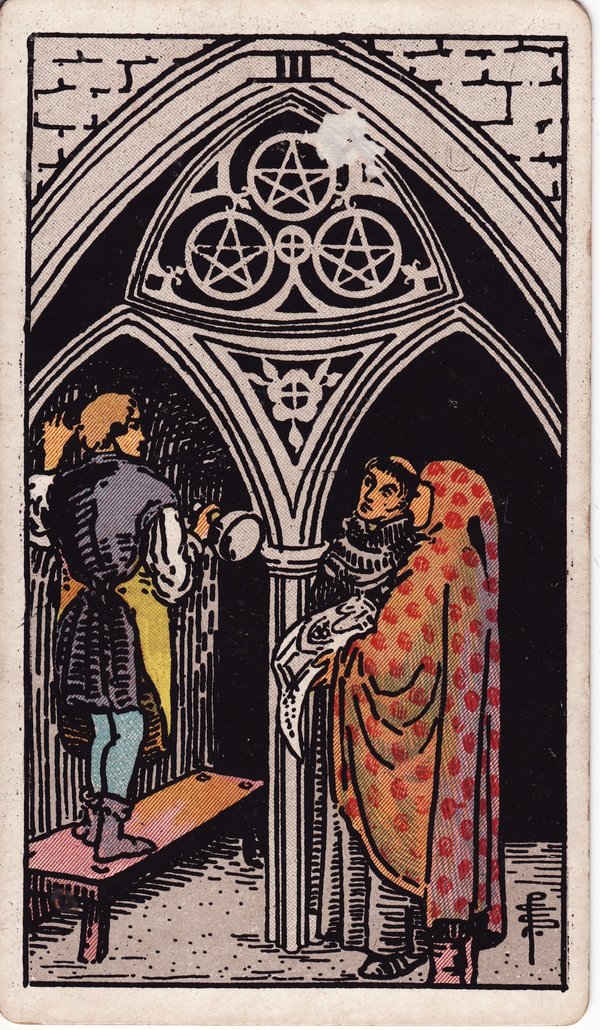
Rider-Waite-Smith (RWS): Pamela Colman Smith's card shows three figures in a cathedral workshop. A young apprentice or stonemason stands on a wooden bench, chisel in hand, working on a column. His posture is open — he has paused to explain his progress. Two other figures face him: a robed monk or priest holding architectural plans, and a nobleman or patron in a cap and cloak. The three pentacles are carved into the stone arch above them — not floating in the air, but worked into the fabric of the building itself. This is the only Pentacles card where the coins are physically integrated into a structure.
The monk represents tradition and spiritual purpose; the nobleman represents worldly authority and material backing; the apprentice represents the hands that execute the vision. Together they embody the collaborative trinity of any successful project: vision, resources, and craft.
Thoth (Three of Disks): Crowley and Harris radically abstract the RWS scene into pure geometric and alchemical symbolism. The Thoth Three of Disks shows a three-sided pyramid viewed from above the apex — Crowley's "pyramid situated in the great Sea of Binah." Three wheels occupy the vertices at the pyramid's base, each inscribed with an alchemical principle: Mercury (the volatile, the unifying force), Sulphur (the active, the fiery, the soul), and Salt (the fixed, the stable, the body) — corresponding to the Hindu gunas of Sattvas, Rajas, and Tamas. Crowley also associates these three wheels with the three Mother Letters of the Hebrew alphabet: Aleph (Air), Shin (Fire), and Mem (Water).
The pyramid rests on a field that is "mottled, a cold thin dark grey with a pattern of indigo and green" — the "solidified sea of Binah," the form-giving waters of Understanding made dense and material. A white-winged angelic hand holds a branch of a rose tree with two white rosebuds touching and surmounting the topmost pentacle. Above and below are the symbols of Mars (♂) and Capricorn (♑).
Key RWS vs. Thoth contrast: RWS shows collaboration in a social context — the human dimension of craft. Thoth shows the metaphysical architecture behind all creation — the cosmic principles that govern how spirit crystallizes into matter. RWS asks: "Are you working well with others?" Thoth asks: "Are you aligning your work with the fundamental laws of manifestation?"
4c. Astrological & Elemental Layer
The Three of Pentacles is ruled by Mars in Capricorn, specifically the 2nd Decan of Capricorn (approximately December 31 to January 9). This is one of the most potent and constructive placements in the zodiac.
Mars in Capricorn: Mars, the planet of drive, aggression, action, and desire, finds one of its strongest expressions in Capricorn, the cardinal Earth sign of ambition, structure, and long-term achievement. In traditional astrology, Mars is exalted in Capricorn — meaning it operates at its highest and best expression here. The warrior planet's raw, often reckless energy is channeled into disciplined, patient, strategic action. Mars in Capricorn does not waste energy on impulsive gestures; it builds slowly, deliberately, and with an eye on the summit.
The 2nd Decan of Capricorn (Dec 31–Jan 9) is ruled by Mars in the Chaldean system, giving it a double-Mars influence. Crowley writes: "He [Mars] is exalted in that Sign, and therefore at his best. His energy is constructive, like that of the builder or engineer."
The combination of Mars (fire drive) in Capricorn (Earth structure) creates a unique energetic signature: the will to create something permanent through sustained, disciplined effort. It is the card of the craftsman who loves the work itself as much as the result.
4d. Kabbalistic / Tree of Life Layer (Binah in Assiah)
On the Tree of Life, the Three of Pentacles occupies Binah (Understanding) within the world of Assiah (the material plane of Action).
Binah (Understanding): Binah is the third Sephirah, the first vessel of form on the Tree of Life. Chokmah (Wisdom, the second Sephirah) is the raw, undifferentiated impulse — the Father. Binah receives that impulse and gives it shape — the Mother, the Great Sea, the womb of creation. It is called the Understanding that understands from itself — the capacity to grasp the structure and meaning of things.
Binah in Assiah: The Three of Pentacles is Binah operating at the densest level of reality. This means: understanding through building. Not through contemplation alone, but through the hands, through craft, through the discipline of making. The Three of Pentacles says: you do not truly understand something until you have built it, repaired it, or worked with it materially.
Crowley writes that the card shows "the material establishment of the idea of the Universe, the determination of its basic form." The pyramid — solid, geometric, three-sided — is the form that Understanding takes in the world of matter. The three wheels (Mercury-Sulphur-Salt) represent the three fundamental principles whose harmonious combination makes any creation possible.
4g. Sequential Narrative
The Pentacles suit tells the story of material life from seed to legacy.
From the Two of Pentacles: The Two is the card of juggling, of adaptation, of managing competing demands. The Two asks: Can you hold it all together? It is the energy of evaluation. Into the Three: The Three emerges from the Two's evaluation. A decision has been made. Resources have been allocated. Where the Two was about holding possibilities in balance, the Three is about committing to one path and beginning to build. The dancer has stopped dancing and picked up the chisel. Toward the Four: The Four of Pentacles is what happens when the Three's energy solidifies into possession. The craftsman who built well now guards what he has built. The arc from Two through Three to Four is one of progressive crystallization: from fluid possibility through active construction to fixed ownership. The Three is the golden mean — the point where the work is still alive, still collaborative, still open to revision.
4h. Advising For / Against
If advising FOR: Lean into the work. You have the skills, the collaborators, and the right conditions. Seek out mentors whose expertise complements yours. Collaboration is not a compromise; it is multiplication. Put your best effort into this project, and let the quality of your work speak for itself.
If advising AGAINST: Do not work in isolation. The Three warns against going it alone when collaboration would serve better, or against refusing to listen to feedback. It also warns against the shadow of Mars in Capricorn: working only for gain, treating others as tools for your advancement, or measuring your worth solely by your output.
4i. Card of the Day
Today is a day for making. Whether your hands touch a tool, a keyboard, a pen, or a phone call to a collaborator, produce something tangible. You've dreamed long enough. Pick up the chisel, open the file, make the call. The work doesn't need to be perfect — it needs to be done, done well, done with your full attention. Notice who shows up to work alongside you today. They aren't competitors — they're co-creators.
4j. Card of the Year (Shadow Note)
If this appears as a defining minor card in a year's spread, it signals a twelve-month period dominated by apprenticeship, skill-building, and collaborative projects. This is a year to learn a craft, deepen a professional skill, or commit to a significant building project. The shadow note: beware of making your identity too small by defining yourself only by your output. The Three's emphasis on productivity can tip into workaholism. Let the year be one of learning to build rather than building to prove.
Elemental Dignities Notes
| Dignity | Adjacent Element | Effect |
|---|---|---|
| Strengthened by | Fire (Wands) | Fire supports Earth: passion and vision fuel the work. The project gains momentum and creative risk-taking. Mars in Capricorn loves fire. |
| Strengthened by | Earth (Pentacles) | Like with like: multiple Earth cards amplify material focus. The Three becomes intensely grounded — productive but at risk of one-dimensionality. |
| Weakened by | Air (Swords) | Air is Earth's enemy. Swords cut into the solid work, introducing doubt, criticism, or over-analysis that disrupts the flow of making. |
| Neutral with | Water (Cups) | Earth and Water form mud — neither friendly nor hostile. Can create fertile ground or mire the work in emotional confusion. |
Deck-Specific Notes
- Rider-Waite-Smith: Classic image of apprentice, monk, and nobleman. Emphasize the collaborative, social dimension. The three pentacles carved into stone are a reminder that reward is in the work itself.
- Thoth: Pure alchemical architecture — the pyramid, three wheels, solidified sea of Binah. Emphasis shifts to the metaphysics of work. Dense with Kabbalistic and alchemical meaning.
- Marseille-tradition: Three disks in a triangle with flowering vine coiling around them in a heart-like shape. Work and love are intertwined. What you build with care carries your life-force.
- Blended/contemporary: Core themes of craftsmanship, collaboration, skill development persist across visual traditions.
Journaling & Contemplation Prompts
- What am I currently building — literally or metaphorically — and who am I building it with? If I am building alone, what would it look like to invite collaboration?
- Where in my life am I holding back my best work? Where am I cutting corners, and what is the fear behind that choice?
- The Three speaks of apprenticeship. What skill or craft am I currently learning? Who are my teachers, and am I humble enough to learn from them?
- Mars in Capricorn is ambition channeled through patience. Where am I acting with discipline toward a long-term goal — and where am I expecting immediate results from insufficient preparation?
- The Thoth card shows Mercury, Sulphur, and Salt. How balanced are these forces in my current work? Am I overexerting, overthinking, or stuck in inertia?
Additional Associations Table
| Association Type | Value |
|---|---|
| Colors | Red (Mars), indigo and green (sea of Binah), grey (solidified understanding), warm brown of carved stone |
| Crystals / Stones | Ruby (Mars), bloodstone, citrine, granite (stone of permanence) |
| Herbs / Plants | Thistle (Mars), rosemary (apprentice's herb for focus), ivy (tenacity), grapevine |
| Archetypes | The Artisan, The Apprentice, The Master, The Builder |
| Mythological Figures | Hephaestus/Vulcan (divine craftsman), Daedalus (master artisan), Ptah (Egyptian god of craftsmen), Goibniu (Celtic smith-god) |
| Numerological Resonance | 3 — the first number of synthesis, the triangle, the first stable form. In this card: vision + resources + craft. |
| Playing Card Equivalent | Three of Diamonds |
| I Ching Hexagram | Hexagram 63 — Chi Chi / After Completion: success in small matters, but the end of one cycle begins another |
| Body / Organ Correspondence | The hands (instrument of craft), the knees (patience at the workbench), sacral chakra, musculoskeletal system |
Shadow & Integration Message
The shadow of the Three of Pentacles whispers: Your value is your output. If you are not producing, you are not worthy. This is the workaholic's shadow — the spirit that cannot rest, cannot receive, cannot let the work be imperfect. Mars in Capricorn, at its shadow extreme, becomes the ruthless careerist who uses people as rungs on the ladder.
Crowley was blunt: his divinatory meanings include "selfishness," "narrow and prejudiced," "keen in matters of gain," and "sometimes given to seeking after impossibilities." The Lord of Works can become the Lord of Overwork.
Integration: The integrated Three of Pentacles is the artisan who works with devotion and then puts down the tools to eat, rest, and love. The antidote is not to work less but to work differently — to bring presence rather than ambition to the craft, to collaborate rather than compete, to trust that the work will be completed in its own time.
Elemental Intelligence — Gnome (Suit Framing)
Pentacles/Disks correspond to Sensation — the function that apprehends reality through the physical senses. The Three is Sensation in its most productive, disciplined form — the focused, trained, expert application of the senses to a single task. The stonemason feels the grain of the stone; the musician hears the microtones between notes; the surgeon's fingers know the resistance of tissue. This is Sensation elevated to mastery.
Humour: Melancholic — but constructive, not depressive. The humour of the serious artist, the dedicated craftsman. Class: Merchant/Working class — the skilled tradesperson, the artisan whose social value arises from what they can make. In the RWS image, the craftsman stands before both priest and nobleman — and they are listening to him.
Timing & Manifestation
The Three corresponds to the 2nd Decan of Capricorn, approximately December 31 to January 9. It suggests:
- A timeframe measured in three months (number 3 as temporal unit)
- A period of focused work — not immediate results, but results within a project cycle
- Seasonal association with Capricorn season — the heart of winter, when the year turns
- The waxing phase of a material project
Yes / No Tendency
Yes — but with conditions. The Three is affirmative for questions about work, collaboration, apprenticeship, and skilled projects. However, the "yes" is not a guarantee of effortless success. It is a green light that comes with responsibility: Yes, but you must work for it. Yes, but you must collaborate. Yes, but you must meet the standards of the craft.
Common Misreads / Nuances
Misread 1: "This card is only about work." The Three is about work, but equally about learning, collaboration, and the dignity of craft. It applies to creative projects, relationships, health, and spiritual life.
Misread 2: "The Thoth pyramid means ancient Egypt or past lives." The pyramid is a geometric symbol of stability and the three fundamental principles (Mercury-Sulphur-Salt). It is alchemical and Kabbalistic, not literal.
Misread 3: "Apprenticeship means I'm not good enough yet." The apprentice in RWS is being consulted, not judged. Being a learner is not a weakness — it is the only path to mastery.
Misread 4: "Mars in Capricorn means this card is harsh or ruthless." Mars is exalted in Capricorn — at his best. His energy is constructive, like that of the builder or engineer.
Misread 5: "The three figures represent specific people." They can, but they also represent inner functions: the craftsman (what you do), the visionary (what you imagine), and the authority (what the world requires).