The Poetic Line
"The cold lies. Lift your head — the light is closer than the fear would have you believe."
Keywords
| Category | Dignified | Undignified |
|---|---|---|
| General | Hardship, material loss, spiritual crisis, the dark night, recognition of need, seeking help | Self-pity, wallowing, refusing offered aid, poverty mentality, martyrdom, spiritual abandonment |
| Spiritual | The dark night of the soul, purification through ordeal, finding faith in deprivation, the stripping away of false comforts, authentic encounter with lack | Spiritual despair, rejection of comfort, the wounded ego that defines itself by suffering, refusing to see the light because darkness has become identity |
| Psychological | Facing limitation, the humility of need, the courage to ask for help, reckoning with what has been lost | Chronic helplessness, learned hopelessness, the refusal to see resources, isolation as self-punishment, depression that rejects connection |
| Physical Health | Illness, physical depletion, the body signaling its limits, convalescence that requires rest, the need for medical or material support | Ignoring the body's needs, refusing treatment, hypochondria as identity, the body as the site of unprocessed grief |
| Relationships | Leaning on a partner during hardship, the relationship tested by external pressure, asking for emotional support, the intimacy of shared vulnerability | Self-isolation within relationship, refusing to let a partner help, the martyr who makes suffering a competition, pushing away love when it is most needed |
| Financial | Financial crisis, loss of income, material deprivation, the moment of reckoning after poor management, the need to seek financial assistance | Refusing financial help out of pride, spiraling debt from denial, the poverty mentality that sabotages recovery, ignoring bills and hoping they disappear |
| Vocational | Job loss, career crisis, being passed over, the work environment that excludes, the need to seek new opportunities or retraining | Chronic underemployment as identity, refusing to look for work, blaming external forces without taking any action, professional isolation that becomes a self-fulfilling prophecy |
| Shadow / Thoth Distinction | Mercury in Taurus — the mind (Mercury) fixated on lack (Taurus shadow). The worry that has something real to worry about. Geburah as the necessary breaking — the illness that forces rest, the loss that forces reprioritization. | The mind that has become its own prison. Worry that feeds on itself, creating the very scarcity it fears. Geburah without the redemptive arc — punishment that teaches nothing, suffering that isolates rather than purifies. |
Narrative Description
General Meaning
The Five of Pentacles is the card of being out in the cold — literally, spiritually, emotionally, financially. It is the dark night of the material world: the moment when the structures that sustained you collapse, when the resources you relied on fail, when the warmth you took for granted is withdrawn and you are left shivering outside the church door.
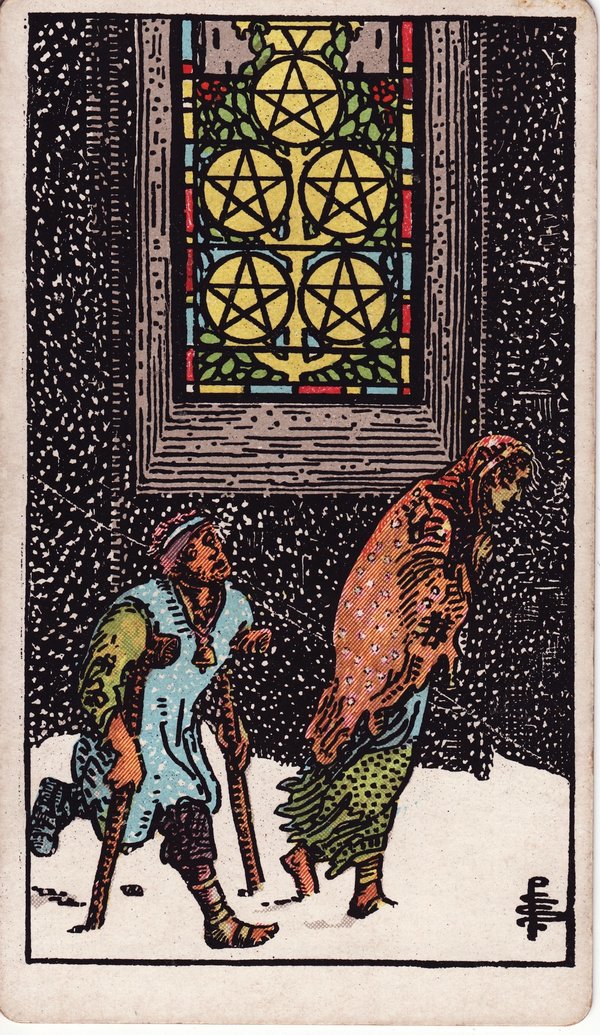
In the RWS imagery, two figures — haggard, wounded, wrapped in thin blankets — limp through falling snow past a brightly lit stained-glass window. The window belongs to a church, a place of sanctuary and warmth, but the figures do not enter. Whether they cannot enter (exclusion, stigma, their own shame) or will not enter (pride, despair, the belief that they do not belong) is deliberately ambiguous — and that ambiguity is the card's central tension. The Five of Pentacles is about the gap between need and help, between where you are and where sanctuary waits — and about the forces (internal and external) that keep that gap from closing.
In a reading, the Five of Pentacles almost always signals genuine difficulty. This is not the imagined crisis of the Nine of Swords (the midnight anxiety that evaporates at dawn) but a real material challenge: financial strain, health problems, job loss, the dissolution of a support system. The card validates that what you are going through is hard. It does not minimize or spiritualize the pain. And yet — here is the crucial nuance — it also asks: where is the help you are not seeing?
The astrological layer sharpens the meaning. Mercury in Taurus — the mind (Mercury) grounded in the sign of material security and physical comfort (Taurus) — but in the first decan, where the energy is raw, unformed, the seed just planted. Mercury in Taurus thinks about what it has and what it might lose. It is the mind that calculates, inventories, frets about resources. When the resources are gone, Mercury in Taurus becomes the mind that cannot stop thinking about lack — the obsessive worry that transforms a material problem into a spiritual crisis. The Lord of Worry is aptly named.
The Geburah assignment is crucial. Geburah is not just severity — it is necessary severity. The surgeon's knife hurts, but it removes the tumor. The warrior destroys, but in service of a larger peace. The Five of Pentacles is a crisis that serves a purpose: it strips away false security, exposes what was never solid, forces the querent to discover resources (inner and outer) that comfort had concealed. The cold outside the church is real — and it is also the thing that will teach you what warmth actually is.
Symbolism & Imagery
Rider-Waite-Smith (1909): The RWS Five of Pentacles is one of the most emotionally immediate images in the deck. Two figures trudge through deep snow, their bodies bent against the cold. One is on crutches, his leg bandaged — physical debility made visible. The other wears a thin shawl pulled tight, her head bare against the elements. Both are looking down, focused on the difficult ground beneath their feet. Neither is looking at the stained-glass window just behind them.
That window is the visual and thematic heart of the card. It glows with warm light — gold, red, blue — the colors of sanctuary, of community, of the divine presence housed within an institution. Above the window, five pentacles are arranged in a pattern that mirrors the five wounds of Christ — a detail that connects material poverty to spiritual sacrifice, the body's suffering to the soul's ordeal. The church is physically close — the figures could reach it in a few steps — but psychologically, it might as well be on the other side of the world.
The snow falls steadily. Snow in the tarot often represents spiritual coldness, emotional numbness, the frozen state that can follow trauma or grief. The dark sky offers no break in the weather — there is no sign that the suffering will end soon. This is the experience of hardship: the sense that it has always been this way and always will be.
The figures are not alone — they have each other — but they are not looking at each other either. They are both isolated in their own suffering, even as they walk side by side. This is another of the card's layers: the way hardship can make people inaccessible to each other, even when they are physically together.
Thoth (Crowley/Harris, 1944): The Thoth Five of Disks (Pentacles) is titled Lord of Worry and presents a very different visual field. Here, five disks are arranged in an inverted pentagram — the pentagram with the point downward, symbolizing matter dominating spirit, the world of form pressing down on the divine spark. The disks are heavy, dark, earthy — they seem to pull the composition downward by sheer weight. The background features harsh, angular geometric forms — reds and blacks — that convey agitation, disruption, the sense of a system under stress.
Where the RWS card tells a story (two figures in the snow), the Thoth card depicts a state: the condition of material oppression, the heaviness of the world when spirit is subordinated to matter. The inverted pentagram is not necessarily "evil" in the Thoth system — it represents the descent of spirit into form, which is a necessary phase of manifestation — but when the balance is lost, the descent becomes a fall, and the form becomes a prison.
The key difference between traditions: RWS emphasizes the emotional experience of the Five — the cold, the isolation, the pathos of the figures. Thoth emphasizes the structural condition — the inversion, the weight, the system that produces suffering. Both are true: the Five of Pentacles is simultaneously the feeling of being out in the cold and the structural reality that puts people there.
Astrological & Elemental Layer
The Five of Pentacles is astrologically attributed to Mercury in Taurus — specifically the first decan of Taurus, approximately April 21–30 in the solar calendar. This is one of the most psychologically precise attributions in the minor arcana, because Mercury and Taurus are in fundamental tension.
Mercury is the planet of thought, communication, movement, analysis, and exchange. It is quick, mercurial, interested in everything, committed to nothing. Taurus is the sign of stability, material security, the body, the senses, and the slow accumulation of value. It is the fixed earth sign — the most stubborn, the most attached to what is, the most resistant to change.
When Mercury enters Taurus, the restless mind enters the still body. The effect can be grounding — Mercury's anxiety settling into Taurus's calm — but it can also be agitating, like a trapped fly buzzing against a window. Mercury in Taurus thinks about material things: money, possessions, physical comfort, security. When those things are present, the thinking is satisfied. When they are absent, the thinking becomes obsessive — the mind circling endlessly around what is missing, what has been lost, what might go wrong. This is the "worry" of the Lord of Worry: not panic (that would be Mercury in Aries) but the slow, grinding anxiety of the mind that has fastened onto lack and cannot let go.
The first decan of Taurus is ruled by Mercury itself in the Chaldean decan system — a double dose of mercurial energy that intensifies the card's mental quality. This is the decan of the mind's first contact with the material: the initial inventory, the first assessment, the seed of worry that will either be addressed or will grow into obsession.
In elemental terms, the Five of Pentacles is Earth in crisis — the element of stability, security, and physical wellbeing disrupted by the Geburah force that belongs to all Fives. The Earth is breaking, cracking, unable to hold. The body is failing. The bank account is empty. The ground that was supposed to be solid has become a sinkhole.
And yet — the Geburah force, while painful, serves a purpose. The Earth that cracks open may reveal a spring beneath. The security that collapses may have been a false security, built on sand. The Five of Pentacles asks whether the crisis is purely destructive or whether it is the necessary destruction that clears space for something more authentic.
Kabbalistic / Tree of Life Layer
The Five of Pentacles sits in Geburah, the fifth Sephirah on the Tree of Life — the sphere of Severity, Discipline, Judgment, and Strength. Geburah is the left-hand pillar of the Tree, the pillar of restriction and form, and it balances the expansive, merciful energy of Chesed (the fourth Sephirah, directly above it). Where Chesed gives, Geburah limits. Where Chesed forgives, Geburah judges. Where Chesed builds the kingdom, Geburah raises the army that defends it.
Geburah's essential quality is necessary destruction. It is the surgeon's knife, the pruner's shears, the fire that clears dead wood from the forest so new growth can emerge. In its highest expression, Geburah is righteous severity — the discipline that strengthens, the justice that restores balance. In its lowest (the Qliphothic distortion), Geburah becomes cruelty — punishment without purpose, violence that feeds on itself, the severity that has forgotten mercy.
In the suit of Pentacles (Assiah — the material world of action and manifestation), Geburah's energy expresses as material hardship. The Five of Pentacles is the moment when the structure built by the Four (the savings, the boundaries, the defended position) is tested — and found inadequate. The fortress walls crack. The savings run out. The body gets sick. This is Geburah in Assiah: the material world delivering the lesson that nothing material is permanent.
The path that flows into Geburah from Chesed carries the memory of mercy — and this is crucial to understanding the card. The severity of the Five does not come from nowhere; it is a corrective to the Four's excess, a response to the hoarding, clutching energy that preceded it. The cold outside the church is, in some readings, the direct consequence of refusing to share the warmth inside. Geburah asks: what are you being stripped of, and what is the stripping meant to teach?
For the querent, the Kabbalistic layer asks: Is this crisis meaningless suffering, or is it the severity that burns away what was never true? What is Geburah trying to correct? What will be left when the fire has done its work?
Sequential Narrative: Position in the Suit Story
The suit of Pentacles tells the story of material manifestation — from seed (Ace) to legacy (Ten), with each number representing a stage in the development of physical, financial, and embodied wisdom.
From the Four of Pentacles: The Four is the card of holding, protecting, clutching, and hoarding. The structure has been built. The resources have been secured. The boundaries have been drawn. But the Four carries the seed of its own undoing: the tighter the grip, the more brittle the security, the more vulnerable the holder to the shock of loss.
The Five of Pentacles emerges directly from the Four's shadow. The miser who hoarded gold loses it. The community that built walls to keep others out finds itself isolated and starving. The person who refused to ask for help when times were good now cannot find anyone to ask when times are bad. The transition from Four to Five is the transition from holding to losing — and the question of the Five is whether the loss is purely destructive or whether it is the Geburah corrective, the severity that shatters a false security so that a truer one can be found.
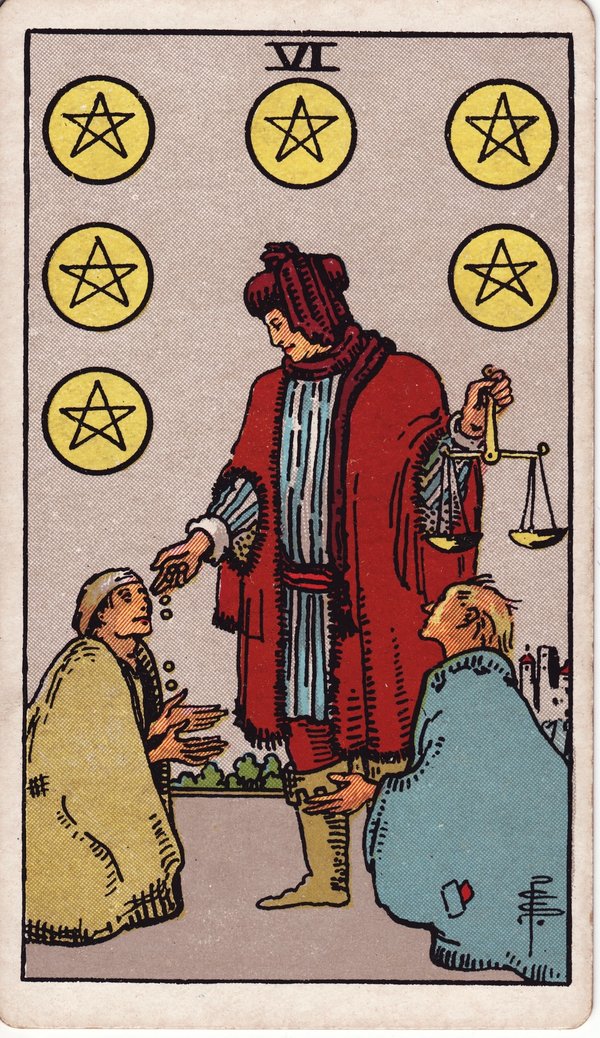
Toward the Six of Pentacles: The Five's endpoint is not permanent. The Six of Pentacles — the Lord of Success — is the card of generosity, charity, and the restoration of balance. After the cold of the Five, the Six offers warmth: the hand that gives, the scale that measures fairly, the community that supports its members. The transition from Five to Six is the transition from crisis to recovery, from isolation to connection, from receiving nothing to both giving and receiving in balance.
But the Six is not automatic. The figures in the Five must see the window, must approach the door, must accept the help that is offered. The Six is what happens when the Five's lesson is learned: when the person in crisis reaches out, when the community responds, when the flow of resources is restored. If the Five's lesson is refused — if pride or despair keeps the figures in the snow — the Six never arrives, and the Five becomes a permanent condition, a frozen hell of one's own making.
The overall arc: Within the Pentacles journey, the Five occupies the crisis point — the moment when the material world fails. This crisis is not avoidable within the logic of the suit: everything that is built must eventually be tested, and everything that is held must eventually be opened. The Five is the test. The question is not whether the crisis will come but how the querent will meet it.
Advising For / Advising Against
-
If advising FOR: Admit that you are struggling. The pride that keeps you from asking for help is the wall that keeps you in the cold. The Five of Pentacles, strangely, counsels vulnerability — not as weakness but as the necessary precondition for receiving what you need. Look up. The window is lit. The help is closer than you think — but you must stop looking at the ground and start looking for the light. This card also counsels spiritual honesty: whatever you have been relying on that is not solid, let it go now. The Geburah force will take it anyway — better to release it consciously than to have it ripped away.
-
If advising AGAINST: Do not make suffering your identity. The Five reversed warns against the seduction of the victim position — the way that hardship, once it becomes familiar, can become a form of security in itself. If you are refusing help that is genuinely offered, if you are defining yourself by what you lack rather than what you might receive, if your suffering has become a way of controlling others or avoiding responsibility — the Five reversed calls you out. Get up. Walk toward the window. The cold is real, but so is the door.
Card of the Day
Today you may encounter lack — in your resources, your energy, your hope. This isn't a punishment; it's an invitation to notice what you actually need and whether you've been too proud to ask for it. Look for the help you have been overlooking — the friend you haven't called, the resource you haven't accessed, the practice you abandoned when things got hard. The cold is real but it is not permanent. Lift your head. There is light nearby. The only question is whether you are willing to walk toward it.
Card of the Year
Note: Year cards are calculated from Major Arcana numbers (0–21). This Minor Arcana card does not function as a primary year card. However, as a Personal Year Shadow Card, the Five of Pentacles may appear as a recurring theme within a larger year-card energy — particularly in years governed by The Hierophant (V), which shares the number 5, or The Hanged Man (XII), which echoes the Five's theme of necessary suspension and ordeal. In such a year, the Five of Pentacles manifests as: periods of material or physical difficulty that test your relationship to security, encounters with lack that reveal what you truly value, the slow work of learning to ask for and receive help. The invitation is to let the hardship teach you what it was meant to teach, rather than letting it define you.
Elemental Dignities Notes
The Five of Pentacles is Earth — disrupted, cracking, under pressure, but still Earth. In a spread, its elemental relationship to neighboring cards follows the Golden Dawn system:
- Strengthened by Earth (Pentacles): Like element intensifies like element. Adjacent Pentacles cards deepen the Five's material focus — the hardship becomes more concrete, more physically real. But additional Earth can also provide the resources the Five lacks: a neighboring Pentacles card may indicate help arriving, a practical solution, the material support that ends the crisis.
- Strengthened by Water (Cups): Water supports Earth in the elemental system. Adjacent Cups cards bring emotional support, compassion, and the softening influence that allows the isolated figures to reach out. The church window, in elemental terms, is Water (the warmth of community, the compassion of the divine) waiting to support the Earth that has grown too cold.
- Weakened by Air (Swords): Air and Earth are enemies. Adjacent Swords cards may cut away the Five's last defenses — intellectual clarity revealing uncomfortable truths about how the crisis was created. But Air can also provide perspective: the mind that sees beyond the immediate hardship, that strategizes a way out.
- Weakened by Fire (Wands): Fire and Earth are enemies. Adjacent Wands cards may burn through the Five's frozen state — passion, initiative, and the will to act disrupting the paralysis of despair. But Fire can also represent the thing that consumes what little remains: the passion that burns the last of the reserves.
Deck-Specific Notes
-
If using a Thoth deck: The card appears as the Five of Disks, titled Lord of Worry. The imagery emphasizes the inverted pentagram — spirit subordinated to matter — and the heavy, oppressive weight of the disks. The Thoth reading emphasizes the structural and spiritual dimensions of the Five: more than a bad day, a condition of material oppression, a state in which the physical world has become an obstacle to the soul's development. The dignifying question of the Thoth card is: what has been inverted, and how can it be righted?
-
If using a Marseille-tradition deck: In the Marseille tradition, the Five of Coins typically shows five coins arranged in a cross or quincunx pattern, often surrounded by ornate botanical borders. The emphasis is on the disruption of the Four's stable square — the pattern has been broken, and the coins no longer form a coherent structure. The Marseille reading is less narrative than RWS and less metaphysical than Thoth, but the core meaning of material disruption endures.
-
If using a blended or contemporary deck (e.g., Fountain Tarot, Wild Unknown, etc.): The psychological and astrological layers of this entry apply across visual traditions. The core archetype — material crisis, spiritual destitution, the gap between need and help — persists regardless of specific imagery. Consult your deck's guidebook for any departures from the RWS/Thoth framework.
Journaling & Contemplation Prompts
- What am I currently lacking — materially, emotionally, spiritually — and have I been honest with myself and others about the depth of that lack?
- Where is the "lit window" in my current situation — the help or resource I have been too proud, too ashamed, or too exhausted to approach?
- What has this period of difficulty taken from me? What has it given me that comfort never could?
- Is my suffering connecting me to others (through shared vulnerability) or isolating me from them (through the belief that no one understands)?
- If this crisis is Geburah — if it is severity with a purpose — what is it trying to correct, burn away, or teach?
Additional Associations
| Association Type | Value |
|---|---|
| Color(s) | Gray (the snow, the cold, the draining of color from life); dark brown (the dead earth of winter); the gold warm light of the church window (sanctuary, the divine presence that remains even when we cannot feel it); black (the sky, the void, the absence of comfort) |
| Crystals / Stones | Snowflake Obsidian (the beauty within darkness, the pattern that emerges through hardship); Smoky Quartz (grounding through grief, transmuting suffering into resilience); Black Onyx (protection during times of crisis, the stone of the survivor) |
| Herbs / Plants | Willow (the tree of grief, of bending without breaking — associated with the Moon and with mourning); Mullein (the plant that grows in waste places, that offers its soft leaves as bandages — a remedy for those who have been discarded); Myrrh (the resin of suffering and sacrifice, associated with wounds and their healing) |
| Archetypes (Jungian) | The Orphan (the one who has been abandoned, who must learn to survive without the protection that was promised); The Wounded Healer (Chiron — the one whose own wounds become the source of their capacity to heal others); The Exile (the one cast out of community, who must find their way back — or find a new community to call home) |
| Mythological Figures | Job (the righteous man stripped of everything — wealth, health, children — who must confront the question of whether suffering is punishment); The Prodigal Son (who squandered his inheritance and found himself starving among pigs — but who also found his way home); Persephone in the Underworld (the goddess of spring trapped in the realm of the dead — the life-force frozen until the return is permitted) |
| Numerological Resonance | 5 = the pentagram, the human form, the meeting of spirit and matter. In the Five of Pentacles, matter has overwhelmed spirit — the pentagram is inverted (Thoth) or the five pentacles mirror the five wounds (RWS). The number carries both the crisis (the human being overwhelmed by material forces) and the solution (the human being who, by acknowledging their need, reconnects with spirit). |
| Playing Card Equivalent | Five of Diamonds — a card of financial difficulty, unexpected expenses, and the need to weather a period of material strain. In cartomancy, the Five of Diamonds can indicate a reversal of fortune but also the support that arrives when the situation is honestly assessed. |
| I Ching Hexagram Parallel | Hexagram 39 — Chien / Obstruction. "The superior man turns his attention to himself and molds his character." The hexagram of the obstacle that cannot be overcome by force — the mountain that blocks the path. The counsel is not to attack the obstacle but to turn inward, to cultivate virtue, to wait for the conditions to shift. The hardship is real, but it is also a teacher. |
| Body / Organ Correspondence | The immune system (the body's defenses depleted, vulnerability to illness); the throat and neck (Taurus's body part — the throat chakra, the voice — what the Five's figures cannot use, cannot cry out); the feet (walking through snow, the foundation of the body tested and strained). In astrological medicine, Taurus governs the throat, thyroid, and the body's capacity to store and maintain resources — all of which are under threat in the Five's condition. |
Shadow & Integration Message
The shadow of the Five of Pentacles is not mere suffering — it is suffering that has become an identity, a home, a way of being that the sufferer will not surrender because they have forgotten who they are without it. This is the shadow that keeps the figures in the snow even when the church door is open, even when a hand is extended. The fear is not of the cold but of the warmth: what if I enter the sanctuary and discover that I am no longer special in my suffering? What if, without my wounds, I am nobody?
This shadow often originates in real trauma that was never fully metabolized. A person who experienced genuine deprivation — economic, emotional, physical — may carry the expectation of deprivation into situations of actual abundance, unconsciously recreating the conditions of their original wound because those conditions are familiar and therefore, in a terrible way, safe.
Integration of the Five's energy means learning to receive. It means letting the hardship teach its lesson without letting the hardship become your name. It means walking through the church door — accepting help, admitting need, allowing the warmth to touch you — even when that acceptance feels like a loss of the self you built in the cold. Integration is the movement from Job in his ash heap to Job restored — not because the suffering was meaningless but because the meaning of the suffering was never the suffering itself; it was the transformation the suffering made possible.
Elemental Intelligence (Suit Framing)
In the Jungian cognitive function mapping, the suit of Pentacles corresponds to the Sensation function (Jungian cognitive functions), the melancholic humour, and the laboring/peasant class. The Five of Pentacles represents Sensation in crisis — the felt reality of the physical world becoming a source of pain rather than a medium of experience.
The melancholic humour, associated with Earth, is characterized by depth, seriousness, and a tendency toward rumination. In the Five of Pentacles, the melancholic tendency toward fixation becomes pathological: the mind (Mercury) cannot stop thinking about what is missing, what has been lost, what has gone wrong. The melancholic gift for depth becomes the melancholic trap of dwelling.
The class association of Pentacles — the laborers, the poor, the ones who live close to the bone — is not abstract in this card. The Five of Pentacles, perhaps more than any other card in the suit, speaks directly to the experience of poverty, of being the one outside looking in, of lacking the resources that others take for granted. The card does not romanticize this experience; it portrays it with unflinching clarity. And yet its counsel is not to accept poverty as identity but to recognize that help exists, that community is a resource, that the isolation of the Five is not inevitable.
Timing & Manifestation
For timing in a reading, the Five of Pentacles points to the first decan of Taurus in the solar calendar: approximately April 21–30 in any given year. This is the cusp of spring in the northern hemisphere — the season when the promise of warmth is present but the cold still bites, when the ground is thawing but not yet fertile.
More archetypally, the Five of Pentacles suggests a timeframe characterized by difficulty, waiting, and the slow accumulation of the conditions for change. The crisis will not resolve quickly. Endurance is required. But the crisis is also not permanent — the decan window is finite, and the transition to the next card (the Six of Pentacles) is built into the sequential narrative.
In the context of a project or process, the Five marks the point of maximum strain — the moment when resources are thinnest, morale is lowest, and the temptation to abandon the effort is strongest. The card's counsel is not to abandon but to seek support, to recognize that the church window is nearby, that help is closer than it appears.
Yes / No Tendency
The Five of Pentacles leans toward No — the resources are not sufficient, the support is not in place, the timing is wrong. This is not a card that blesses new ventures or bold risks. Its energy is depleted, strained, and the answer to most practical questions is: not now, not like this, not until the situation stabilizes.
However, there is a crucial nuance: the "no" of the Five is often conditional. If the question is "Will I always feel this way?" the answer is no — the Five's crisis is temporary by its nature. If the question is "Can I find help?" the answer is yes, but you must ask for it, and you must be willing to receive it. The "no" applies to the desire for things to remain comfortable or easy; it does not apply to the possibility of transformation and recovery.
In reversed / ill-dignified position, the tendency shifts toward Yes — but recovery is beginning, and the worst is passing. The reversal suggests that the figures are turning toward the window, that help has been recognized and is being approached.
Common Misreads / Nuances to Know
Misread 1: "The Five of Pentacles means you're going to be poor/destitute." The Five signals a period of material strain, not a permanent condition. It is a moment in the narrative, not the end of the story. The card's position in the sequential narrative — directly before the Six of Pentacles, the card of generosity and restoration — is crucial context.
Misread 2: "The church window means the answer is spiritual — just pray harder." The window does represent spiritual sanctuary, but the card's message is not that material help is unnecessary, only spiritual. The church is a real place with real resources — food, shelter, community. The card's question is: why are you not accessing the help that exists? The answer may be pride, shame, despair, or genuine structural exclusion. The spiritual dimension is real, but it does not negate the material.
Misread 3: "The Five of Pentacles reversed means the crisis is over." The reversal often indicates the beginning of recovery, not its completion. The figures have turned toward the window, but they have not yet entered. The work of asking, receiving, and rebuilding is still ahead. The reversal shifts the energy from passive suffering to active seeking — but seeking is not the same as finding.
Nuance for Taurus placements: People with strong Taurus placements (Sun, Moon, Ascendant in Taurus, or a loaded 2nd house) may experience the Five of Pentacles as particularly resonant — and particularly challenging. Taurus seeks security, stability, and comfort; the Five denies all three simultaneously. For the Taurus-influenced querent, this card may signal a crisis of identity as much as a crisis of resources: if I am not what I own, what am I?