The Poetic Line
"Ten thousand times the same motion. The ten-thousand-and-first — the work begins to move through you."
Keywords
| Category | Dignified | Undignified |
|---|---|---|
| General | Diligence, craftsmanship, skill development, focused effort, apprenticeship, dedication, meticulous work | Perfectionism, monotony, drudgery, lack of motivation, cutting corners, half-hearted effort, burnout from overwork |
| Spiritual | Sacred practice, devotion through repetition, the sanctification of work, discipline as worship, craft as meditation | Empty ritual, going through the motions without presence, spiritual laziness, performative diligence without inner commitment |
| Psychological | Flow state, deep focus, pride in work, growth mindset, the satisfaction of incremental progress, self-discipline | Workaholism as avoidance, tying self-worth entirely to productivity, boredom with routine, imposter syndrome, paralysis by perfectionism |
| Physical Health | Dedication to physical practice, consistent exercise, learning a new physical skill, attention to bodily detail | Repetitive strain, neglecting the body for work, obsessive exercise, ignoring body signals in pursuit of goals |
| Relationships | Investing consistent effort, learning relationship skills, practicing communication, the daily work of love | Neglecting the relationship for work, going through the motions, expecting mastery without practice, emotional laziness |
| Financial | Steady skill-building leading to financial growth, investing in education, patience with incremental returns, vocational training | Underearning from undervaluing skills, financial stagnation from lack of development, debt from training without application |
| Vocational | Apprenticeship, professional development, mastering a craft, pride in workmanship, continuous improvement, finding one's calling | Dead-end job, refusing to learn new skills, coasting on past competence, producing shoddy work, career stagnation |
| Shadow / Thoth Distinction | Prudence as sacred discipline, the Solar-Virgoan radiance illuminating the work, skill as a path to self-realization, diligence without pride | The shadow of prudence: obsessive perfectionism, the inability to finish because nothing is ever good enough, the Sun's light becoming scorching self-criticism |
Thoth note: Crowley's title "Lord of Prudence" reflects the Virgoan quality of careful, methodical attention. In the Thoth system, "prudence" is not timidity but the wisdom that understands timing, proportion, and the value of incremental progress. The Sun in Virgo attribution emphasizes the Solar radiance that illuminates the detailed work — the Sun is not diminished by being in Virgo but channeled through the sign's analytical, service-oriented lens. The Thoth Eight of Disks is about the alchemical discipline of the Great Work: the slow, careful transformation of base material into gold through sustained, intelligent effort. A Thoth-influenced reading emphasizes the spiritual dimension of craft — the understanding that all skilled work is a form of meditation and that mastery is not an achievement but a way of being.
Narrative Description
General Meaning
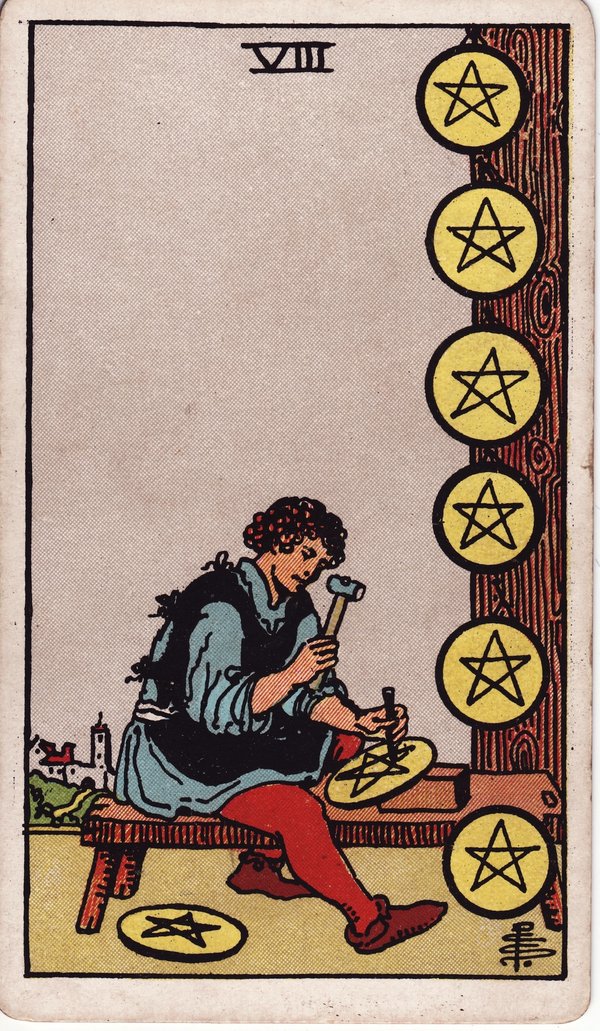
The Eight of Pentacles is the card of the craftsperson — the apprentice, the artisan, the dedicated worker who has found meaning in the labor itself rather than only in its rewards. In the RWS image, a young man sits at a workbench, carving pentacles into golden coins. Six completed pentacles hang on the wall behind him; a seventh occupies his hands; the eighth is implied by the title. His focus is absolute. The town in the background — the world of distractions, relationships, normal life — has been left behind, not in rejection but in temporary suspension. He is in the zone.
This card appears when the querent is being asked to commit to the work — not in a burst of inspiration but in the steady, daily, unseen labor that builds real competence. The Eight of Pentacles does not celebrate the finished product (that is the Nine and Ten); it celebrates the process. The energy is Sun in Virgo: the life-giving radiance of the Sun channeled through Virgo's meticulous, analytical, service-oriented intelligence. This is not the Sun of Leo — glorious, performative, regal. It is the Sun of the workshop, the studio, the practice room — the light by which the craftsperson sees their work.
For the querent, the Eight of Pentacles asks: What are you willing to practice? What skill, what craft, what way of being is worth the thousands of repetitions that mastery demands? And just as importantly: Can you find joy in the repetition itself — not just in the outcome but in the act of doing the work well? This card blesses the beginner, honors the journeyman, and reminds the master that mastery is never complete.
Symbolism & Imagery
Rider-Waite-Smith (1909): Pamela Colman Smith's Eight of Pentacles is one of the most focused, contained images in the deck. A young craftsman in a simple apron sits on a wooden bench, bent over his work. In his left hand, he holds a coin; in his right, a hammer and chisel — he is engraving the pentacle shape into the gold. Six completed pentacles hang on the wooden post beside him, arranged in two neat rows of three. A seventh lies at his feet, finished and set aside. This is the eighth.
The craftsman's posture is the key to the card. He is not straining; he is absorbed. His body language communicates deep concentration — the state that Mihaly Csikszentmihalyi would later call "flow." He is not checking his phone, not wondering when lunch is, not comparing his work to the master down the road. He is entirely present with the task. The small town visible through an archway in the background represents the ordinary social world he has temporarily stepped away from — not abandoned, but placed at a distance that allows focus.
The pentacles hanging on the post create a visual record of progress. Each one represents a completed act of craft. The two rows of three suggest the orderly accumulation of skill — the Six (harmony, balance) expressed through material form. The tools in his hands — hammer and chisel — are simple, ancient, requiring no electricity, only the intelligence of the body trained through practice. The card suggests that mastery is available to anyone willing to do the work, regardless of equipment or circumstance.
Thoth (Crowley/Harris, 1944): In the Thoth deck, the Eight of Disks is titled "Prudence" and presents a dramatically different visual. Eight disks are arranged in a geometric pattern that suggests the flower of life, each one marked with plant-like motifs. The disks are golden and orderly, suggesting cultivation and deliberate arrangement rather than the RWS craftsman's workshop. Crowley associates this card with the agricultural metaphor — the disks are like plants carefully spaced in a garden, each one the product of soil preparation, planting, watering, and weeding. The title "Prudence" reflects the Virgoan quality of careful, methodical attention to what has been planted, ensuring it receives the right care at the right time.
The Thoth version emphasizes the system of cultivation rather than the individual craftsperson. Where RWS shows one person absorbed in a task, Thoth shows the pattern that emerges from disciplined, intelligent arrangement — the garden that looks effortless because the gardener has done the work. Both traditions honor the diligent, repetitive labor that produces excellence, but Thoth frames it in terms of the natural order: just as the farmer cannot rush the crop, the craftsperson cannot skip the apprenticeship. Prudence is the wisdom of the right action at the right time.
The key difference between traditions: RWS emphasizes the experience of dedicated work — the flow state, the absorption. Thoth emphasizes the structure of dedicated work — the pattern, the method, the wisdom of proper timing. Together, they form a complete picture: mastery requires both the inner discipline of presence and the outer discipline of system.
Astrological & Elemental Layer
The Eight of Pentacles carries Sun in Virgo — one of the most quietly powerful combinations in the decan system, marrying the Sun's vital radiance with Virgo's analytical precision.
The Sun is the source of all life in the solar system — the principle of consciousness, identity, vitality, and creative expression. The Sun illuminates whatever it touches, making it visible, warming it into growth. In the decan system, when the Sun rules a decan, it brings clarity, energy, and a sense of purpose to the sign it occupies. The Sun does not merely shine on the work — it enters the work, filling it with the vitality of focused consciousness.
Virgo is the mutable Earth sign — analytical, service-oriented, perfectionistic, and deeply attentive to detail. Virgo energy discriminates: it separates the useful from the wasteful, the precise from the approximate, the ripe from the unripe. Virgo is associated with the harvest (the word comes from the same root), with health and healing, with craft and technique. Where its opposite sign Pisces dissolves boundaries, Virgo draws them, clarifies them, insists on them. Virgo is the sign of the craftsperson, the editor, the healer, the one who makes things better through careful, informed attention.
The first decan of Virgo (approximately August 23–September 1) carries the additional Solar rulership that makes this the most radiant and confident of the Virgo decans — the moment when Virgo's analytical gifts are lit from within by the Sun's vital energy rather than weighed down by Mercury's more cerebral influence (as in the second decan) or Venus's more sensual concerns (as in the third). This is the decan of the dedicated beginner — the apprentice whose enthusiasm and attention to detail combine to create the conditions for rapid learning.
The elemental layer places this in Pentacles/Earth, which governs material skill, physical craft, and the tangible results of labor. The Sun in Virgo within Earth is the card of illuminated craft — work that is not merely competent but radiant, not merely functional but beautiful. It is the difference between a chair that holds weight and a chair that rewards the eye, between a meal that satisfies hunger and a meal that honors the ingredients.
Kabbalistic / Tree of Life Layer
The Eight of Pentacles sits in Hod, the eighth Sephirah on the Tree of Life — the sphere of Splendor, Intellect, and the structured mind. Hod is Mercury-ruled, belonging to the Pillar of Severity, and represents the capacity of consciousness to analyze, classify, name, and perfect. If Netzach (the Seven) is the raw, instinctual force of desire that drives creation, Hod is the intellect that gives that force form — the architect who draws the plans that the builder follows, the editor who refines the rough draft into polished prose.
In the Sephirothic arc of the numbered cards, the Eight represents the crystallization of the suit's energy into structured, teachable form. After the Seven's emotional-instinctual pause (Netzach), the Eight (Hod) introduces the clarifying, refining, systematizing intelligence of the mind. In Pentacles/Earth, this means: skill is not enough — it must become technique. The raw persistence of the farmer (Seven) becomes the trained craft of the artisan (Eight). The difference between the two cards is the difference between stubbornly continuing and intelligently improving.
Hod's Mercurial energy is what makes mastery possible. Before Hod, learning is by trial and error — the body gradually discovering what works. With Hod, learning becomes structured: the apprentice understands why a technique works, can analyze and correct errors, can pass knowledge to others. The Mercurial quality of this Sephirah also connects the Eight of Pentacles to communication: the master craftsperson not only makes beautiful things but can explain how they are made, can teach, can write the manual, can pass the tradition forward.
The path forward is through Yesod (the Nine), where Hod's intellectual refinement of craft is internalized as self-sufficiency and the quiet confidence of earned competence. But the Eight itself is not yet about reaping rewards — it is about the discipline of the workshop, the daily return to the bench, the willingness to do the same motion again and again until the body knows what the mind cannot articulate.
Sequential Narrative: Position in the Suit Story
The Eight of Pentacles is the suit's turn from reflection to renewed action — the moment when assessment crystallizes into commitment.
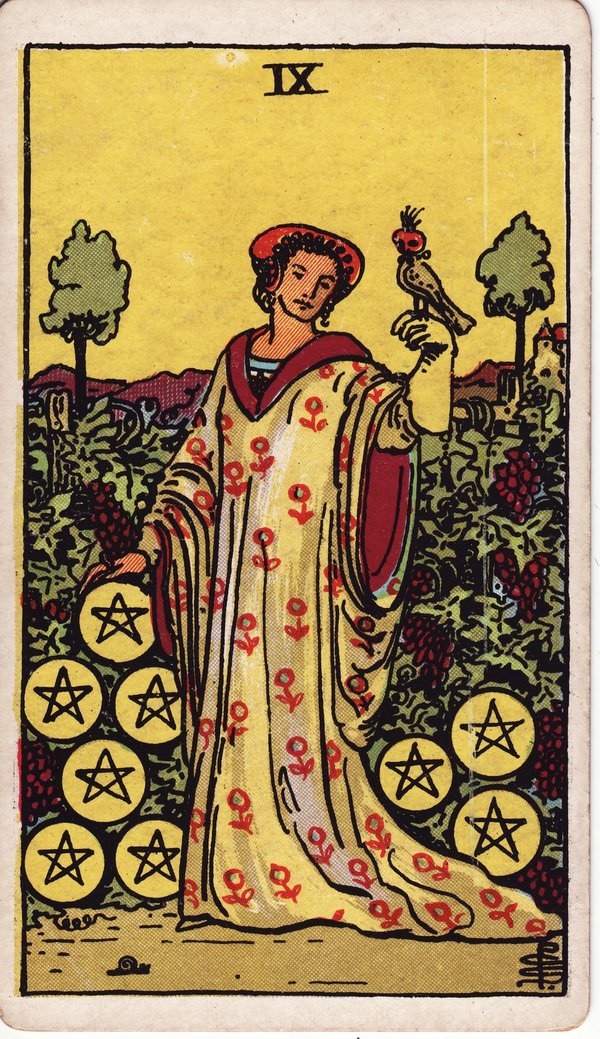
From the Seven of Pentacles (Lord of Failure): The Seven of Pentacles (Taurus 3rd decan, Saturn) is the card of the long pause — the farmer leaning on his hoe, evaluating whether his labor has been worth it. The Eight is the answer to that evaluation: Yes, it is worth it — now get back to work, but work smarter. Where the Seven was characterized by Saturn's heaviness and uncertainty, the Eight carries the Sun's clarity and Virgo's precision. The emotional ambiguity of the Seven resolves into the focused dedication of the Eight. The transition from Seven to Eight is the movement from questioning the work to refining the work — from standing in the field wondering whether to continue to sitting at the bench and continuing with greater skill.
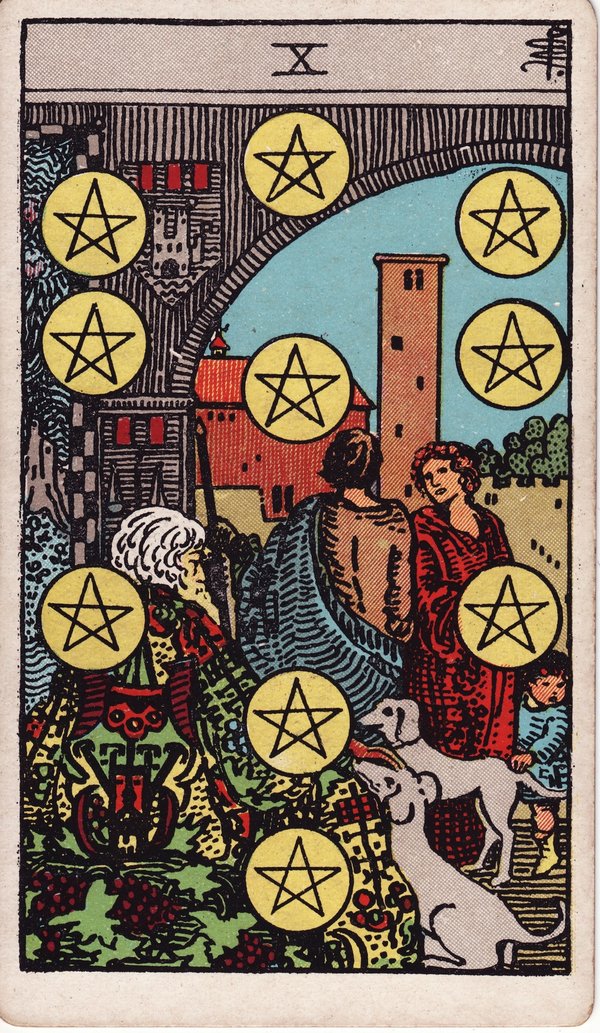
Toward the Nine of Pentacles (Lord of Gain): The Eight's dedicated craftwork lays the foundation for the Nine, where the fruits of that labor become visible as personal abundance, independence, and self-sufficiency. The craftsman who has carved a thousand pentacles eventually produces one that is exquisite — and the market notices. The apprentice who has practiced daily for years wakes up one morning to discover they are now the teacher. The Eight flows into the Nine's quiet confidence: the work was not wasted, the repetitions were not meaningless, the skill has become second nature and now supports a life of earned ease.
The overall arc: The Pentacles suit traces the material journey from potential (Ace) to legacy (Ten). The Eight occupies a critical inflection point — it is the moment when the suit transitions from external circumstance to internal skill. The earlier numbers dealt with what happens to you or what you have (the Two's decisions, the Three's collaboration, the Four's security, the Five's hardship, the Six's generosity, the Seven's assessment). The Eight introduces the dimension of what you become through work — not what you possess but what you can do, not what you have accumulated but what you have mastered. It is the first card in the suit that points toward the Nine and Ten's earned abundance, but it does so not by promising wealth but by demanding craft.
Advising For / Advising Against
-
If advising FOR: Commit to the practice. Whatever skill, craft, or way of being you are developing, now is the time for disciplined repetition. Show up at the bench. Put in the hours. The work itself — not the outcome, not the recognition, not the mastery — the work itself is the path. Find satisfaction in the small improvements, the incremental progress that only you can see. The Sun in Virgo blesses the humble, patient labor that no one applauds and that changes everything.
-
If advising AGAINST: Do not mistake busyness for progress. The Eight reversed warns against perfectionism that prevents completion, against overwork that leads to burnout, against the obsession with craft that sacrifices relationships, health, and joy. It also warns against half-hearted work — the going-through-the-motions that produces shoddy results and erodes self-respect. If you cannot find genuine engagement in the work, it may be time to ask whether this particular craft is yours to pursue. Not every bench is your bench.
Card of the Day
Dedicate yourself fully to the task in front of you today. Whatever it is — a work project, a practice session, a household chore — approach it as a craftsperson. Pay attention to the details. Take pride in doing it well for its own sake. Notice the small improvements that come when you are fully present. The day contains eight hundred opportunities to practice something. Choose one and give yourself to it. Tonight, you'll know what real work feels like.
Card of the Year
The Eight of Pentacles as a year card signals a year of apprenticeship, skill-building, and dedicated practice. This is a year to learn something deeply — a profession, a craft, a physical discipline, a creative practice. The emphasis is on process over product, on repetition over novelty, on depth over breadth. You may find yourself in formal training, under a mentor, or simply committing to a self-directed course of study. The challenges of this year include perfectionism (the Virgo shadow), impatience with slow progress, and the temptation to chase new things instead of deepening current skills. The gifts include the quiet satisfaction of genuine competence, the flow state that comes with deep practice, and the foundation of skill that will support the abundance of the years to come.
Elemental Dignities Notes
The Eight of Pentacles is Earth — the element of body, matter, craft, and tangible results. In a spread, its elemental relationship to neighboring cards follows the Golden Dawn system:
- Strengthened by Earth (Pentacles) and Water (Cups): Like element intensifies like element — multiple Earth cards deepen the focus on material skill and physical craft. Water supports Earth — Cups adjacent to the Eight bring emotional fulfillment to the work, reminding the craftsperson that what they make serves the heart as well as the hand.
- Weakened by Air (Swords): Air is Earth's enemy in elemental dignity. Adjacent Swords cards may indicate that overthinking is interfering with the hands-on quality of the Eight — the mind analyzing when the body should be doing. Alternatively, too much intellectual stimulation may be pulling the craftsperson away from the bench.
- Neutral with Fire (Wands): Fire and Earth have a neutral-to-friendly relationship. Wands adjacent to the Eight can bring creative fire to the work — new ideas, inspired variations, the entrepreneurial energy to market the craft. However, too much Fire can make the patient, repetitive work of the Eight feel unbearably slow.
Deck-Specific Notes
-
If using a Thoth deck: The Thoth Eight of Disks ("Prudence") shifts the visual register from the workshop to the garden. The emphasis is less on personal effort and more on intelligent arrangement — the wisdom of planting the right thing in the right soil at the right time. The card may be read as advice about timing and method rather than sheer diligence. Prudence in the Thoth sense includes knowing when not to work — when to let the soil rest, when the crop needs water rather than cultivation.
-
If using a Marseille-tradition deck: In Marseille decks, eight coins are typically arranged in precise, orderly patterns — often two rows of four, emphasizing structure, balance, and deliberate arrangement. The lack of a figurative scene shifts the interpretive weight to the number eight and its relation to craftsmanship. The Marseille Eight of Coins emphasizes the structural intelligence behind skilled work — the pattern, the method, the underlying order that makes craft possible.
-
If using a blended or contemporary deck: The core themes of dedication, skill development, and the dignity of craft are universal across visual traditions. Consult your deck's guidebook for any departures from the RWS/Thoth framework, particularly regarding astrological attributions or the symbolic vocabulary used to represent focused labor.
Journaling & Contemplation Prompts
- What skill or craft have I always wanted to develop but told myself I didn't have the talent for? What would happen if I substituted "talent" with "five hundred hours of practice"?
- Where in my life am I showing up as an apprentice — humble, attentive, willing to be bad at something before I become good?
- When have I experienced the flow state — the absorption in a task where time disappeared and the work was its own reward? What conditions created that experience?
- Am I taking pride in my work, or am I producing "good enough" and moving on? Which feels more aligned with who I want to be?
- What would I be willing to practice ten thousand times? And if nothing comes to mind, what does that tell me?
Additional Associations
| Association Type | Value |
|---|---|
| Color(s) | Warm gold (the pentacles, the Sun's radiance); earth tones (the workshop, Virgo's groundedness); blue (the craftsman's tunic in RWS, suggesting devotion and clarity); green (Thoth's garden imagery, growth through cultivation) |
| Crystals / Stones | Citrine (Solar energy, abundance through effort, the merchant's stone); Carnelian (creative focus, stamina for long work); Fluorite (mental clarity, the Hod intelligence that organizes skill into method) |
| Herbs / Plants | Rosemary (focus and memory, the scholar's herb); Lavender (the calm concentration of the dedicated craftsperson); Wheat (Virgo's harvest, the grain that sustains, the product of patient cultivation) |
| Archetypes (Jungian) | The Artisan (the maker, the craftsperson, the one who finds meaning in the work of the hands); The Apprentice (the humble beginner, the eternal student); The Smith (Hephaestus/Vulcan — divine craft, the beauty of the well-made thing) |
| Mythological Figures | Hephaestus / Vulcan (the divine smith, the beauty of craft, the integration of work and art); Athena (goddess of wisdom, craft, and weaving — the intelligence that patterns skill); Daedalus (the master craftsman, the labyrinth-builder, the one whose skill borders on the miraculous) |
| Numerological Resonance | 8 = mastery, infinity, the lemniscate of eternal return, the octave (where a scale completes and begins again at a higher level). In the Sephiroth: Hod — the sphere of intellectual splendor, where raw force is shaped by mind. Eight is the number of Hermes/Mercury in Pythagorean numerology — the swift intelligence that knows, names, and perfects. |
| Playing Card Equivalent | 8 of Diamonds — a card of skilled labor, financial growth through personal expertise, and the value of specialized knowledge |
| I Ching Hexagram Parallel | Hexagram 48 — Ching / The Well. "The Well. The town may be changed, but the well cannot be changed." The hexagram of the unchanging source that sustains all — the craftsperson who draws from the deep well of tradition and practice, the skill that outlasts changing fashions. |
| Body / Organ Correspondence | Hands (the primary instruments of craft, the body's most skilled tools); the nervous system (Mercury/Hod — the fine motor control that skilled work requires); the intestines (Virgo's domain — the body's workshop, where raw material is processed with precision) |
Shadow & Integration Message
The Eight of Pentacles' shadow is not laziness — it is the perfectionism that masquerades as diligence. The craftsperson who never finishes because nothing is ever good enough. The student who is always preparing, never performing. The worker who hides in busyness to avoid the deeper question of whether the work is meaningful.
More subtly, the shadow includes the work-as-avoidance pattern — the devotion to craft that becomes a way of avoiding relationships, emotions, or the messiness of life outside the workshop. "I can't — I'm working" becomes a shield against intimacy, against vulnerability, against the risk of being seen as something other than competent.
Integration of the Eight's energy means sustaining the discipline of craft while releasing the compulsion to prove worth through productivity. The integrated Eight works with joy, not desperation — practices because the practice itself is fulfilling, not because the finished product will finally make them "enough." The integrated craftsperson knows when to put down the hammer and join the world.
Elemental Intelligence (Suit Framing)
In the Jungian cognitive function mapping — which maps the four suits to Jungian cognitive functions, humours, and class theory — Pentacles aligns with the Sensation function, the melancholic humour, and the productive/merchant class. Sensation is the cognitive function that learns through direct, concrete, hands-on experience — the apprentice who learns by doing, the craftsperson whose intelligence lives in their hands.
The Eight of Pentacles as Sensation in its most developed mode represents the peak of skill acquisition through practice — the point where the sensor's accumulated physical knowledge becomes so refined that it begins to look like magic to outsiders. This is the "unconscious competence" stage of learning: the craftsperson who no longer needs to think about technique because the body knows.
The melancholic humour, associated with Pentacles, tends toward carefulness, precision, and a certain perfectionistic quality — all of which serve the Eight's dedication to craft but become liabilities when they prevent completion or joy. The class framing of the Pentacles suit as the productive class places the Eight of Pentacles in the position of the journeyman — the skilled worker who has completed apprenticeship and now works with growing independence but has not yet achieved the mastery and autonomy of the Nine.
Timing & Manifestation
For timing in a reading, the Eight of Pentacles maps to the first decan of Virgo, approximately August 23 to September 1. When appearing in a timing position, this card suggests a timeframe of several weeks to a few months — long enough for dedicated practice to show measurable improvement. The Sun's influence suggests that the time will be illuminated — progress will be visible, not hidden.
In manifestation work, the Eight of Pentacles advises: the magic is in the doing. There is no shortcut. The most powerful manifestation practice is consistent, skilled labor directed toward a clear goal. This card blesses the daily practice, the morning pages, the workout routine, the scheduled creative time — all the unglamorous habits that accumulate into transformation.
Yes / No Tendency
The Eight of Pentacles leans toward "Yes, with sustained effort." This is not a card of instant gratification — it does not promise that the outcome will arrive next week or without work. But it does affirm that the path is real, the craft is learnable, and the goal is achievable through diligence. The "yes" of the Eight is: yes, you can build this, master this, become this — if you are willing to do the work. The Sun in Virgo does not shine on empty promises — it shines on the bench where you are sitting right now, illuminating the tools already in your hands.
In reversed / ill-dignified position, the tendency shifts toward "Not until you address the quality of your effort" — the warning against half-hearted work, against perfectionism that prevents completion, against the refusal to invest the time necessary for genuine skill development.
Common Misreads / Nuances to Know
Misread 1: "The Eight of Pentacles means you should work harder." The card is not about the quantity of work but the quality of engagement. It blesses focus, not burnout. The craftsman is not exhausted — he is absorbed. If you are already working too hard, the Eight's message is about finding the flow state within necessary work, not adding more hours.
Misread 2: "The Eight means you're stuck in a rut." Repetition and rut are different phenomena. The Eight's repetition is deliberate, attentive, and oriented toward growth — the musician practicing scales, not the assembly-line worker dissociating. The difference is consciousness: the Eight's craftsman is fully present with his task; the person in a rut has checked out.
Misread 3: "The Eight is only about career and work." While the vocational dimension is prominent, the Eight applies to any domain where skill is developed through practice — relationships (learning to communicate), spirituality (daily meditation), physical health (consistent exercise), creative practice (the daily writing, the daily canvas). The card is about practice in its broadest sense — the intentional repetition that transforms capacity.
Nuance for Thoth readers: The Thoth title "Prudence" should not be read as caution or timidity. In the alchemical tradition, Prudence is the cardinal virtue that knows the right action at the right moment — the wisdom of timing, proportion, and method. The Thoth Eight of Disks often appears when the querent needs to consider not just what they are doing but how and when — the method and timing are as important as the effort.