The Poetic Line
"The arch was built by hands now dust — but the stones remember, and the children in the courtyard sing what you started without knowing you were singing."
Keywords
| Category | Dignified | Undignified |
|---|---|---|
| General | Legacy, inheritance, generational wealth, family, tradition, lasting achievement, material culmination, belonging | Family dysfunction, financial ruin, inheritance disputes, the weight of tradition, being trapped by wealth, losing oneself in the family system, bankrupt legacy |
| Spiritual | The sacredness of lineage, ancestors and descendants as spiritual reality, the material world as divine expression, the sanctification of the home | Ancestral trauma repeating, spiritual inheritance of dysfunction, attachment to material forms preventing spiritual growth, the soul crushed by family expectation |
| Psychological | Rootedness, the security of belonging to something larger than oneself, mature responsibility, the healthy ego that knows its place in a lineage | Enmeshment, being psychologically trapped by family roles, inherited limitation, the shadow of the family system, inability to individuate |
| Physical Health | Inherited vitality, the health of the family line, generational patterns of wellness, the body as an inherited home | Genetic illness, inherited health conditions, the physical toll of maintaining family wealth/structure, neglect of self in service of family |
| Relationships | Marriage as alliance, family bonds, multigenerational household, the partnership that builds something lasting, commitment to legacy | Family feuds, marriage for money, relationships destroyed by inheritance disputes, the couple lost within the larger family system, transactional unions |
| Financial | Generational wealth, inheritance, trusts and estates, the family business, long-term investment strategies, financial legacy, the patriarch's/matriarch's fortune | Inheritance battles, squandered family wealth, financial dependence on family, the burden of inherited debt, wealth that corrupts relationships, golden cage |
| Vocational | Family business, legacy career, building an institution, passing the torch, work that outlasts the worker, the professional dynasty | Nepotism, coasting on family connections, being trapped in the family business, career path dictated by inheritance expectations |
| Shadow / Thoth Distinction | Mercury-in-Virgo's intricate architecture of wealth, the intelligence that builds systems that survive the builder, wealth as both material and spiritual legacy | The shadow of wealth: accumulation without meaning, the dynasty that devours its children, Mercury's cleverness turned to manipulation, inheritance as a substitute for love |
Thoth note: Crowley's "Lord of Wealth" is the culmination of the Pentacles suit's material journey. In the Thoth system, wealth is never merely financial — it is the fullness of manifestation, the density of achieved reality. The Mercury-in-Virgo attribution brings together Mercury's capacity for communication, commerce, and complex systems with Virgo's meticulous attention to detail and orientation toward service. The result is wealth that is not accidental but architected — the product of intelligent design, careful management, and the understanding that true wealth is a system that benefits many, not a pile of coins. The third decan of Virgo is Saturn-ruled (Chaldean sequence), adding a note of gravity and finality — this is the last decan of the last Earth sign of the zodiac year, the harvest before the descent into autumn. A Thoth-influenced reading emphasizes the spiritual dimension of wealth: the Ten of Disks is the alchemical stone achieved — the Great Work completed in its material expression, the proof that spirit can become flesh.
Narrative Description
General Meaning
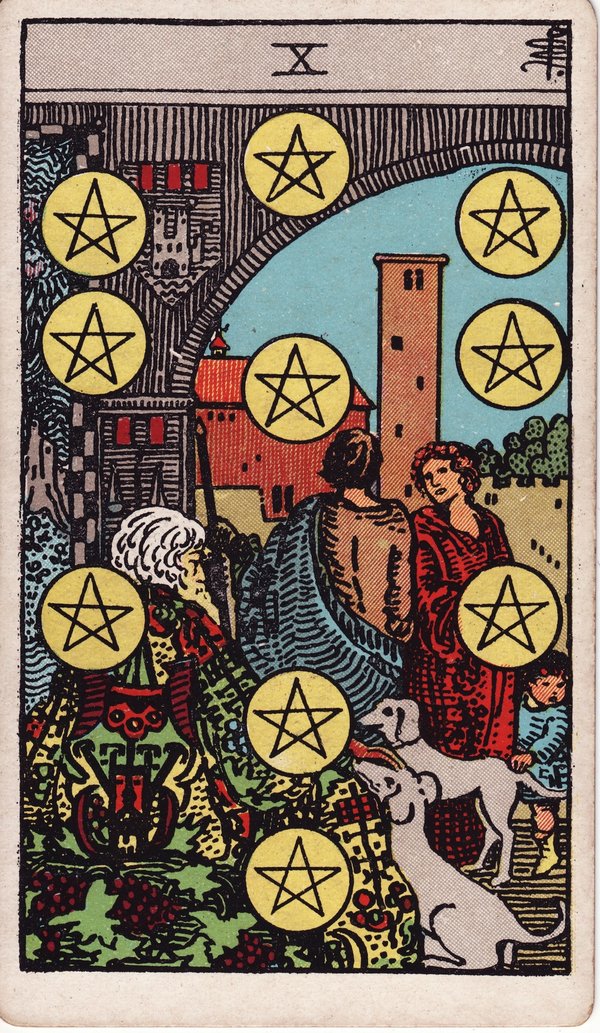
The Ten of Pentacles is the card of arrival — not the arrival of the self-made individual (the Nine) but the arrival of the lineage, the family, the institution. In the RWS image, an elderly patriarch sits in the courtyard of a grand estate, surrounded by his dogs, while a younger couple converses nearby and a child plays at the edge of the scene. Ten pentacles are arranged in the pattern of the Tree of Life above an arched gateway. This is the card of the family fortune, the ancestral home, the business that has passed through three generations, the legacy that was built over a lifetime and now supports lives the builder will never meet.
The energy is Mercury in Virgo — the swift intelligence of Mercury channeled through Virgo's disciplined, analytical, service-oriented nature. This is Mercury not as the trickster messenger but as the architect of trade, the designer of systems, the intelligence that understands how wealth is structured, maintained, and transmitted. The Ten of Pentacles is not about winning the lottery — it is about the estate plan, the family trust, the business succession, the long, careful work of building something that will outlast the builder.
For the querent, the Ten of Pentacles asks: What are you building that will survive you? What structures — financial, familial, institutional — are you a part of, and what is your role in sustaining or transforming them? And more personally: Do you know where you belong? In the family, the lineage, the community — can you locate yourself within the larger story? This card blesses the rooted, the established, the multigenerational. But it also challenges: are the structures supporting life or constraining it? Is the legacy you inherit a gift or a burden?
Symbolism & Imagery
Rider-Waite-Smith (1909): Pamela Colman Smith's Ten of Pentacles is one of the most architecturally rich compositions in the deck. The scene is set before a grand stone archway that frames a view into a wealthy estate. The arch itself is carved with heraldic emblems — symbols of lineage, coat of arms, the visual language of inherited status. Ten pentacles are arranged in the form of the Tree of Life on the arch, explicitly linking material wealth with the Kabbalistic structure of creation — as if to say: this family, this fortune, this legacy is a microcosm of the divine order.
In the foreground, an elderly man in a richly embroidered robe sits with two white hounds. He is the patriarch — the one who built the fortune, or the current steward of a fortune built before him. His posture is relaxed but his presence is weighty. The hounds, symbols of loyalty and the tamed animal nature, sit at his feet. They suggest that the wild instincts that built the fortune have been civilized, domesticated, integrated into the family structure.
To the left, a younger man and woman stand in conversation — the next generation. Their posture is comfortable, familiar; they live within the estate, within the fortune, as naturally as fish in water. They are not building — they are inhabiting. They may be discussing the future of the family, the management of the wealth, the raising of the child. A small child — barely visible, often overlooked — plays at the far left of the card. This is the third generation, the one for whom all of this is merely the world into which they were born. The child does not know that the arch was built, that the fortune was earned, that the patriarch was once young and hungry. The child simply lives.
The gateway behind the family opens into a view of the estate — towers, buildings, the suggestion of a domain that extends beyond the frame. This is not a single house; it is a seat of power, a landed estate, generational wealth made visible in stone. But the gate is also a threshold — between the family and the outside world, between the generations, between life and death, between what has been built and what will be built next.
Thoth (Crowley/Harris, 1944): The Thoth Ten of Disks is titled "Wealth" and presents ten disks arranged in a complex, interlocking pattern that suggests both the Tree of Life and the structure of a well-designed system. The disks are richly ornamented with symbolic patterns — hexagrams, geometric figures, astrological symbols — emphasizing the intelligence of wealth, the understanding that true prosperity is not a pile of coins but a working architecture. The background colors are rich earth tones and deep golds, suggesting autumn harvest, the fullness of the season, the moment before the cycle turns.
Crowley writes that this card represents "the complete manifestation of material prosperity and riches, and consequently the culmination of all the work that has been done under the influence of the previous cards." The Mercury-in-Virgo quality manifests as the intricate pattern — wealth that is not merely accumulated but designed, structured with the same intelligence that governs language, trade, and communication. The Thoth Ten of Disks is about the system of wealth — the understanding that a fortune is not a thing you have but a set of relationships, commitments, and structures that you participate in.
The key difference between traditions: RWS personalizes wealth as a family narrative — the patriarch, the heirs, the estate. Thoth abstracts wealth as a structural pattern — the design, the system, the architecture. RWS tells the story; Thoth shows the blueprint. Both traditions agree on the fundamental truth: the Ten is not about having money but about belonging to something that has been built over time — something that was here before you and will, if well-tended, remain after you.
Astrological & Elemental Layer
The Ten of Pentacles carries Mercury in Virgo — a combination that fuses Mercurial intelligence with Virgoan precision, producing wealth that is not merely possessed but understood and managed.
Mercury is the planet of communication, commerce, intellect, and the movement of information and goods. Mercury governs trade, negotiation, contracts, and the systems — legal, financial, linguistic — that allow value to be created, measured, and transferred. In the decan system, Mercury brings adaptability, cleverness, and the capacity to see the patterns that others miss. Mercury is the planet of the merchant, the lawyer, the accountant, the system architect — all the roles that build and maintain wealth.
Virgo is the mutable Earth sign — analytical, meticulous, service-oriented, and deeply attentive to detail. Virgo is Mercury's Earth home (Mercury rules Virgo), which makes Mercury's intellectual gifts particularly focused and practical here. This is not Mercury flitting between ideas but Mercury building a spreadsheet, Mercury auditing the accounts, Mercury designing the estate plan. When Mercury is in Virgo, its intelligence serves the material world — it wants to know how things work and how to make them work better.
The third decan of Virgo (approximately September 12–22) is Saturn-ruled in the Chaldean sequence, which adds a note of gravity, finality, and structural integrity to Mercury's intelligence. This is the last decan of Virgo, the last decan of the last Earth sign before the zodiac turns to Libra and autumn begins. There is a quality of summation, of ripeness, of the moment when the harvest must be gathered or lost. The Saturnine influence ensures that the wealth of the Ten is not frivolous or ephemeral — it is structured, tested, built to last.
The elemental layer places this in Pentacles/Earth, which governs material reality at its densest — land, money, inheritance, the physical structures of civilization. Mercury in Virgo within Earth is the card of intelligent wealth — money that is not just made but managed, fortunes that are not just accumulated but architected, legacies that are designed to endure. It is the difference between the spendthrift and the steward, between the lottery winner and the family whose wealth has survived for five generations.
Kabbalistic / Tree of Life Layer
The Ten of Pentacles sits in Malkuth, the tenth and final Sephirah on the Tree of Life — the Kingdom, the sphere of physical manifestation, the material world. Malkuth is unique among the Sephiroth: it is the only sphere that has no light of its own but reflects the light of all the others. It is the receiver, the vessel, the place where spirit becomes matter. The Kabbalists say that Malkuth and Kether are one — the lowest Sephirah is identical in essence to the highest, just experienced at a different density. The Ten of Pentacles, as Malkuth in the suit of Earth, is the densest, most substantial card in the entire deck — the place where the suit's entire journey condenses into stone and gold and inheritance law.
In the Sephirothic arc of the numbered cards, the Ten represents completion — the full expression of the suit's energy in all its dimensions. After the Nine's personal integration of abundance (Yesod), the Ten (Malkuth) represents the externalization of that abundance into the world — the fortune that is no longer private (the Nine's solitary garden) but public, shared, institutional. The money moves from the personal account to the family trust. The skill moves from the individual craftsperson (Eight) to the training program that teaches the craft to the next generation. The assessment of the Seven and the generosity of the Six all find their culmination here: the structures of material life that sustain human civilization.
Malkuth's quality of density is essential to understanding the Ten of Pentacles. This card is not about spiritual wealth or emotional abundance — though those may accompany it. It is about actual wealth — money, land, houses, businesses, the tangible assets that can be inherited and that shape the material conditions of life. The Kabbalistic teaching is that this is not "lower" than spiritual wealth — Malkuth is not inferior to Kether, only more contracted. The Ten of Pentacles affirms that the material world is a valid and sacred domain, that building a family fortune can be a form of spiritual practice, that the arch of stone honors the divine as truly as the prayer of the hermit.
Sequential Narrative: Position in the Suit Story
The Ten of Pentacles is the final card in the suit's narrative — the destination toward which every previous number has been traveling.
From the Nine of Pentacles (Lord of Gain): The Nine of Pentacles (Venus in Virgo, 2nd decan) was the card of personal, solitary abundance — the self-made woman standing alone in her garden. The Ten is the expansion of that personal achievement into a shared, generational legacy. Where the Nine asked "what have I built for myself?", the Ten asks "what have I built that will survive me?" The shift from Venus (Nine) to Mercury (Ten) is the movement from the enjoyment of wealth to the management of wealth — from the pleasure of standing in the garden to the responsibility of designing an estate that will feed descendants. The Nine's falcon is a personal tool; the Ten's heraldic arch is a family crest.
Toward the Ace of Pentacles (the return): In the cyclical understanding of the suit, the Ten flows back into the Ace — the completion of one cycle generates the seed of the next. The fortune established in the Ten becomes the inheritance that seeds the next generation's potential (Ace). But this is not automatic — the Ten that is hoarded, corrupted, or squandered does not become a fertile Ace but a dead end. The Ten's spiritual task is to ensure that the wealth it accumulates serves life — that the arch remains a gateway, not a wall.
The overall arc: The Pentacles suit traces the material journey from potential to legacy. The Ten is the suit's telos — the purpose toward which the Ace's seed, the Two's decision, the Three's collaboration, the Four's security, the Five's hardship, the Six's generosity, the Seven's assessment, the Eight's craft, and the Nine's abundance have all been building. It is the card of the completed work — the life's project finished, the family provided for, the institution established. And because it is Malkuth, the end that is also a beginning, it carries the implicit question: What next? What will you build with what has been built for you?
Advising For / Advising Against
-
If advising FOR: Take the long view. Think in generations, not quarters. The structures you are building — family, business, financial, institutional — have the potential to outlast you, and that potential is sacred. Invest in permanence. Write the will, establish the trust, train the successor, document the system. The Mercury-in-Virgo energy asks you to attend to the details of legacy — the small print that determines whether what you have built will survive your departure. And equally important: enjoy the belonging. You are part of something larger than yourself — a family, a lineage, a tradition. Receive that as a gift, even as you work to pass it forward.
-
If advising AGAINST: Do not mistake the structure for the soul it is meant to serve. The Ten reversed warns against inheritance that crushes individuality, family systems that demand conformity at the expense of wellbeing, wealth that becomes a prison rather than a platform. It also warns against squandering what has been built — the fortune that disappears in a generation because the heirs never learned the discipline of the Eight or the humility of the Seven. If you inherit this card's reversed energy, ask: Is the legacy lifting me or crushing me? Am I a steward or a parasite? What am I building that will outlast me — and if the answer is nothing, what needs to change?
Card of the Day
Consider today what you are part of that extends beyond your lifetime. A family, a tradition, an institution, a community — something that was here before you and will be here after. What is your role in that larger story? Steward, rebuilder, beneficiary, founder? Allow yourself to feel the weight and the gift of belonging to something multigenerational. If the legacy is complicated — and most are — hold the complications with the same respect you hold the gifts. Nothing real is unsullied. Nothing lasting is simple.
Card of the Year
The Ten of Pentacles as a year card signals a year of culmination, inheritance, and the settling of legacies — both literal and figurative. Financially, it may bring the maturation of long-term investments, the receipt of an inheritance, the sale of a major asset, or the completion of a large financial project (buying a home, establishing a business). Familially, it may involve weddings, births, deaths, and the reorganization of family structures around a new generation or the departure of an old one. It is a year of rootedness — of belonging to something, whether you chose it or inherited it. The challenge is to receive the legacy without being defined by it, to honor the past without being trapped by it, and to ensure that what you pass forward is more life-giving than what you received. The gift is the deep stability of knowing where you come from and where you belong.
Elemental Dignities Notes
The Ten of Pentacles is Earth — the element of body, matter, stability, and physical legacy. In a spread, its elemental relationship to neighboring cards follows the Golden Dawn system:
-
Strengthened by Earth (Pentacles) and Water (Cups): Like element intensifies like element — multiple Earth cards deepen the focus on material legacy, inheritance, and physical structures. Water supports Earth — Cups adjacent to the Ten bring emotional richness to the legacy, suggesting that the family's true wealth is love, not money, or that the inheritance comes with genuine emotional connection rather than cold transaction.
-
Weakened by Air (Swords): Air is Earth's enemy in elemental dignity. Adjacent Swords cards may indicate legal disputes over the inheritance, family conflicts driven by intellectual or ideological divisions, or the kind of over-analysis that paralyzes the transmission of wealth. Swords can also indicate that the family system is cutting off individual expression — the cold wind of judgment that prevents the child from becoming anything other than the parent's design.
-
Neutral with Fire (Wands): Fire and Earth have a neutral-to-friendly relationship. Wands adjacent to the Ten can bring entrepreneurial fire to the established wealth — new ventures, expansion, the dynamic energy that prevents the family fortune from stagnating. However, too much Fire may destabilize the careful structures of the Ten — the impulsive heir who burns through the fortune the patient patriarch built.
Deck-Specific Notes
-
If using a Thoth deck: The Thoth Ten of Disks ("Wealth") presents abundance as a complex structural pattern rather than a family narrative. The absence of human figures invites the reader to consider wealth as a system — the architecture of prosperity — rather than as a personal drama. In a Thoth-influenced reading, the card may be interpreted as advice about the design and management of resources, the intelligence that makes wealth sustainable, and the spiritual understanding that true wealth is a system that serves life.
-
If using a Marseille-tradition deck: In Marseille decks, ten coins are typically arranged in dense, abundant patterns — often the Tree of Life formation or variations that emphasize fullness and completion. The lack of a figurative scene shifts the interpretive weight to the number ten: the end of the cycle, the fullness of manifestation, the return to unity. The Marseille Ten of Coins emphasizes the abstract quality of completion — the satisfaction of a cycle fully realized.
-
If using a blended or contemporary deck: The core themes of legacy, inheritance, family, and lasting material achievement are universal across visual traditions. Consult your deck's guidebook for any departures from the RWS/Thoth framework, particularly regarding the card's relationship to wealth, family, or the numerological/spiritual meaning of the Ten.
Journaling & Contemplation Prompts
- What am I building that will outlast me? If I died tomorrow, what would remain of my work, my values, my love — and is that enough?
- What legacy have I inherited — from my family, my culture, my ancestors? What parts of it do I cherish? What parts do I need to heal, transform, or release?
- Where do I belong? In my family, my community, my lineage — can I name my place, my role, my responsibility? If not, what would it take to find it?
- Is the structure of my material life (home, finances, career, relationships) serving the life I want to live — or am I living in service to the structure?
- If I were the child at the edge of this card — born into a world I did not create — what would I want the adults who built that world to have done differently?
Additional Associations
| Association Type | Value |
|---|---|
| Color(s) | Deep gold (the pentacles, accumulated wealth); rich earth tones (Malkuth, the material world); stone grey (the arch, permanence, the structures that outlast lives); burgundy/crimson (the patriarch's robe, the weight of tradition) |
| Crystals / Stones | Garnet (the stone of commitment, grounding, and prosperity across generations); Black Tourmaline (Malkuth's stone of grounding and protection — the foundation that supports the structure); Tiger's Eye (wealth, practicality, the balance between material and spiritual abundance) |
| Herbs / Plants | Oak (the tree of the patriarch, slow growth, deep roots, the wood of doors and thresholds — the gateway to the estate); Cedar (strength, preservation, the wood used to build lasting structures); Wheat (the harvest, the staff of life, the grain that feeds the village — Virgo's harvest completed) |
| Archetypes (Jungian) | The Patriarch/Matriarch (the founder, the elder, the one who built it); The Heir (the receiver of the legacy, the steward of what was built); The Ancestor (the presence of those who came before, the invisible lineage that shapes the visible life) |
| Mythological Figures | Saturn / Chronos (the god of time and harvest, the weight of the completed cycle, the patriarch who must eventually yield to the next generation); Abraham (the biblical patriarch, the founder of a lineage, the one to whom the promise of descendants was given); Penelope (the weaver who maintains the household through twenty years, the matriarch whose patience sustains the legacy) |
| Numerological Resonance | 10 = completion, the Tetractys (1 + 2 + 3 + 4), the decade, the number of the Sephiroth. Ten is the number of manifestation — the Tree of Life in its fullness, the divine architecture that contains all creation. In the Sephiroth: Malkuth — the Kingdom, the physical world, the place where spirit becomes matter. Ten is both an ending and a return: 1 + 0 = 1, the Ace reborn. |
| Playing Card Equivalent | 10 of Diamonds — a card of financial completion, the family fortune, the inheritance that secures the future |
| I Ching Hexagram Parallel | Hexagram 11 — T'ai / Peace. "Peace. The small departs; the great approaches. Good fortune. Success." The hexagram of heaven and earth in harmony — the ideal state where the spiritual pervades the material and all things are in their proper place. The Ten's legacy, at its best, is this peace: the order that allows life to flourish. |
| Body / Organ Correspondence | The skeletal system (the body's architecture, the structure that outlasts the soft tissue — the body's legacy); the DNA (the literal inheritance, the code passed from generation to generation); the skin (Malkuth's organ of boundary, the container of the self, the interface between inner and outer) |
Shadow & Integration Message
The Ten of Pentacles' shadow is not poverty — it is the family system that becomes a prison. The patriarch whose love is conditional on the heir following the prescribed path. The fortune that becomes a weapon — "do as I say or you're out of the will." The generational trauma that travels alongside the generational wealth, invisible as the air in the courtyard, shaping lives without ever being named.
More subtly, the shadow includes the neglect of the individual in favor of the dynasty. The child at the edge of the RWS card is alone — playing by himself, separate from the adults. He is the future of the family, but he is also, right now, a person who needs attention and presence, not just an inheritance. The shadow of the Ten is the belief that money can substitute for love, that providing structure is the same as providing care, that the arch is more important than the people who walk under it.
Integration of the Ten's energy means holding the legacy lightly — honoring the ancestors without being bound by their limitations, receiving the inheritance without being defined by it, building structures that serve the flourishing of actual human beings rather than the perpetuation of a name. The integrated Ten knows that the most valuable inheritance is not money but wisdom, not the estate but the story of how it was built, not the arch but the gateway that remains open.
Elemental Intelligence (Suit Framing)
In the Jungian cognitive function mapping — which maps the four suits to Jungian cognitive functions, humours, and class theory — Pentacles aligns with the Sensation function, the melancholic humour, and the productive/merchant class. Sensation is the cognitive function that values the tangible, the inherited, the real — the estate that can be walked through, the gold that can be counted.
The Ten of Pentacles as Sensation in its most crystallized form represents the point where the sensor's relationship to the material world becomes institutional — no longer just individual objects but whole systems of ownership, inheritance, and legacy. This is the Sensation that has learned to think in centuries — that understands a building not as a one-time project but as a structure that will house generations.
The melancholic humour, associated with Pentacles, tends toward carefulness, tradition, and a certain respect for what has endured — all of which serve the Ten's orientation toward legacy. The class framing of the Pentacles suit as the productive class places the Ten of Pentacles in the position of the landed proprietor — the merchant family that has risen through trade to become an institution, the craft dynasty whose name has become synonymous with quality. They have arrived — and now the question is what "arrival" means for the souls who live inside the estate.
Timing & Manifestation
For timing in a reading, the Ten of Pentacles maps to the third decan of Virgo, approximately September 12 to September 22. When appearing in a timing position, this card suggests that events are reaching culmination — the harvest is at hand. The time for planting (Ace), tending (Eight), and waiting (Seven) is over; now is the time of gathering. For questions about inheritance or long-term financial outcomes, the Ten may indicate a timeframe of months to a year — the Saturn-influenced decan does not rush, but it delivers.
In manifestation work, the Ten of Pentacles advises: think in terms of structures that will outlast you. The most powerful manifestation is not the acquisition of things but the creation of systems — the business, the trust, the training program, the family tradition — that will continue generating abundance long after the initial impulse has passed. Plant trees under whose shade you will never sit. That is the Malkuth magic of the Ten.
Yes / No Tendency
The Ten of Pentacles leans toward "Yes — with permanence." This is one of the strongest affirmatives in the deck for questions about financial security, family matters, inheritance, and long-term stability. The "yes" is not conditional — the structures are in place, the lineage is solid, the wealth is real. But the card adds a subtext: this blessing comes with responsibility. The "yes" is not a lottery win (that is more the Wheel of Fortune or the Ace) — it is an inheritance, a family business, an established institution. You did not build this alone, and you are not free to treat it as a personal indulgence. The yes comes with membership in something larger than yourself.
In reversed / ill-dignified position, the tendency shifts toward "The structure is unstable — examine the foundation." The inheritance may be more burden than blessing. The family system may be dysfunctional beneath the beautiful surface. The wealth may have been accumulated at costs that are now coming due. Or the querent may be rejecting the legacy — refusing to participate, walking away from the fortune — which may be a liberation or a loss, depending on the surrounding cards.
Common Misreads / Nuances to Know
Misread 1: "The Ten of Pentacles means you're going to be rich." The card is not a promise of personal enrichment so much as an acknowledgment of existing wealth — whether the querent's own or their family's. In many readings, the Ten indicates that the querent is part of a larger structure of material abundance, not that they are about to receive a windfall. The blessing of the Ten is belonging, not winning.
Misread 2: "The Ten means a happy family." The RWS Ten shows a family, and the card is often read as "happy family, domestic bliss." But the card is fundamentally about legacy, not relationship quality. A family can be wealthy and miserable; a fortune can be intact while the individuals are crushed. The Ten describes the material structure; the emotional content of that structure is determined by the surrounding cards.
Misread 3: "The Ten reversed means financial ruin." While financial loss is one possible reading, the reversed Ten often has more to do with the meaning of wealth than its quantity. The querent may have money but be spiritually impoverished. The inheritance may be intact but feel like a curse. The family may be wealthy but toxic. The reversal often indicates a crisis of values around money and family, not a crisis of solvency.
Misread 4: "The dog at the Ten means loyalty." In the RWS image, the two white hounds at the patriarch's feet are often read as symbols of loyalty and fidelity. But in the iconography of the period, hounds also represented the tamed animal nature — the instincts that built the fortune (the hunt, the kill, the competitive drive) now domesticated and aestheticized. The dogs are a reminder that every family fortune was built, at some point, by people who were ruthless enough to accumulate — and the civility of the present moment rests on earlier generations' ferocity.
Nuance for Thoth readers: The Thoth title "Wealth" should be understood within the alchemical framework, where material wealth is the external sign of an internal completion. The Thoth Ten of Disks often appears when the querent is being asked to recognize that their material circumstances are a mirror of their spiritual development — and that the management of money is, for this person at this time, a spiritual practice. The intricate geometric patterns on the Thoth disks suggest that wealth is a design problem — a question of structure, proportion, and the intelligence to build systems that serve life.