The Poetic Line
"The garden is yours. The falcon waits. You were never the one who needed saving."
Keywords
| Category | Dignified | Undignified |
|---|---|---|
| General | Self-sufficiency, earned abundance, independence, refinement, luxury, cultivated grace, enjoying the fruits of labor | Financial dependence, insecurity despite wealth, isolation mistaken for independence, materialism without meaning, looking rich but feeling empty |
| Spiritual | Gratitude for abundance, the sacredness of solo time, self-worth as spiritual truth, the garden as sanctuary | Spiritual materialism, treating enlightenment as another luxury good, using spiritual practice to avoid intimacy, loneliness masked as chosen solitude |
| Psychological | Self-esteem, healthy autonomy, confidence earned through competence, comfort in one's own company, self-respect | Arrogance masking insecurity, inability to receive help, isolation as defense, equating net worth with self-worth, fear of losing what was gained |
| Physical Health | Enjoying a well-maintained body, the results of consistent self-care, physical grace, savoring sensual pleasures in balance | Overindulgence in luxury and food, body as status symbol, neglecting health while appearing well, addiction to comfort |
| Relationships | Choosing partnership from want not need, maintaining independence within intimacy, attracting from a place of fullness | Refusing to let anyone in, measuring partners by their financial worth, keeping people at a distance behind a beautiful life, transactional relationships |
| Financial | Financial independence, passive income, enjoying wealth without guilt, the reward of long-term investment, treating yourself | Debt-financed lifestyle, being "house poor," spending to fill an emotional void, financial insecurity masked by appearances, dependence on others' money |
| Vocational | Career mastery, being at the top of one's field, working by choice not necessity, the professional who can afford to be selective | Coasting on past success, golden handcuffs, career plateau masked by trappings, the successful person who hates what they do |
| Shadow / Thoth Distinction | Venus-in-Virgo refinement, the earned grace of the cultivated self, solitude as chosen richness, the falcon as disciplined desire, gain as spiritual as well as material | The shadow of gain: accumulation without satisfaction, beauty without depth, the garden that becomes a fortress, luxury as compensation for loneliness |
Thoth note: Crowley's "Lord of Gain" is deceptively simple. In the Thoth system, "gain" is not merely financial — it is the alchemical acquisition of substance, the solidification of spiritual energy into material form. The Venus-in-Virgo attribution brings together Venus's capacity for beauty, pleasure, and value with Virgo's discipline, discernment, and attention to detail. The result is gain that is not luck but the natural fruit of cultivated skill — the harvest that comes to those who have learned to tend their garden well. A Thoth-influenced reading emphasizes the alchemical principle of "as above, so below": the material abundance of the Nine is a reflection of an inner abundance that was cultivated first in the soul.
Narrative Description
General Meaning
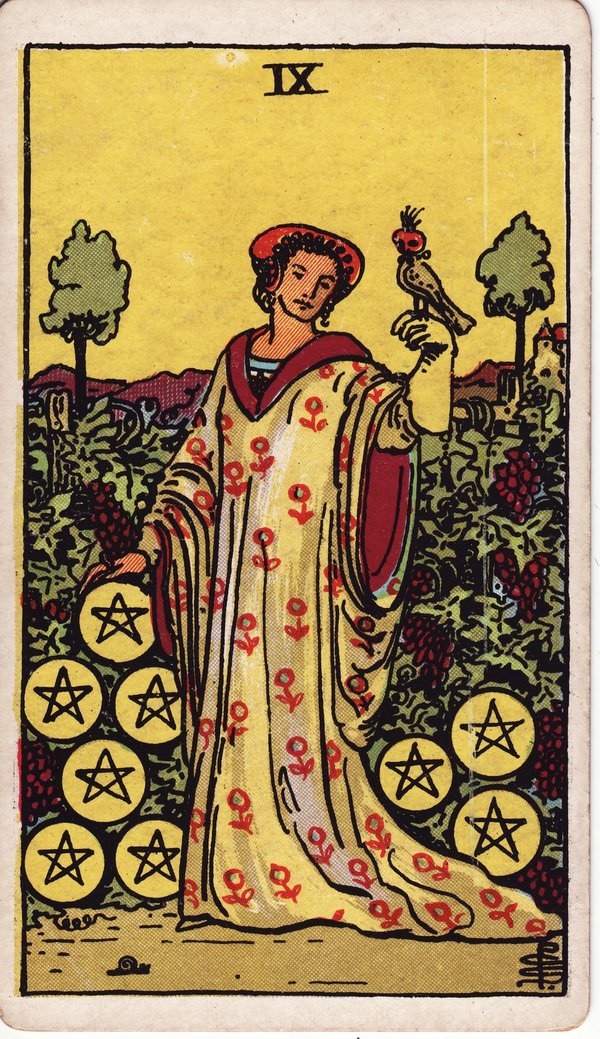
The Nine of Pentacles is the card of the self-made woman — the one who has done the work, built the life, cultivated the garden, and now stands in it, alone and complete. In the RWS image, a woman in a flowing golden robe stands in a vineyard at harvest time. A hooded falcon rests on her gloved left hand. Behind her, grapevines heavy with fruit climb a trellis. Nine pentacles form an arc of abundance around her. She is elegant, composed, utterly at ease — and entirely alone. Not lonely. Alone. The distinction is the card's entire teaching.
This card appears when the querent has reached — or is approaching — a state of earned self-sufficiency. The energy is Venus in Virgo: Venus brings beauty, pleasure, and the capacity to receive and enjoy; Virgo brings discipline, discernment, and the willingness to do the unglamorous work. Together, they form the Venus that is not merely decorative but accomplished — the beauty that comes from cultivation, the pleasure that is not purchased but grown. This is not the Venus of the Empress (fertile, generative, Mother) but the Venus of the woman who owns the vineyard, who has pruned the vines herself, who knows exactly what her life costs and exactly what it produces.
For the querent, the Nine of Pentacles asks: Can you stand in your own abundance without apology? Can you receive what you have earned without guilt? Can you enjoy the garden without needing someone else to validate that it is beautiful? And more challengingly: Is your solitude chosen or defensive? Does your independence serve connection, or does it prevent it?
Symbolism & Imagery
Rider-Waite-Smith (1909): Pamela Colman Smith's Nine of Pentacles is one of the most visually sumptuous cards in the deck. The central figure is a woman in a long, flowing golden gown embroidered with Venus symbols — the glyph for the planet, the sign of the feminine, the mark of beauty and value. Her red cap and sleeves add a note of vitality and passion within the overall golden elegance. She stands in a cultivated garden — not wild nature but tended nature, a vineyard at harvest. The grapes are ripe, the vines are heavy, the season is peak abundance.
On her gloved left hand perches a hooded falcon — one of the most symbolically loaded details in the minor arcana. The falcon is a bird of prey, a hunter, a creature of sharp vision and lethal precision. But it is hooded — its power is contained, disciplined, held in reserve. The woman does not need her falcon to hunt for her right now. She has trained it, she commands it, and she chooses when to release it. The falcon represents desire, ambition, and the killer instinct — all of which this woman possesses, and all of which she has brought under the discipline of her will.
Behind her, a formal garden with a trellised grapevine — order imposed on nature, fertility channeled through structure. A small snail, barely visible at the bottom left of the card, represents the slow, patient pace at which this abundance was built. There was no overnight success here. The garden was planted one seed at a time, the falcon trained one command at a time, the woman shaped one discipline at a time. In the distance, a manor house — the seat of her domain — sits serenely in the landscape. She owns this view.
Thoth (Crowley/Harris, 1944): The Thoth Nine of Disks is titled "Gain" and presents nine golden disks arranged in a geometric pattern that suggests the completeness of the Ennead — the ninefold structure that, in Pythagorean and Egyptian thought, represents the fullness of manifestation. The disks are radiant and ornate, each marked with a different symbolic pattern, suggesting the diversity and completeness of material abundance. There is no human figure — the Thoth version abstracts the RWS woman's achievement into pure pattern, the structural evidence of accomplished work.
Crowley writes that this card represents "the full manifestation of material prosperity and well-being." The Venus-in-Virgo quality manifests as the beauty of the well-ordered garden — the aesthetic pleasure that comes not from decoration but from the sight of a system working perfectly. The Thoth Nine of Disks is about the architecture of abundance — the understanding that a beautiful life, like a beautiful garden, is the product of sound design, consistent maintenance, and the wisdom to let some things grow while pruning others.
The key difference between traditions: RWS personalizes the achievement — the woman in her garden is a specific person enjoying specific fruits. Thoth abstracts the achievement — the pattern of disks is a universal structure. RWS emphasizes enjoyment — the pleasure of standing in one's own garden. Thoth emphasizes completeness — the structural integrity of a system that produces sustainable abundance. Both traditions agree on the fundamental truth: the Nine is not gifted but earned, not luck but cultivation.
Astrological & Elemental Layer
The Nine of Pentacles carries Venus in Virgo — a combination that integrates Venusian grace with Virgoan discipline, producing the most refined and earned expression of the Pentacles suit.
Venus is the planet of love, beauty, value, pleasure, and the capacity to attract and receive. Venus governs what we desire, what we find beautiful, and how we experience the sweetness of life. In the decan system, Venus brings harmony, aesthetic sensitivity, and a natural relationship with abundance. Venus does not fight for value — Venus recognizes value, cultivates it, and radiates it.
Virgo is the mutable Earth sign — analytical, discerning, perfectionistic, oriented toward service and refinement. Virgo is the sign that improves things — the editor, the craftsperson, the healer, the one who can see what is wrong and fix it. When Venus enters Virgo, the combination is potent: Venus provides the sense of what is beautiful and desirable; Virgo provides the discipline to actually build it. This is not Venus lounging on a couch — it is Venus with dirt under her fingernails, Venus who has pruned the roses and knows that beauty requires maintenance.
The second decan of Virgo (approximately September 2–11) carries Venus's rulership in the Chaldean sequence. This is the decan where Virgo's analytical gifts are softened and enriched by Venus's aesthetic sensitivity. The result is a Virgo that cares not only about what works but about what is beautiful — the Virgo of the master gardener, the Virgo of the designer, the Virgo of the artisan whose work is both functional and exquisite.
The elemental layer places this in Pentacles/Earth, which governs material reality — money, body, home, the tangible world. Venus in Virgo within Earth is the card of cultivated abundance — wealth that is not merely accumulated but curated, a life that is not merely comfortable but beautiful, a body that is not merely healthy but honored. It is the difference between having money and having taste, between owning things and curating a life.
Kabbalistic / Tree of Life Layer
The Nine of Pentacles sits in Yesod, the ninth Sephirah on the Tree of Life — the sphere of the Foundation, the Moon, the astral realm, and the threshold between spirit and matter. Yesod is the last Sephirah before Malkuth — the final vessel that receives the emanations of all higher Sephiroth and stabilizes them into a coherent form capable of manifesting in the physical world.
In the Sephirothic arc of the numbered cards, the Nine represents the culmination of the suit's energy — the fullness of the cycle before the Ten's completion-in-manifestation. After the Eight's intellectual refinement of craft (Hod), the Nine (Yesod) represents the internalization and integration of all that has been learned. The skill has become second nature. The discipline has become identity. The craftsman who spent years at the bench now walks through the world as a master — not because they are always working but because the work has become part of who they are.
Yesod's Lunar quality is essential to understanding the Nine of Pentacles. The Moon reflects light rather than generating it — and the Nine of Pentacles reflects the accumulated wisdom of the entire suit back to the self. The woman in the garden is not creating new pentacles; she is standing in the presence of pentacles already created, receiving their meaning, allowing them to confirm something about who she is. This is the Lunar wisdom of the Nine: abundance is not just something you have; it is something you become — something that reshapes your identity, your sense of worth, your relationship to the world.
The path forward is into Malkuth (the Ten), where the Nine's personal abundance expands outward into legacy, inheritance, family, and the material structures that survive beyond the individual. But the Nine itself is not yet about transmission — it is about arrival. The self-made person who pauses to recognize that they have, in fact, arrived.
Sequential Narrative: Position in the Suit Story
The Nine of Pentacles is the suit's attainment — the point where the long arc of material development reaches its personal culmination.
From the Eight of Pentacles (Lord of Prudence): The Eight of Pentacles (Sun in Virgo, 1st decan) was the card of apprenticeship — the dedicated repetition, the focused practice, the disciplined refinement of skill. The Nine is the fruit of that apprenticeship. The bench has become the garden. The individual pentacles the craftsman carved one by one have accumulated into a vineyard. Where the Eight was about doing, the Nine is about having done — and now being the person who has done it. The shift from Sun (Eight) to Venus (Nine) is the movement from the discipline of illumination to the pleasure of arrival — from the hot focus of the workshop to the cool serenity of the garden.
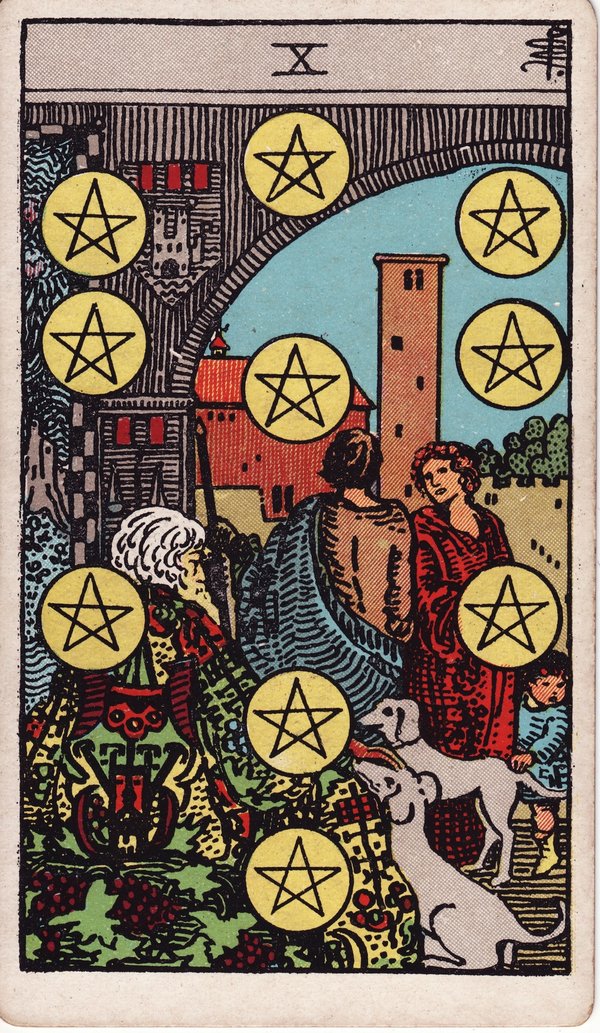
Toward the Ten of Pentacles (Lord of Wealth): The Nine's personal, solitary abundance naturally extends into the Ten, where the wealth becomes generational — the family estate, the inheritance, the legacy. Where the Nine is the self-made individual standing alone in her garden, the Ten is the family gathered beneath the archway of accumulated generations. The Nine flows into the Ten's broader vision — the question shifts from "what have I built for myself?" to "what have I built that will outlast me?" The transition is the movement from independence to lineage, from self-sufficiency to contribution.
The overall arc: The Pentacles suit traces the material journey from the Ace's seed through the long labor of cultivation to the harvest of the Nine and the legacy of the Ten. The Nine is the suit's peak of personal achievement — the moment when all the decisions, sacrifices, and efforts of the previous numbers crystallize into a life that is genuinely one's own. It is the card of the person who has built something real, and now faces the most important question of maturity: What do you do with what you've built — and who do you share it with?
Advising For / Advising Against
-
If advising FOR: Enjoy what you have built. You have earned it. Stand in your garden without apology, without guilt, without the need to diminish your achievement to make others comfortable. The Venus-in-Virgo energy asks you to take pleasure in the details — the way the light falls on the vines, the weight of the falcon, the feel of the ground under your feet. This is not arrogance; it is the simple, honest acknowledgment of work completed and fruits ripened. Receive. Celebrate. Rest. And from that place of fullness, consider what you want to build next — not from lack but from overflow.
-
If advising AGAINST: Do not let your garden become a fortress. Independence that prevents intimacy is not freedom — it is isolation. Examine whether your solitude is chosen or defensive. Do you push people away with your self-sufficiency? Do you measure others — and yourself — by net worth rather than human worth? The Nine reversed warns against materialism without meaning, luxury without love, and the loneliness that can hide behind a beautiful life. The falcon on your wrist is a weapon; be sure you are not using it to keep everyone at a distance.
Card of the Day
Allow yourself to enjoy what you have built today. Not what you are still building or what you plan to build — what is already here, already grown, already yours. Take pleasure in the small luxuries: the good coffee, the clean space, the skills you've earned, the body that carries you. Don't apologize for your abundance — to yourself or anyone else. The garden did not grow overnight. The falcon was not born tame. You have earned the right to stand in the sunlight and simply receive.
Card of the Year
The Nine of Pentacles as a year card signals a year of harvest, self-sufficiency, and the enjoyment of earned abundance. This is not a year of striving but of receiving — the period when the investments of previous years mature. Financially, it suggests stability, growth, and the luxury of choice. Personally, it suggests a deepening sense of self-worth, independence, and the quiet confidence that comes from knowing you can take care of yourself. The challenge of this year is to remain open to connection even in your strength — to remember that independence is not the same as isolation, and that the deepest pleasures of life (love, family, community) require a vulnerability that the Nine, at its shadowy extreme, can resist. The gift of this year is the permission to enjoy — to stand in the garden and know that you are, in this moment, exactly where you worked to be.
Elemental Dignities Notes
The Nine of Pentacles is Earth — the element of body, matter, stability, and tangible abundance. In a spread, its elemental relationship to neighboring cards follows the Golden Dawn system:
-
Strengthened by Earth (Pentacles) and Water (Cups): Like element intensifies like element — multiple Earth cards deepen the material abundance and self-sufficiency. Water supports Earth — Cups adjacent to the Nine bring emotional richness to the material comfort, suggesting that the abundance is not merely financial but relational and spiritual as well. The garden becomes a place of emotional sanctuary.
-
Weakened by Air (Swords): Air is Earth's enemy in elemental dignity. Adjacent Swords cards may indicate that over-analysis is interfering with the capacity to simply enjoy — the mind questioning whether one "deserves" the abundance, or calculating what might go wrong. Swords can also indicate that intellectual pursuits are pulling the querent away from the embodied pleasure that the Nine represents.
-
Neutral with Fire (Wands): Fire and Earth have a neutral-to-friendly relationship. Wands adjacent to the Nine can bring creative fire to the cultivated garden — new projects, entrepreneurial inspiration, the desire to share abundance in creative ways. However, too much Fire energy may make the gently settled quality of the Nine feel stagnant, pushing the querent toward new ventures before the current harvest has been fully enjoyed.
Deck-Specific Notes
-
If using a Thoth deck: The Thoth Nine of Disks ("Gain") presents abundance as a completed structural pattern rather than a personal scene. The absence of a human figure invites the reader to consider gain as a universal principle — the architecture of sustainable wealth — rather than as a personal achievement. In a Thoth-influenced reading, the card may be interpreted as advice about system design, resource management, and the cultivation of wealth as a disciplined practice rather than a personal indulgence.
-
If using a Marseille-tradition deck: In Marseille decks, nine coins are typically arranged in three rows of three — a square pattern that emphasizes completeness, structure, and the stability of the Ennead. The lack of a figurative scene shifts the interpretive weight to the number nine: fulfillment, the final single digit, the moment before the cycle completes and returns to one. The Marseille Nine of Coins emphasizes the abstract quality of earned completion — the satisfaction of a task well done, regardless of its specific nature.
-
If using a blended or contemporary deck: The core themes of self-sufficiency, earned abundance, and the enjoyment of one's own accomplishments are universal across visual traditions. Consult your deck's guidebook for any departures from the RWS/Thoth framework, particularly regarding astrological attributions or the symbolic vocabulary used to represent cultivated wealth.
Journaling & Contemplation Prompts
- When have I felt genuinely self-sufficient — not defiantly independent but quietly, peacefully capable of taking care of myself? What made that feeling possible?
- What have I built with my own hands, my own time, my own discipline? When have I allowed myself to stand in that garden and simply enjoy it — without immediately planning the next project?
- Is my solitude chosen or defensive? Can I tell the difference — and if I'm honest, which is it more often?
- What does "luxury" mean to me? Do I allow myself to receive pleasure without guilt, or do I believe I must always be earning, striving, proving?
- If I stopped trying to impress anyone — including myself — what would I truly enjoy about the life I have already built?
Additional Associations
| Association Type | Value |
|---|---|
| Color(s) | Gold (the pentacles, Venus's radiance, the ripened harvest); deep green (the garden, Virgo's earth, cultivated nature); red (the woman's cap/sleeves — vitality, passion contained within elegance) |
| Crystals / Stones | Emerald (Venus's stone, abundance, cultivated beauty, the green of the garden); Rose Quartz (self-love, the capacity to receive, Venusian gentleness); Malachite (the green of growth, the transformation of raw material into beauty, the gardener's stone) |
| Herbs / Plants | Grapevine (the harvest, the vineyard, Dionysian abundance tamed into cultivation); Myrtle (Venus's sacred plant, love and beauty); Rose (with thorns — beauty that requires discipline to cultivate) |
| Archetypes (Jungian) | The Self-Made Woman / Man (the archetype of earned autonomy, the one who built their own life); The Landowner (the steward of cultivated ground, the one who tends what they own); Demeter after Persephone's return (the goddess whose abundance is restored, who has earned the right to stand in a flowering field) |
| Mythological Figures | Pomona (Roman goddess of orchards and gardens, the cultivation of fruit); Vertumnus (god of seasons and change, Pomona's partner — the dance between cultivation and nature); the mature Persephone (queen of the underworld AND goddess of spring — the one who has integrated both worlds and now owns both) |
| Numerological Resonance | 9 = completion, the fullness of the cycle, the Ennead. Nine is 3 × 3 — the Empress squared, creativity multiplied into abundance. In the Sephiroth: Yesod — the Foundation, the Moon's sphere, the mirror that reflects and integrates. Nine is the number of initiation in many traditions — the mystic who has completed the outer work and now stands at the threshold of the inner. |
| Playing Card Equivalent | 9 of Diamonds — a card of financial independence, the "wish card" in some traditions, the satisfaction of material goals achieved |
| I Ching Hexagram Parallel | Hexagram 55 — Feng / Abundance (Fullness). "Abundance has success. The king attains abundance. Be not sad. Be like the sun at midday." The hexagram of peak fullness, of the moment when the light is at its brightest — with the implicit warning that after midday comes afternoon. The Nine's abundance is real but must be received with awareness that cycles continue. |
| Body / Organ Correspondence | The skin (Venus's domain — the boundary of the self, the organ of touch and pleasure); the lower back/hips (the body's foundation, the support structure that allows us to stand in our own strength); the pancreas (Virgo's association with blood sugar regulation — the balance between pleasure and health) |
Shadow & Integration Message
The Nine of Pentacles' shadow is not greed — it is the fortress of self-sufficiency that becomes a prison. The woman in the garden is alone, and while the card celebrates that aloneness as achievement, the shadow asks: At what cost? The falcon is hooded — its hunting instinct disciplined into stillness. But discipline that becomes permanent suppression is not mastery; it is numbness. The garden is walled — beautiful, cultivated, protected. But walls that were built to keep out threat can become walls that keep out love.
More subtly, the shadow includes the identification of self with possessions — the gradual slide from "I have built a beautiful life" to "I am only as valuable as what I own." This is the Venus-in-Virgo distortion: the perfectionism that was so useful in building the garden now criticizes every imperfect vine, every grape that is less than perfect, every day when the woman does not look exactly like the portrait of success.
Integration of the Nine's energy means enjoying the garden while leaving the gate unlocked. It means the falcon that is trained but not broken — power that can be released as well as restrained. It means knowing that the most beautiful thing about the garden is not the grapes or the trellis or the manor house — it is the gardener, who can walk out into the world, give away the harvest, and still know who she is.
Elemental Intelligence (Suit Framing)
In the Jungian cognitive function mapping — which maps the four suits to Jungian cognitive functions, humours, and class theory — Pentacles aligns with the Sensation function, the melancholic humour, and the productive/merchant class. Sensation is the cognitive function that knows the world through direct, embodied experience — the taste of the grape, the weight of the falcon, the feel of the sun on skin.
The Nine of Pentacles as Sensation in its most integrated form represents the point where the sensor's accumulated wealth of experience becomes a cultivated way of being rather than a set of possessions. This is the Sensation that has been refined by Venus — that cares about quality, beauty, and the aesthetics of daily life — and disciplined by Virgo — that maintains the garden, tends the details, never takes abundance for granted.
The melancholic humour, associated with Pentacles, tends toward carefulness and a certain solitary quality — both of which serve the Nine's self-sufficiency but can tip into isolation and over-seriousness if unchecked. The class framing of the Pentacles suit as the productive class places the Nine of Pentacles in the position of the successful proprietor — the craftsperson or merchant who has risen through the ranks to own their own business, their own land, their own life. They are no longer working for anyone else's dream.
Timing & Manifestation
For timing in a reading, the Nine of Pentacles maps to the second decan of Virgo, approximately September 2 to September 11. When appearing in a timing position, this card suggests that the fruition is near — the harvest season has arrived. Events will come to completion within a timeframe of weeks to a couple of months. Venus's influence suggests that the timing will be graceful rather than urgent — the fruit will ripen on its own schedule, not yours.
In manifestation work, the Nine of Pentacles advises: you have already done the inner work; now trust that the outer manifestation is forming. This is not a card of seeding (Ace) or labor (Eight) — it is the card of receiving. The most powerful thing you can do now is to feel, viscerally and in advance, what it will be like to have what you desire. Walk through the garden before it has fully bloomed. The feeling of arrival attracts the arrival.
Yes / No Tendency
The Nine of Pentacles leans toward "Yes — you are in a position of abundance." In a yes/no context, this card suggests that the resources, skills, and circumstances are aligned in your favor. The "yes" is not a guarantee of effortless success — the garden was not effortless — but it is an affirmation that the foundation is solid, the harvest is real, and you have the capacity to receive what you have earned. If the question is about independence, self-sufficiency, or the enjoyment of life's pleasures, the Nine is one of the strongest affirmatives in the deck.
In reversed / ill-dignified position, the tendency shifts toward "Yes, but at what cost?" — the querent may be achieving material success at the expense of relationships, emotional health, or spiritual fulfillment. Or the reversal may indicate that the appearance of abundance masks an underlying insecurity or dependence. The card invites a deeper look at whether the garden is genuinely flourishing or merely well-decorated.
Common Misreads / Nuances to Know
Misread 1: "The Nine of Pentacles means you're rich." The Nine is not about the quantity of wealth but the relationship to it. A person of modest means who lives within their resources, takes genuine pleasure in what they have, and has built their life through their own effort embodies the Nine more perfectly than a billionaire who is never satisfied. The card's abundance is relative to the individual — the garden does not need to be a vineyard; it needs to be genuinely one's own.
Misread 2: "The Nine means you should be alone." The woman in the RWS card is alone, and the card does celebrate the capacity for solitude. But it does not prescribe permanent isolation. The Nine's independence is a platform for relationship, not a replacement for it. The healthiest expression of the card is: "I can be alone, and therefore I can choose partnership freely, from want rather than need."
Misread 3: "The Nine reversed means you're bad with money." While financial mismanagement is one possible reading, the reversed Nine more often points to the emotional and relational costs of a focus on material success — the loneliness that can accompany achievement, the armor of self-sufficiency that prevents vulnerability, the subtle belief that one's worth is measured by one's net worth.
Nuance for Thoth readers: The Thoth title "Gain" should be understood within the alchemical tradition, where material gain is always also a spiritual gain — a reflection of inner development made visible. The Thoth Nine of Disks often appears when the querent is being asked to recognize that their material circumstances are a mirror of their inner state — and that the cultivation of the soul and the cultivation of the garden are, ultimately, the same work.