The Poetic Line
"The blindfold is not tied — it is worn. The swords do not block the path; they only mark the way she has not yet chosen."
Keywords
| Category | Dignified | Undignified |
|---|---|---|
| General | Recognizing limits, respecting boundaries, feeling restricted, self-imposed limitation, the discipline of restraint | Feeling trapped, victim mentality, helplessness, failing to see the way out, imprisonment by thought |
| Spiritual | Sacred limitation, the discipline of spiritual practice, the narrow path, fasting, vows | Spiritual imprisonment, dogma as cage, the guru who controls through rules, losing spirit in the letter of the law |
| Psychological | Self-protective boundaries, the necessary limits of the ego, healthy compartmentalization | Self-imposed mental prison, learned helplessness, the inner critic as jailer, refusing to see options |
| Physical Health | Physical limitation requiring adaptation, the body's boundaries respected, mobility challenges met with dignity | Chronic pain as identity, the body as prison, refusing adaptive tools, the illness that defines rather than informs |
| Relationships | Healthy boundaries, knowing your limits in relationship, the pause before deeper commitment | Feeling trapped in a relationship, the partner as jailer, the dynamic that limits growth, fear of leaving |
| Financial | Budget constraints, necessary frugality, the discipline of limits, living within means | Financial prison, debt as cage, feeling trapped by money, the budget that has become a jail |
| Vocational | Working within constraints, the job that has clear boundaries, specialization within limits | Dead-end job, golden handcuffs, the career that feels like a trap, bureaucratic imprisonment |
| Shadow / Thoth Distinction | The Lord of Interference: Jupiter in Gemini's gift of expansive thinking within constraints — the mind that discovers, even in limitation, the freedom of understanding the rules well enough to navigate them | Jupiter in Gemini shadow: the expansive mind that has been interfered with — potential that is blocked not by the world but by the self's own mental constructions |
Narrative Description
General Meaning
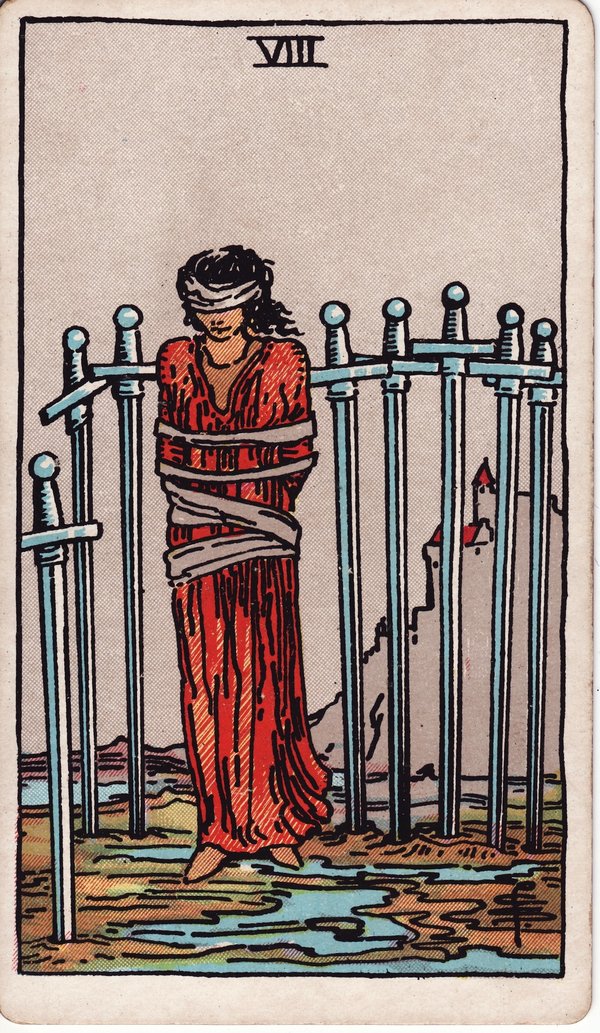
The Eight of Swords is the card of the self-imposed prison — the mind that has built a cage from its own thoughts and now cannot see the door. In the RWS image, a woman stands bound and blindfolded, surrounded by eight swords planted in the ground in a loose semicircle. Behind her, on a hill, a castle rises. The swords do not touch her. The bindings around her arms and body appear loose. The blindfold covers her eyes, but she could remove it. The path out of the circle is open — the swords form a barrier, but not a complete one. She is trapped, but it is not the swords that trap her.
In a reading, the Eight of Swords signals a feeling of powerlessness, entrapment, or limited options — but with the crucial recognition that the limitation is at least partly mental. The situation may have real constraints, but the primary prison is the mind's interpretation of those constraints. The woman is not in a dungeon; she is in a field, outside, near a castle that could be refuge or prison depending on her relationship to it. The swords are planted, not wielded — they are thoughts that have been set in place and accepted as permanent.
The card's gift is the recognition that perception shapes reality. The Eight of Swords does not say "you are not really trapped" — it says "examine whether the trap is real, and whether the key is in your own hand." The blindfold can be removed. The loose bindings can be slipped. The gap in the circle of swords can be walked through. But first, the trapped one must believe that she is allowed to try.
Symbolism & Imagery
Rider-Waite-Smith (1909): A woman in a red dress — the color of passion, will, and life — stands bound with loose ropes around her arms and torso. A blindfold covers her eyes. Eight swords are planted upright in the ground around her, forming a semicircle. The swords do not form a complete enclosure; there is a gap through which she could walk. Behind her, on a hill, rises a castle — white or grey, its significance ambiguous: is it the prison she has been taken from, or the refuge she cannot reach? The ground is wet, marshy — the footing is uncertain, but not impassable.
The loose bindings are where the card's meaning lives. She is bound, but not tightly. With effort, she could free her arms. The blindfold, similarly, is hers to remove — no one is holding it in place. The swords are planted in the ground, not held by guards. The entire scene is a study in perceived vs. actual constraint. The woman has more agency than she believes, but her belief in her powerlessness is itself the primary obstacle.
The castle on the hill is a Rorschach: for some readers it represents authority, institutional power, the source of her imprisonment. For others, it represents safety, civilization, the place she needs to reach. The ambiguity is intentional. The castle's meaning depends on the woman's relationship to it — and she cannot see it clearly with the blindfold on.
Thoth (Crowley/Harris, 1944): The Thoth Eight of Swords — Lord of Interference — presents eight swords in a disrupted geometry, with two larger swords crossing through the center at an angle that suggests obstruction. The composition conveys mental interference: the mind that cannot think clearly because one thought blocks another, because the intellectual structures (Hod) have become tangled. Jupiter in Gemini — the planet of expansion in the sign of multiplicity — suggests a mind overwhelmed by options, paralyzed by too many possibilities rather than too few.
Astrological & Elemental Layer
Jupiter in Gemini. Jupiter is the planet of expansion, wisdom, and opportunity. In Gemini — the sign of multiplicity, communication, and mental agility — Jupiter expands the mind's range. This should be liberating. But in the Eight of Swords, this expansion manifests as interference: the mind has so many perspectives, so many considerations, so many rules and categories that it cannot move. The gift of Gemini (seeing all sides) becomes the curse of Gemini (being unable to choose any side).
The first decan of Gemini (approximately May 21 through May 31) is the decan of initiation — the Gemini energy is just beginning, fresh and intense. The mind is active, curious, hungry for input. But the hunger can become overwhelming. The Lord of Interference is Jupiter in Gemini in its shadow form: the expansive mind that has expanded itself into a labyrinth.
Kabbalistic / Tree of Life Layer
The Eight of Swords sits in Hod — the eighth Sephirah, Splendor/Intellect, the sphere of rational thought, language, and systematic organization. Hod is the mind's filing system — the categories, definitions, and procedures through which we make sense of the world. It is essential for functioning, but it can also become a prison. When the categories become more real than the reality they describe, Hod becomes interference rather than intelligence.
In the Swords suit, Hod manifests as the intellectual structures that the mind has built — and that now build walls around the mind. The rules, the definitions, the shoulds and shouldn'ts, the careful taxonomies of what is possible and what is not. The Eight of Swords is Hod at its most constraining: the intellect that has become a jailer.
For the querent, the Kabbalistic layer suggests: examine your categories. The limitation you feel may not be in the world but in the way you have defined the world. What rules are you following that you did not choose? What definitions are you accepting that are not actually true? Hod's gift is intellectual order; its shadow is intellectual imprisonment. The way out is to question the architecture.
Sequential Narrative: Position in the Suit Story
The Eight of Swords follows the Seven of Swords — the cunning escape, the strategic withdrawal. The Seven's cleverness has consequences. The thief has escaped the camp, but the new territory is not safe — it is a swamp of uncertainty, and the mind, having relied on cunning, now turns that cunning against itself. The Seven's strategy becomes the Eight's prison: the cleverness that was meant to liberate has instead constructed a cage of second-guessing, suspicion, and over-analysis.
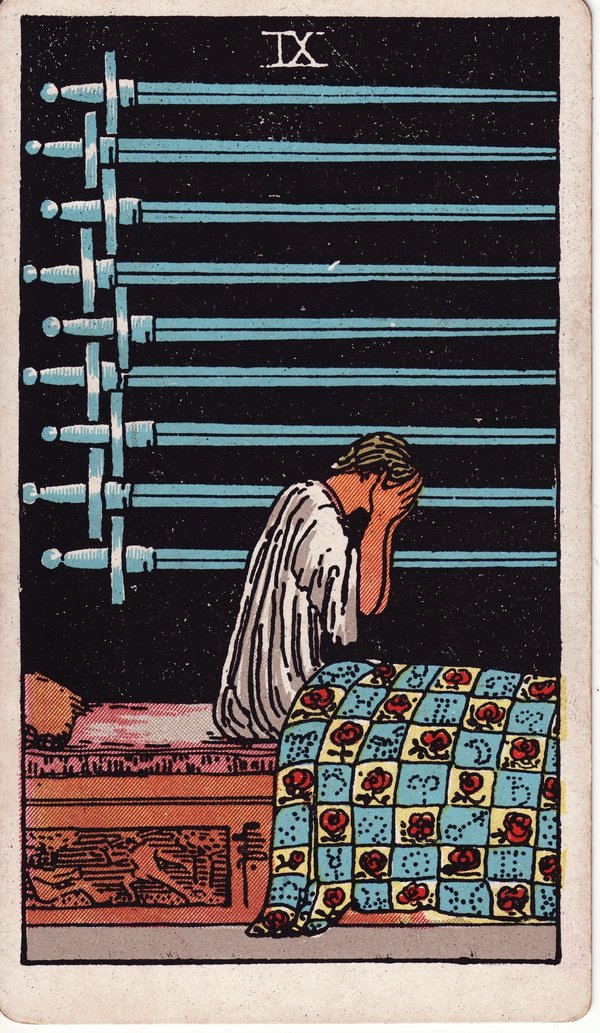
The Eight flows into the Nine of Swords — the Lord of Cruelty, the card of the dark night of the mind. The prison of the Eight, if not escaped, becomes the torment of the Nine. The bound woman, if she does not remove the blindfold and walk through the gap in the swords, will eventually collapse into the anguish of the Nine. The Eight is the last moment before the descent into real suffering — the threshold where liberation is still possible.
The arc from Seven through Eight to Nine is a descent into the mind's darkness: cunning → imprisonment → torment. The Eight is the pivot — the point where the descent can be arrested, where the bindings can be slipped, where the blindfold can be removed.
Advising For / Advising Against
-
If advising FOR: Stop. Look at the situation you believe you are trapped in. How many of the constraints are real — enforced by external forces — and how many are rules you have imposed on yourself? The swords around you are thoughts, not guards. The blindfold is yours to remove. The gap in the circle is real. You have more options than you believe. The first step is not to escape; it is to let yourself see clearly what the situation actually is, rather than what your fear has made of it.
-
If advising AGAINST: You are not as trapped as you feel, but you have been in this state so long that you have stopped looking for exits. The victim narrative has become comfortable — it absolves you of responsibility for your life. The bindings are loose; you have not tested them. The blindfold is on; you have not removed it. Before you ask for rescue, ask yourself: have I actually tried to free myself? Or have I been waiting for someone else to do it?
Card of the Day
Today, notice where you feel trapped — and then notice whether the trap is real or perceived. The limitation you feel may have more to do with your beliefs about the situation than the situation itself. If you feel stuck, ask: what would I do if I believed I had options? Then test whether those options exist. The blindfold may be thinner than you think.
Elemental Dignities Notes
- Strengthened by Fire (Wands): Fire energizes the Eight — the will to escape becomes stronger. Risk: fire can also burn the bindings before the querent is ready to be free, creating panic rather than liberation.
- Strengthened by Air (Swords): Multiple Air cards intensify the mental prison — the thoughts multiply, the overthinking deepens. The escape requires grounding in another element.
- Weakened by Earth (Pentacles): Earth grounds the Eight in practical reality — the body's needs, the material constraints, the actual obstacles. This can either clarify what is real and what is imagined, or deepen the sense of imprisonment by adding physical weight.
- Neutral with Water (Cups): Water brings the emotions that the Eight has been repressing — the fear beneath the paralysis, the grief beneath the helplessness. This can be the key to escape (feeling what has been denied) or the flood that makes movement impossible.
Deck-Specific Notes
- If using a Thoth deck: The Lord of Interference presents tangled swords geometry — mental interference as a structural problem. Jupiter in Gemini's expansive intellect has become its own obstacle. The Thoth emphasis is on cognitive, not emotional, imprisonment — the mind tangled in its own categories.
- If using a Marseille-tradition deck: The Eight of Swords in the Marseille tradition shows eight curved blades interlocking in a double knot, with a blossom all but crushed. Even in extreme constraint, potential for growth remains — the crushed blossom is evidence that life existed here and might exist again.
- If using a blended or contemporary deck: The psychological layer of self-imposed limitation applies across traditions. Some decks emphasize the realness of the external constraints; others emphasize the mental construction. The core truth persists: perception shapes possibility.
Journaling & Contemplation Prompts
- What am I telling myself I cannot do that, if I were honest, I have simply not tried?
- Where did I learn the rules I am following? Who wrote them? Do they still serve me?
- If I removed the blindfold and looked at my situation directly, what would I see that I don't want to see — and what would I see that I didn't know was there?
- What would I do if I believed I had options? What prevents me from testing that belief?
- Is my current limitation protecting me from something, or protecting something in me?
Additional Associations
| Association Type | Value |
|---|---|
| Color(s) | Red (the dress — passion, will, the life force trapped but not extinguished); grey (the swords, the foggy mental state); white (the castle, the distant goal or authority) |
| Crystals / Stones | Citrine (the stone of will, solar plexus activation, the courage to act); Hematite (grounding during mental confusion, the stone of clarity through embodiment); Tiger's Eye (seeing through illusion, the stone of practical perception) |
| Herbs / Plants | Rosemary (mental clarity, the herb of remembrance — remembering who you are beyond the prison); Lemon Balm (lifting mental fog, the gentle clarity of the calm mind); St. John's Wort (light in darkness, the herb for when the mind has become a cage) |
| Archetypes (Jungian) | The Prisoner (conscious or unconscious); The Bound Woman (the anima imprisoned by patriarchal structures — or by internalized patriarchy); The One Who Cannot See (Oedipus before the revelation) |
| Mythological Figures | Andromeda (chained to the rock, awaiting rescue — but the rescue eventually comes); Sleeping Beauty (the binding that is also a protection, the prison that is also a pause); Rapunzel (the tower that is both prison and sanctuary) |
| Numerological Resonance | 8 = action, outer work, movement, the octagon. In Swords, 8 is the mind's active construction of boundaries — the architecture that can protect or imprison. Hod's number: the splendor of intellectual order — and its shadow. |
| Playing Card Equivalent | Eight of Spades — in cartomancy, restriction, interference, a difficult situation where options seem limited. Sometimes: a health concern, a period of convalescence. |
| I Ching Hexagram Parallel | Hexagram 47 — K'un / Oppression (Exhaustion). "Oppression. Success. Perseverance. The great man brings about good fortune. When one has something to say, it is not believed." The hexagram of the situation where one is blocked not by external force but by the inability to be heard or believed. |
| Body / Organ Correspondence | The eyes (blindfolded — the organ of perception that is blocked); the hands and arms (bound — the instruments of action that are restrained); the shoulders and neck (the tension of the bound, the weight of perceived imprisonment) |
Shadow & Integration Message
The Eight of Swords' shadow is the victim identity — the person who has been in the prison so long that they have forgotten the door was never locked. This is the shadow of Hod: the intellectual system that has become more real than the self it was meant to serve. The rules were made for the person; the person was not made for the rules. But the shadow self forgets this and begins to organize life around the prison rather than around liberation.
Integration of the Eight's energy means removing the blindfold — choosing to see the situation clearly, including one's own complicity in maintaining it. It means testing the bindings — discovering what is genuinely constrained and what is merely familiar. The integrated Eight of Swords is the one who, having been imprisoned, can now see prisons — in others and in themselves — and can speak to the bound with the authority of one who has been there, saying: the bindings are looser than you think.
Elemental Intelligence (Suit Framing)
In the Jungian cognitive function mapping, the Eight of Swords is the Thinking function in its most constricted mode — the mind that has become a jailer, the intellect that confuses its own categories with reality. The sanguine humour is suppressed here, almost melancholic: the natural buoyancy of Air is weighted down by rules, shoulds, and the architecture of thought that was meant to liberate and has instead imprisoned. This is the scholar trapped in the academy, the thinker who can no longer think outside the system.
Timing & Manifestation
For timing, the Eight of Swords suggests a period of weeks — the duration of a significant blockage that feels permanent but is actually temporary. The first decan of Gemini corresponds approximately to May 21 through May 31. The situation will shift when the querent recognizes their own agency — not before. The timing is not external but internal: it lasts until you take off the blindfold.
Yes / No Tendency
The Eight of Swords leans toward not yet — the conditions for movement are not in place because the querent cannot yet see clearly. In dignified position, the not-yet is protective: the pause is necessary. In undignified position, the not-yet is self-imposed: the querent could move but will not allow themselves to see the path.
Common Misreads / Nuances to Know
Misread 1: "The Eight of Swords means you are a victim of circumstances." The card emphasizes self-imposed limitation. The swords are her own thoughts. The bindings are loose. The victim position is a perception, not a fact — though it may feel like a fact.
Misread 2: "Just break free." The card acknowledges that the feeling of entrapment is real and powerful, even if the actual constraints are looser than they appear. "Just break free" ignores the psychological weight of perceived imprisonment. The work is to see clearly first; movement follows vision.
Misread 3: "Reversed means you're free." Reversed, the Eight often indicates the beginning of seeing — the blindfold slipping, the first recognition that options exist. But liberation is a process, not a flip of the card. The reversed Eight is the first step, not the last.
Nuance for Thoth readers: The Lord of Interference frames the imprisonment as cognitive rather than situational — the mind blocked by its own mental constructions. The emphasis is on untangling thought patterns, not escaping external circumstances.