The Poetic Line
"He takes what he can carry and flees — but the two he left behind will weigh heavier than the five in his arms."
Keywords
| Category | Dignified | Undignified |
|---|---|---|
| General | Strategy, cunning, self-reliance, tactical withdrawal, working behind the scenes, using wit over force | Deception, theft, betrayal, dishonesty, getting away with it, cowardice disguised as cleverness |
| Spiritual | The inner path walked alone, spiritual independence, the wisdom that cannot be taught, esoteric knowledge | Spiritual bypassing, using spiritual language to deceive, the guru who exploits, secret knowledge as power over others |
| Psychological | Mental agility, adaptive thinking, the part of the self that survives by being smarter, not stronger | Imposter syndrome, self-deception, the inner thief who steals credit, rationalizing dishonesty |
| Physical Health | Recovery through unconventional means, the body's hidden reserves, alternative healing modalities | Ignoring health issues, hiding symptoms, the body that is secretly struggling |
| Relationships | Strategic distance, knowing when to withhold, protecting oneself from emotional overexposure | Infidelity, emotional theft, taking more than you give, the relationship built on secrets |
| Financial | Strategic financial planning, tax strategy, protecting assets, the clever deal | Theft, embezzlement, financial deception, cutting ethical corners, hidden debt |
| Vocational | Strategic career moves, working the system, office politics played well, the clever pivot | Plagiarism, stealing credit, office politics as sabotage, the career built on others' work |
| Shadow / Thoth Distinction | The Lord of Futility: Moon in Aquarius's gift of seeing through illusions — the mind that recognizes when a strategy is doomed, when effort is wasted, when the clever plan is actually self-deception | Moon in Aquarius shadow: the plan that is too clever by half, the strategy that collapses under its own complexity, the thief who steals from himself |
Narrative Description
General Meaning
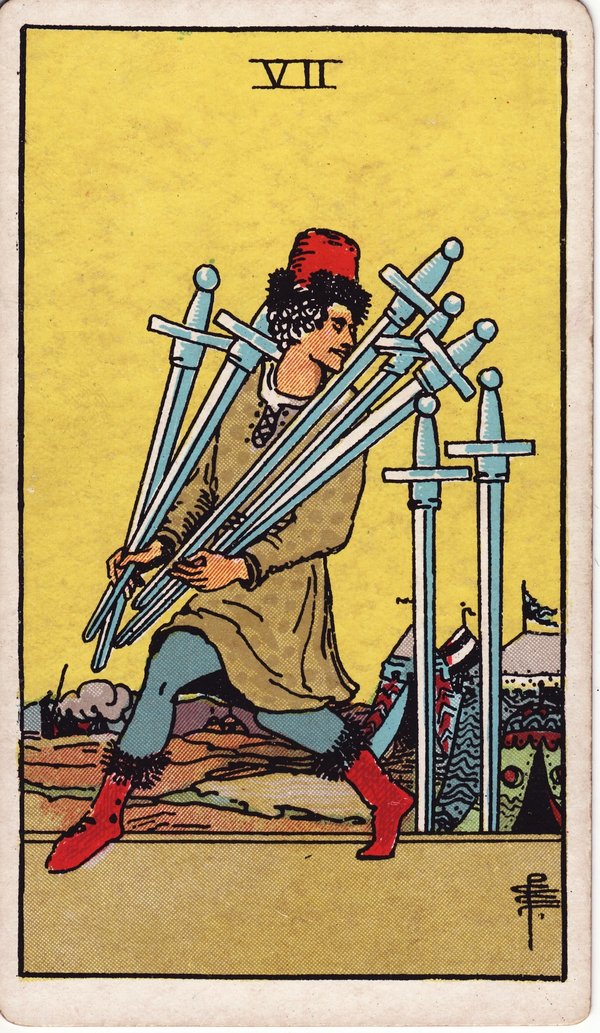
The Seven of Swords is the card of cunning — the mind operating in the shadows, the strategy executed quietly, the victory achieved not by confrontation but by stealth. In the RWS image, a figure tiptoes away from a military encampment, carrying five swords in his arms while glancing back over his shoulder. Two swords remain planted in the ground behind him. He is not fighting — he is escaping, or stealing, or strategically withdrawing, depending on how you read the scene.
In a reading, the Seven of Swords often signals a situation involving deception, strategy, or hidden motives. It can be the card of the thief — literal or metaphorical — or the card of the one who must act alone, without allies, relying only on wit. The ethical valence of the card depends entirely on context. Is the figure a thief, stealing from his own people? Or is he a spy, infiltrating the enemy camp and making off with their weapons? The card does not answer. It only shows the action and its ambiguity.
The Moon in Aquarius brings an unstable emotional quality to the intellectual realm: the mind is clever, detached, capable — but the emotions driving the cleverness are hidden, even from the self. The Seven of Swords asks: what are you really after? And are you willing to look at your own motives as clearly as you look at your strategy?
Symbolism & Imagery
Rider-Waite-Smith (1909): A man in a distinctive cap (often read as a jester's cap or a spy's cap) carries five swords, glancing backward toward an encampment of colorful tents. Two swords remain planted in the ground behind him. His posture is furtive, almost comical — he tiptoes on the balls of his feet, caught mid-step between the camp and the open space ahead.
The five swords he carries represent the number of instability, disruption — the chaos of Geburah that has been internalized and is now being carried away. The two swords left behind represent the duality of the Two — the dilemma, the choice that was abandoned rather than resolved. He has taken what he could carry and left what he could not. The camp in the background may be his own community (he is a thief) or an enemy's (he is a saboteur). The card's ambiguity is intentional: the same action looks different depending on whose side you are on.
The figure's glance backward is crucial. He is not purely confident — he is checking whether he has been noticed. The escape is not complete. The two swords left behind are evidence. This is not a clean getaway. Every cunning plan leaves a trace.
Thoth (Crowley/Harris, 1944): The Thoth Seven of Swords — Lord of Futility — presents seven swords in a disrupted geometric pattern. The central sword is larger, more prominent, but its angle is unstable. The composition suggests a plan that is clever but ultimately self-defeating — the strategy that collapses under its own weight. The Moon in Aquarius renders the emotional subtext visible: the mind, detached from feeling, can become lost in its own machinations. Crowley titled it the Lord of Futility because the effort expended in cunning is often wasted — the same energy, directed honestly, would have achieved more.
Astrological & Elemental Layer
Moon in Aquarius. The Moon governs emotion, intuition, the unconscious, and the tides of feeling. In Aquarius — the sign of detachment, intellectual independence, and the collective — the Moon operates at a distance from its own feelings. This is the astrological signature of emotional self-alienation: the person who is clever enough to analyze their own emotions but not connected enough to feel them directly.
The third decan of Aquarius (approximately February 9 through February 18) is the decan of culmination — the Aquarian energy has fully manifested. The ideals of the first decan (the Five's Venus) and the analysis of the second decan (the Six's Mercury) have reached their expression: the mind is autonomous, detached, brilliant — and possibly lost. The Moon here can become the need to operate in secret, to protect one's inner life from exposure, to win through indirection because direct confrontation feels too vulnerable.
Kabbalistic / Tree of Life Layer
The Seven of Swords sits in Netzach — the seventh Sephirah, Victory/Endurance, the sphere of instinct, desire, and the emotional force that drives all action. Netzach is the will to persist, to prevail, to achieve — but in the Swords suit, this drive manifests as intellectual cunning rather than emotional passion (as it would in Cups) or physical drive (as in Wands).
Netzach in Air is the mind that wants to win. The victory it seeks is intellectual, strategic. The endurance it represents is the patience of the long game — the plan that unfolds over time, the scheme that requires silence and timing. But Netzach, unbalanced, can become obsession — the desire to win that overrides ethics, the cleverness that becomes an end in itself.
For the querent, the Kabbalistic layer suggests: examine your motives. The strategy you are employing — the silence, the indirection, the withholding — is it serving a legitimate end, or has the cunning become its own reward? Netzach asks not "will you succeed?" but "what are you succeeding at, and is it worth the self you are becoming in the process?"
Sequential Narrative: Position in the Suit Story
The Seven of Swords follows the Six of Swords — the passage across water, the journey from rough to calm. The Six arrives at the far shore. The Seven shows what happens next: the new territory is not safe. It requires new skills — stealth, strategy, self-reliance. The passage of the Six did not solve everything; it only changed the nature of the challenge.
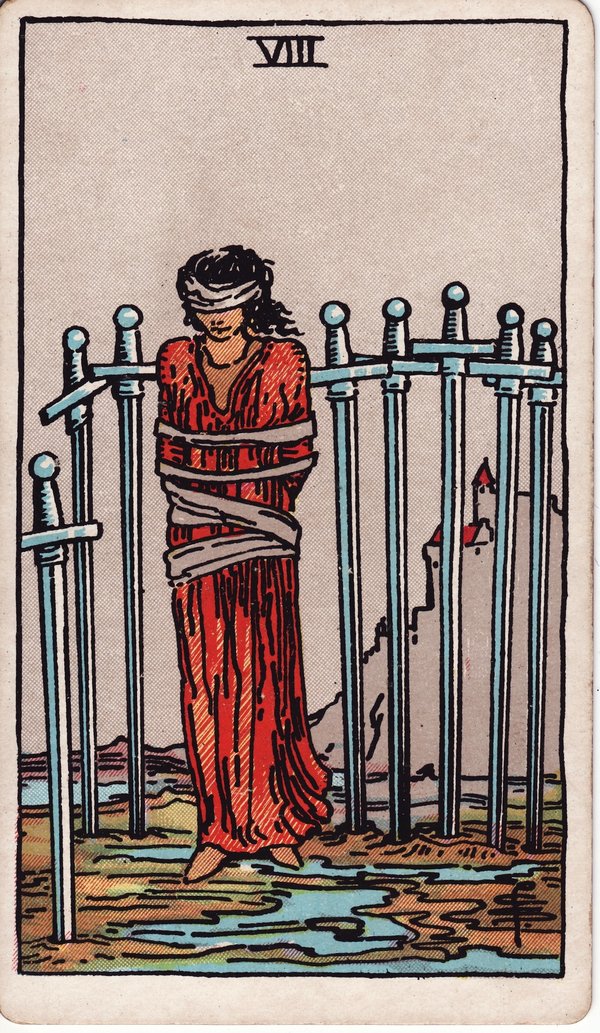
The Seven flows into the Eight of Swords — the Lord of Interference, the card of imprisonment and self-imposed limitation. The cunning of the Seven, if it is dishonest or ultimately futile, leads to the Eight's bondage. The thief may escape the camp, but he carries the consequences of his theft. The strategy may succeed, but it builds a cage of its own making. The Seven plants the seeds of the Eight: the cleverness that traps the clever one.
Advising For / Advising Against
-
If advising FOR: Be strategic. Not every battle is won by frontal assault. The situation you face requires discretion, timing, and perhaps a certain amount of indirection. Use your wits. Work behind the scenes. You do not need to announce your moves — you need to make them count. But know your own motives. The strategy is only as ethical as the end it serves. If you are taking more than you give, acknowledge that to yourself even if you tell no one else.
-
If advising AGAINST: You are being dishonest — with others, with yourself, or both. The clever plan you are executing has a cost you are not accounting for. The swords you are carrying were not yours to take. The two you left behind are evidence, and eventually they will be noticed. Before that happens, ask yourself: is the gain worth the risk? Is the strategy worth the person you become while executing it? There is still time to put the swords back. There is still time to walk into the camp openly and declare your intentions. The cleverness that feels like power now may feel like shame later.
Card of the Day
Today, pay attention to what is being hidden — by you, by others, by the situation itself. Not every silence is dishonesty, but today's silences are worth examining. If you need to act strategically, do it with clean intention. If you suspect someone is less than honest, trust your instincts but don't accuse without evidence. The clever mind is a tool. Use it with integrity.
Elemental Dignities Notes
- Strengthened by Fire (Wands): Fire energizes the Seven's strategy — the plan gains momentum, the cunning becomes bold. Risk: the thief becomes the arsonist; boldness becomes recklessness.
- Strengthened by Air (Swords): Multiple Air cards intensify the intellectual dimension — the scheme becomes more elaborate, more abstract, potentially more detached from reality.
- Weakened by Earth (Pentacles): Earth grounds the Seven in material consequences — the theft becomes real, the stolen goods become evidence, the plan meets the physical world.
- Neutral with Water (Cups): Water reveals the emotional subtext — why the cunning, why the hiding, what the strategy is protecting against. This can be clarifying or destabilizing.
Deck-Specific Notes
- If using a Thoth deck: The Lord of Futility appears as disrupted geometry — the plan that collapses under its own weight. The emphasis is on the self-defeating nature of excessive cunning: the effort that could have been directed honestly is wasted on strategy. Moon in Aquarius suggests emotional self-alienation as the root of the futility.
- If using a Marseille-tradition deck: The Seven of Swords in the Marseille tradition shows a central sword increasingly constrained by the curved blades surrounding it. The emphasis is on the individual being limited by group assumptions — the cleverness that the collective cannot accommodate, or the strategy that the system prevents.
- If using a blended or contemporary deck: The psychological layer of cunning, strategy, and hidden motives applies across traditions. Some decks depict the figure as more clearly a thief; others emphasize the spy/strategist reading. The core meaning persists: the mind operating in the shadows.
Journaling & Contemplation Prompts
- What am I hiding — and from whom? What would happen if I stopped hiding it?
- Is my current strategy serving a worthy end, or has the cleverness become its own purpose?
- What have I taken that was not mine to take? What have I left behind that I should have carried?
- When I act strategically rather than directly, what am I protecting?
- If I were completely honest with myself about my motives, what would I admit?
Additional Associations
| Association Type | Value |
|---|---|
| Color(s) | Yellow (the tents, the color of intellect and caution); dark blue (the night sky of secret action, Aquarius's deep field); grey-taupe (the color of concealment, the figure who blends in) |
| Crystals / Stones | Fluorite (mental clarity, the stone of strategy and organization); Labradorite (the stone of the trickster, seeing through illusion, the hidden light); Smoky Quartz (grounding during deception, protection from self-deception) |
| Herbs / Plants | Fennel (the herb of the fox, cunning, strategic vision); Wormwood (the bitter herb, the cost of deception, absinthe's green fairy); Clove (protection, the hidden safeguard) |
| Archetypes (Jungian) | The Trickster (Loki, Coyote, the clever one who operates outside the rules); The Spy; The Shadow Self (the part that acts from hidden motives) |
| Mythological Figures | Odysseus (the man of many wiles, the strategist who wins by cunning); Loki (the trickster whose cleverness ultimately entraps him); Prometheus (the thief of fire — a theft that served humanity, the Seven of Swords in its most noble form) |
| Numerological Resonance | 7 = the seeker, the number of inner work, the seven classical planets, the seven days. In Swords, 7 is the mind's strategic dimension — the intellect turned inward, the plan that unfolds in silence. Netzach's number: the endurance of the long game. |
| Playing Card Equivalent | Seven of Spades — in cartomancy, a warning of deception, a theft, a strategy that may backfire. Sometimes: a clever escape, a plan that succeeds against odds. |
| I Ching Hexagram Parallel | Hexagram 29 — K'an / The Abyss, Water. "The Abysmal repeated. If you are sincere, you have success in your heart, and whatever you do succeeds." The hexagram of danger, of navigating treacherous terrain through skill and sincerity. The danger is real, but sincerity navigates it. |
| Body / Organ Correspondence | The feet (the tiptoe, the quiet escape, the part that carries the thief away); the eyes (the backward glance, hypervigilance, the watchful mind); the hands (the instruments of theft, the parts that carry what was taken) |
Shadow & Integration Message
The Seven of Swords' shadow is the inner thief — the part of the self that takes without earning, that wins by deception, that rationalizes dishonesty by focusing on the dishonesty of others. This is the shadow of Netzach: the drive to achieve that has lost its ethical compass, the endurance that persists in the wrong direction.
Integration of the Seven's energy means reclaiming cunning for worthy ends — being strategically intelligent without being dishonest, being clever without being cruel, knowing when to act in the open and when to work in the shadows, and being willing to examine one's own motives with the same clarity one applies to one's strategy. The integrated Seven of Swords is the strategist who serves truth, not the thief who serves only himself.
Elemental Intelligence (Suit Framing)
In the Jungian cognitive function mapping, the Seven of Swords is the Thinking function in its most independent mode — the mind that operates alone, that trusts its own calculations over collective wisdom, that values cleverness over consensus. The sanguine humour is here in its detached, almost amoral register: the bright intellect that can justify anything, the mind that is too clever for its own good. This is the strategist, the spy, the consultant who knows the system well enough to game it.
Timing & Manifestation
For timing, the Seven of Swords suggests a situation that will resolve quickly — days to a week — but with consequences that unfold slowly. The third decan of Aquarius corresponds approximately to February 9 through February 18. The event is characterized by suddenness (the escape, the theft, the realization) followed by a longer period of processing — the backward glance, the evidence left behind.
Yes / No Tendency
The Seven of Swords leans toward maybe, but not in the way you expect — or yes, but at a cost to your integrity. The outcome is achievable, but the method matters. In dignified position, the yes comes through strategy and self-reliance. In undignified position, the yes comes through deception, and the querent will have to live with how they got it.
Common Misreads / Nuances to Know
Misread 1: "The Seven of Swords means someone is deceiving you." The card can indicate the querent's own cunning as often as someone else's deception. Before looking for a thief outside, look at where you might be the thief — stealing from yourself, from relationships, from your own integrity.
Misread 2: "This card is always about dishonesty." Strategy is not inherently dishonest. The spy working against an enemy, the whistleblower removing documents, the employee strategically positioning for a promotion — these are Seven of Swords situations that carry different ethical weights. Context determines the valence.
Misread 3: "The figure is getting away with it." The backward glance, the two swords left behind — the evidence of the act remains. The Seven of Swords is rarely a clean escape. What is hidden will eventually surface.