The Poetic Line
"The swords do not fall. But she has been waiting so long that waiting has become its own wound."
Keywords
| Category | Dignified | Undignified |
|---|---|---|
| General | Anxiety, worry, sleepless nights, mental anguish, facing fears, the dark before dawn | Depression, self-torture, catastrophic thinking, obsession, refusing comfort, the mind that has become its own enemy |
| Spiritual | Dark night of the soul, spiritual crisis, the testing of faith, the silence of God, purification through despair | Spiritual despair, crisis of meaning, the belief that one is abandoned, losing faith and refusing to seek it |
| Psychological | Confronting the shadow, the anxiety that demands attention, the breakthrough that follows breakdown | Rumination, obsessive thinking, the inner critic as torturer, refusing to seek help, depression as identity |
| Physical Health | The body's stress signals, insomnia as messenger, the physical cost of mental anguish, the need for rest | Chronic insomnia, stress-induced illness, the body breaking down from worry, refusing medical or therapeutic help |
| Relationships | Anxiety about relationship, the fear of loss that reveals what matters, the conversation that must happen | Relationship paranoia, pushing partner away through worry, the love that is strangled by fear, refusing reassurance |
| Financial | Financial anxiety, the worry that prompts planning, facing the numbers honestly | Financial catastrophe thinking, paralysis through fear, the debt that is magnified by the mind, refusing to look at accounts |
| Vocational | Career anxiety, imposter syndrome acknowledged, the pressure that pushes toward excellence | Burnout from overwork, the job that haunts your nights, stress breakdown, refusing to delegate or rest |
| Shadow / Thoth Distinction | The Lord of Cruelty: Mars in Gemini's gift of aggressive mental clarity — the mind that attacks its own illusions, the intellectual violence that can destroy false comforts to reach truth | Mars in Gemini shadow: the mind turned against itself — the intellect as weapon aimed inward, the cruelty that is self-inflicted and therefore hardest to escape |
Narrative Description
General Meaning
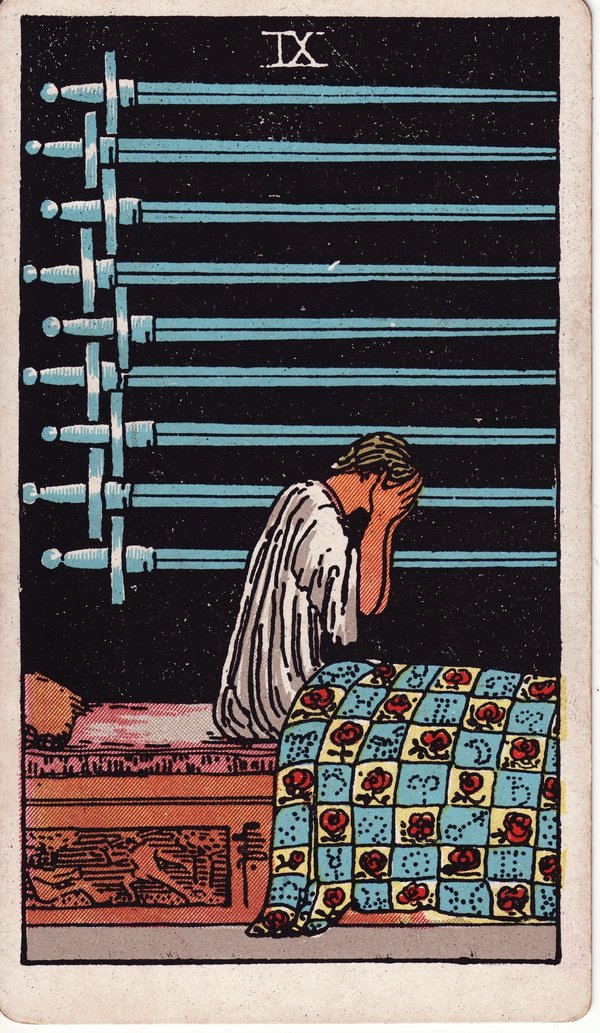
The Nine of Swords is the card of the dark night of the mind — the hour before dawn when every fear, every regret, every worst-case scenario crowds into consciousness and refuses to leave. In the RWS image, a figure sits up in bed, face buried in hands, in a posture of absolute anguish. Nine swords hang on the wall behind her, arranged horizontally — a rack of torment, the mind's inventory of everything that could go wrong. A quilt decorated with roses and astrological symbols covers her legs — beauty and cosmic order, present but unseen because she cannot lift her head.
In a reading, the Nine of Swords signals anxiety, worry, and mental torment. It is the card of the 3 a.m. awakening, the thought spiral that begins with one small worry and ends in catastrophe. The swords on the wall are thoughts — not events, not realities, but the mind's projections of disaster. They hang above her, but they have not fallen. The torment is real, but its source is internal. The Nine of Swords does not describe what is happening; it describes what the mind fears is happening, which can feel indistinguishable.
But the Nine of Swords is not a card of permanent despair. It is the ninth card in a suit of ten — the position of completion before renewal. The dark night ends. The sun rises. The mind's cruelty to itself is a habit that can be broken.
Symbolism & Imagery
Rider-Waite-Smith (1909): A figure — usually read as female, though the gender is ambiguous — sits bolt upright in bed, face hidden in hands. The posture is one of sudden awakening from nightmare, or of sleepless anguish that has persisted through the night. Nine swords hang on the black wall behind her, arranged in a horizontal row. They are not piercing her (as in the Three of Swords); they are suspended, pointed toward her but not touching — threats, not wounds. The swords are the mind's projections, the fears that have not materialized but feel imminent.
The quilt covering her lower body is carved with roses and astrological symbols — beauty, order, the cosmos that continues its orderly motion regardless of her anguish. The quilt is significant: it is there, it is real, it is beautiful — but she cannot see it because she cannot lift her face from her hands. The comfort is present but inaccessible while she remains in the grip of her thoughts.
The black background is the darkness of the unlit mind, the night of the soul, the void into which the anxious mind stares. The single lit candle (visible in some versions) or the grey light of pre-dawn (in others) suggests that the darkness is not total. Dawn is approaching. The night will end.
Thoth (Crowley/Harris, 1944): The Thoth Nine of Swords — Lord of Cruelty — presents nine swords in a violent, disrupted geometry. The swords appear to be falling, clashing, intersecting at brutal angles. Drops of blood (or tears) fall among them. Mars in Gemini is rendered visible as aggressive mental energy — the mind attacking itself with the violence of a planet of war expressed through the sharp instrument of intellect. The card's cruelty, in Thoth, is not external — it is the cruelty of the truth that the mind cannot bear, the honesty of the Swords suit taken to its most painful extreme: the cruelty is in the truth, not in the card.
Astrological & Elemental Layer
Mars in Gemini. Mars is the planet of aggression, drive, conflict, and will. In Gemini — the sign of mind, communication, and multiplicity — Mars turns its aggressive energy inward, toward the intellect. This is the astrological signature of the mind at war with itself: the restless, relentless thought that attacks sleep, peace, and perspective. Mars wants to fight; Gemini provides an unending supply of targets — every worry, every possible outcome, every regret — and the fight never ends because the enemy is the self.
The second decan of Gemini (approximately June 1 through June 10) is the decan of intensification — the Gemini energy has developed, the multiplicity of the mind has multiplied, and the aggression of Mars has found purchase in every corner. This is the decan of rumination — the thought that cannot be released because releasing it would mean admitting that the fight was unnecessary, and the fighter's identity is built on fighting.
Kabbalistic / Tree of Life Layer
The Nine of Swords sits in Yesod — the ninth Sephirah, Foundation, the sphere of the unconscious, dreams, the astral plane, and the psyche. Yesod is the moon-ruled realm where the light of all the higher Sephiroth is gathered, reflected, and distorted. It is the sphere of dreams and nightmares, of the inner life that underlies the physical world of Malkuth.
In the Swords suit, Yesod is the mind's accumulated burden — every unresolved thought from the Ace through the Eight, gathered into a single point of anguish. The foundation (Yesod) of the mind is unstable because it has not processed its material. The nightmares are unprocessed thought. The torment is unexpressed grief. The cruelty of the Nine is the cruelty of the self that has refused to feel what needed to be felt and is now being forced to feel it all at once, in the dark, alone.
For the querent, the Kabbalistic layer suggests: the anxiety you are experiencing is not random. It is Yesod reflecting the light of everything you have not faced. The worries about the future are often displaced grief about the past. The mind that tortures itself at night is a mind that has not been allowed to speak during the day. The foundation can be rebuilt, but only by facing what the foundation is built on.
Sequential Narrative: Position in the Suit Story
The Nine of Swords follows the Eight of Swords — the self-imposed prison, the bound and blindfolded woman — and represents what happens when the prison is not escaped: the bound woman becomes the sleepless figure, the blindness becomes nightmare, the self-limitation becomes self-torture. The Eight's bindings are still present in the Nine, but now they are internal — the thoughts themselves have become the cage.
The Nine flows into the Ten of Swords — the Lord of Ruin, the card of finality, of hitting bottom. The torment of the Nine, if it does not lead to release, leads to collapse. The figure who cannot lift her face from her hands eventually falls. But the Ten is also the card of endings that enable beginnings — the ruin that clears the ground. The Nine is the last station before the fall — and sometimes the fall is the only way out of the torment. The Ten of Swords, paradoxically, can be a relief after the Nine: the worst has happened, and you are still here.
Advising For / Advising Against
-
If advising FOR: Let yourself feel the anxiety — not as a permanent state but as information. The worries that visit you at night are not random; they are pointing at something. What is the fear beneath the fear? What is the truth you are avoiding that the mind, in its cruel way, keeps bringing to your attention? The Nine of Swords is not a prophecy of disaster; it is an alarm system. Listen to what it is alarming you about, and then address it — not by worrying more, but by taking action, by speaking the fear aloud, by letting someone else see what you have been hiding in the dark.
-
If advising AGAINST: You are torturing yourself with thoughts that are not facts. The swords on the wall are fears, not events. They have not fallen. They may never fall. But you are living as if they have already pierced you, and the living is worse than the piercing would be. Stop feeding the spiral. Get out of bed. Talk to someone. Write the fear down and ask: is this true, or is this the mind's cruelty? The night will end if you let it. But you have to stop waiting for dawn and start looking for the light.
Card of the Day
Anxiety may surface today — a worry, a regret, a fear that has been waiting for a quiet moment. Listen to it, but don't obey it. The thought is not the thing. The fear is not the event. If you wake in the night, don't lie there in the dark — get up, make tea, write it down, speak it to someone. The mind's cruelty is a habit. Habits can be changed. Be kinder to the one who is worried. That one is you.
Elemental Dignities Notes
- Strengthened by Fire (Wands): Fire intensifies the anxiety — the worry becomes more passionate, more urgent. Mars in Gemini meets the fire of Wands and the mental battle becomes a blaze. Risk: panic. Gift: the fire can burn through the fog if directed outward.
- Strengthened by Air (Swords): Multiple Air cards deepen the intellectual torment — the mind spirals faster, the thoughts multiply. The worst-case scenarios elaborate themselves into novels.
- Weakened by Earth (Pentacles): Earth can ground the anxiety in practical reality — the body's needs, the physical world's demands — pulling the mind out of its spiral. Or it can add material worries to the mental ones.
- Neutral with Water (Cups): Water brings the emotions beneath the anxiety — the grief, the fear of loss, the unexpressed sorrow that fuels the spiral. This can be the key to release (feeling what the anxiety is protecting against) or can deepen the anguish.
Deck-Specific Notes
- If using a Thoth deck: The Lord of Cruelty presents falling, clashing swords with drops of blood or tears. The emphasis is on the violence of the truth — the cruelty of honest perception, the mind that sees too clearly what it cannot bear. Mars in Gemini is the intellect as weapon, turned inward. The card asks: what truth are you fighting against?
- If using a Marseille-tradition deck: The Nine of Swords in the Marseille tradition shows a central sword trapped by the eight curved blades surrounding it — the individual thought imprisoned by the collective mental patterns. The emphasis is on the structure of torment — the thought that cannot escape because the system of thinking has no exit.
- If using a blended or contemporary deck: The psychological layer of anxiety, worry, and the dark night of the mind applies across traditions. Some decks soften the RWS image; others intensify it. The core meaning persists: the mind's capacity for self-torture, and the possibility of dawn.
Journaling & Contemplation Prompts
- What fear visits me at night? What is it trying to tell me that I refuse to hear during the day?
- Is what I am worrying about something that has happened, something that might happen, or something I am afraid to admit has already happened?
- If I could speak my worst fear aloud to someone I trust, would it still have the same power?
- What comfort am I refusing — and why? What would happen if I let myself be comforted?
- What would dawn look like — what concrete change would signal that the night is ending?
Additional Associations
| Association Type | Value |
|---|---|
| Color(s) | Black (the background, the void, the night of the soul); dark grey (the swords, the color of the unlit mind); silver (Yesod's color, the moon's reflection, the pale light of pre-dawn) |
| Crystals / Stones | Moonstone (Yesod's stone, the moon's calming influence on the psyche, dream integration); Lepidolite (the stone of transition, lithium content for anxiety, calming the spiral); Amethyst (spiritual protection during dark nights, the stone of the sleepless seeker) |
| Herbs / Plants | Valerian (sleep, the root of deep rest, the calming of the overactive mind); Passionflower (the herb of nighttime anxiety, the racing thought quieted); Skullcap (nervine, the herb that stills mental chatter, the quieting of the spiral) |
| Archetypes (Jungian) | The Tortured Artist; The Insomniac Seeker; The Shadow Self made visible (what we refuse to face during the day visits us at night) |
| Mythological Figures | Job (the righteous sufferer, the one who cries out in the night and receives no answer — until dawn); The Gorgon Medusa (the face that cannot be looked at directly without turning to stone — the fear that must be approached indirectly); Cassandra (the truth-teller whose truth is not believed, whose nights are filled with what she knows and cannot speak) |
| Numerological Resonance | 9 = completion, the last single digit, the fullness before the return. In Swords, 9 is the mind's accumulated burden — every unresolved thought brought to its maximum intensity. Yesod's number: the foundation that must be examined before the final step into manifestation. |
| Playing Card Equivalent | Nine of Spades — in cartomancy, the card of the sleepless night, worry, and mental anguish. Sometimes called the "worry card" — the darkest card in the deck for many traditional readers. |
| I Ching Hexagram Parallel | Hexagram 36 — Ming I / Darkening of the Light. "Darkening of the Light. In adversity it furthers to be persevering." The hexagram of the light that has been wounded — the period when the sun is hidden, when truth is suppressed, when the wise person conceals their light and waits. The dark will end. |
| Body / Organ Correspondence | The brain at night (the organ of worry, the sleepless cortex); the adrenal glands (the stress response that will not shut off); the pineal gland (melatonin, the sleep that will not come); Mars governs the head — and Mars in Gemini is the headache, the mind under siege |
Shadow & Integration Message
The Nine of Swords' shadow is the addiction to worry — the mind that has been anxious for so long that it does not know who it would be without anxiety, the person who has confused vigilance with wisdom and cannot put down the sword of self-criticism because they believe it keeps them safe. This is the shadow of Yesod: the foundation of the psyche built on fear, the unconscious that has been trained to scan for threats and cannot stop.
Integration of the Nine's energy means learning to distinguish between the thought and the thing, between the fear and the event. It means being able to feel anxiety without being consumed by it, to hear the alarm without believing the fire has already started. The integrated Nine of Swords is the one who can sit with the dark and wait for dawn — who has learned that the night always ends, and who can use the quiet hours not for self-torture but for the deep reflection that only the dark allows.
Elemental Intelligence (Suit Framing)
In the Jungian cognitive function mapping, the Nine of Swords is the Thinking function in its most tormented mode — the mind that has become a torture chamber, the intellect that has turned its sharpness inward. The sanguine humour is entirely suppressed here — the natural optimism of Air has been crushed by the accumulated weight of every unresolved thought. This is the scholar who has read too much and slept too little, the thinker who has analyzed themselves into paralysis, the mind that has forgotten that thought is a tool and has made it a master.
Timing & Manifestation
For timing, the Nine of Swords suggests a night — literally or metaphorically — that must be endured. The second decan of Gemini corresponds approximately to June 1 through June 10. The torment peaks and then breaks; the card does not describe a permanent state. Dawn comes. The timing answer is: this too shall pass, and likely sooner than you fear — but you must stop feeding the spiral for it to pass at all.
Yes / No Tendency
The Nine of Swords leans toward no, but the no is in your mind — the outcome you fear is more likely the product of anxiety than of reality. In dignified position, the no is a warning: your thinking is catastrophizing; check your premises. In undignified position, the no is a symptom: you are refusing to see that dawn is available because you have identified with the darkness.
Common Misreads / Nuances to Know
Misread 1: "The Nine of Swords means something terrible is about to happen." The swords on the wall are fears, not events. The card describes mental state, not external reality. The terrible thing has usually not happened — and may never happen. The suffering is real, but its cause is internal.
Misread 2: "This card is the worst in the deck." The Nine of Swords is painful, but it is the ninth card in a suit of ten — the position of completion before renewal. The night ends. The card's darkness is proportional to its potential for dawn.
Misread 3: "Just think positive." The Nine of Swords' anxiety is not a choice — it is a pattern, often deeply ingrained. "Thinking positive" can feel like another failure when the mind cannot comply. The card invites acknowledgment, not suppression: name the fear, examine it, speak it — but do not simply try to replace it with positivity that the anxious mind will not believe.
Nuance for Thoth readers: The Lord of Cruelty frames the card's pain as the cruelty of truth rather than the cruelty of the self. The mind suffers because it sees clearly what it cannot accept. The "cure" is not to stop seeing but to learn to bear what is seen.