The Poetic Line
"Face-down on the shore, but the sea is calm. The worst has arrived — and there is a strange freedom in being past the end."
Keywords
| Category | Dignified | Undignified |
|---|---|---|
| General | Rock bottom, final ending, the worst is over, release through collapse, necessary conclusion, the gift of finality | Premature defeat, melodrama, refusing to get up, the victim who could rise but won't, dwelling in ruin |
| Spiritual | Ego death, surrender, the end of the false self, the collapse that precedes rebirth, the dark before the resurrection | Spiritual despair as identity, refusing the dawn, the martyr complex, believing the ruin is punishment rather than release |
| Psychological | Hitting bottom as turning point, the breakthrough that follows breakdown, releasing what cannot be saved | Depression as identity, catastrophizing, the mind that prefers the known ruin to the unknown recovery, suicide ideation |
| Physical Health | The body's demand to stop, complete exhaustion as messenger, the crisis that forces change, hitting physical limit | Total collapse, burnout, refusing medical help, the body giving out, martyrdom through self-neglect |
| Relationships | The definitive ending, the relationship that cannot be saved, the truth that frees by destroying | Dramatic endings that could have been clean, the breakup that becomes a performance, refusing closure |
| Financial | Bankruptcy as fresh start, the bottom that forces restructuring, financial ruin that clears the slate | Wallowing in financial disaster, refusing to rebuild, the debt that defines rather than informs |
| Vocational | Career ending, the job that is definitively over, the collapse that redirects, the failure that teaches | Professional martyrdom, the career death that becomes identity, refusing to start over |
| Shadow / Thoth Distinction | The Lord of Ruin: Sun in Gemini's gift of illumination at the end — the light that reveals what has been destroyed so that what remains can be seen clearly, the intellectual honesty that admits: this is over | Sun in Gemini shadow: the mind that is illuminated only to see its own destruction — the clarity that is cruel, the light that shows nothing but wreckage, the refusal to see that the sun is rising, not setting |
Narrative Description
General Meaning
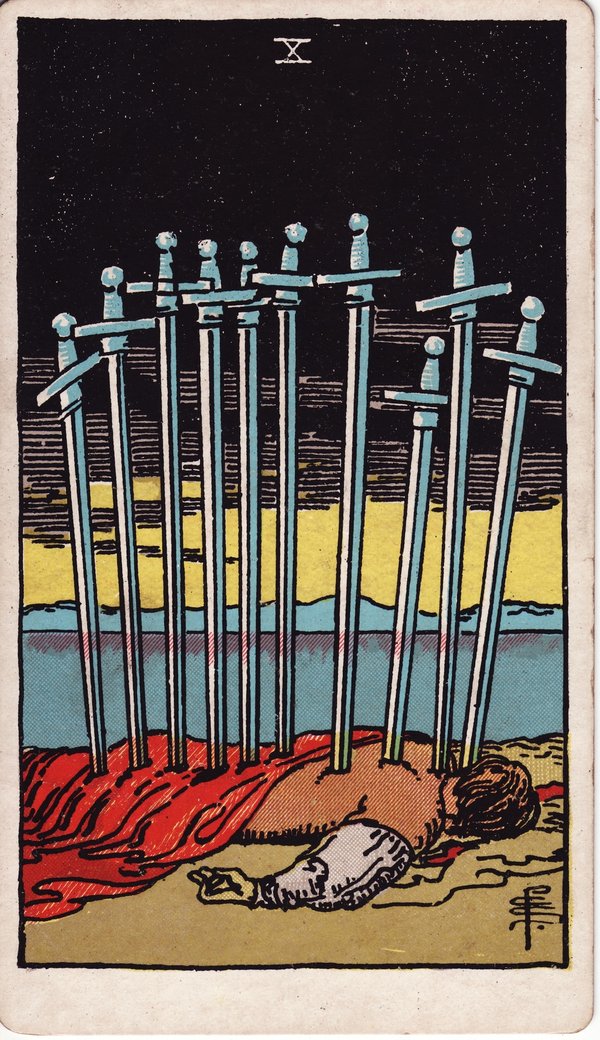
The Ten of Swords is the card of the absolute end — the moment when the mind has run its course, the overthinking has exhausted itself, and there is nothing left to do but fall. In the RWS image, a figure lies face down on the ground, ten swords thrust into his back from shoulders to waist. The sky is black above him, but on the horizon, the sun is rising over a calm sea. He has been destroyed — and yet the image is strangely peaceful. The worst has happened. The waiting is over. The only direction now is up.
In a reading, the Ten of Swords signals an ending — often a painful one, often one that the querent has been resisting. It can indicate the collapse of a situation, a belief, a relationship, or a way of thinking that has run its course. The drama of the card — ten swords in the back — can be alarming, but experienced readers know that the Ten of Swords is often less catastrophic than it appears. The figure on the ground is not dead; he is face down, at rest. The swords have done their work, and the work was the end of something that needed to end.
The card's deepest message is not "disaster" but "the disaster you feared has happened, and you are still here." The fear of the worst is often worse than the worst itself. The Ten of Swords delivers the worst — definitively, completely. In doing so, it releases the querent from the anxiety of anticipating it. The sun rises. The sea is calm. What was destroyed was not the self but the self's attachments, delusions, and exhausted patterns. The ruin is real, but ruin is also a foundation.
Symbolism & Imagery
Rider-Waite-Smith (1909): A man lies face down on barren ground, ten swords thrust into his back from his shoulders to his lower spine. His right hand forms a gesture — the fingers curled in a mudra that some readers interpret as a blessing, a sign of benediction even in collapse. He wears a red cloak — the color of life, of will, of the life force that is not extinguished even as the body is pierced.
Above him, the sky is black — the darkness of the end, the void that follows destruction. But on the horizon, a band of golden light is visible, and beneath it, the sea is calm. The sun is rising, not setting. The darkness is behind the figure, not in front of him. The message is unmistakable: the worst has passed. The swords are in his back, which means the attack came from behind — perhaps unexpectedly, perhaps in betrayal, perhaps simply as the culmination of forces he did not see coming. But the direction he faces is toward the light.
The calm sea is the same sea that the Six of Swords crossed — rough then, calm now. The journey that began in the Six's passage has reached its terminus. The water that was turbulent has stilled. The mind, which has fought and fled and strategized and imprisoned and tormented itself through ten cards, has finally stopped.
Thoth (Crowley/Harris, 1944): The Thoth Ten of Swords — Lord of Ruin — presents ten swords in a geometric configuration of collapse. The blades are splintered, broken, pointing in every direction. The Sun in Gemini is rendered as illumination at the point of disintegration — the mind seeing clearly, perhaps for the first time, what it has been doing to itself. The ruin is intellectual as much as situational: the mental constructs that have governed the suit's journey have all collapsed, and what remains is the raw, unfiltered light of consciousness without the structures that once gave it shape.
Astrological & Elemental Layer
Sun in Gemini. The Sun is the planet of vitality, consciousness, illumination, and the essential self. In Gemini — the sign of mind, communication, and multiplicity — the Sun shines its light on the intellectual realm. This should be clarifying, energizing. But in the Ten of Swords, the Sun in Gemini illuminates what has been destroyed: the mind's architecture in ruins, the accumulated thought-patterns of the entire suit lying broken on the ground.
The third decan of Gemini (approximately June 11 through June 20) is the decan of culmination — the Gemini energy has reached its maximum expression and is beginning to dissolve into Cancer. The mind has thought as much as it can think. The multiplicity of Gemini has multiplied to the point of collapse. The Sun's light reveals the wreckage — but it also reveals that the wreckage is not the self. The self is the one who sees the wreckage, not the wreckage itself.
Kabbalistic / Tree of Life Layer
The Ten of Swords sits in Malkuth — the tenth and final Sephirah, the Kingdom, the sphere of physical manifestation and the end of the lightning flash. Malkuth is where all the energies of the Tree of Life descend into concrete form. It is the ground beneath your feet, the body you inhabit, the world you walk through. It is the end — and the beginning, because the Tree is a circle, and Malkuth of one world is Kether of the next.
In the Swords suit, Malkuth is the mind's final landing — the collapse of every intellectual structure that the suit has built and destroyed and rebuilt. The Ace's pure clarity has descended through the Two's dilemma, the Three's heartbreak, the Four's rest, the Five's defeat, the Six's passage, the Seven's cunning, the Eight's imprisonment, and the Nine's torment — and has arrived here, at the ground, at the body, at the simple fact of being alive after all of it. Malkuth says: you are here. The thinking is over. The body remains. The sun rises.
For the querent, the Kabbalistic layer suggests: the ruin you are experiencing is not the end of you. It is the end of a cycle of thought. The mind has done what minds do — it has analyzed, worried, strategized, imprisoned, and tormented itself through ten stages. And now it has reached the ground. The thinking is complete. What remains is the simple fact of existence — the body on the earth, the sun on the horizon, the calm sea. Malkuth is the kingdom of the real. You are real. That is enough.
Sequential Narrative: Position in the Suit Story
The Ten of Swords is the final card in the Swords suit — the end of the journey that began with the Ace's pure clarity. Every card in the suit has led here: the Ace's breakthrough, the Two's stalemate, the Three's heartbreak, the Four's rest, the Five's defeat, the Six's passage, the Seven's cunning, the Eight's imprisonment, the Nine's torment — and now, the collapse. The mind has exhausted itself. The thinking is done.
But the suit does not end in tragedy. It ends in Malkuth — the kingdom, the ground, the body. The figure on the ground is alive. The sun is rising. The sea is calm. The Ten of Swords is the end of thinking, and the beginning of being. The next suit — if the deck is read sequentially — is Pentacles, the suit of earth, of the body, of the material world. After the mind has done its work and collapsed, what remains is the physical self, the practical world, the ground beneath your feet. The Ten of Swords clears the way for the Ace of Pentacles: a new beginning, this time in the realm of the real.
Advising For / Advising Against
-
If advising FOR: Let it end. The situation, the belief, the relationship, the way of thinking — it has run its course. You have been fighting the ending, and the fighting has cost more than the ending will. The swords are already in your back; you are already on the ground. The worst has happened. Now you can stop anticipating it. Now you can rest. The sun is rising. The sea is calm. What has been destroyed was not your life — it was the attachments, delusions, and patterns that were keeping you from living. Surrender to the ending, and let the ending become a beginning.
-
If advising AGAINST: You are not at rock bottom — you are performing rock bottom. The melodrama of the Ten of Swords can be seductive: the tragic figure, the one who has been destroyed, the victim whose suffering proves their righteousness. But the sun is rising and you are refusing to look at it. The swords in your back may be real, or they may be props in a story you are telling about your life. Get up. The ground is not a grave. The ruin can be walked away from. The ending can be accepted without becoming an identity. You are not your collapse. You are the one who survives it.
Card of the Day
Something may end today — a situation, a phase, a way of thinking that has been dying for a long time. Let it. Don't fight the ending. Don't dramatize it into more than it is. The worst has already been anticipated; the reality will be gentler than the fear. Notice what remains after the collapse: your body, the ground beneath you, the light on the horizon. You are still here. That is the gift of the Ten of Swords — having nothing left to lose.
Elemental Dignities Notes
- Strengthened by Fire (Wands): Fire burns the ruin — the destruction is complete, the ground is cleared. The fire can feel like more catastrophe, or it can be the energy of the new beginning that follows the end.
- Strengthened by Air (Swords): Additional Air cards intensify the intellectual collapse — the mind has more thoughts about its own destruction, more analysis of the ruin. This delays the moving-on the card points toward.
- Weakened by Earth (Pentacles): Earth grounds the Ten in physical reality — the body's needs, the material aftermath, the practical work of rebuilding. This is the natural progression: the mind collapses, and the body begins again.
- Neutral with Water (Cups): Water brings the grief that the Ten's collapse has been avoiding — the sorrow beneath the drama, the genuine loss beneath the performance of loss. This can be healing or overwhelming.
Deck-Specific Notes
- If using a Thoth deck: The Lord of Ruin presents shattered sword geometry — intellectual structures in total collapse. The Sun in Gemini illuminates the wreckage with the clarity of honest perception. The Thoth framing emphasizes the intellectual dimension of the collapse: it is not the self that is ruined but the mental constructs the self was identified with.
- If using a Marseille-tradition deck: The Ten of Swords in the Marseille tradition shows two crossed swords piercing through eight curved blades — the final, definitive act of mental violence. The emphasis is on the completeness of the ending: nothing remains to be thought, no further debate is possible. It is over.
- If using a blended or contemporary deck: The psychological layer of ending, collapse, and dawn applies across traditions. Some decks soften the RWS image; others make it even more dramatic. The core meaning persists: the worst has happened, and you are still here.
Journaling & Contemplation Prompts
- What in my life is ending that I have been refusing to admit is over?
- What would happen if I stopped fighting the collapse and let myself fall?
- What remains after the thinking is done — what is true about me that is not a thought?
- Am I at rock bottom, or am I performing rock bottom to avoid the work of rebuilding?
- If the sun is rising — what specifically is the light falling on that I have not been willing to see?
Additional Associations
| Association Type | Value |
|---|---|
| Color(s) | Black (the sky of the ending, the void of collapse); gold (the sunrise, the light that follows darkness); red (the cloak of life, the will that is not extinguished) |
| Crystals / Stones | Obsidian (the stone of endings, grounding during collapse, the volcanic glass that is born of destruction); Smoky Quartz (Malkuth's grounding, the stone of survival, transmuting pain into stability); Black Tourmaline (protection during the end, the stone that grounds catastrophic energy) |
| Herbs / Plants | Comfrey (knit-bone, the herb of repair after injury, the healing that follows destruction); Yarrow (the wound-herb, the plant of the battlefield, the healing of the pierced); St. John's Wort (the herb of the sun, the light that follows darkness, the plant that blooms at midsummer — the decan of this card) |
| Archetypes (Jungian) | The Phoenix (the self that is destroyed and reborn from its own ashes); The Martyr (the one whose destruction proves their point — shadow form); The Survivor (the self that endures beyond the destruction of its identities) |
| Mythological Figures | Osiris (dismembered and reassembled — the god who dies and returns); Christ on the cross (the sacred victim whose death enables resurrection); The Fisher King (the wounded king whose land lies waste until the question is asked — the ruin that waits for acknowledgment) |
| Numerological Resonance | 10 = completion, the end of the cycle, the number that reduces to 1. In Swords, 10 is the mind's exhaustion — the thinking that has gone as far as it can go. But 10 reduces to 1, which means: every ending is a new Ace in another suit. The end of thought is the beginning of being. |
| Playing Card Equivalent | Ten of Spades — in cartomancy, the card of ruin, destruction, and the end of a cycle. Sometimes read as a warning of betrayal, sometimes as the sign that the worst is over. |
| I Ching Hexagram Parallel | Hexagram 23 — Po / Splitting Apart. "Splitting Apart. It does not further to go anywhere." The hexagram of the old being stripped away, the structure that collapses, the dark before the return of light. It does not further to go anywhere because the only direction is through. |
| Body / Organ Correspondence | The back (where the swords strike — the part we cannot see, the vulnerabilities we turn away from, the betrayals that come from behind); the spine (the structural axis, the part that supports us even when we are face down); the hands (the mudra of blessing, the part that can still gesture toward meaning even in collapse) |
Shadow & Integration Message
The Ten of Swords' shadow is the addiction to catastrophe — the person who has been destroyed so many times that destruction has become an identity, who confuses drama with depth and collapse with insight. This is the shadow of Malkuth: the kingdom that has become a wasteland because the king will not rise. The sun is rising, but the shadow self keeps its face in the dirt because looking up would mean admitting that the worst is over and the next chapter must be written.
Integration of the Ten's energy means accepting the ending without becoming it. It means lying on the ground for as long as the body needs, and then getting up. It means seeing the sunrise and letting it be a sunrise — not a metaphor, not a performance, but the simple fact of light after darkness. The integrated Ten of Swords is the one who has hit bottom and lived, who carries the memory of the collapse without being defined by it, who can say: that was the end of something. And I am still here.
Elemental Intelligence (Suit Framing)
In the Jungian cognitive function mapping, the Ten of Swords is the Thinking function at its terminus — the mind that has thought itself to exhaustion, the intellect that has analyzed until there is nothing left to analyze, the consciousness that has processed every permutation of its dilemma and arrived at the ground. The sanguine humour is entirely spent — the natural buoyancy of Air has been drained by the journey through ten stages. What remains is not thought but presence. The mind has done its work. The body, the earth, the rising sun — these are what remain when thinking is done.
Timing & Manifestation
For timing, the Ten of Swords signals the end that is immediate or already present. The third decan of Gemini corresponds approximately to June 11 through June 20 — the final days of spring before the summer solstice, the completion of the Air cycle before the turn to Water (Cancer). The event has already happened or is happening now. The question is not when but what comes after.
Yes / No Tendency
The Ten of Swords leans toward no — but the no is definitive and therefore liberating. What you hoped for is not going to happen in the way you hoped. The ending is final. But the no clears the field for a different yes. In dignified position, the no is the truth that sets you free. In undignified position, the no is being resisted — the querent is refusing to accept what has already ended.
Common Misreads / Nuances to Know
Misread 1: "The Ten of Swords means death, disaster, the worst card in the deck." The Ten of Swords is the card of the ending, not the card of permanent destruction. The figure on the ground is alive; the sun is rising. It is one of the most commonly misunderstood cards in tarot. The drama of the image overshadows the message: it is over, and that is a gift.
Misread 2: "This card predicts a terrible event." The Ten of Swords more often describes an ending that has already been anticipated and feared — the worst that the mind has been dreading. When it arrives, it is often less catastrophic than the anticipation. The card is about the relief of the worst being over more than the horror of it arriving.
Misread 3: "The figure is dead." In the RWS image, the figure's hand forms a mudra of blessing. His head is turned to the side. The red cloak suggests life. He is not dead; he is at rest after the attack. The distinction matters: the Ten of Swords is about survival, not mortality.
Misread 4: "Rock bottom means it can't get worse." The Ten of Swords does not promise that things cannot get worse — it promises that the thinking about it cannot get worse. The mind has exhausted its capacity for further analysis, worry, or strategizing. The collapse is a collapse of the mental architecture, not necessarily of the external situation. The gift is not that the world improves but that the mind stops fighting it.