The Poetic Line
"One hand gives. The other weighs. True generosity does not count — but the giver must know from which well they draw."
Keywords
| Category | Dignified | Undignified |
|---|---|---|
| General | Generosity, charity, sharing, fair exchange, balanced giving and receiving, prosperity that flows | Strings-attached giving, power imbalance, charity as control, exploitation, unfair distribution, receiving without gratitude |
| Spiritual | The grace of circulation, tithing, the open hand, divine reciprocity, giving as spiritual practice, trust in the flow | Spiritual materialism, using charity for status, the guru who keeps disciples dependent, grace withheld as punishment |
| Psychological | Healthy interdependence, the generosity of the secure self, the capacity to both give and receive with grace | Codependency masked as giving, the martyr who gives to control, inability to receive (the pride of the perpetual giver), manipulation through generosity |
| Physical Health | Balanced health, recuperation supported by others, the body receiving what it needs, the healing that comes through care | Over-giving depleting health, the caregiver who neglects their own body, receiving care that comes with unwanted obligations |
| Relationships | Mutual support, fair division of labor, generous partnership, the relationship where both give and both receive | One-sided giving, financial control in relationship, the partner who keeps score, generosity as seduction or manipulation |
| Financial | Financial generosity, charitable giving, fair compensation, receiving what is owed, the flow of money through community | Loans that become chains, unfair pay, the boss who gives bonuses to those who flatter, financial dependence on a controlling benefactor |
| Vocational | Mentorship, fair leadership, sharing knowledge and opportunity, the manager who develops people, the expert who teaches freely | The boss who plays favorites, withholding opportunity to maintain power, the mentor who needs disciples more than students, patronage that demands loyalty |
| Shadow / Thoth Distinction | Moon in Taurus — the emotional (Moon) capacity to nurture and sustain (Taurus). Tiphareth as the balanced heart — giving that neither depletes the giver nor diminishes the receiver. | The Moon's shadow: giving that changes with mood, generosity that is withdrawn when the giver feels unappreciated. Tiphareth inverted: the false harmony that papers over exploitation, the "balance" that keeps the powerful powerful and the needy needy. |
Narrative Description
General Meaning
The Six of Pentacles is the card of generosity in balance — the moment in the suit's story when resources begin to flow again, when the hand that holds and the hand that receives find each other, when the community that seemed absent in the Five of Pentacles reappears as a network of mutual support.
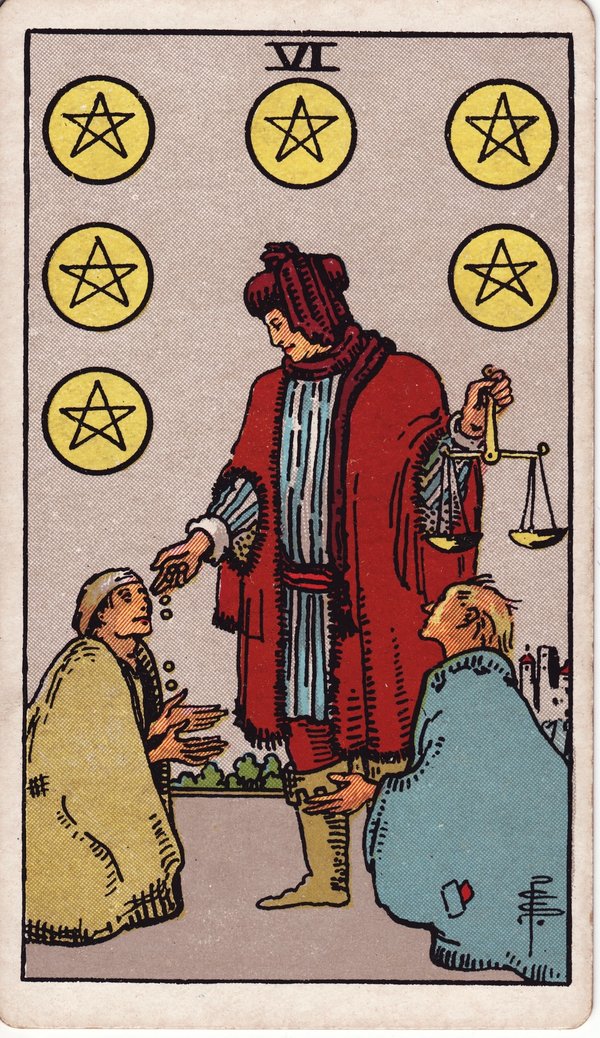
In the RWS imagery, a wealthy merchant — finely dressed, holding scales in one hand — distributes coins to two kneeling beggars. The image at first glance suggests straightforward charity: the rich giving to the poor. But look longer and the questions emerge: Who is this giver, and what is his relationship to the receivers? Are the scales balanced, or are they tilted? Is the giving truly free, or are there invisible strings? The kneeling posture of the recipients — is it gratitude or subordination? The Six of Pentacles does not resolve these questions; it presents them as the essential inquiry of the card.
In a reading, the Six of Pentacles signals a time of relative abundance after the deprivation of the Five. Resources are available — either because you have them to give or because someone has them to give to you. The card's central question is not whether resources exist but how they are flowing: freely or with conditions, generously or with strings, in a way that dignifies both parties or in a way that creates dependence.
The Tiphareth assignment is the structural heart of this card's meaning. Tiphareth is the sphere of beauty, harmony, and Christ-consciousness — the center of the Tree of Life that receives from the divine triad above and distributes to the personal triad below. The Six of Pentacles is Tiphareth in the material world: the experience of being a channel, of receiving in order to give, of participating in a flow that is larger than the individual self. The dignified Six does not hoard and does not give recklessly — it circulates. It receives graciously and gives freely, knowing that both acts are necessary to the health of the whole.
The astrological layer — Moon in Taurus, second decan — adds emotional texture. The Moon in Taurus is the nurturer, the one who feeds, the maternal capacity to sustain life with steady, reliable care. This is not the dramatic generosity of Fire (the impulsive gift, the grand gesture) but the quiet, consistent generosity of Earth: the meal prepared, the bill paid, the time given week after week without fanfare. The second decan of Taurus is ruled by the Moon itself in the Chaldean system — a double lunar influence that intensifies the card's themes of care, emotional nourishment, and the cyclical nature of giving.
Symbolism & Imagery
Rider-Waite-Smith (1909): The RWS Six of Pentacles presents a scene of apparent charity with unsettling undercurrents. A wealthy merchant stands at the center, richly dressed in a red robe (power, status) over a blue tunic (communication, perhaps the throat chakra — he speaks the terms of the gift). In his left hand, he holds a balance scale — the instrument of fair measure, the symbol of justice and commerce. In his right hand, he extends coins to two kneeling figures, dropping them one at a time.
The kneeling figures are dressed in ragged clothes, their postures submissive. One receives the coin with an open palm — acceptance, gratitude, perhaps relief. The other's hands are raised in a gesture that could be supplication, could be praise, could be desperation. The figures are not looking at the merchant's face; they are looking at the coins. The merchant, in turn, appears to be looking at the scales rather than at the people he is helping. The transaction is happening, but is connection happening?
Behind the figures, the landscape is sparse — a few bare trees, an open sky. There is no church window here (as in the Five) but also no warm hearth (as in the Ten). The Six exists in a transitional space, between crisis and arrival, between the cold of the Five and the settled prosperity of the later Pentacles.
The scales are the image's crucial detail. They suggest that the giving, while real, is measured — that the merchant has determined what each recipient deserves or needs. This can be read as fairness (everyone gets what they need, no more, no less) or as control (the one who holds the scales decides who is worthy). The card does not tell you which reading is correct; it asks you to examine the dynamics of the specific situation.
Thoth (Crowley/Harris, 1944): The Thoth Six of Disks (Pentacles) is titled Lord of Success and presents a harmonious, geometric composition. Six disks are arranged in a hexagonal pattern — a symbol of balanced integration, the six-petaled rose of Tiphareth, the perfected form. The disks are connected by lines of force that suggest circulation, flow, the movement of resources through a stable system. The color palette is warm — golds, rich greens, earthy browns — reflecting the Moon in Taurus's capacity for nurturing abundance.
Where the RWS card dramatizes the social dynamics of giving (the merchant and the beggars, the power differential, the question of strings), the Thoth card depicts the energetic structure of success: the system in which resources circulate, the pattern that, when functioning correctly, produces prosperity for all connected to it. The Thoth Lord of Success is less about individual acts of charity and more about the systemic conditions that make generosity and prosperity possible.
The key difference between traditions: RWS emphasizes the ethical question — who gives, who receives, and on what terms? Thoth emphasizes the structural answer — the balanced system in which giving and receiving are natural functions of a healthy whole. Both are true: the Six of Pentacles is simultaneously the personal encounter between giver and receiver and the larger pattern that makes that encounter possible and meaningful.
Astrological & Elemental Layer
The Six of Pentacles is astrologically attributed to the Moon in Taurus — specifically the second decan of Taurus, approximately May 1–10 in the solar calendar. This is one of the most harmonious attributions in the minor arcana, because the Moon and Taurus are in a deeply sympathetic relationship.
The Moon rules the tides, the emotions, the body's rhythms, the unconscious, the mother, and the capacity to nurture and be nurtured. In Taurus — the sign of stability, material comfort, and the physical senses — the Moon finds a natural home (the Moon is exalted in Taurus in traditional astrology). Here, the Moon's emotional attunement is given the stability and patience of the fixed earth. The Moon in Taurus is the energy of the steady caregiver — the parent who shows up, the provider who is reliable, the love that is expressed through physical presence and material care rather than dramatic declarations.
The second decan of Taurus is ruled by the Moon in the Chaldean decan system, doubling the lunar quality. This is Tiphareth expressed through lunar, Taurean energy: the heart (Tiphareth) that nurtures (Moon) through steady, material means (Taurus). The Six of Pentacles carries this triple blessing — the harmony of Tiphareth, the emotional attunement of the Moon, the material stability of Taurus — into its dignified expression of generosity and fair exchange.
The shadow of this attribution is that the Moon in Taurus can become possessive (the Taurus shadow) and emotionally dependent on the role of giver (the Moon's shadow). The person who gives in order to be needed, who builds their identity around being the provider, who cannot receive because receiving would threaten their sense of themselves as the one who has — this is the Moon in Taurus operating from lack rather than fullness, and it produces the undignified Six: the gift that is actually a claim, the generosity that is actually control.
In elemental terms, the Six of Pentacles is Earth in its most generous expression — the soil that gives freely to the seed, the tree that produces fruit, the earth that supports all life without asking anything in return except that the cycle continue. The Tiphareth influence brings heart, balance, and the recognition that true generosity does not deplete the giver — it feeds both parties, because what is given in love returns in forms the giver could not have predicted.
Kabbalistic / Tree of Life Layer
The Six of Pentacles sits in Tiphareth, the sixth Sephirah on the Tree of Life — the central sphere, the heart, the sun around which the entire system orbits. Tiphareth is the sphere of beauty, harmony, and the Christ-principle: the divine made manifest in balanced, radiant form.
Tiphareth's essential quality is mediation. It stands at the center of the Tree, receiving the light of the upper triad (Kether, Chokmah, Binah) and distributing it to the lower triad (Netzach, Hod, Yesod). It is the conduit, the channel, the point where the infinite touches the finite and transforms it. In the human psyche, Tiphareth is the integrated self — the "I" that can hold the tensions of the personality (the drives of Netzach and the forms of Hod, the foundation of Yesod) in a coherent, centered whole.
In the suit of Pentacles (Assiah — the material world), Tiphareth's energy expresses as the balanced, harmonious flow of material resources. The Six of Pentacles is Tiphareth in Assiah — the experience of having what you need and sharing what you have, of participating in an economy (of money, time, energy, attention) that is grounded in the recognition that all resources ultimately flow from the divine and are held in trust, not ownership.
The path that flows into Tiphareth from Geburah (the Five) carries the memory of severity — the crisis is still recent, the cold of the Five still remembered in the warmth of the Six. This is why the generosity of the Six is not naive: it knows what it is to lack, and it gives from that knowledge. The path that flows out of Tiphareth toward Netzach (the Seven) and Hod (the Eight) carries the energy of circulation — the gift given becomes the gift received, and the cycle continues.
For the querent, the Kabbalistic layer asks: Are you in right relationship with the flow of resources in your life? Are you giving from your center or from your wound? Are you receiving with grace or with shame? Is the balance you have achieved a true harmony or a fragile truce?
Sequential Narrative: Position in the Suit Story
The suit of Pentacles tells the story of material manifestation — from seed (Ace) to legacy (Ten), with each number representing a stage in the development of physical, financial, and embodied wisdom.
From the Five of Pentacles: The Five is the card of being out in the cold — material crisis, spiritual destitution, the figures limping past the lit church window. The Five's crisis is real, but it is not the end of the story. The Six of Pentacles emerges as the answer to the Five's unasked question: where is the help?
The transition from Five to Six is the transition from lack to flow, from isolation to connection, from receiving nothing to both giving and receiving. But this transition is not automatic — it depends on the figures in the Five lifting their heads, seeing the light, and approaching the door. The Six is what happens when the crisis is acknowledged and help is both offered and accepted.
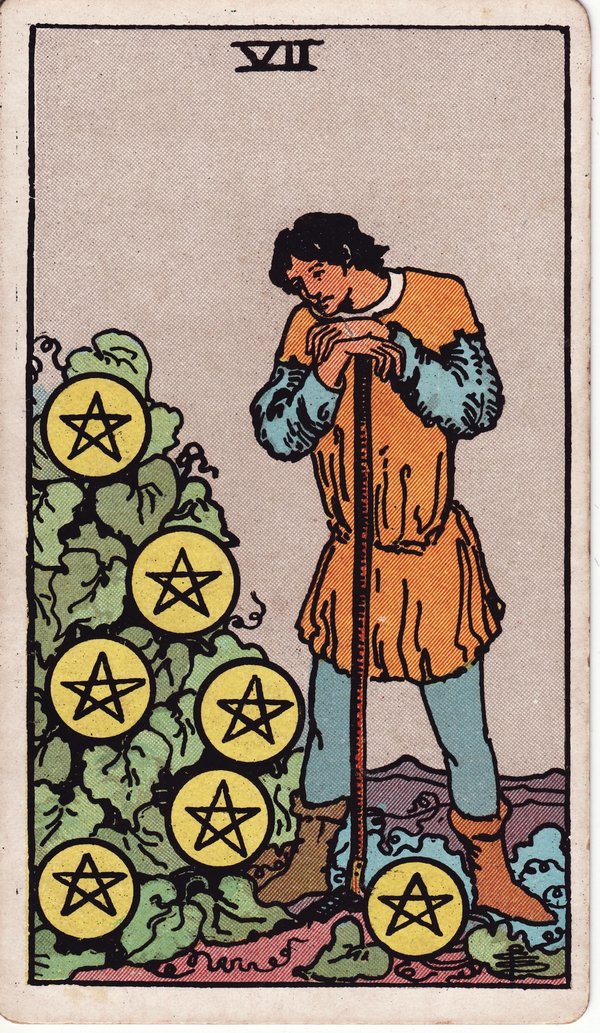
Toward the Seven of Pentacles: The Seven is the card of assessment — the farmer leaning on his hoe, surveying the crop, asking whether the work has been worth it. The Six's generosity builds the foundation for this assessment: the resources have flowed, the support has been given and received, and now it is time to step back and evaluate. The transition from Six to Seven is the transition from circulation to reflection — the pause that allows the next phase of growth to be planned.
But the Seven also carries the shadow of impatience — the worry that the harvest will not come, that the investment will not pay off. If the Six's generosity was given with strings, those strings will tighten in the Seven. If the Six's receiving was taken for granted, the Seven's assessment will reveal a debt that must be repaid.
The overall arc: Within the Pentacles journey, the Six occupies the point of restoration — the moment when the crisis (Five) gives way to the renewed flow of resources that makes further growth (Seven, Eight) and eventual harvest (Nine, Ten) possible. The Six is not the destination; it is the bridge. But the quality of the bridge — whether it is built on genuine generosity or on hidden strings — determines the quality of everything that follows.
Advising For / Advising Against
-
If advising FOR: Give. The resources you have — money, time, energy, expertise, attention — are needed by someone else, and you have enough to share. The Six of Pentacles counsels generosity, but not the kind that depletes you or makes the other dependent. Give from your fullness, not your need to be needed. Give in a way that dignifies the receiver, not in a way that reminds them of their lack. And if you are the one in need: receive. The hand being extended is real. Do not let pride or shame prevent you from accepting what is offered.
-
If advising AGAINST: Check your strings. If you are giving — money, support, attention — ask yourself honestly: what do I expect in return? Is there an unspoken contract? Does my generosity feel clean, or does it carry the weight of obligation, guilt, or control? The Six reversed warns against the gift that is actually a loan, the help that is actually a power play. If you are receiving: be wary of the benefactor who needs you to stay needy. Not every open hand is offering freedom; some are offering a gilded cage.
Card of the Day
Today, the flow of resources is on your mind — what you have to give and what you need to receive. The Six of Pentacles invites a specific act of generosity: give something today that you usually hoard, whether that is money, praise, time, or attention. Give it freely, without expecting anything in return. Alternatively, if you are the one in need, let someone help you. Receiving with grace is its own form of generosity — it honors the giver and completes the circuit.
Card of the Year
Note: Year cards are calculated from Major Arcana numbers (0–21). This Minor Arcana card does not function as a primary year card. However, as a Personal Year Shadow Card, the Six of Pentacles may appear as a recurring theme within a larger year-card energy — particularly in years governed by The Lovers (VI), which shares the number 6, or The Star (XVII), which echoes the Six's theme of generosity and flow after crisis. In such a year, the Six of Pentacles manifests as: repeated opportunities to examine your relationship to giving and receiving, situations that test whether your generosity is clean or conditional, the slow work of learning that true prosperity is measured not by what you accumulate but by what flows through you. The invitation is to become a good channel — one who receives from the universe and gives to the world, without hoarding and without keeping score.
Elemental Dignities Notes
The Six of Pentacles is Earth — stable, generative, and now in a state of harmonious flow. In a spread, its elemental relationship to neighboring cards follows the Golden Dawn system:
- Strengthened by Earth (Pentacles): Like element intensifies like element. Adjacent Pentacles cards deepen the Six's material focus — the flow of resources becomes more substantial, more concretely real. The Six flanked by other Pentacles suggests genuine material prosperity and stable systems of exchange.
- Strengthened by Water (Cups): Water supports Earth. Adjacent Cups cards add emotional depth to the Six's generosity — the giving becomes more heartfelt, the receiving more grateful. The merchant's scales are softened by the heart's wisdom. The Six next to a Cups card often indicates a gift that carries emotional as well as material significance.
- Weakened by Air (Swords): Air and Earth are enemies. Adjacent Swords cards may cut against the Six's harmony — intellectual analysis revealing the strings attached, the hidden motives, the power dynamics beneath the surface. But Air can also provide the clarity that ensures the giving is genuinely fair: the Six next to a Swords card may indicate a contract, a formal agreement, or a gift that has been carefully thought through.
- Weakened by Fire (Wands): Fire and Earth are enemies. Adjacent Wands cards may disrupt the Six's careful balance — passionate impulse overwhelming measured generosity, the grand but unsustainable gesture. But Fire can also provide the warmth that the Six's Earth needs: the gift given with genuine enthusiasm rather than dutiful obligation.
Deck-Specific Notes
-
If using a Thoth deck: The card appears as the Six of Disks, titled Lord of Success. The imagery emphasizes geometric harmony — the hexagonal pattern, the balanced circulation of energy — rather than the dramatic social scene of the RWS card. The Thoth reading emphasizes success as a systemic condition rather than success as a particular act. The dignifying question of the Thoth card is: is the system you are part of functioning in a way that produces prosperity for all its members, or does it extract from some to enrich others?
-
If using a Marseille-tradition deck: In the Marseille tradition, the Six of Coins typically shows six coins arranged in two rows of three or in a floral/geometric pattern with a central emblem. The emphasis is on order, balance, and the harmonious arrangement of material resources — less narrative than RWS, less metaphysical than Thoth, more a statement of the structural possibility of material harmony.
-
If using a blended or contemporary deck (e.g., Fountain Tarot, Wild Unknown, etc.): The psychological and astrological layers of this entry apply across visual traditions. The core archetype — generosity, fair exchange, the balanced flow of resources, the questions of power that attend every act of giving — persists regardless of specific imagery. Consult your deck's guidebook for any departures from the RWS/Thoth framework.
Journaling & Contemplation Prompts
- When I give — money, time, attention, care — do I give freely, or do I keep a ledger? What would it feel like to give something with no expectation of return?
- Am I more comfortable giving or receiving? If I am more comfortable giving, is that true generosity, or is it a way of staying in the superior position?
- Who in my life has given to me in a way that felt genuinely dignifying — that made me feel seen and valued rather than pitied or obligated? What did that giving look like?
- Where in my life am I receiving resources (support, money, love, opportunity) that I have not fully acknowledged or been grateful for?
- If I viewed all my resources as held in trust rather than owned — as flowing through me rather than belonging to me — how would my relationship to giving and receiving change?
Additional Associations
| Association Type | Value |
|---|---|
| Color(s) | Rich green (Taurus earth, abundance, growth, the color of the heart chakra — Tiphareth); gold (the coins, prosperity, the radiance of balanced material life); warm brown (the stable earth, the ground of generosity); deep red (the merchant's robe — power, status, and the question of who holds the scales) |
| Crystals / Stones | Green Aventurine (prosperity, generosity, heart-centered abundance — the stone of the open hand); Citrine (the merchant's stone, wealth that circulates rather than stagnates, the solar warmth of Tiphareth); Jade (harmony, balanced exchange, the stone of right relationship with resources) |
| Herbs / Plants | Basil (prosperity, hospitality, the herb that welcomes and shares — associated with the home and the open door); Mint (abundance, refreshment, the plant that spreads generously and gives freely to all who pass); Apple (the fruit of Tiphareth in many traditions — the gift that nourishes, that carries seeds for the future) |
| Archetypes (Jungian) | The Benefactor / The Philanthropist (the one who gives from abundance — dignified when clean, shadow when controlling); The Beggar (the one who receives — dignified when grateful and empowered, shadow when dependent and entitled); The Mediator (the one who holds the scales — the Tiphareth function of balancing upper and lower, self and other) |
| Mythological Figures | The Good Samaritan (the stranger who gives without expectation — generosity that crosses boundaries of tribe and status); Lakshmi (Hindu goddess of prosperity and abundance — but her gifts come when they are circulated, not hoarded); St. Nicholas (the secret giver who drops coins through the window at night — generosity without the need for recognition) |
| Numerological Resonance | 6 = the first perfect number (1+2+3=6), the number of harmony and completion. The six days of creation before the seventh day of rest. In the tarot, 6 = The Lovers (union, choice, the heart's decision). The Six of Pentacles is The Lovers in the material suit: the harmony of giving and receiving, the choice to open the hand or to close it. |
| Playing Card Equivalent | Six of Diamonds — a card of financial improvement, the receipt of money owed, and sometimes an inheritance or gift. In cartomancy, the Six of Diamonds can indicate a patron or benefactor; reversed, it warns of financial entanglements and the hidden cost of favors. |
| I Ching Hexagram Parallel | Hexagram 14 — Ta Yu / Possession in Great Measure. "The superior man curbs evil and furthers good, thereby obeying the benevolent will of heaven." The hexagram of abundance held in trust — the sun shining on all things equally, the ruler whose greatness lies in sharing, not hoarding. The warning: abundance without humility attracts disaster. |
| Body / Organ Correspondence | The heart (Tiphareth's organ — the center that receives and distributes, the pump that circulates life through the entire system); the throat and thyroid (Taurus's body parts — the voice that asks and thanks, the metabolism that regulates the body's resources); the hands (the instruments of giving and receiving, the physical expression of the Six's central dynamic). |
Shadow & Integration Message
The shadow of the Six of Pentacles is not greed (that belongs to the Four) but conditional generosity — the gift that is not a gift but a transaction, the help that is not help but a power play, the open hand that is actually a leash. This shadow is often unconscious: the giver genuinely believes they are being generous while simultaneously using their generosity to maintain control, to keep the receiver in a subordinate position, to purchase loyalty or gratitude or love.
The shadow can manifest on both sides of the transaction. The giver who needs to be the giver — who cannot receive, who cannot be vulnerable, whose entire identity is built on being the one who has and helps — is as shadow-bound as the miser. And the receiver who has learned to perform gratitude as a survival strategy, who knows that their access to resources depends on staying small and needy, is participating in the shadow dynamic as fully as the giver.
Integration of the Six's energy means learning to give without strings and to receive without shame. It means recognizing that true generosity is not measured by what is given but by the freedom it creates: the gift that liberates the receiver to become a giver in turn, the help that works to make itself unnecessary. Integration is the movement from charity (which can perpetuate hierarchy) to solidarity (which recognizes mutual dependence and shared dignity). It is the scales, finally, truly balanced — not because the merchant has measured carefully but because the distinction between merchant and beggar has dissolved, and what remains is simply the flow of life through all its vessels.
Elemental Intelligence (Suit Framing)
In the Jungian cognitive function mapping, the suit of Pentacles corresponds to the Sensation function (Jungian cognitive functions), the melancholic humour, and the laboring/peasant class. The Six of Pentacles represents Sensation at its most harmonious and socially integrated: the felt reality of the physical world, experienced not as a possession to be guarded (Four) or a lack to be endured (Five) but as a flow to be participated in.
The melancholic humour, associated with Earth, is characterized by depth, seriousness, and a tendency toward reflection. In the Six of Pentacles, the melancholic depth becomes the depth of genuine care — the kind of giving that thinks about what the other actually needs, not what the giver wants to give. The melancholic seriousness becomes the ethical seriousness of fair exchange — the recognition that every transaction carries moral weight.
The class association of Pentacles — the laborers, the ones who work with their hands — finds in the Six a vision of economic justice. The scales held by the merchant are not just for measuring coins; they are for measuring fairness. The Six of Pentacles, in its most radical reading, is the card that asks what a just economy would look like — one in which resources circulate freely, in which giving and receiving are not markers of status but natural functions of a healthy community, in which no one is left outside in the snow.
Timing & Manifestation
For timing in a reading, the Six of Pentacles points to the second decan of Taurus in the solar calendar: approximately May 1–10 in any given year. This is the heart of spring in the northern hemisphere — the season of growth, flowering, and the first fruits of the year's labor beginning to appear.
More archetypally, the Six of Pentacles suggests a timeframe characterized by flow, reciprocity, and the resolution of material imbalances. Help is arriving. Resources that were stuck are beginning to move. Debts — financial and otherwise — are being settled. The energy of the Six is not instantaneous (that belongs to the Eight of Wands) but it is steady, reliable, and moving in the right direction.
In the context of a project or process, the Six marks the phase when contributions are being recognized, resources are being allocated fairly, and the team or system is functioning with a healthy balance of giving and receiving. The earlier tensions (the Five's crisis) have been addressed, and a new equilibrium is establishing itself.
Yes / No Tendency
The Six of Pentacles leans toward Yes — especially for questions of material help, fair exchange, and balanced outcomes. This is one of the more affirmatively generous cards in the deck. If the question is "Will I receive the help I need?" the answer is yes — but the form of the help may come with expectations or conditions that should be examined. If the question is "Should I give / invest / contribute?" the answer is yes — your resources are flowing and the giving will not deplete you.
In reversed / ill-dignified position, the tendency shifts toward Yes, but be careful. The help is available, but it may come with strings. The gift is being offered, but the giver's motives may not be clean. Or alternatively: No, not until you examine your own motives for giving or your own resistance to receiving.
Common Misreads / Nuances to Know
Misread 1: "The Six of Pentacles is purely positive — it just means generosity and charity." The card contains a genuine tension between clean giving and conditional giving, between help that liberates and help that creates dependence. The presence of the scales is not incidental — it asks the reader to weigh the dynamics of power, not just to celebrate the fact that giving is occurring.
Misread 2: "The merchant is the good guy and the beggars are the needy." The card invites identification with either role — and sometimes with both simultaneously. You may be the merchant in one area of life and the beggar in another. The card's teaching is not "be generous" but "examine your relationship to giving and receiving in all its forms."
Misread 3: "The Six of Pentacles reversed means someone is being stingy." The reversal more often indicates problematic generosity than absent generosity — the gift with strings, the help that controls, the charity that humiliates. Or it may indicate the inability to receive: the person who gives and gives and gives but cannot let anyone give to them, whose "generosity" is actually a defense against intimacy and vulnerability.
Nuance for Moon in Taurus placements: People with Moon in Taurus (or strong 2nd house / Taurus placements) may resonate deeply with this card. The Moon in Taurus's gift is the capacity to nurture steadily, to provide reliably, to love through material care. The Moon in Taurus's shadow is possessiveness and emotional dependence on the role of provider. The Six of Pentacles can serve as both a validation and a warning for those who carry this energy: your gift is real — make sure it is clean.